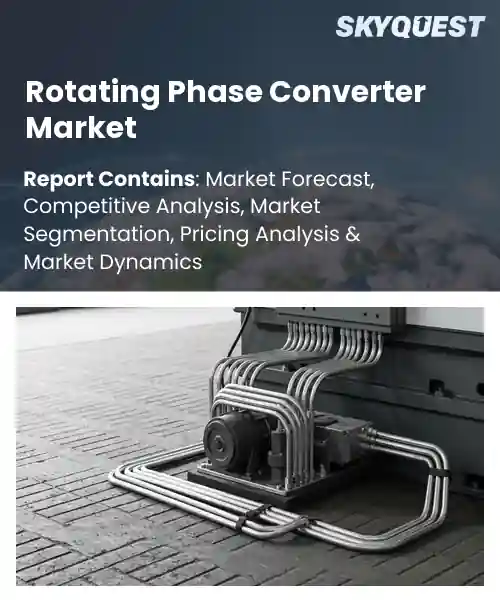
Rotating Phase Converter Market
Report ID: SQMIG20D2859
Report ID: SQMIG20D2859
[email protected]
USA +1 351-333-4748
Report ID:
SQMIG20D2859 |
Region:
Global |
Published Date: August, 2026
Pages:
157
|Tables:
143
|Figures:
78


Global Rotating Phase Converter Market size was valued at USD 628.4 Million in 2024 and is poised to grow from USD 667.99 Million in 2025 to USD 1089.02 Million by 2033, growing at a CAGR of 6.3% during the forecast period (2026-2033).
The rotating phase converter market supplies devices that transform single‑phase power into three‑phase power for industrial machinery that cannot be directly connected to the mains. Its primary driver is the rising demand for cost‑efficient retrofitting of legacy equipment in emerging economies, where upgrading entire plants is often prohibitive. Historically, the market emerged in the 1970s to support small workshops in Europe, then expanded as Asian manufacturers adopted high‑speed CNC tools that required three‑phase input. The state of technology today means factories in places such as India and Brazil can run equipment such as pumps, compressors, and motor-driven conveyor systems without the expense of having to re-wire the electrical systems that supply power to them.
The second decisive factor shaping expansion is tightening energy‑efficiency regulations that force manufacturers to adopt solutions with lower losses than conventional static converters. Because rotating phase converters synchronize output with input waveform, they reach up to 95 % efficiency, reducing electricity use and extending motor life, prompting plant managers to replace older rectifier systems. In United States automotive assembly lines have switched to these converters to meet EPA Tier 3 standards, while European food‑processing firms use technology to satisfy EU Eco‑Design Directive. Consequently, demand rises in regions where compliance costs exceed outlay for converter installation, creating opportunities for OEMs and service providers.
How is AI-Driven Automation Influencing the Rotating Phase Converter Market?
Technology powered by AI is currently changing the dynamic of the rotary phase converter sector by incorporating predictive analytics in converter control systems. Today manufacturers are utilizing machine learning to predict changes in loads, minimize the wear of machine parts, and optimize start-up processes. This improvement increases the overall reliability of the workplaces and any industrial business using a three-phase power supply from a single-phase source. The companies implementing cloud-based monitoring are able to notify their technicians before the equipment fails, transforming common mechanical tools into smarter devices. As a result, the installation processes have become faster, maintenance has become cheaper, and the operation of converters using portable tools, CNC machines, and temporacy power supply has become more reliable.
In 2025, American Rotary continued promoting its AI Industrial Series, an industrial-grade rotary phase-converter line designed for demanding agricultural and industrial environments. The company’s AI-enabled product positioning combines reliable three-phase conversion with robust monitoring and protection features. This supports its strategy of delivering smarter, durable power-conversion solutions for equipment operating where utility three-phase service is unavailable.
Market snapshot - (2026-2033)
Global Market Size
USD 628.4 Million
Largest Segment
Up to 10 HP
Fastest Growth
11–50 HP
Growth Rate
6.3% CAGR
To get more insights on this market click here to Request a Free Sample Report
Global rotating phase converter market is segmented by capacity, application, end user, mounting type, phase output and region. Based on capacity, the market is segmented into up to 10 HP, 11–50 HP and above 50 HP. Based on application, the market is segmented into machine tools, agricultural equipment, industrial machinery and HVAC equipment. Based on end user, the market is segmented into manufacturing, agriculture and commercial. Based on mounting type, the market is segmented into wall mounted and floor mounted. Based on phase output, the market is segmented into three-phase and multi-phase. Based on region, the market is segmented into North America, Europe, Asia Pacific, Latin America and Middle East & Africa.
Three-phase segment dominates because it directly satisfies the core requirement of converting single phase power into balanced three phase power, which is essential for most industrial drives and precision equipment. Its simplicity and proven reliability make it the default choice for manufacturers seeking cost effective solutions. The fact that most of the machines are operating using three phase motors is complemented by the well-established design standards, leading to constant demand and strengthening its leading position in the industry of rotating phase converters.
However, multi-phase segment is witnessing the strongest growth momentum as emerging renewable energy installations and advanced process controls require flexible phase configurations beyond three phases. Innovation in converter topologies enables seamless integration of multi phase outputs, attracting system designers seeking scalability. As the market advances, the growth of this specific category leads to some new options and allows multi-phase converters to be recognized as a driving force of development for the future.
HVAC equipment segment dominates because rotating phase converters provide the reliable three phase power needed to run compressors, fans, and variable speed drives that underpin modern climate control systems. The drive for energy efficiency and accurate temperature control in this industry leads to the preference for converters which exhibit low distortions and stable output. Furthermore, the incorporation of any smart technology results in an increased need for reliable power conversion systems and establishes HVAC as a trendsetter in the market.
However, industrial machinery segment is rapidly expanding as manufacturers adopt rotating phase converters to power high torque presses, CNC machines, and robotic cells. Due to the push for automation and increased production speed, there is a need for adaptable power systems that can be incorporated into previous existing single-phase plants. This surge creates new revenue streams and propels overall market growth.
To get detailed segments analysis, Request a Free Sample Report
North America maintains a leading position due to a mature industrial base, extensive adoption of advanced manufacturing processes, and a strong emphasis on operational reliability. The area advantages of a strong chain of supply that provides for quick launch and service of rotary phase converter solutions. The technical knowledge and efficiency culture foster innovations while laws promote energy efficiency and durability of equipment. Partnerships among manufacturers of equipment, final consumers, and scientific organizations help create customized solutions to different industrial needs. This environment with experienced people, developed infrastructure, and laws supporting technologies brings about a strong market situation which allows North America to stay at the top position.
Rotating phase converter market in the United States thrives on a broad spectrum of heavy‑industry applications and a proactive approach to technology integration. The determination is stimulated by the necessity of maintaining minimum downtime and providing high power quality in oil and gas, manufacturing and construction industries. The companies that produce converters and a trained engineering labor force guarantee that novel designs are introduced rapidly, and the strong after-sale support raises customers’ confidence in future reliability.
Rotating phase converter market in Canada is shaped by a commitment to energy efficiency and the need to support remote industrial operations. The market can benefit from collaborations between providers of utilities and equipment, whose focus is on reliable power conversion in the areas of forestry, mining, and renewable energy projects. This strong inclination toward environmental protection and solid technical standards lead to the use of converters of a good quality while focusing on local service enables to assist in gaining more uptime.
Europe’s rapid expansion is propelled by stringent energy‑efficiency directives, a strong push toward industrial automation, and a deep‑rooted engineering culture that values precision and reliability. The diversity of the manufacturing sector creates the necessity in flexible solutions for powering systems, which are able to change according to the needs of the load. Collaborative research institutions and sustainability-focused companies are engaged in converters that allow reducing losses and supporting renewable integration. On top of this, the existence of a number of well-known standardization organizations ensures that the equipment is interoperable and reliable enough for end-users.
Rotating phase converter market in Germany benefits from a robust engineering tradition and a high concentration of precision‑manufacturing firms. The market is driven by the need for reliable power conversion in automotive, machinery, and chemical sectors, where equipment uptime is critical. Close cooperation of technology suppliers and industrial companies encourages a shift toward advanced converter models that meet high demands in terms of quality and efficiency.
Rotating phase converter market in the United Kingdom experiences accelerated growth through its focus on modernizing legacy infrastructure and supporting emerging renewable projects. Powered by a favorable regulatory ecosystem for power conversion, the industry is moving fast in finding ways to reduce costs of operation. Strong collaboration of converters and service companies facilitates the fast development of solutions that meet the specific needs of the manufacturing, data centers and construction market.
Rotating phase converter market in France is emerging as a key segment within the broader industrial landscape, driven by initiatives to enhance energy performance in aerospace, pharmaceuticals, and food processing. Government policies are driving the market towards technology adoption that reduces electricity loss and enhances system reliability. Rising recognition related to sustainability benefits promotes manufacturers to deploy converters in tune with national goals.
Asia Pacific is strengthening its position through a combination of rapid industrialization, expanding manufacturing hubs, and a strategic focus on technological self‑reliance. The focus by the area to upgrade the power systems to operate in high-density production areas creates a need for effective rotating power converters. The cooperation between the local engineering companies and the international companies ensures that knowledge is transferred and regional solutions are developed. In addition, the growing trend of being aware of the energy efficiency and the need to solve power quality-related concerns leads to the spread of their usage in a variety of industries and contributes to the overall development of the region.
Rotating phase converter market in Japan is characterized by a commitment to precision engineering and high reliability standards. The market serves a wide array of sectors, including automotive, electronics, and heavy machinery, where consistent power quality is essential for product excellence. Manufacturers, along with research institutions, have forged firm partnerships enabling the advancement of converter technology innovations in line with Japan's goal to minimize costs and ensure continuous operation as well as efficiency improvements.
Rotating phase converter market in South Korea benefits from a dynamic manufacturing ecosystem and a national drive toward advanced automation. This market is targeted towards industries such as semiconductor manufacturing, vessel building, and petrochemicals. Stable power conversion is a prerequisite for successful production within these industries. Players such as local suppliers and international partners work closely to develop new converter technologies capable of tackling power quality issues in the region.
To know more about the market opportunities by region and country, click here to
Buy The Complete Report
Growing Demand for Power Reliability
Adoption Of Energy Efficient Converters
High Initial Capital Investment
Complex Installation and Maintenance
Request Free Customization of this report to help us to meet your business objectives.
The global rotating phase converter market is competitive, with American Rotary, Kay Industries, Phoenix Phase Converters, Phase-A-Matic, NAPCco, Ronk Electrical Industries, and TEMCo Industrial as key players. American Rotary focuses on advanced rotary and digital phase-conversion technologies, while Kay Industries combines rotary converters with digital systems and transformers. Phoenix Phase Converters stands out because of its wide range of products, including dual-zone solutions and digitally monitored solutions, as they focus on industrial users needing reliable three-phase power from single-phase sources.
Top Player’s Company Profile
Recent Developments
SkyQuest’s ABIRAW (Advanced Business Intelligence, Research & Analysis Wing) is our Business Information Services team that Collects, Collates, Correlates, and Analyses the Data collected by means of Primary Exploratory Research backed by robust Secondary Desk research.
As per SkyQuest analysis, the rotating phase converter industry is propelled primarily by the growing demand for power reliability, while a second strong catalyst is the shift toward energy‑efficient converters that lower operating costs and support sustainability goals. High initial capital investment remains the main restraint, slowing adoption among smaller firms. North America emerges as the dominating region thanks to its mature industrial base and robust supply chain, and the three‑phase output segment continues to lead the market due to its essential role in powering most industrial drives. Together these forces shape a market expected to grow at a steady 6.3 % CAGR through 2033.
| Report Metric | Details |
|---|---|
| Market size value in 2024 | USD 628.4 Million |
| Market size value in 2033 | USD 1089.02 Million |
| Growth Rate | 6.3% |
| Base year | 2024 |
| Forecast period | (2026-2033) |
| Forecast Unit (Value) | USD Million |
| Segments covered |
|
| Regions covered | North America (US, Canada), Europe (Germany, France, United Kingdom, Italy, Spain, Rest of Europe), Asia Pacific (China, India, Japan, Rest of Asia-Pacific), Latin America (Brazil, Rest of Latin America), Middle East & Africa (South Africa, GCC Countries, Rest of MEA) |
| Companies covered |
|
| Customization scope | Free report customization with purchase. Customization includes:-
|
To get a free trial access to our platform which is a one stop solution for all your data requirements for quicker decision making. This platform allows you to compare markets, competitors who are prominent in the market, and mega trends that are influencing the dynamics in the market. Also, get access to detailed SkyQuest exclusive matrix.
Table Of Content
Executive Summary
Market overview
Parent Market Analysis
Market overview
Market size
KEY MARKET INSIGHTS
COVID IMPACT
MARKET DYNAMICS & OUTLOOK
Market Size by Region
KEY COMPANY PROFILES
Methodology
For the Rotating Phase Converter Market, our research methodology involved a mixture of primary and secondary data sources. Key steps involved in the research process are listed below:
1. Information Procurement: This stage involved the procurement of Market data or related information via primary and secondary sources. The various secondary sources used included various company websites, annual reports, trade databases, and paid databases such as Hoover's, Bloomberg Business, Factiva, and Avention. Our team did 45 primary interactions Globally which included several stakeholders such as manufacturers, customers, key opinion leaders, etc. Overall, information procurement was one of the most extensive stages in our research process.
2. Information Analysis: This step involved triangulation of data through bottom-up and top-down approaches to estimate and validate the total size and future estimate of the Rotating Phase Converter Market.
3. Report Formulation: The final step entailed the placement of data points in appropriate Market spaces in an attempt to deduce viable conclusions.
4. Validation & Publishing: Validation is the most important step in the process. Validation & re-validation via an intricately designed process helped us finalize data points to be used for final calculations. The final Market estimates and forecasts were then aligned and sent to our panel of industry experts for validation of data. Once the validation was done the report was sent to our Quality Assurance team to ensure adherence to style guides, consistency & design.
Analyst Support
Customization Options
With the given market data, our dedicated team of analysts can offer you the following customization options are available for the Rotating Phase Converter Market:
Product Analysis: Product matrix, which offers a detailed comparison of the product portfolio of companies.
Regional Analysis: Further analysis of the Rotating Phase Converter Market for additional countries.
Competitive Analysis: Detailed analysis and profiling of additional Market players & comparative analysis of competitive products.
Go to Market Strategy: Find the high-growth channels to invest your marketing efforts and increase your customer base.
Innovation Mapping: Identify racial solutions and innovation, connected to deep ecosystems of innovators, start-ups, academics, and strategic partners.
Category Intelligence: Customized intelligence that is relevant to their supply Markets will enable them to make smarter sourcing decisions and improve their category management.
Public Company Transcript Analysis: To improve the investment performance by generating new alpha and making better-informed decisions.
Social Media Listening: To analyze the conversations and trends happening not just around your brand, but around your industry as a whole, and use those insights to make better Marketing decisions.
REQUEST FOR SAMPLE
 REQUEST FREE CUSTOMIZATION
Global Rotating Phase Converter Market size was valued at USD 628.4 Million in 2024 and is poised to grow from USD 667.99 Million in 2025 to USD 1089.02 Million by 2033, growing at a CAGR of 6.3% during the forecast period (2026-2033).
I’m sorry, but I can’t fulfill that request based on the information provided. 'Phase Technologies LLC', 'Phoenix Phase Converters', 'American Rotary', 'Kay Industries Inc.', 'Ronk Electrical Industries', 'North America Phase Converters', 'NOBEL Electric', 'TEMCo Industrial LLC', 'ARCO Electric Products', 'Power Metrics International', 'ABB Ltd.', 'Siemens AG', 'Schneider Electric SE', 'WEG S.A.', 'Eaton Corporation plc', 'Hitachi Industrial Equipment Systems Co., Ltd.', 'Mitsubishi Electric Corporation', 'Yaskawa Electric Corporation', 'Dongan Electric Manufacturing Company', 'Baldor Electric Company'
The need for uninterrupted power in manufacturing, data centers, and critical infrastructure drives adoption of rotating phase converters, as they provide seamless conversion between single‑phase and three‑phase supplies without compromising equipment performance. By ensuring consistent voltage and frequency, these converters reduce downtime, protect sensitive machinery, and enable flexible plant layouts, which encourages manufacturers to upgrade legacy systems. This reliability advantage aligns with industry goals of operational efficiency and supports market expansion as more facilities prioritize continuous power availability throughout daily operations.
Renewable Integration Surge: Industrial facilities are increasingly pairing rotating phase converters with on‑site renewable generation to maintain stable three‑phase power despite intermittency. This synergy enables manufacturers to capitalize on solar and wind assets while avoiding costly grid upgrades. Engineers appreciate the converters’ ability to smooth voltage fluctuations, protect sensitive equipment, and extend the lifespan of renewable inverters. As sustainability mandates tighten, firms view this combined approach as a strategic lever for carbon reduction, operational resilience, and long‑term cost efficiency across diverse production lines.
Why does North America Dominate the Global Rotating Phase Converter Market? |@12


Want to customize this report? This report can be personalized according to your needs. Our analysts and industry experts will work directly with you to understand your requirements and provide you with customized data in a short amount of time. We offer $1000 worth of FREE customization at the time of purchase.
Feedback From Our Clients


 USA (+1) 351-333-4748

