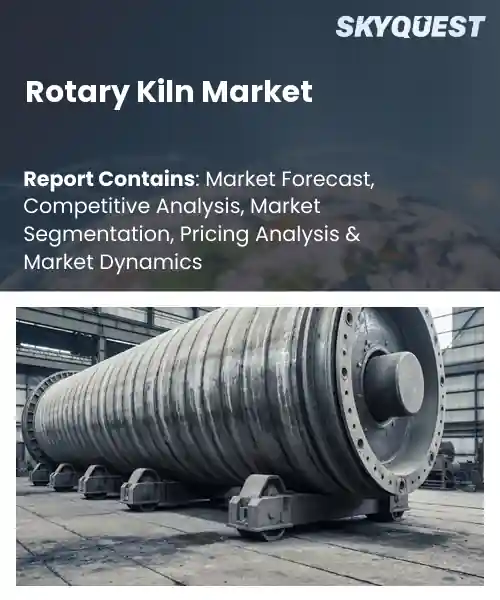
Rotary Kiln Market
Report ID: SQMIG20I3226
Report ID: SQMIG20I3226
[email protected]
USA +1 351-333-4748
Report ID:
SQMIG20I3226 |
Region:
Global |
Published Date: July, 2026
Pages:
157
|Tables:
149
|Figures:
78


Global Rotary Kiln Market size was valued at USD 773.4 Million in 2024 and is poised to grow from USD 791.96 Million in 2025 to USD 957.42 Million by 2033, growing at a CAGR of 2.4% during the forecast period (2026-2033).
The global rotary kiln market has become a segment of the processing industry, supplying cylindrical furnaces that drive cement, lime and metallurgical production worldwide. Its primary driver is the relentless demand for cement, a material essential for infrastructure growth in emerging economies such as India, Brazil and Vietnam. Over the past two decades, rising urbanization and construction programs have expanded cement consumption by more than 30 %, prompting manufacturers to upgrade capacity and adopt kiln designs. Consequently, the market has shifted from basic steel‑shell models to systems that integrate automation and waste‑heat recovery, underscoring its importance for industrial productivity and compliance. Energy efficiency and emissions reduction have become a decisive factor for the global rotary kiln market, as stricter regulations and higher fuel costs compel manufacturers to seek lower consumption. Investing in pre‑heat and multi‑stage combustion technologies can cut fuel use by about 15 %, which immediately lowers operating expenses and aligns plants with carbon‑credit frameworks. A European cement producer that added waste‑heat recovery reported a 12 % drop in CO₂ emissions and generated revenue by selling excess electricity. This clear significant financial benefit drives firms to install advanced kiln designs and adopt real‑time monitoring systems, broadening demand in regions tightening sustainability standards.
How is AI-driven automation impacting efficiency in the rotary kiln market?
AI driven automation is reshaping rotary kiln operations by linking sensors, analytics and control software. Sensors feed temperature and gas data to platforms that predict optimal firing patterns. Operators can adjust fuel flow before inefficiencies appear, reducing waste and extending equipment life. The technology also enables remote monitoring, allowing engineers to troubleshoot without site visits. As new cement plants come online, the industry seeks ways to lower energy use and meet tighter emissions standards. AI driven solutions therefore provide a clear path to higher productivity while aligning with sustainability goals, making them a focal point for modern kiln managers.Ansac Corp, April 2022, introduced AI driven automation to its kiln operations, allowing continuous performance tuning and faster response to process variations. The rollout cut downtime and improved fuel efficiency, illustrating how intelligent control is accelerating growth and operational excellence in the rotary kiln sector worldwide and market performance.
Market snapshot - (2026-2033)
Global Market Size
USD 773.4 Million
Largest Segment
Direct Heated Rotary Kilns
Fastest Growth
Indirect Heated Rotary Kilns
Growth Rate
2.4% CAGR
To get more insights on this market click here to Request a Free Sample Report
Global rotary kiln market is segmented by kiln configuration, process technology, fuel input, process application, end-use industry and region. Based on kiln configuration, the market is segmented into Direct Heated Rotary Kilns and Indirect Heated Rotary Kilns. Based on process technology, the market is segmented into Dry Process and Wet Process. Based on fuel input, the market is segmented into Coal Powered, Natural Gas Powered, Fuel Oil Powered, Alternative Biomass Fuels and Waste Derived Fuels. Based on process application, the market is segmented into Cement Clinker Calcination, Lime Calcination, Alumina Reduction, Iron Ore Pelletizing, Hazardous Waste Incineration and Environmental Remediation. Based on end-use industry, the market is segmented into Construction Materials Manufacturing, Metallurgy Industries, Chemical Processing, Mining Operations and Waste Management Facilities. Based on region, the market is segmented into North America, Europe, Asia Pacific, Latin America and Middle East & Africa.
Direct Heated Rotary Kilns segment dominates because manufacturers prioritize energy efficiency and rapid temperature response, which are critical for high throughput cement production. The direct flame contact provides superior heat transfer, reducing cycle times and enhancing product consistency. This configuration aligns with the market’s demand for lower operational costs and flexible processing, making it the preferred choice for large scale installations seeking reliable performance under varying load conditions.
However, Indirect Heated Rotary Kilns are witnessing the strongest growth momentum as environmental regulations push for lower emissions and cleaner process streams. The separated heating zone enables precise temperature control while minimizing direct flame contact, attracting users in lime calcination and waste incineration seeking reduced pollutant release and enhanced safety, thereby expanding market opportunities.
Coal Powered segment dominates because it offers a mature supply chain and low fuel cost, which remain central to traditional cement and iron ore pelletizing operations. The high calorific value of coal ensures stable temperature profiles within the kiln, supporting continuous production cycles. Established infrastructure and familiar handling practices reinforce its preference among plant operators seeking dependable energy sources without extensive retrofitting.
On the other hand, Alternative Biomass Fuels are emerging as the key high growth area because sustainability goals encourage renewable energy inputs. Using waste derived and agricultural residues cuts carbon footprints and supports circular economy principles, prompting manufacturers to test biomass combustion. This momentum creates fresh market pathways and spurs investment in cleaner kiln technologies.
To get detailed segments analysis, Request a Free Sample Report
Asia Pacific dominates the global rotary kiln market due to a confluence of advanced manufacturing capabilities, strong demand from high‑growth industries such as cement, steel and chemicals, and sustained investment in modernising production facilities. The region benefits from a deep supplier base that delivers sophisticated kiln designs and efficient after‑sales support, fostering rapid adoption of energy‑saving technologies. Close proximity to emerging economies accelerates technology transfer and creates a robust demand pipeline. Moreover, established engineering expertise and collaborative R&D initiatives across Japan and South Korea drive continuous innovation, reinforcing the region’s competitive edge and allowing it to set global standards for performance and environmental compliance.
Rotary Kiln Market in Japan is characterised by a focus on high‑precision engineering and stringent quality standards. Local manufacturers integrate cutting‑edge automation and material‑handling solutions, catering to sophisticated cement and specialty chemicals producers. Strong collaboration between industry and research institutions fuels development of low‑emission kiln configurations, while long‑term service contracts secure reliable performance. The market’s emphasis on durability and efficiency supports Japan’s reputation for technological leadership in kiln technology.
Rotary Kiln Market in South Korea leans heavily on rapid adoption of smart manufacturing concepts and a proactive stance toward environmental stewardship. Domestic producers combine robust steel fabrication with sophisticated control systems, meeting the exacting needs of the petrochemical and refractory sectors. Close ties with global equipment suppliers encourage technology sharing, while government‑backed initiatives promote energy‑efficient kiln upgrades. This synergy drives a resilient market that prioritises operational reliability and lower carbon footprints.
Europe’s rotary kiln market is expanding rapidly thanks to stringent environmental regulations, a mature industrial base and strong emphasis on circular economy principles. European manufacturers are pioneering the integration of alternative fuels and advanced heat‑recovery systems, which aligns with policy incentives for lower emissions. The region’s well‑developed engineering ecosystem encourages collaborative innovation across the cement, lime and waste‑to‑energy sectors. A focus on modular, high‑efficiency kiln designs enables quicker deployment and adaptation to evolving market demands. Together, these factors create a fertile environment for sustained growth and position Europe as a hub for next‑generation kiln technology.
Rotary Kiln Market in Germany is driven by a tradition of precision engineering and a rigorous approach to sustainability. Leading producers offer highly automated kilns equipped with state‑of‑the‑art emissions control, catering to a sophisticated cement industry that values reliability and low environmental impact. Close collaboration with research institutes accelerates the rollout of digital monitoring solutions, while strong after‑sales networks ensure optimal uptime. This combination sustains Germany’s role as a benchmark for efficiency and technological excellence.
Rotary Kiln Market in United Kingdom is emerging through a blend of renewable energy initiatives and revitalised construction activity. Domestic suppliers focus on flexible kiln configurations that can accommodate alternative fuels and variable production schedules, addressing the sector’s shift toward greener practices. Partnerships with academic centres drive experimentation with carbon‑capture integration, while supportive policy frameworks encourage investment in modernised plant assets. These dynamics foster a market that, while still developing, shows strong potential for innovative growth.
Rotary Kiln Market in France is recognised as the fastest growing segment within Europe, propelled by aggressive adoption of low‑carbon technologies and ambitious national climate targets. French manufacturers prioritize the development of high‑efficiency kilns that incorporate waste‑heat recovery and modular design, enabling rapid scaling for both traditional cement and emerging bio‑based material applications. Government incentives for circular economy projects stimulate collaborations between industry and research laboratories, fostering breakthrough solutions. This proactive stance positions France at the forefront of transformational kiln advancements.
North America is strengthening its position in the rotary kiln market through a combination of robust industrial demand, technological innovation and a strategic focus on energy efficiency. The United States benefits from a large, diversified manufacturing base that drives continuous upgrades to kiln performance and reliability. Collaborative research programs with leading universities accelerate the deployment of advanced sensor networks and predictive maintenance tools. In Canada, abundant natural resources and a commitment to green manufacturing encourage the integration of alternative fuels and carbon‑reduction strategies. Together, these elements reinforce a competitive landscape where North America leads in adopting next‑generation kiln solutions.
Rotary Kiln Market in United States is characterised by large‑scale operations and a strong drive toward digital transformation. Industry players invest heavily in automation, data analytics and real‑time monitoring to optimise fuel consumption and extend equipment life. Partnerships with technology firms enable the integration of Internet‑of‑Things platforms, delivering actionable insights for process improvement. Environmental regulations further motivate the shift toward low‑emission kiln designs, while a well‑established supply chain ensures timely access to high‑quality components. This environment sustains a market that emphasizes performance, innovation and regulatory compliance.
Rotary Kiln Market in Canada reflects a commitment to sustainable production and utilization of abundant natural gas resources. Canadian manufacturers emphasize kiln designs that can efficiently burn low‑grade fuels and incorporate extensive heat‑recovery systems, aligning with national objectives for reduced carbon intensity. Collaborative ventures with research centres focus on developing carbon‑capture compatible kilns and exploring bio‑fuel integration. A supportive policy landscape encourages investment in modernisation projects, while a skilled labor force ensures effective implementation. These factors combine to create a resilient market attentive to both economic and environmental priorities.
To know more about the market opportunities by region and country, click here to
Buy The Complete Report
Increasing Industrial Production Capacity
Adoption Of Energy Efficient Technologies
Rising Raw Material Costs
Stringent Environmental Regulations
Request Free Customization of this report to help us to meet your business objectives.
The competitive landscape of the global rotary kiln market is shaped by aggressive technology upgrades, strategic acquisitions and targeted funding that accelerate capacity expansion and emissions‑reduction capabilities; recent M&A activity such as the acquisition of Bennett Hardwoods by Vast Ventures illustrates consolidation, while partnerships between kiln manufacturers and cement producers drive integration of AI‑based monitoring and modular designs to meet stricter environmental standards.
Top Player’s Company Profile
Recent Developments
SkyQuest’s ABIRAW (Advanced Business Intelligence, Research & Analysis Wing) is our Business Information Services team that Collects, Collates, Correlates, and Analyses the Data collected by means of Primary Exploratory Research backed by robust Secondary Desk research. As per SkyQuest analysis, the global rotary kiln market is being propelled primarily by expanding industrial production capacity, especially in cement and steel, which fuels demand for larger, more efficient kilns; a second important catalyst is the rapid uptake of energy‑efficient technologies such as waste‑heat recovery and AI‑driven controls that cut fuel use and lower emissions. The market is chiefly led by Asia Pacific, reflecting its strong construction activity and supplier ecosystem, and the Direct Heated Rotary Kilns segment holds the largest share because of superior heat transfer and lower cycle times. However, rising raw material costs for refractory and steel components act as a restraint, tempering new‑investment cycles.
| Report Metric | Details |
|---|---|
| Market size value in 2024 | USD 773.4 Million |
| Market size value in 2033 | USD 957.42 Million |
| Growth Rate | 2.4% |
| Base year | 2024 |
| Forecast period | (2026-2033) |
| Forecast Unit (Value) | USD Million |
| Segments covered |
|
| Regions covered | North America (US, Canada), Europe (Germany, France, United Kingdom, Italy, Spain, Rest of Europe), Asia Pacific (China, India, Japan, Rest of Asia-Pacific), Latin America (Brazil, Rest of Latin America), Middle East & Africa (South Africa, GCC Countries, Rest of MEA) |
| Companies covered |
|
| Customization scope | Free report customization with purchase. Customization includes:-
|
To get a free trial access to our platform which is a one stop solution for all your data requirements for quicker decision making. This platform allows you to compare markets, competitors who are prominent in the market, and mega trends that are influencing the dynamics in the market. Also, get access to detailed SkyQuest exclusive matrix.
Table Of Content
Executive Summary
Market overview
Parent Market Analysis
Market overview
Market size
KEY MARKET INSIGHTS
COVID IMPACT
MARKET DYNAMICS & OUTLOOK
Market Size by Region
KEY COMPANY PROFILES
Methodology
For the Rotary Kiln Market, our research methodology involved a mixture of primary and secondary data sources. Key steps involved in the research process are listed below:
1. Information Procurement: This stage involved the procurement of Market data or related information via primary and secondary sources. The various secondary sources used included various company websites, annual reports, trade databases, and paid databases such as Hoover's, Bloomberg Business, Factiva, and Avention. Our team did 45 primary interactions Globally which included several stakeholders such as manufacturers, customers, key opinion leaders, etc. Overall, information procurement was one of the most extensive stages in our research process.
2. Information Analysis: This step involved triangulation of data through bottom-up and top-down approaches to estimate and validate the total size and future estimate of the Rotary Kiln Market.
3. Report Formulation: The final step entailed the placement of data points in appropriate Market spaces in an attempt to deduce viable conclusions.
4. Validation & Publishing: Validation is the most important step in the process. Validation & re-validation via an intricately designed process helped us finalize data points to be used for final calculations. The final Market estimates and forecasts were then aligned and sent to our panel of industry experts for validation of data. Once the validation was done the report was sent to our Quality Assurance team to ensure adherence to style guides, consistency & design.
Analyst Support
Customization Options
With the given market data, our dedicated team of analysts can offer you the following customization options are available for the Rotary Kiln Market:
Product Analysis: Product matrix, which offers a detailed comparison of the product portfolio of companies.
Regional Analysis: Further analysis of the Rotary Kiln Market for additional countries.
Competitive Analysis: Detailed analysis and profiling of additional Market players & comparative analysis of competitive products.
Go to Market Strategy: Find the high-growth channels to invest your marketing efforts and increase your customer base.
Innovation Mapping: Identify racial solutions and innovation, connected to deep ecosystems of innovators, start-ups, academics, and strategic partners.
Category Intelligence: Customized intelligence that is relevant to their supply Markets will enable them to make smarter sourcing decisions and improve their category management.
Public Company Transcript Analysis: To improve the investment performance by generating new alpha and making better-informed decisions.
Social Media Listening: To analyze the conversations and trends happening not just around your brand, but around your industry as a whole, and use those insights to make better Marketing decisions.
REQUEST FOR SAMPLE
 REQUEST FREE CUSTOMIZATION


Want to customize this report? This report can be personalized according to your needs. Our analysts and industry experts will work directly with you to understand your requirements and provide you with customized data in a short amount of time. We offer $1000 worth of FREE customization at the time of purchase.
Feedback From Our Clients


 USA (+1) 351-333-4748

