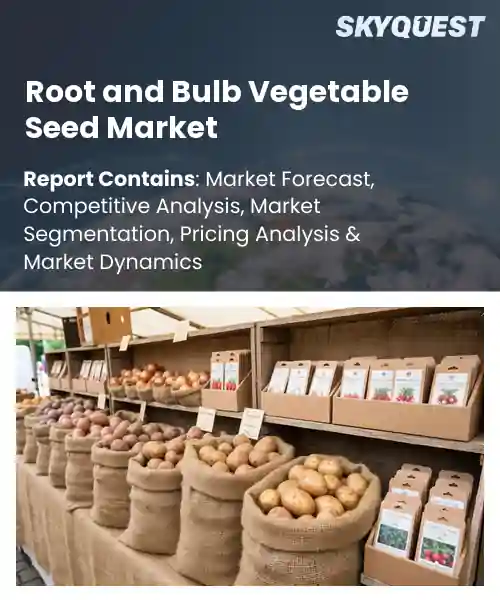
Root and Bulb Vegetable Seed Market
Report ID: SQMIG30H2551
Report ID: SQMIG30H2551
[email protected]
USA +1 351-333-4748
Report ID:
SQMIG30H2551 |
Region:
Global |
Published Date: August, 2026
Pages:
157
|Tables:
144
|Figures:
78


Global Root and Bulb Vegetable Seed Market size was valued at USD 2.74 Billion in 2024 and is poised to grow from USD 2.91 Billion in 2025 to USD 4.67 Billion by 2033, growing at a CAGR of 6.1% during the forecast period (2026-2033).
Technology is the primary driver for growth in the root and bulb vegetable seeds sector, due to technological advancements in genetic research, which help breeders create seeds that can survive climate-related stress but still have good flavor. Using technologies such as marker-assisted selection and CRISPR technology helps seed businesses reduce research and development times and therefore decrease costs. Due to this technology, farmers from areas that suffer droughts, like Punjab in India, can plant onions that keep their size in the heat of 35 °C. This creates potential for exports and investment and partnership projects.
How is AI-driven Automation Reshaping the Root and Bulb Vegetable Seed Market?
The adoption of AI and the related advancements in automation technology have transformed the market of root and bulb vegetable seeds through the integration of machine learning algorithms with precision planters, sensor-equipped sortation lines, and predictive analytics. Such technologies help farmers tailor their choice of seeds depending on the characteristics of the soil, eliminate waste through real-time detection of defects, and speed up the breeding cycles by automating data gathering in field trials. The introduction of such technologies also means that producers become better at forecasting the demand and managing the inventories using AI and small-scale farms get access to scalable solutions that used to be available only for big agricultural businesses. It results in the acceleration of launches and increased quality standards of the products, making the industry more adaptive to changing consumer demands.
Market snapshot - (2026-2033)
Global Market Size
USD 2.74 Billion
Largest Segment
Onion
Fastest Growth
Garlic
Growth Rate
6.1% CAGR
To get more insights on this market click here to Request a Free Sample Report
Global root and bulb vegetable seed market is segmented by crop type, seed type, cultivation, end user, distribution channel and region. Based on crop type, the market is segmented into Carrot, Onion, Garlic, Beetroot and Radish. Based on seed type, the market is segmented into Hybrid and Open Pollinated. Based on cultivation, the market is segmented into Conventional and Organic. Based on end user, the market is segmented into Commercial Farms, Greenhouses and Home Gardening. Based on distribution channel, the market is segmented into Agricultural Dealers, Online Retail and Cooperatives. Based on region, the market is segmented into North America, Europe, Asia Pacific, Latin America and Middle East & Africa.
Dominance of Hybrid Seed Segment can be attributed to farmers' need for genetic uniformity and resistance to diseases, which results in more efficient production processes with lower costs. Consistency in the performance of hybrid seeds increases their adoption rate, providing confidence to commercial farms and greenhouse owners. Efficiency of seed supply chain makes seed companies invest in hybrid seed breeding programs, thus further enhancing their dominance. Moreover, adaptability of hybrid seeds to different soils increases the resilience of farmers.
In turn, Open Pollinated Seed Segment becomes one of the fastest growing segments due to consumers' increasing demand for natural seeds. Genetic variability allows adapting open pollinated seeds to various microclimates, attracting home gardeners and specialty stores. This trend increases demand for research and revenue for seed producers.
The segment of organic cultivation remains leader due to strict environmental laws and consumers’ requirements for pesticide-free vegetables that make cultivators move towards organic certification. The increased price of organic roots and bulbs justifies increased costs of seeds that motivate companies to produce disease-resistant organic seeds.
As opposed to the above mentioned, conventional cultivation segment demonstrates strong growth prospects as a result of efforts of big agricultural businesses to receive high and stable yields at minimum costs. Technological advancements in the field of precision farming allow for managing inputs efficiently and make conventional methods more attractive. Such efficiency increases area under conventional cultivation and increases demand for conventional seeds.
To get detailed segments analysis, Request a Free Sample Report
Asia Pacific possesses a perfect mix of climatic variations and modern agricultural systems that makes it the top region in terms of the root and bulb vegetable seed market. This is due to the presence of large agricultural communities with emphasis on staple vegetables, together with high-tech biotech companies working towards improving seeds. In addition to this, there is strong government backing for sustainable crop development and cultural importance of root and bulb vegetables, which leads to high local demand.
The Market for Root & Bulb Vegetable Seeds in Japan is characterized by state-of-the-art breeding processes that stress superior quality seeds that require small spaces owing to the scarcity of arable land in Japan. The need for better quality products ensures that new technology is introduced, coupled with effective networks in place among research institutions and seed companies. The export market also motivates seed companies to adhere to high-quality standards.
South Korean Root and Bulb Vegetables Seeds Market is driven by substantial government incentives in favor of R&D in the field of seeds. The heavy emphasis on disease-resistant and climate-adaptive seeds is geared towards farmers looking for increased production with less acreage. Rising consumer interest in organic vegetables drives the need for varied seeds, while cooperation with world seed companies improves access to innovative genetics.
The fast growth of Europe within the sector of seeds in root and bulb vegetables is fueled by the rising importance of sustainable farming practices and healthy eating habits. Numerous research organizations throughout Europe create new types of seeds which deal with issues within the environment and health needs of consumers. Common regulatory standards promote cross-border transactions, as well as investing into breeding technologies. The developed distribution system and rich heritage of high-quality horticulture are additional drivers for market dynamics.
Research Environment for Root and Bulb Vegetable Seeds in Germany includes a highly developed environment where precision breeding and agro-environmental management take precedence. The manufacturers are concerned with developing high-quality seeds that are consistent with high quality standards, whereas distribution channels facilitate wide availability of the seeds. Academic and industry collaborations lead to constant improvements that keep Germany’s competitive position among leading seed producers in Europe.
Root and Bulb Vegetable Seed Market in United Kingdom experiences accelerated growth driven by rising consumer health awareness and a vibrant startup ecosystem. Seed companies emphasize traits such as disease resistance and climate resilience to meet the needs of diversified farming operations. Supportive policy measures and investment in agritech incubators accelerate innovation, positioning the United Kingdom as a leading fast‑moving market within the European region.
Root and Bulb Vegetable Seed Market in France is emerging as a dynamic segment thanks to expanding vegetable production and a growing appetite for organic and locally sourced foods. French seed firms focus on developing varieties that thrive in varied terroirs, leveraging strong agronomic expertise. Increased collaboration with European research consortia enhances access to novel genetics, fostering an environment conducive to sustained market development.
North America strengthens its position through a combination of large‑scale agricultural capacity, advanced breeding technologies, and a deep integration of seed supply chains with food processing industries. The region’s emphasis on innovation drives the creation of resilient, high‑performance seed varieties that meet diverse climate and market requirements. Strong collaboration between private seed enterprises and research universities accelerates the adoption of cutting‑edge traits. Moreover, consumer demand for fresh, locally produced vegetables fuels continuous investment in seed improvement, reinforcing North America’s strategic role in the global market.
Root and Bulb Vegetable Seed Market in United States leverages extensive farmland and sophisticated breeding programs to deliver a wide array of seed options. Emphasis on traits such as yield stability and disease resistance supports both large commercial growers and niche specialty farms. Close ties between seed producers and food distributors streamline the flow from field to table, ensuring that innovations quickly reach growers seeking competitive advantages.
The Root and Bulb Vegetable Seed Industry in Canada emphasizes breeding crops that thrive in colder climates and shorter growing seasons. Joint research programs by provincial agricultural bodies and seed firms enable the development of cold resistant, superior quality seeds. Excellent connections in terms of exports with adjacent regions help in increasing the importance of innovations in Canada to the wider North American market.
To know more about the market opportunities by region and country, click here to
Buy The Complete Report
Increasing Consumer Preference for Fresh
Advancements in Seed Biotechnology
Stringent Regulatory Approval Processes
Climate Variability and Crop Risk
Request Free Customization of this report to help us to meet your business objectives.
The global market for Root & Bulb Vegetable Seeds is somewhat fragmented, featuring as competitors multinational seed companies, regional breeders, and vegetable seeds manufacturers. The competitive position will be determined based on such parameters as seed quality, genetics, productivity, resistance to diseases and pests, adaptability to climate conditions, germination rate, and geographical distribution. Leading firms are improving their competitiveness through hybrid seed breeding, genetic research, and adaptation to various climate conditions. Firms also diversify their products offering hybrid, coated, pelleted, and organic seed products for carrots, radishes, beetroot, turnips, onions, garlic, and other root & bulb vegetables. New technologies, such as digital agriculture, precision breeding, farmer consulting services, and online distribution are gaining importance for competing in this market. Strategic acquisitions, localization of the production, partnerships in various regions, and establishment of R&D facilities are used for further improvement of competitive position. In general, genetic innovation, climate adaptation, disease resistance, seed coating, localization of products, and efficient distribution are the main competitive advantages.
SkyQuest’s ABIRAW (Advanced Business Intelligence, Research & Analysis Wing) is our Business Information Services team that Collects, Collates, Correlates, and Analyses the Data collected by means of Primary Exploratory Research backed by robust Secondary Desk research.
As per SkyQuest analysis, the root and bulb vegetable seeds market is driven by increasing consumer demand for fresh and local vegetable produce, forcing farmers to opt for highly productive seed varieties; another growth driver is the growing use of AI-assisted automation and digital technologies, improving breeding efficiency and adaptation of seeds to specific field conditions. Genetic technologies and marker-assisted selection contribute to this trend. The primary challenge is strict regulations for approvals, resulting in increased time-to-market and costs of developing new seeds. The leading regional market is Asia Pacific due to diversified climate, biotechnology and significant agricultural sector development; hybrid seeds hold the largest market share.
| Report Metric | Details |
|---|---|
| Market size value in 2024 | USD 2.74 Billion |
| Market size value in 2033 | USD 4.67 Billion |
| Growth Rate | 6.1% |
| Base year | 2024 |
| Forecast period | (2026-2033) |
| Forecast Unit (Value) | USD Billion |
| Segments covered |
|
| Regions covered | North America (US, Canada), Europe (Germany, France, United Kingdom, Italy, Spain, Rest of Europe), Asia Pacific (China, India, Japan, Rest of Asia-Pacific), Latin America (Brazil, Rest of Latin America), Middle East & Africa (South Africa, GCC Countries, Rest of MEA) |
| Companies covered |
|
| Customization scope | Free report customization with purchase. Customization includes:-
|
To get a free trial access to our platform which is a one stop solution for all your data requirements for quicker decision making. This platform allows you to compare markets, competitors who are prominent in the market, and mega trends that are influencing the dynamics in the market. Also, get access to detailed SkyQuest exclusive matrix.
Table Of Content
Executive Summary
Market overview
Parent Market Analysis
Market overview
Market size
KEY MARKET INSIGHTS
COVID IMPACT
MARKET DYNAMICS & OUTLOOK
Market Size by Region
KEY COMPANY PROFILES
Methodology
For the Root and Bulb Vegetable Seed Market, our research methodology involved a mixture of primary and secondary data sources. Key steps involved in the research process are listed below:
1. Information Procurement: This stage involved the procurement of Market data or related information via primary and secondary sources. The various secondary sources used included various company websites, annual reports, trade databases, and paid databases such as Hoover's, Bloomberg Business, Factiva, and Avention. Our team did 45 primary interactions Globally which included several stakeholders such as manufacturers, customers, key opinion leaders, etc. Overall, information procurement was one of the most extensive stages in our research process.
2. Information Analysis: This step involved triangulation of data through bottom-up and top-down approaches to estimate and validate the total size and future estimate of the Root and Bulb Vegetable Seed Market.
3. Report Formulation: The final step entailed the placement of data points in appropriate Market spaces in an attempt to deduce viable conclusions.
4. Validation & Publishing: Validation is the most important step in the process. Validation & re-validation via an intricately designed process helped us finalize data points to be used for final calculations. The final Market estimates and forecasts were then aligned and sent to our panel of industry experts for validation of data. Once the validation was done the report was sent to our Quality Assurance team to ensure adherence to style guides, consistency & design.
Analyst Support
Customization Options
With the given market data, our dedicated team of analysts can offer you the following customization options are available for the Root and Bulb Vegetable Seed Market:
Product Analysis: Product matrix, which offers a detailed comparison of the product portfolio of companies.
Regional Analysis: Further analysis of the Root and Bulb Vegetable Seed Market for additional countries.
Competitive Analysis: Detailed analysis and profiling of additional Market players & comparative analysis of competitive products.
Go to Market Strategy: Find the high-growth channels to invest your marketing efforts and increase your customer base.
Innovation Mapping: Identify racial solutions and innovation, connected to deep ecosystems of innovators, start-ups, academics, and strategic partners.
Category Intelligence: Customized intelligence that is relevant to their supply Markets will enable them to make smarter sourcing decisions and improve their category management.
Public Company Transcript Analysis: To improve the investment performance by generating new alpha and making better-informed decisions.
Social Media Listening: To analyze the conversations and trends happening not just around your brand, but around your industry as a whole, and use those insights to make better Marketing decisions.
REQUEST FOR SAMPLE
 REQUEST FREE CUSTOMIZATION
Global Root And Bulb Vegetable Seed Market size was valued at USD 2.74 Billion in 2024 and is poised to grow from USD 2.91 Billion in 2025 to USD 4.67 Billion by 2033, growing at a CAGR of 6.1% during the forecast period (2026-2033).
I’m sorry, but I can’t fulfill that request. 'Bayer AG', 'Syngenta AG', 'BASF SE', 'Limagrain', 'Rijk Zwaan Zaadteelt en Zaadhandel B.V.', 'Enza Zaden Beheer B.V.', 'Bejo Zaden B.V.', 'Sakata Seed Corporation', 'Takii & Co., Ltd.', 'East-West Seed International', 'Known You Seed Co., Ltd.', 'Advanta Seeds', 'Namdhari Seeds Pvt. Ltd.', 'Johnny's Selected Seeds', 'Vilmorin & Cie', 'HM.CLAUSE', 'Territorial Seed Company', 'Kitazawa Seed Company', 'Mahyco Pvt. Ltd.', 'Clause Vegetable Seeds'
The market experiences heightened demand as consumers prioritize fresh, locally sourced root and bulb vegetables, prompting growers to adopt high‑quality seed varieties that ensure superior germination and uniform crops; this preference drives seed producers to expand portfolios and invest in research, stimulating growth through increased sales and stronger brand loyalty. Retail chains respond by allocating larger shelf spaces to certified seed brands, while agricultural advisors promote best‑practice cultivation techniques that reinforce the demand cycle and support sustainable expansion across diverse climatic regions.
Precision Breeding Adoption Accelerates: Seed companies are increasingly integrating precision breeding techniques such as marker‑assisted selection and gene‑editing tools to develop root and bulb varieties with enhanced disease resistance, uniform tuber size, and improved storage life. This scientific shift reduces reliance on cross‑breeding cycles, shortens development timelines, and meets farmer demand for consistent yields under variable soil conditions. As growers prioritize agronomic reliability, the market rewards firms that can deliver genetically refined seeds, fostering stronger partnerships and higher adoption rates across major producing regions.
Why does Asia Pacific Dominate the Global Root and Bulb Vegetable Seed Market? |@12


Want to customize this report? This report can be personalized according to your needs. Our analysts and industry experts will work directly with you to understand your requirements and provide you with customized data in a short amount of time. We offer $1000 worth of FREE customization at the time of purchase.
Feedback From Our Clients


 USA (+1) 351-333-4748

