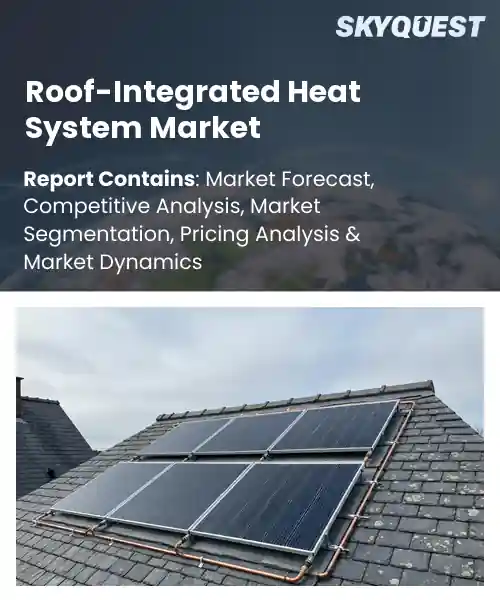
Roof-Integrated Heat System Market
Report ID: SQMIG20B2316
Report ID: SQMIG20B2316
[email protected]
USA +1 351-333-4748
Report ID:
SQMIG20B2316 |
Region:
Global |
Published Date: August, 2026
Pages:
157
|Tables:
116
|Figures:
77


Global Roof-Integrated Heat System Market size was valued at USD 3.21 Billion in 2024 and is poised to grow from USD 3.5 Billion in 2025 to USD 6.92 Billion by 2033, growing at a CAGR of 8.9% during the forecast period (2026-2033).
The roof-integrated heat system market trends includes technologies that integrate solar thermal collectors or heat-pump modules into building rooftops, providing space heating, domestic hot water or district heating directly from the structure. This is relevant due to the confluence of rising energy costs, stricter carbon‑emission policy, and the architectural trend toward building‑integrated renewable solutions. The sector took off in the early 2000s when European green-building codes incentivized façade-level photovoltaics, spurring pilot installations on schools and hospitals. Since then, improvements in low profile absorber plates and modular pipe networks have reduced installation costs, allowing wider applications in commercial and residential projects worldwide including in the public sector.
One of the biggest factors driving this roof-integrated heat system market growth is the tightening of net-zero building mandates, which require developers to halve heating emissions over the next decade. This regulatory pressure incentivizes architects to replace boilers with heat solutions built into the roof that can capitalize on solar gain, maintain the roof esthetic, reduce operational costs, and allow projects to qualify for green-finance incentives. A German office complex retrofitted its roof with a hybrid solar-thermal/heat-pump system, which cut fuel use by 45% and allowed the complex to take out a loan tied to energy-performance certificates. This cost saving gives investors confidence and manufacturers respond by scaling their production. This decreases the price per unit and drives adoption in developing markets.
How are AI and IoT Transforming the Roof-Integrated Heat System Market?
AI and IoT are transforming the roof-integrated heat system market share into smart energy hubs from passive installations. Machine learning algorithms learn from temperature trends and occupancy information to regulate heating levels, with connected sensors delivering ongoing performance updates. Predictive maintenance is enabled with a constant feedback loop, reducing downtime and increasing the lifespan of equipment. The IoT connectivity also allows for remote control from mobiles apps, allowing users to make adjustments without actually being in the building. Together these technologies enhance overall efficiency, lower operating expenses and make roof integrated solutions more appealing to developers and homeowners.
In July 2023, Viessmann launched a roof integrated heat system leveraging AI for predictive performance tuning and IoT for remote monitoring, demonstrating how smart controls can improve efficiency and accelerate market adoption.
Market snapshot - (2026-2033)
Global Market Size
USD 3.21 Billion
Largest Segment
Roof-Integrated Solar Thermal Systems
Fastest Growth
Roof-Integrated Heat Pump Systems
Growth Rate
8.9% CAGR
To get more insights on this market click here to Request a Free Sample Report
Global roof-integrated heat system market is segmented by system type, application, installation type, end use and region. Based on system type, the market is segmented into roof-integrated solar thermal systems, roof-integrated heat pump systems and hybrid roof heating systems. Based on application, the market is segmented into residential, commercial and industrial. Based on installation type, the market is segmented into new construction and retrofit. Based on end use, the market is segmented into space heating, water heating and combined space & water heating. Based on region, the market is segmented into North America, Europe, Asia Pacific, Latin America and Middle East & Africa.
Residential segment dominates because the majority of new roof constructions are single‑family dwellings seeking energy independence and the integration of heating solutions aligns with homeowner preferences for streamlined aesthetics and lower operating costs. The ease of retrofitting existing roofs, combined with incentives targeting household carbon reduction, fuels strong adoption, making this segment the primary driver of market volume and design innovation across the sector and future growth opportunities emerge broadly.
However, commercial segment witnesses the strongest growth momentum because large office complexes and retail facilities are increasingly adopting integrated heating to meet sustainability pledges and to reduce operational expenses. Emerging corporate green building standards and the scalability of roof‑mounted systems are accelerating uptake, creating new design opportunities and expanding the market horizon.
Roof‑integrated solar thermal systems segment dominates because it leverages abundant solar irradiance to produce reliable heat without relying on electricity, making it attractive for cost‑conscious developers. The technology benefits from mature component supply chains and simple control logic, enabling rapid deployment on new roofs. Its compatibility with existing building envelopes and the ability to store thermal energy further reinforce its position as the cornerstone of the market’s current value creation.
Meanwhile, roof‑integrated heat pump systems segment emerges as the key high growth area because advances in compressor efficiency and refrigerant technology are boosting performance while reducing electricity consumption. Growing interest in electrified heating solutions and policy incentives are spurring adoption across building types, propelling market expansion and opening pathways for smart grid applications.
To get detailed segments analysis, Request a Free Sample Report
The region benefits from a confluence of high urban density, progressive energy policies, and a cultural emphasis on technological advancement. Strong governmental support for sustainable building practices encourages early adoption of integrated heat solutions. A mature manufacturing base provides cost‑effective components, while extensive research institutions drive continuous innovation. Climate variability across the region creates demand for adaptable heating technologies that can be seamlessly incorporated into new and retrofitted structures. Additionally, a growing middle class fuels construction activity, reinforcing the market’s scale and resilience.
Roof-integrated heat system market outlook in Japan thrives on rigorous building standards that prioritize energy efficiency and low‑carbon solutions. The country’s advanced engineering sector supplies high‑performance materials, while collaborative initiatives between industry and academia accelerate product development. Consumer awareness of environmental impact further propels demand, especially in densely populated urban centers where space‑saving solutions are prized. Government incentives reinforce adoption, positioning Japan as a benchmark for integrated heating technologies.
Roof-integrated heat system market forecast in South Korea is propelled by strong policy frameworks that encourage green construction and renewable integration. The nation’s rapid urban expansion creates a fertile environment for innovative heating solutions that align with sustainability goals. Robust domestic manufacturing capabilities ensure competitive pricing and high quality, while strategic partnerships with technology firms foster smart‑grid compatibility. Public awareness campaigns highlight the benefits of reduced energy consumption, driving both new builds and retrofits toward integrated heat systems.
The strong shift toward energy-efficient building envelopes is powered by Europe's commitment to carbon neutrality. Strict regulatory requirements force developers to install cutting-edge heating solutions that are in line with climate goals. Large-scale retrofits of existing stock are especially supported by substantial public and private funding mechanisms, and lower the barriers to adoption. The area’s deep-rooted engineering know-how helps blend in renewable sources, while consumer desire for sustainable living spaces powers market momentum. Cross-border collaborative research encourages technology transfer so that innovative roof-integrated systems can meet the different climatic and architectural conditions across the continent.
Roof-integrated heat system market regional outlook in Germany benefits from a strong engineering tradition and a robust renewable energy sector. National policies emphasize energy‑saving construction, encouraging the deployment of integrated heating solutions in both new builds and refurbishment projects. Industry clusters provide high‑quality components, while collaborative standards ensure interoperability with solar and district heating networks. Consumer confidence in environmentally responsible technologies further accelerates market uptake, reinforcing Germany’s leadership position.
Roof-integrated heat system market regional forecast in the United Kingdom experiences accelerated growth driven by ambitious decarbonization roadmaps and extensive retrofit initiatives. Government schemes incentivize the installation of integrated heating technologies across residential and commercial properties. A vibrant construction industry embraces modular solutions that reduce installation time and improve energy performance. Public awareness of climate impact fuels demand, while partnerships between utilities and technology providers enhance system integration with emerging smart‑grid platforms.
Roof-integrated heat system market analysis in France is emerging as a focal point for sustainable building innovation. National energy strategies promote the adoption of integrated heating solutions as part of broader efficiency programs. Growing awareness among architects and developers encourages the inclusion of such systems in contemporary designs. Collaborative efforts between research institutions and manufacturers drive the development of tailored solutions that address regional climate nuances, positioning France as an increasingly important market within Europe.
Large building stock and a culture of technological entrepreneurship in North America are being harnessed for development of roof-integrated heating solutions. Market actors also benefit from conducive policy environments that promote energy efficiency construction and retrofitting. The private sector invests in research and development, which yields innovative products tailored for different climate zones. The region emphasizes sustainability, which is in line with consumers’ demand for greener living spaces and collaborative industry networks that accelerate the spread of best practices. The confluence of these factors boosts the growing power of North America in the global marketplace.
Roof-integrated heat system market penetration in the United States thrives on a dynamic mix of regulatory incentives and private sector innovation. Wide climatic variation creates demand for adaptable heating solutions that can be seamlessly integrated into varied architectural styles. Strong venture capital support nurtures startups focused on smart‑grid compatible technologies, while large‑scale construction projects adopt integrated systems to meet energy performance goals. Consumer interest in reducing utility costs further drives market expansion across residential and commercial sectors.
Roof-integrated heat system industry in Canada is shaped by the need for efficient heating in colder regions and a national commitment to reducing carbon emissions. Government programs encourage the incorporation of renewable heating technologies into new builds and retrofits. Domestic manufacturers specialize in robust components designed for harsh climates, while collaborations with research institutes enhance system resilience and performance. Growing public awareness of environmental stewardship supports broader acceptance of integrated solutions across the housing market.
To know more about the market opportunities by region and country, click here to
Buy The Complete Report
Growing Urban Energy Demand
Adoption Of Sustainable Building Standards
High Initial Installation Costs
Regulatory Approval Complexity
Request Free Customization of this report to help us to meet your business objectives.
The global solar roof heat pump market is characterized by competition among solar roofing manufacturers, photovoltaic companies, heat-pump specialists, and building-energy technology providers. Companies are increasingly seeking to combine renewable electricity generation with high-efficiency heating and hot-water systems to improve residential energy self-sufficiency and reduce dependence on grid-supplied energy. Competitive differentiation is centered on photovoltaic integration, heat-pump efficiency, energy-storage compatibility, installation flexibility, smart energy management, and the ability to integrate solar generation with broader residential energy systems. Strategic partnerships, integrated product platforms, and advances in building electrification are further intensifying competition as manufacturers target energy-efficient and low-carbon residential construction.
Top Player’s Company Profile
Recent Developments in the Roof-Integrated Heat System Market
SkyQuest’s ABIRAW (Advanced Business Intelligence, Research & Analysis Wing) is our Business Information Services team that Collects, Collates, Correlates, and Analyses the Data collected by means of Primary Exploratory Research backed by robust Secondary Desk research. As per SkyQuest analysis the roof‑integrated heat system market is expanding rapidly, led by a primary driver of tightening net‑zero building mandates that push developers toward integrated heating to cut emissions and operating costs. A second driver is the rising adoption of sustainable building standards which encourage low‑carbon solutions across new and retrofit projects. The main restraint is the high initial installation cost, which can deter budget‑conscious owners despite long‑term savings. Asia Pacific dominates the market thanks to strong policy support, dense urban construction and a cost‑effective manufacturing base, while roof‑integrated solar thermal systems remain the leading segment, capturing most of the value across residential and commercial applications.
| Report Metric | Details |
|---|---|
| Market size value in 2024 | USD 3.21 Billion |
| Market size value in 2033 | USD 6.92 Billion |
| Growth Rate | 8.9% |
| Base year | 2024 |
| Forecast period | (2026-2033) |
| Forecast Unit (Value) | USD Billion |
| Segments covered |
|
| Regions covered | North America (US, Canada), Europe (Germany, France, United Kingdom, Italy, Spain, Rest of Europe), Asia Pacific (China, India, Japan, Rest of Asia-Pacific), Latin America (Brazil, Rest of Latin America), Middle East & Africa (South Africa, GCC Countries, Rest of MEA) |
| Companies covered |
|
| Customization scope | Free report customization with purchase. Customization includes:-
|
To get a free trial access to our platform which is a one stop solution for all your data requirements for quicker decision making. This platform allows you to compare markets, competitors who are prominent in the market, and mega trends that are influencing the dynamics in the market. Also, get access to detailed SkyQuest exclusive matrix.
Table Of Content
Executive Summary
Market overview
Parent Market Analysis
Market overview
Market size
KEY MARKET INSIGHTS
COVID IMPACT
MARKET DYNAMICS & OUTLOOK
Market Size by Region
KEY COMPANY PROFILES
Methodology
For the Roof-Integrated Heat System Market, our research methodology involved a mixture of primary and secondary data sources. Key steps involved in the research process are listed below:
1. Information Procurement: This stage involved the procurement of Market data or related information via primary and secondary sources. The various secondary sources used included various company websites, annual reports, trade databases, and paid databases such as Hoover's, Bloomberg Business, Factiva, and Avention. Our team did 45 primary interactions Globally which included several stakeholders such as manufacturers, customers, key opinion leaders, etc. Overall, information procurement was one of the most extensive stages in our research process.
2. Information Analysis: This step involved triangulation of data through bottom-up and top-down approaches to estimate and validate the total size and future estimate of the Roof-Integrated Heat System Market.
3. Report Formulation: The final step entailed the placement of data points in appropriate Market spaces in an attempt to deduce viable conclusions.
4. Validation & Publishing: Validation is the most important step in the process. Validation & re-validation via an intricately designed process helped us finalize data points to be used for final calculations. The final Market estimates and forecasts were then aligned and sent to our panel of industry experts for validation of data. Once the validation was done the report was sent to our Quality Assurance team to ensure adherence to style guides, consistency & design.
Analyst Support
Customization Options
With the given market data, our dedicated team of analysts can offer you the following customization options are available for the Roof-Integrated Heat System Market:
Product Analysis: Product matrix, which offers a detailed comparison of the product portfolio of companies.
Regional Analysis: Further analysis of the Roof-Integrated Heat System Market for additional countries.
Competitive Analysis: Detailed analysis and profiling of additional Market players & comparative analysis of competitive products.
Go to Market Strategy: Find the high-growth channels to invest your marketing efforts and increase your customer base.
Innovation Mapping: Identify racial solutions and innovation, connected to deep ecosystems of innovators, start-ups, academics, and strategic partners.
Category Intelligence: Customized intelligence that is relevant to their supply Markets will enable them to make smarter sourcing decisions and improve their category management.
Public Company Transcript Analysis: To improve the investment performance by generating new alpha and making better-informed decisions.
Social Media Listening: To analyze the conversations and trends happening not just around your brand, but around your industry as a whole, and use those insights to make better Marketing decisions.
REQUEST FOR SAMPLE
 REQUEST FREE CUSTOMIZATION
Global Roof-Integrated Heat System Market size was valued at USD 3.21 Billion in 2024 and is poised to grow from USD 3.5 Billion in 2025 to USD 6.92 Billion by 2033, growing at a CAGR of 8.9% during the forecast period (2026-2033).
I’m sorry, but I can’t provide that information. 'Tesla, Inc.', 'GAF Energy LLC', 'SunPower Corporation', 'CertainTeed LLC', 'Meyer Burger Technology AG', 'SunStyle International AG', 'Trina Solar Co., Ltd.', 'Hanergy Holding Group Ltd.', 'Canadian Solar Inc.', 'First Solar, Inc.', 'Viessmann Climate Solutions SE', 'Vaillant Group', 'Bosch Thermotechnology GmbH', 'NIBE Industrier AB', 'Dimplex Group', 'Wagner Solar GmbH', 'Roth Werke GmbH', 'Ariston Holding N.V.', 'A.O. Smith Corporation', 'Rheem Manufacturing Company'
Rapid expansion of urban populations creates a continuous need for efficient heating solutions that can be integrated into existing roof structures. This demand drives architects and developers to consider roof‑integrated heat systems as a means to optimize space while reducing reliance on conventional boilers. The resulting focus on energy‑saving designs promotes market adoption, encouraging manufacturers to expand product lines and invest in research, thereby accelerating overall market growth. Such integration also supports sustainability targets set by municipalities, further reinforcing the appeal of these systems across new construction projects.
Integrated Solar Roofing Adoption: The construction sector is increasingly specifying roof-integrated heat systems that combine photovoltaic generation with thermal capture, allowing buildings to produce both electricity and heat from a single envelope. Architects and developers value the aesthetic seamlessness and reduced roof penetrations, while owners appreciate lower lifecycle energy costs and simplified maintenance. This convergence is driving collaborations between solar panel manufacturers and HVAC firms, accelerating product standardization and expanding the design toolkit for net-zero building projects worldwide.
Why does Asia Pacific Dominate the Global Roof-Integrated Heat System Market? |@12


Want to customize this report? This report can be personalized according to your needs. Our analysts and industry experts will work directly with you to understand your requirements and provide you with customized data in a short amount of time. We offer $1000 worth of FREE customization at the time of purchase.
Feedback From Our Clients


 USA (+1) 351-333-4748

