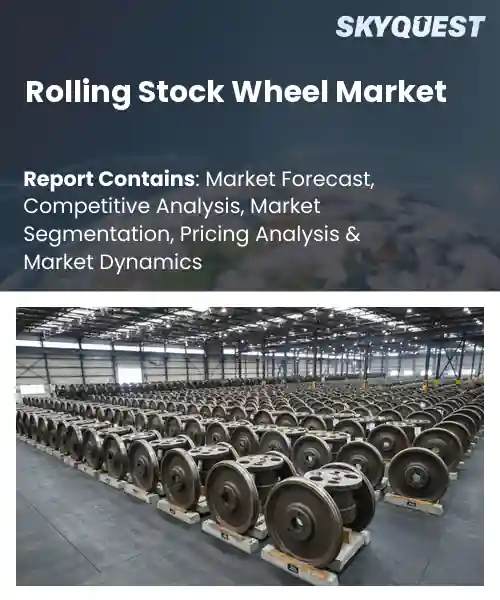
Rolling Stock Wheel Market
Report ID: SQMIG20C2167
Report ID: SQMIG20C2167
[email protected]
USA +1 351-333-4748
Report ID:
SQMIG20C2167 |
Region:
Global |
Published Date: February, 2026
Pages:
157
|Tables:
144
|Figures:
78


Global Rolling Stock Wheel Market size was valued at USD 2.8 Billion in 2024 and is poised to grow from USD 2.98 Billion in 2025 to USD 4.98 Billion by 2033, growing at a CAGR of 6.6% during the forecast period (2026-2033).
The primary driver of the rolling stock wheel market is accelerating demand for rail capacity, reliability and freight modal shift. The market encompasses manufacturing, refurbishment and aftermarket services for wheels fitted to locomotives, passenger coaches and freight wagons, and it matters because wheel quality directly affects safety, energy efficiency and lifecycle costs. Over decades the sector evolved from cast wheels to forged monoblock and resilient designs while inspection advanced from manual checks to ultrasonic and laser profiling. Examples include high-speed train wheelsets in Europe requiring tighter tolerances and China’s freight investments creating large replacement cycles and increasing automation in factories.Given rising replacement cycles, regulatory tightening and lifecycle-cost pressures are pivotal factors accelerating global rolling stock wheel market growth. When safety standards tighten, manufacturers develop higher-grade steels and resilient profiles, increasing capital expenditure but reducing failures and downtime. As electrification and heavier axle loads amplify wheelset stresses, operators adopt heat-treated alloys and automated reprofiling, creating demand for specialized workshops. Urban metros seeking quieter operation have driven composite inserts that spawn niche suppliers. Consequently predictive maintenance and aftermarket refurbishing become profitable opportunities because enhanced materials and inspection regimes lower lifecycle costs and justify new service models while supporting circular economy initiatives.
How is automation improving manufacturing efficiency in the rolling stock wheel market?
Automation is improving manufacturing efficiency in the rolling stock wheel market by tightening control over every step from forging to final machining. Key aspects include robotic material handling, automated machining cells, inline nondestructive inspection, and predictive maintenance driven by sensors and analytics. Today producers use these tools to reduce manual handling, shorten changeovers, and raise consistency of wheel profiles and heat treatment outcomes. The market context is one of rising demand for safety and customization, so automation helps manufacturers meet varied specifications faster while lowering scrap and rework. Real world examples include automated lathe and mill sequences and vision guided handling that keep lines flexible and responsive.Waygate Technologies July 2025, launched an automated ultrasonic wheelset inspection system that speeds reliable detection of defects. This automation reduces teardown time and rework while improving throughput and traceability, helping manufacturers deliver safer wheels faster and supporting market efficiency and growth.
Market snapshot - (2026-2033)
Global Market Size
USD 2.8 Billion
Largest Segment
Solid Wheels
Fastest Growth
Composite Wheels
Growth Rate
6.6% CAGR
To get more insights on this market click here to Request a Free Sample Report
Global rolling stock wheel market is segmented by wheel types, material types, applications, production methods, end users and region. Based on wheel types, the market is segmented into Solid Wheels, Hollow Wheels and Composite Wheels. Based on material types, the market is segmented into Steel Wheels, Aluminum Wheels and Plastic Wheels. Based on applications, the market is segmented into Freight Transport, Passenger Transport and Industrial Use. Based on production methods, the market is segmented into Casting, Forging and Machining. Based on end users, the market is segmented into Railway Companies, Manufacturers and Maintenance Providers. Based on region, the market is segmented into North America, Europe, Asia Pacific, Latin America and Middle East & Africa.
Steel Wheels segment dominates because of its unmatched mechanical strength and wear resistance that suit heavy axle loads and sustained braking forces in rolling stock operations. Proven supply chains and standardized production ensure consistent quality and part interchangeability, while predictable wear behavior simplifies maintenance planning. This combination reduces lifecycle uncertainty for operators and encourages widespread specification by OEMs and maintenance planners seeking dependable fleet performance.
However, Aluminum Wheels are emerging as the most rapidly expanding area thanks to weight advantages that reduce energy use and enable higher-speed passenger service. Advances in alloy and joining techniques lower production barriers, while rising operator demand for lighter, quieter vehicles accelerates adoption and opens new retrofit and aftermarket opportunities.
Hollow Wheels segment stands out because its geometry lowers unsprung mass while maintaining structural stiffness, which directly improves acceleration, braking response, and dynamic track interaction. Manufacturing refinements produce consistent geometries with controlled deformation, reducing stress concentrations and extending service intervals. These operational and maintenance benefits align with operator priorities for energy efficiency and fleet availability, driving broad adoption across vehicle types and reinforcing hollow wheels' leadership.
Meanwhile, Composite Wheels are witnessing the strongest growth momentum because material integration reduces weight while significantly improving noise and vibration damping to meet ride comfort and acoustic requirements. Advances in fiber reinforcement and bonding broaden production feasibility, attracting development programs and creating opportunities for lightweight, low-noise rolling stock and premium passenger upgrades.
To get detailed segments analysis, Request a Free Sample Report
Asia Pacific dominance reflects a combination of concentrated manufacturing capabilities, extensive rail program priorities, and a mature ecosystem of specialized component suppliers. The region benefits from a dense cluster of OEMs and tier suppliers that support high quality production and rapid customization, while localized supply chains minimize lead times and enable responsive maintenance services. Strong emphasis on materials engineering and precision manufacturing yields performance gains in wear resistance and noise reduction. Public and private focus on urban transit and intercity connectivity sustains demand for new builds and refurbishment, and collaborative research initiatives between industry and technical institutes accelerate design refinement and testing capabilities, reinforcing regional leadership and export competitiveness. Extensive aftermarket networks and collaborative research and development with universities underpin product refinement and operational support.
Rolling Stock Wheel Market in Japan is characterized by advanced engineering, high reliability standards, and an emphasis on precision manufacturing. Domestic OEMs and specialized suppliers collaborate closely with rail operators to refine wheel design, materials, and maintenance practices. A strong culture of continual improvement drives innovation in noise reduction and wear resistance, while maintenance regimes and refurbishment programs sustain a stable aftermarket that supports long lifecycle management and premium demand.
Rolling Stock Wheel Market in South Korea benefits from a strong industrial base, integrated supply chains, and close cooperation between manufacturers and national rail operators. Emphasis on technological adoption and modular manufacturing enables efficient production and implementation of design improvements. Local suppliers focus on material optimization and maintenance solutions, while refurbishment and fleet modernization efforts generate sustained aftermarket demand and strengthen domestic capabilities and support export competitiveness and regional integration.
Expansion in Europe is driven by regulatory emphasis on safety, interoperability, and environmental performance combined with active fleet renewal and refurbishment initiatives. A sophisticated OEM and supplier base supports rapid incorporation of material advances, precision machining, and predictive maintenance approaches, enabling operators to improve lifecycle economics while meeting stringent acoustic and durability requirements. Cross-border rail corridors and common technical frameworks promote standardization and collaboration, encouraging modular upgrade strategies and aftermarket specialization. Urban mobility programs and sustainability objectives further prioritize low-noise, long-life components, while deep testing facilities and engineering talent underpin product validation and certification. Investment in automation and digital engineering further accelerates production quality and enables bespoke solutions for diverse service profiles.
Rolling Stock Wheel Market in Germany is anchored by a deep industrial ecosystem, extensive engineering expertise, and insistence on rigorous testing and certification. Manufacturers and suppliers focus on material science, precision machining, and integration with braking systems to meet demanding reliability targets. Strong demand for refurbishment and modular upgrades sustains aftermarket services, while close collaboration between operators and research institutions accelerates innovation in noise reduction, wear performance, and lifecycle management.
Rolling Stock Wheel Market in United Kingdom is emerging through focused fleet renewal, private sector participation, and adoption of digital maintenance practices. Suppliers emphasize lightweight materials, improved tread profiles, and condition monitoring to meet urban and intercity service needs. Growth in refurbishment projects and investment encourages specialized manufacturing and retrofit solutions, while regulatory focus on passenger comfort and infrastructure compatibility supports demand for quieter durable wheel systems and lifecycle services.
Rolling Stock Wheel Market in France is driven by strong integration between domestic manufacturers and national rail operators, with emphasis on high performance, noise abatement, and lifecycle optimization. Industrial clusters support advanced material development, testing, and manufacturing. A refurbishment sector complements new build demand, enabling tailored upgrade solutions and aftercare services. Collaboration with research organizations fosters innovation in rolling contact fatigue resistance and standardized approaches to interoperability across regional networks.
North America is strengthening its role through coordinated fleet renewal priorities, investment in domestic production and maintenance capacity, and an increased focus on lifecycle cost optimization. The market is adopting advanced materials, refined wheel profiles, and predictive maintenance techniques supported by expanded testing and certification capabilities. Collaboration between manufacturers, operators, and technology providers accelerates integration of digital monitoring and condition based maintenance, while regional supply chain initiatives aim to improve resilience and reduce dependency on distant sources. The balance of freight and passenger demands drives diversified product development, and aftermarket service networks alongside refurbishment programs sustain steady demand for durable, high performance wheel systems. Supportive regulatory frameworks and public private partnerships foster capital investments in testing facilities and workforce training, strengthening long term competitiveness.
Rolling Stock Wheel Market in United States is shaped by a diverse mix of freight and passenger requirements, driving demand for durable wheels and versatile maintenance solutions. Domestic manufacturers and aftermarket providers emphasize material innovation, predictive analytics, and flexibility to meet service profiles. Investment in testing infrastructure and partnerships with rail operators supports validation, while refurbishment activities and condition based maintenance broaden offerings and extend asset usability and network resilience.
Rolling Stock Wheel Market in Canada emphasizes robust designs suited to varied climates and long routes, driving interest in durable materials and corrosion resistant finishes. Suppliers and operators focus on maintenance strategies that accommodate dispersed networks and seasonal challenges, while refurbishment and retrofit programs extend fleet utility. Collaborative procurement and cross border supplier relationships support access to manufacturing and testing capabilities, reinforcing a resilient supply chain and localized aftermarket services.
To know more about the market opportunities by region and country, click here to
Buy The Complete Report
Expansion Of Passenger Rail Networks
Advancements In Wheel Materials
High Lifecycle Maintenance Costs
Supply Chain Material Shortages
Request Free Customization of this report to help us to meet your business objectives.
Consolidation and targeted technology partnerships now define the competitive landscape in the global rolling stock wheel market, driven by operator demand for lower life cycle costs and outsourced aftermarket services. Recent strategic moves include Lucchini RS acquiring Valdunes rail wheel operations and suppliers introducing material and design innovations to extend wheel life, illustrating active M&A, joint development agreements and product innovation as direct competition levers.
Top Player’s Company Profile
Recent Developments
SkyQuest’s ABIRAW (Advanced Business Intelligence, Research & Analysis Wing) is our Business Information Services team that Collects, Collates, Correlates, and Analyses the Data collected by means of Primary Exploratory Research backed by robust Secondary Desk research. As per SkyQuest analysis, the global rolling stock wheel market is set for steady growth driven primarily by accelerating demand for rail capacity, reliability and freight modal shift, while adoption of advanced wheel materials and heat treatments serves as a second important growth driver. Steel wheels remain the dominating segment thanks to proven strength, wear resistance and established supply chains, and Asia Pacific leads the market given its concentrated manufacturing base, large rail programs and strong aftermarket networks. High lifecycle maintenance costs represent a clear restraint, pressuring operators' budgets and slowing upgrades, yet opportunities in predictive maintenance, material innovation and automation support healthier aftermarket and refurbishment demand.
| Report Metric | Details |
|---|---|
| Market size value in 2024 | USD 2.8 Billion |
| Market size value in 2033 | USD 4.98 Billion |
| Growth Rate | 6.6% |
| Base year | 2024 |
| Forecast period | (2026-2033) |
| Forecast Unit (Value) | USD Billion |
| Segments covered |
|
| Regions covered | North America (US, Canada), Europe (Germany, France, United Kingdom, Italy, Spain, Rest of Europe), Asia Pacific (China, India, Japan, Rest of Asia-Pacific), Latin America (Brazil, Rest of Latin America), Middle East & Africa (South Africa, GCC Countries, Rest of MEA) |
| Companies covered |
|
| Customization scope | Free report customization with purchase. Customization includes:-
|
To get a free trial access to our platform which is a one stop solution for all your data requirements for quicker decision making. This platform allows you to compare markets, competitors who are prominent in the market, and mega trends that are influencing the dynamics in the market. Also, get access to detailed SkyQuest exclusive matrix.
Table Of Content
Executive Summary
Market overview
Parent Market Analysis
Market overview
Market size
KEY MARKET INSIGHTS
COVID IMPACT
MARKET DYNAMICS & OUTLOOK
Market Size by Region
KEY COMPANY PROFILES
Methodology
For the Rolling Stock Wheel Market, our research methodology involved a mixture of primary and secondary data sources. Key steps involved in the research process are listed below:
1. Information Procurement: This stage involved the procurement of Market data or related information via primary and secondary sources. The various secondary sources used included various company websites, annual reports, trade databases, and paid databases such as Hoover's, Bloomberg Business, Factiva, and Avention. Our team did 45 primary interactions Globally which included several stakeholders such as manufacturers, customers, key opinion leaders, etc. Overall, information procurement was one of the most extensive stages in our research process.
2. Information Analysis: This step involved triangulation of data through bottom-up and top-down approaches to estimate and validate the total size and future estimate of the Rolling Stock Wheel Market.
3. Report Formulation: The final step entailed the placement of data points in appropriate Market spaces in an attempt to deduce viable conclusions.
4. Validation & Publishing: Validation is the most important step in the process. Validation & re-validation via an intricately designed process helped us finalize data points to be used for final calculations. The final Market estimates and forecasts were then aligned and sent to our panel of industry experts for validation of data. Once the validation was done the report was sent to our Quality Assurance team to ensure adherence to style guides, consistency & design.
Analyst Support
Customization Options
With the given market data, our dedicated team of analysts can offer you the following customization options are available for the Rolling Stock Wheel Market:
Product Analysis: Product matrix, which offers a detailed comparison of the product portfolio of companies.
Regional Analysis: Further analysis of the Rolling Stock Wheel Market for additional countries.
Competitive Analysis: Detailed analysis and profiling of additional Market players & comparative analysis of competitive products.
Go to Market Strategy: Find the high-growth channels to invest your marketing efforts and increase your customer base.
Innovation Mapping: Identify racial solutions and innovation, connected to deep ecosystems of innovators, start-ups, academics, and strategic partners.
Category Intelligence: Customized intelligence that is relevant to their supply Markets will enable them to make smarter sourcing decisions and improve their category management.
Public Company Transcript Analysis: To improve the investment performance by generating new alpha and making better-informed decisions.
Social Media Listening: To analyze the conversations and trends happening not just around your brand, but around your industry as a whole, and use those insights to make better Marketing decisions.
REQUEST FOR SAMPLE
 REQUEST FREE CUSTOMIZATION


Want to customize this report? This report can be personalized according to your needs. Our analysts and industry experts will work directly with you to understand your requirements and provide you with customized data in a short amount of time. We offer $1000 worth of FREE customization at the time of purchase.
Feedback From Our Clients


 USA (+1) 351-333-4748

