
Rolling Road Market
Report ID: SQMIG20G2118
Report ID: SQMIG20G2118
[email protected]
USA +1 351-333-4748
Report ID:
SQMIG20G2118 |
Region:
Global |
Published Date: March, 2026
Pages:
157
|Tables:
119
|Figures:
77


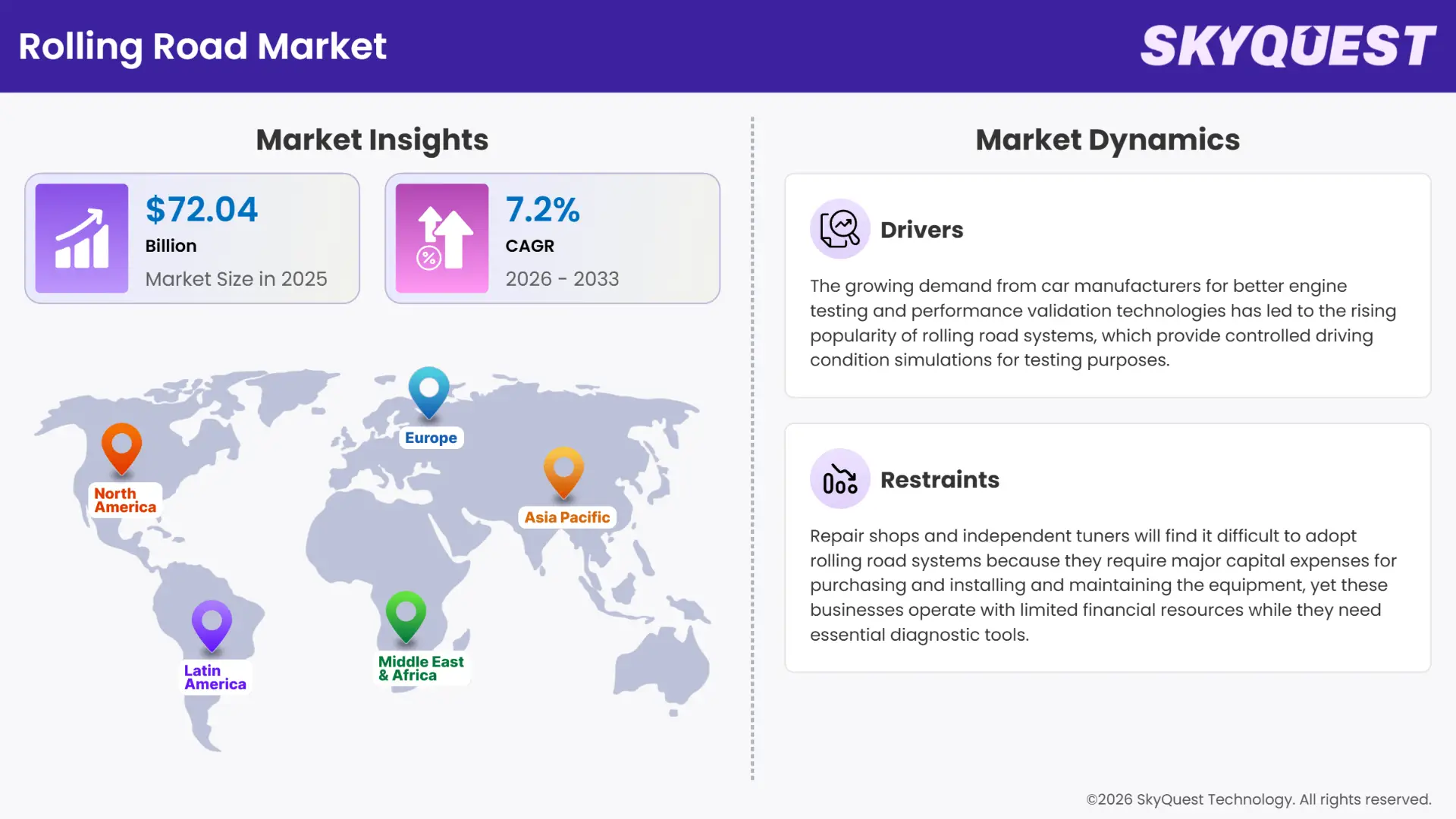
Global Rolling Road Market size was valued at USD 67.20 Billion in 2024 and is poised to grow from USD 72.04 Billion in 2025 to USD 125.64 Billion by 2033, growing at a CAGR of 7.2% during the forecast period (2026-2033).
Key Takeaways: Market Trends & Insights
The global rolling road market growth depends on precise testing methods which can be repeated to perform vehicle assessments. The industry requires chassis dynamometer systems which OEMs and independent workshops and testing centers use to test vehicle performance. The platforms create road conditions to measure torque and horsepower and emissions which scientists use for performance tuning and certification testing and diagnostic testing. The market exists because customer demand for efficient, powerful products led to increased market adoption and investment.
Moreover, the global rolling road market outlook progressed through successive technological advancements which converted belt-driven rollers into computer-controlled systems that used high-resolution data logging and customizable road simulation profiles and vehicle software integration to produce accurate results. The rolling road industry grows because technological convergence happens when sensor accuracy improves through advanced telemetry and simulation software which creates new value streams. The testing facilities provide accurate tuning solutions which meet emissions testing requirements of regulatory bodies and fleet operators thus promoting system investments by other operators. The logistics companies test engine retuning by using dynos while the OEM R&D teams use lab simulations of complex drive cycles to speed up their calibration processes. The ripple effect creates new revenue opportunities for vendors who can sell analytics services and create EV-specific rollers and establish measurement protocols which generate recurring revenue.
How is AI Enhancing Diagnostic Accuracy in the Rolling Road Market?
Rolling road systems function as chassis dynamometers which replicate actual road conditions for vehicle testing while gathering detailed sensor data together with control information. AI enhances diagnostic accuracy by combining synchronized sensor data with fault signatures that have been learned, and it finds probable root causes of problems. Dyno control software now includes machine learning, which helps vendors reduce testing time while creating more realistic simulations of actual test conditions. The shift enables workshops to handle both electrified powertrains and advanced driver assistance systems. The process includes automated anomaly detection which detects temporary drivability issues together with adaptive test sequences that effectively find transmission or calibration problems.
The AI-based inspection assistant developed by MAHA, which was released in February 2025, interprets rolling road outputs to perform automated fault finding. The innovation makes diagnostics more efficient while increasing testing confidence. The company increased lab productivity to support their validation work for more complex powertrain systems and advanced driver assistance systems.
To get more insights on this market click here to Request a Free Sample Report
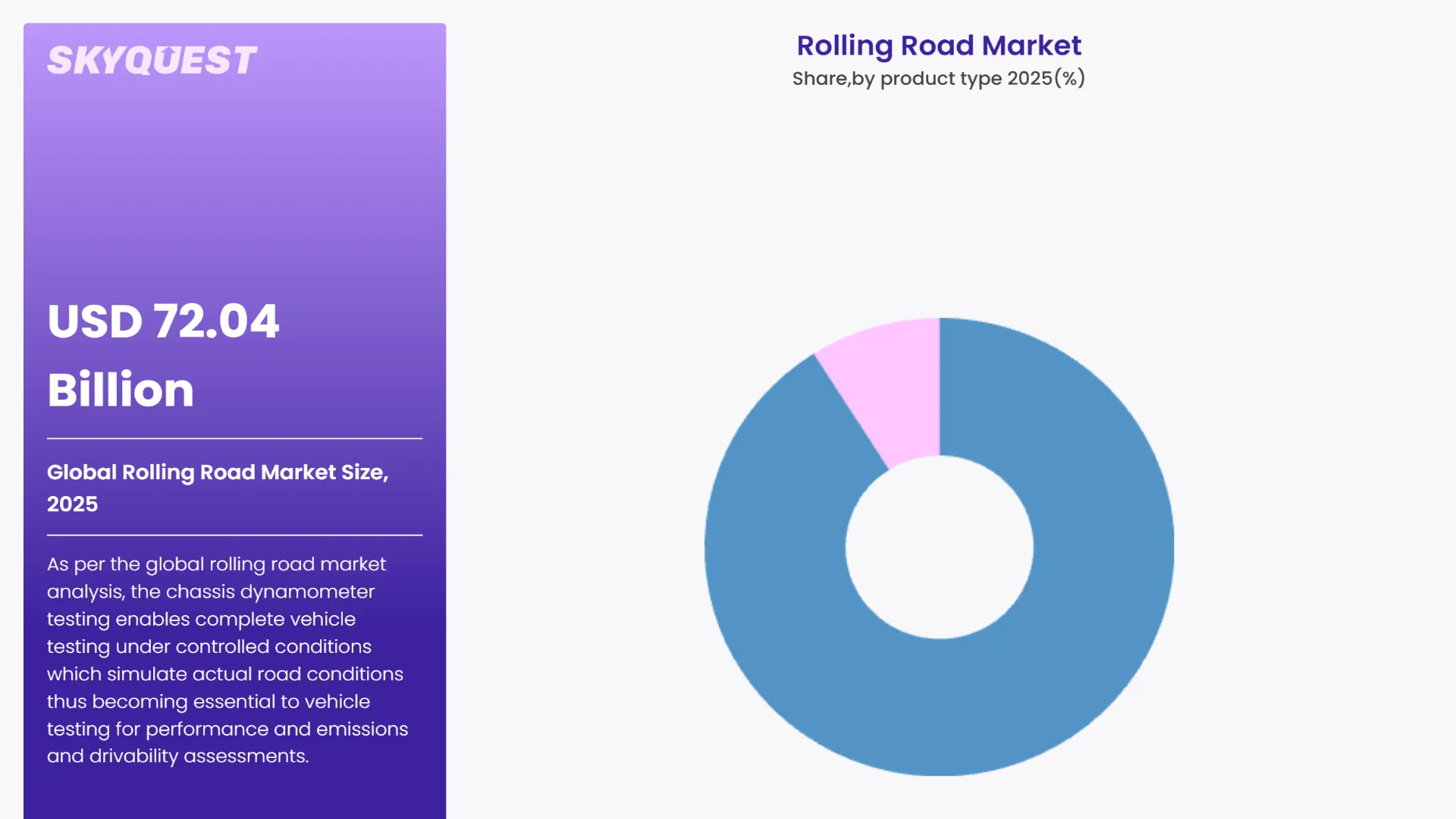
The global rolling road market is segmented by product type, vehicle type, application, end-user, and region. In terms of product type, the market is divided into chassis dynamometers and engine dynamometers. Based on vehicle type, it is categorized into passenger vehicles, commercial vehicles, heavy commercial vehicles (trucks and buses), and motorcycles and two-wheelers. By application, the market includes automotive testing, motorsport, research and development, and other uses. In terms of end-users, the segmentation covers automotive manufacturers, independent testing facilities, research institutions, and others. Geographically, the market is segmented into North America, Europe, Asia Pacific, Latin America, and the Middle East & Africa.
As per the global rolling road market analysis, the chassis dynamometer testing enables complete vehicle testing under controlled conditions which simulate actual road conditions thus becoming essential to vehicle testing for performance and emissions and drivability assessments. The system has high adoption rates because it enables powertrain testing through complete testing of powertrain systems which connects to vehicle calibration procedures.
Whereas the engine dynamometer testing has gained popularity because it provides precise control over engine testing to enable engine development and hybrid development and R&D testing acceleration. The bench testing system creates testing value through its modular design which allows special testing services to develop in the market for component testing and aftermarket calibration services.
According to the global rolling road market forecast, the automotive manufacturers segment dominates because original equipment producers rely on rolling road systems to validate vehicle performance, calibrate powertrain control units and meet regulatory testing requirements throughout development. Companies use unified testing systems to create purchasing standards which lead suppliers to develop testing systems with higher testing accuracy and higher testing fidelity while maintaining reproducibility and traceability and matching manufacturer service requirements.
Whereas the independent testing facilities segment is anticipated to have the largest rolling road market share because third party testing labs increase their capacity to deliver testing services to multiple markets through their flexible service models which allow them to meet client needs at quick speeds. Companies improve market expansion through their ability to use specialized rolling road systems while it drives smaller manufacturers and aftermarket service providers to follow its business model, which delivers extra value to customers.
To get detailed segments analysis, Request a Free Sample Report
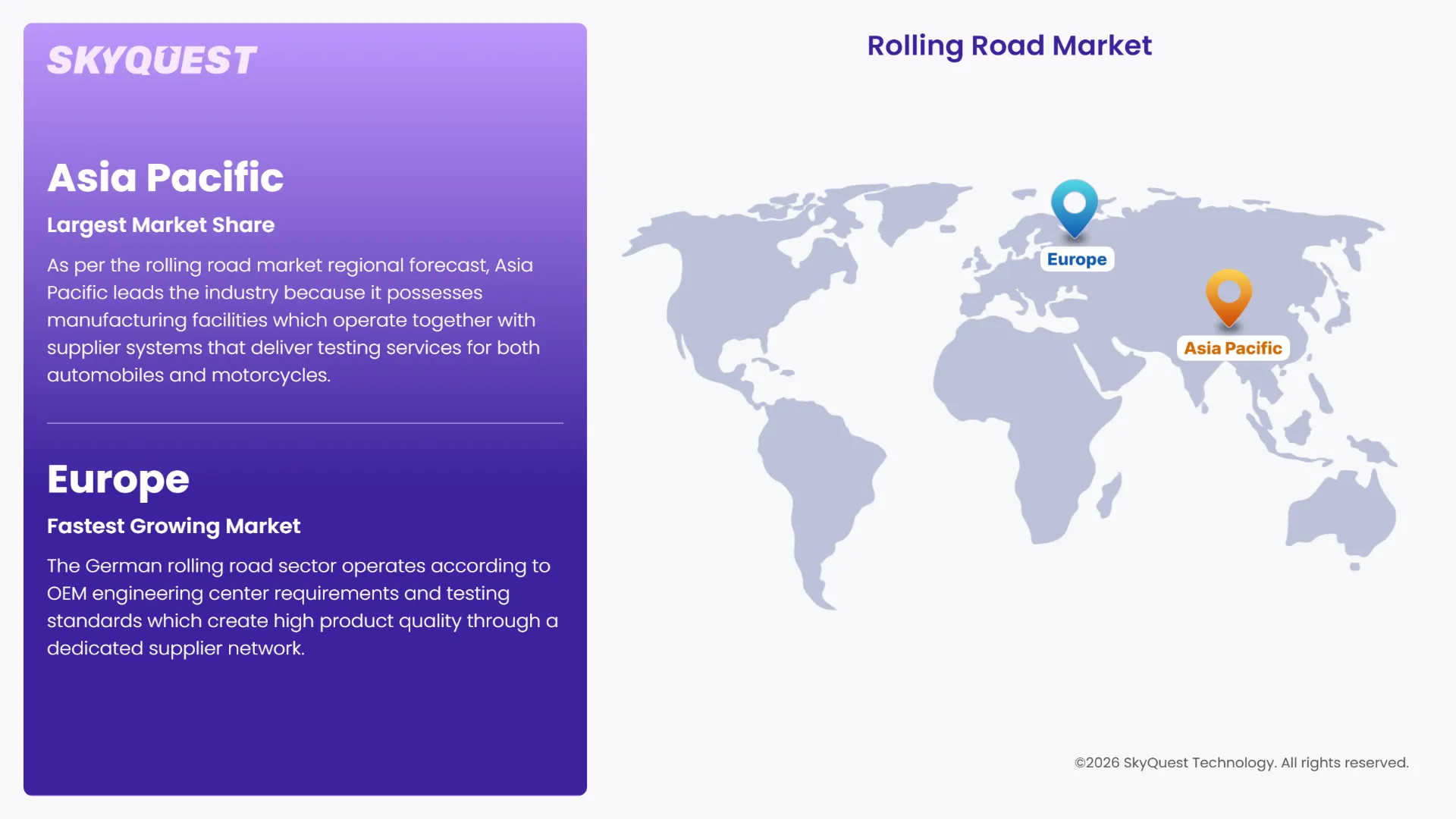
As per the rolling road market regional forecast, Asia Pacific leads the industry because it possesses manufacturing facilities which operate together with supplier systems that deliver testing services for both automobiles and motorcycles. The implementation of advanced dynamometer technology is achieved through two main elements which include advanced testing equipment and strong relationships with original equipment manufacturers. The combination of regional engineering talent and vocational training programs enables quick vehicle profile and emissions protocol customization for different areas. The market becomes more extensive through our strategic initiatives which aim to standardize aftermarket services and develop calibration service solutions. The combination of international supply chains and production efficiency allows us to offer affordable prices, which enables our products to reach more customers in repair shops and research centers and performance tuning facilities. Industry clusters work together to develop new measurement software and durability testing methods which establish the region as the primary center for developing and commercially using rolling road technology. A strong aftersales network system establishes all essential components which create enduring operational reliability.
The Japanese Rolling Road industry advances its operations through precise engineering methods which enable accurate testing between automotive manufacturers and testing equipment manufacturers while maintaining high quality assurance standards. Calibration services operate as the primary focus for local service ecosystems while software integration work and operator training activities enable performance standards to be sustained at their maximum level. Established research institutions and specialized workshops cultivate technical know-how for vehicle specific tuning and emissions testing. Advanced dynamometers and custom measurement solutions continue to be required in repair service environments because of ongoing demand for these technologies.
Technology workshops, research institutions, and performance tuners work together with calibration facilities to support the South Korean rolling road market penetration. Automotive companies need software testing procedures which combine both diagnostic capabilities and vehicle-specific testing protocols for their products. Local suppliers provide adaptable hardware and maintenance networks with skilled technical workforce support. The commercial sector and enthusiast facilities adopt advanced dynamometer systems because of aftermarket specialization and a culture of continuous improvement.
The European market expands because vehicle performance verification regulations require verification through testing, and the established base of automotive suppliers and performance testing centers create high demand. European countries possess strong engineering capabilities which allow them to create testing protocols and develop advanced diagnostic software that works with rolling road systems. The equipment market requires emissions of validation tools and performance measurement systems which drive companies to produce a variety of equipment. Operating standards and calibration networks and training programs need investment for improved operator skills and equipment availability. Innovative measurement solutions emerge from research institutions and private laboratories which work together on cross-country data analysis projects. The motorsport community and enthusiast base drive testing operations in Europe which creates a diverse market with both technical expertise and multiple business opportunities.
The German rolling road sector operates according to OEM engineering center requirements and testing standards which create high product quality through a dedicated supplier network. The three main customer groups, which include testing laboratories and vehicle development facilities and aftermarket service providers, create a market for dynamometer equipment. The industry needs advanced hardware and software solutions because they require precise measurement systems which work with diagnostic systems. The German equipment market achieves operational reliability through two main service areas which include vocational training and calibration services.
The United Kingdom rolling road market operates through independent workshops and tuning houses which conduct emissions and diagnostics research at their dedicated research centers. The demand for modular software-based dynamometer systems increases through two main drivers, which include flexible procurement models and motorsport activity. The integrated system enables wider deployment through its focus on operator training processes and service partnership development and vehicle telematics system integration. The collaborative work between private laboratories and universities creates advanced data analytics systems which also develop comprehensive testing protocols that meet various market demands for services and performance.
The French rolling road market development occurs through independent garages and research institutes and tuning operators who are showing interest in customized testing services. The nature of vehicle diagnostics and emissions compliance drives suppliers to change their dynamometer products according to the requirements of different regions and vehicle types. The strengthening of calibration services together with training programs results in operators gaining better operational abilities. Technical institutes and manufacturers together with aftermarket specialists work together to create new software interfaces and hardware designs which work optimally in workshop environments.
North America advances its regional influence through its testing infrastructure investments and its collaborative work between diagnostic tool manufacturers and service networks and the rising requirements from commercial service centers and performance enthusiasts. Rolling road systems achieve better data results and operational processes because they depend on telematics integration and software diagnostic system compatibility. Operators benefit from decreased total equipment ownership costs when suppliers deliver modular products which can be serviced and when they offer extensive service options. Technical capacity development occurs through research laboratory partnerships with vocational training programs and aftermarket supplier collaboration which provides calibration and maintenance service availability.
The United States rolling road market depends on repair networks and performance shops and testing laboratories which require complete diagnostic systems to meet their demands. The modular systems developed by suppliers together with their telematics compatible products and their service networks enhance both implementation and support procedures. Training programs and industry research partnerships enhance operator capabilities while ensuring accurate measurements. The motorsport and aftermarket sectors enable advanced dynamometers to be used for everyday maintenance and performance calibration across various vehicle types.
The Canadian rolling road market trends function through collaborative relationships which service providers develop with research groups and distributors to create solutions for local vehicle needs. The combination of diagnostic systems and training programs with calibration services creates operational reliability for all equipment used in workshops. The suppliers create operational systems through which customers can handle various operational conditions by designing modular products which need scheduled servicing. The demand for dynamometers which automotive maintenance facilities and car enthusiasts need for their routine maintenance and performance testing requirements has led to broader market distribution.
To know more about the market opportunities by region and country, click here to
Buy The Complete Report
Rising Demand from Automakers
Growth In Vehicle Performance Tuning
High Capital Investment Requirements
Technical Complexity and Skilled Labor
Request Free Customization of this report to help us to meet your business objectives.
The global rolling road market exists through established test equipment manufacturers who built the market framework while new companies create products which serve electric vehicle applications and portable testing needs. The active market drivers range from original equipment manufacturers who need electric vehicle testing dynos to organizations which create product uniqueness through their M&A deals and joint product development projects and technology companies which create partnerships that unite analytical software with physical equipment. MAHA established its first partnership with an analytics provider through its hardware connection while developing EV dyno systems together with OEM partners for their new facility launches.
SkyQuest’s ABIRAW (Advanced Business Intelligence, Research & Analysis Wing) is our Business Information Services team that Collects, Collates, Correlates, and Analyses the Data collected by means of Primary Exploratory Research backed by robust Secondary Desk research.
As per SkyQuest analysis, the rising demand from automakers for functional testing which replicates laboratory conditions drives the global rolling road market, while the increasing popularity of vehicle performance tuning at workshops and among enthusiasts drives market momentum. Asia Pacific shows the highest adoption rate because its manufacturing base and OEM connections and aftermarket distribution systems promote faster implementation of chassis dynamometer systems which dominate this market segment because their capability to assess total vehicle functional performance and emissions output. The need for high capital investments acts as a barrier which prevents smaller service providers from entering the market and results in extended procurement times. The best position for vendors arises when they combine modular hardware with educational digital services and training packages which help users to access their products while creating possibilities for generating recurring revenues.
| Report Metric | Details |
|---|---|
| Market size value in 2024 | USD 67.20 Billion |
| Market size value in 2033 | USD 125.64 Billion |
| Growth Rate | 7.2% |
| Base year | 2024 |
| Forecast period | 2026-2033 |
| Forecast Unit (Value) | USD Billion |
| Segments covered |
|
| Regions covered | North America (US, Canada), Europe (Germany, France, United Kingdom, Italy, Spain, Rest of Europe), Asia Pacific (China, India, Japan, Rest of Asia-Pacific), Latin America (Brazil, Rest of Latin America), Middle East & Africa (South Africa, GCC Countries, Rest of MEA) |
| Companies covered |
|
| Customization scope | Free report customization with purchase. Customization includes:-
|
To get a free trial access to our platform which is a one stop solution for all your data requirements for quicker decision making. This platform allows you to compare markets, competitors who are prominent in the market, and mega trends that are influencing the dynamics in the market. Also, get access to detailed SkyQuest exclusive matrix.
Table Of Content
Executive Summary
Market overview
Parent Market Analysis
Market overview
Market size
KEY MARKET INSIGHTS
COVID IMPACT
MARKET DYNAMICS & OUTLOOK
Market Size by Region
KEY COMPANY PROFILES
Methodology
For the Rolling Road Market, our research methodology involved a mixture of primary and secondary data sources. Key steps involved in the research process are listed below:
1. Information Procurement: This stage involved the procurement of Market data or related information via primary and secondary sources. The various secondary sources used included various company websites, annual reports, trade databases, and paid databases such as Hoover's, Bloomberg Business, Factiva, and Avention. Our team did 45 primary interactions Globally which included several stakeholders such as manufacturers, customers, key opinion leaders, etc. Overall, information procurement was one of the most extensive stages in our research process.
2. Information Analysis: This step involved triangulation of data through bottom-up and top-down approaches to estimate and validate the total size and future estimate of the Rolling Road Market.
3. Report Formulation: The final step entailed the placement of data points in appropriate Market spaces in an attempt to deduce viable conclusions.
4. Validation & Publishing: Validation is the most important step in the process. Validation & re-validation via an intricately designed process helped us finalize data points to be used for final calculations. The final Market estimates and forecasts were then aligned and sent to our panel of industry experts for validation of data. Once the validation was done the report was sent to our Quality Assurance team to ensure adherence to style guides, consistency & design.
Analyst Support
Customization Options
With the given market data, our dedicated team of analysts can offer you the following customization options are available for the Rolling Road Market:
Product Analysis: Product matrix, which offers a detailed comparison of the product portfolio of companies.
Regional Analysis: Further analysis of the Rolling Road Market for additional countries.
Competitive Analysis: Detailed analysis and profiling of additional Market players & comparative analysis of competitive products.
Go to Market Strategy: Find the high-growth channels to invest your marketing efforts and increase your customer base.
Innovation Mapping: Identify racial solutions and innovation, connected to deep ecosystems of innovators, start-ups, academics, and strategic partners.
Category Intelligence: Customized intelligence that is relevant to their supply Markets will enable them to make smarter sourcing decisions and improve their category management.
Public Company Transcript Analysis: To improve the investment performance by generating new alpha and making better-informed decisions.
Social Media Listening: To analyze the conversations and trends happening not just around your brand, but around your industry as a whole, and use those insights to make better Marketing decisions.
REQUEST FOR SAMPLE
 REQUEST FREE CUSTOMIZATION
Global Rolling Road Market size was valued at USD 67.2 Billion in 2024 and is poised to grow from USD 72.04 Billion in 2025 to USD 125.64 Billion by 2033, growing at a CAGR of 7.2% during the forecast period (2026-2033).
Competitive landscape in the global rolling road market is anchored by established test equipment manufacturers while newer entrants target EV specific and portable solutions. Competitive drivers include OEM demand for EV capable dynos, differentiation through strategic M&A and co development deals, and technology led partnerships that combine hardware with analytics. Recent concrete moves include MAHA linking hardware with analytics providers and OEM co development of EV dynos as part of facility rollouts. 'MAHA Maschinenbau Haldenwang GmbH & Co. KG', 'AVL List GmbH', 'Horiba Ltd.', 'MTS Systems Corporation', 'Schenck RoTec GmbH', 'Mustang Advanced Engineering / Mustang Dynamometer', 'Rototest International AB', 'Dynapack International Inc.', 'Meidensha Corporation', 'SuperFlow Technologies Group', 'V-tech Dynamometers', 'Dyno Dynamics Pty Ltd.', 'Dynocom Industries Inc.', 'Dynostar', 'Dynojet Research Inc.', 'Froude, Inc.', 'Taylor Dynamometer', 'Power Test Inc.', 'Sierra Instruments, Inc.', 'KAHN Industries, Inc.'
Rising demand from automakers for more efficient engine testing and performance validation is encouraging adoption of rolling roads, as these systems enable controlled, repeatable simulation of real-world driving conditions within workshops and test centers. Manufacturers value the ability to rapidly assess tuning changes, emissions control strategies, and calibration adjustments without the variables of road testing. This translates into procurement of standardized dyno equipment and integration into R&D and aftersales facilities, supporting steady expansion of the rolling road market through consistent commercial uptake.
Digital Integration And Connectivity: Rolling road systems are increasingly integrated with vehicle telematics, cloud platforms and diagnostic software to enable remote calibration, real time performance reporting and predictive maintenance workflows. This trend shifts value from standalone equipment to data enabled service offerings, allowing workshops and fleet operators to optimize testing schedules, reduce downtime and deliver standardized certification. Vendors are adapting by providing interoperable interfaces, subscription software and secure data management, creating recurring revenue potential and closer alignment with OEM service ecosystems.
Asia Pacific Dominate the Global Rolling Road Market.
The Chassis Dynamometer segment holds the largest share of the market due to its ability to evaluate complete vehicle performance, emissions, and drivability under simulated road conditions.
AI is improving diagnostic accuracy by analyzing synchronized sensor data, detecting anomalies, automating fault identification, and optimizing test procedures, resulting in faster and more reliable vehicle assessments.
High equipment costs, substantial capital investment requirements, and longer procurement cycles can limit adoption, particularly among smaller workshops and service providers.


Want to customize this report? This report can be personalized according to your needs. Our analysts and industry experts will work directly with you to understand your requirements and provide you with customized data in a short amount of time. We offer $1000 worth of FREE customization at the time of purchase.
Feedback From Our Clients


 USA (+1) 351-333-4748

