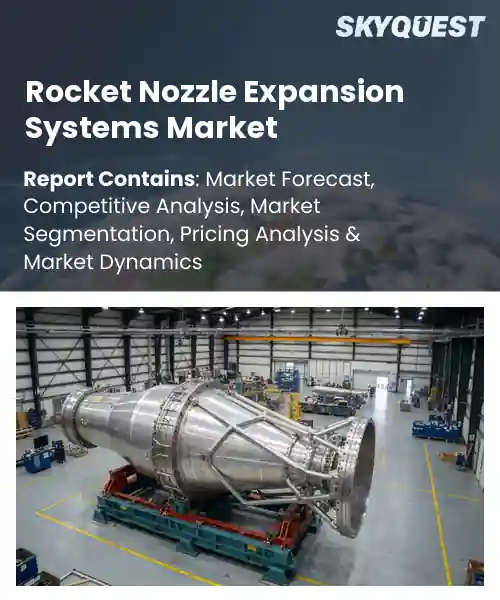
Rocket Nozzle Expansion Systems Market
Report ID: SQMIG45A2799
Report ID: SQMIG45A2799
[email protected]
USA +1 351-333-4748
Report ID:
SQMIG45A2799 |
Region:
Global |
Published Date: June, 2026
Pages:
157
|Tables:
174
|Figures:
79


Global Rocket Nozzle Expansion Systems Market size was valued at USD 756.2 Million in 2024 and is poised to grow from USD 812.16 Million in 2025 to USD 1437.73 Million by 2033, growing at a CAGR of 7.4% during the forecast period (2026-2033).
Global Rocket Nozzle Expansion Systems Market is the design, manufacture and supply of devices that shape the exhaust flow to maximize thrust efficiency in launch vehicles. Its importance is due to higher payload ratios and less propellant consumption which results in lower launch costs and increased mission capability. The market started in the 1960s with simple bell-shaped nozzles, changed in the 1990s to convergent-divergent cryogenic engines, and now uses carbon-composite throats for reusable rockets. The main driver today is the boom in commercial spaceflight, with companies such as SpaceX and Blue Origin looking for lightweight, high-performance expansion solutions to support rapid-turnaround launches for future missions.
The main driver behind the growth of the market is the move to reusable launch architectures, forcing manufacturers to focus on nozzle designs that are durable and thermally-resistant. Companies such as United Launch Alliance’s Vulcan Centaur and Rocket Lab’s Photon want modular expansion modules to survive thermal cycling without degradation in performance. This need drives industry investment in advanced materials such as silicon‑carbide ceramics and additive‑manufactured alloys that reduce weight and increase service life, enabling operators to reduce turnaround time and cost of launch. So, suppliers that certify high-cycle components win lucrative contracts and accelerate the adoption of sustainable space logistics for future missions around the world.
How is AI-driven automation influencing rocket nozzle expansion system design and performance?
The design of rocket nozzle expansion systems is being transformed by AI-enabled automation, with rapid geometry optimization, real-time flow analysis and material behaviour prediction. Its shape could be changed to improve thrust efficiency and reduce weight. The modifications are learned from high fidelity CFD data using machine learning models. The integrated digital twins allow engineers to simulate the impact of thermal cycling and structural loads over the entire flight envelope so they can identify potential failure points early. It shortens the development cycle, eliminates the expense of physical prototypes and lessens the burden on manufacturers to adapt to changing mission needs. AI tools and advanced manufacturing are converging in a market expansion, calling for better performance and smaller, reliable nozzles.
Market Momentum and Operational Efficiency Leading aerospace supplier in March 2026 published an AI-enabled redesign of a nozzle that improved the speed of iteration and the consistency of thrust.
Market snapshot - (2026-2033)
Global Market Size
USD 756.2 Million
Largest Segment
Fastest Growth
Growth Rate
7.4% CAGR
To get more insights on this market click here to Request a Free Sample Report
Global rocket nozzle expansion systems market is segmented by nozzle type, propulsion type, vehicle type, material type, end user, installation type and region. Based on nozzle type, the market is segmented into Fixed Expansion Nozzles, Extendable Expansion Nozzles, Aerospike Nozzles and Others. Based on propulsion type, the market is segmented into Liquid Propulsion Systems, Solid Propulsion Systems and Hybrid Propulsion Systems. Based on vehicle type, the market is segmented into Launch Vehicles, Missiles, Spacecraft Propulsion Systems and Others. Based on material type, the market is segmented into Metallic Nozzles, Composite Nozzles, Ceramic-Based Nozzles and Others. Based on end user, the market is segmented into Government Space Agencies, Defense Organizations, Commercial Space Companies and Others. Based on installation type, the market is segmented into OEM Installation and Retrofit Installation. Based on region, the market is segmented into North America, Europe, Asia Pacific, Latin America and Middle East & Africa.
The convergent divergent segment is dominant because it is the design heritage of most launch vehicles and gives a reliable compromise between performance and manufacturing simplicity. Engineers like its known expansion ratio, which efficiently converts chamber pressure into thrust with minimum risk of flow separation. The maturity of the computational tools and the extensive flight heritage provide confidence to suppliers to focus on production capacity and continuous improvement of this configuration for a wide array of mission profiles.
But the plug nozzle is showing the strongest growth momentum as developers are seeking higher specific impulse for upper stage applications. Its natural altitude adaptability minimizes the need for heavy extension mechanisms, and recent progress in additive manufacturing reduces manufacturing barriers. This innovation allows new mission architectures and expands market opportunities for high performance propulsion.
The chemical propulsion segment is the largest segment as it is still the workhorse of orbital launch as it provides the high thrust levels needed to overcome the gravity well of the Earth and allow for quick payload insertion. The broad engine portfolio, proven reliability and robust supply chains provide confidence to both satellite operators and governments. The technology remains relevant as propellant chemistry and injector design continue to improve . There will always be a need for custom nozzle expansion solutions for various mission sets .
At the same time, electric propulsion is emerging as the key growth area, with mission planners targeting long duration deep space and on-orbit servicing tasks. Electric thrusters are thrusty and at the same time efficient, driving the demand for lightweight expansion nozzles that can operate over periods. The market is looking beyond launch services into space operations.
To get detailed segments analysis, Request a Free Sample Report
North America remains decisively in the lead, with a combination of strong aerospace capabilities, ongoing government investment in defense and space exploration, and a thriving commercial launch industry. The area has a strong infrastructure of research universities and national laboratories which provide a strong base for continued innovation in propulsion technology. Established manufacturers have a skilled labor pool that allows rapid development cycles, and use high-tech machining and additive processes to deliver high performance components. The integration of government agencies, commercial launch providers and supply chain partners creates an integrated environment that speeds up product qualification and deployment, solidifying the region’s reputation as the gold standard for reliability and technology advancement.
The US Rocket Nozzle Expansion Systems market is a very competitive environment with fast technology turnover, driven by a strong mix of legacy aerospace players and nimble commercial players. And there’s a lot of testing infrastructure and specialized manufacturing clusters to accelerate new designs. And strong intellectual property regimes to protect innovative progress. Strategic partnerships between academia, defense agencies and private investors further energize the ecosystem, providing a pipeline to continuously feed breakthrough ideas into operational hardware.
Rocket Nozzle Expansion Systems Market is useful for the dedicated aerospace sector in Canada with their focus on precision engineering and collaborative research efforts. Thanks to our strong ties with North American launch programs, we have access to large test facilities and the exchange of expertise. Government programs promoting new materials and additive manufacturing are encouraging Canadian companies to focus on niche parts that link into larger supply chains. Canada’s technical capabilities, supportive policy and integration with continental partners position it as a valuable contributor to the regional ecosystem.
Europe’s rapid growth is powered by a potent mix of coordinated public research agendas, collaborative industrial networks and a nascent private launch sector. Pan‐European agencies and multinational consortia create a climate of common standards and joint development platforms and reduce entry barriers for new players. Investment in new nozzle designs is driven by the emphasis on sustainable propulsion and reusable technologies, while a heritage of high-precision engineering underpins the production of complex components at a competitive cost. Regulatory frameworks that enable cross-border cooperation, and funding mechanisms specifically designed for space projects, further accelerate market growth positioning Europe as a centre for cutting-edge propulsion solutions.
Germany’s Rocket Nozzle Expansion Systems market is backed by a long history of precision engineering and a dense cluster of aerospace suppliers with expertise in high-performance manufacturing. In addition, strong links between research institutes and industry enable a rapid transfer of advances in material science into practical nozzle solutions. And continental collaboration projects underpin standards and shared testing resources. A trained workforce guarantees quality and reliability. These elements combined support Germany’s leading position in the European supply chain.
The UK Rocket Nozzle Expansion Systems Market is experiencing a rapid growth due to ambitious national space policies and increasing private sector activities. The lure of new launch facilities and a focused investment in propulsion research attracts talent and ignites innovative design approaches. The ecosystem for rapid prototyping and validation of advanced nozzle concepts is based on partnerships between universities, government agencies and emerging launch firms. This vibrant setting underpins the UK’s role as a fast-growing player in the European market.
The French Rocket Nozzle Expansion Systems Market is a significant part of the larger European space ambition, with a solid history in aerospace manufacturing and involvement in multinational programs. The existing industrial clusters provide the precision tooling and testing capabilities, and government incentives are developing next generation propulsion technologies. The links of collaboration with the European space agency facilitate transfer of technology and puts France in a position to become an ever more influential emerging player.
Asia Pacific is rapidly emerging as a force to be reckoned with, thanks to government programs, private launch ventures and a flurry of satellite constellation deployments. The countries in the region rely on their massive industrial capacity and profound expertise in high-technology manufacturing to produce sophisticated nozzle components at scale. Through dedicated investments in research centers and test sites, local companies can rapidly iterate designs, and global aerospace companies are sharing knowledge and opening markets through partnerships, he said. An effective combination of policy support, manufacturing know-how and entrepreneurial drive is laying the foundation for the region to become a significant hub for cutting-edge rocket propulsion solutions.
Japan’s tradition of high‐precision engineering and a strong defense‐driven research base are a positive for the Rocket Nozzle Expansion Systems Market. Japanese companies combine state-of-the-art materials science with sophisticated manufacturing processes to deliver highly reliable nozzle solutions. Cooperative arrangements between government agencies and new commercial launch providers speed technology development and a variety of test facilities provide strict routes to validation. These elements serve to enhance Japan’s expanding role in the regional market.
South Korea rocket nozzle expansion system market is driven by the increasing commercial launch market and the strong government support. Investment in aerospace research centres and incentives for high tech manufacturing are enabling the development of innovative nozzle designs. Industrial conglomerates partner with start-up launch providers to reduce development times and improve the quality of components. Such strategic pivot on advanced materials and digital manufacturing is positioning South Korea as a rising power in the greater Asia Pacific region.
To know more about the market opportunities by region and country, click here to
Buy The Complete Report
Increasing Demand for Efficient Propulsion
Growth of Small Satellite Launch Services
High Development Cost and Complexity
Regulatory and Export Control Restrictions
Request Free Customization of this report to help us to meet your business objectives.
There’s a lot of competition to get that technology out and raise strategic money within the rocket nozzle expansion space. Funding and partnerships are changing the competitive dynamics: 2024: HEN Nozzles secures $10M Series A to accelerate development of additively manufactured nozzle designs. 2024: Starcloud developed a data-platform prototype for performance analytics for nozzle manufacturers with a Y-Combinator partnership.
SkyQuest’s ABIRAW (Advanced Business Intelligence, Research & Analysis Wing) is our Business Information Services team that Collects, Collates, Correlates, and Analyses the Data collected by means of Primary Exploratory Research backed by robust Secondary Desk research.
As per SkyQuest analysis the global rocket nozzle expansion systems market is being propelled primarily by the increasing demand for efficient propulsion, which pushes manufacturers toward lighter, higher‑thrust designs, while the rapid growth of small‑satellite launch services adds a second driver by creating strong demand for compact, high‑expansion nozzles. However, high development cost and technical complexity act as a restraint, limiting entry for smaller firms. North America remains the dominant region, supported by extensive aerospace expertise, government investment and a vibrant commercial launch ecosystem. Within the market the convergent‑divergent nozzle segment continues to dominate, thanks to its proven performance and manufacturing simplicity.
| Report Metric | Details |
|---|---|
| Market size value in 2024 | USD 756.2 Million |
| Market size value in 2033 | USD 1437.73 Million |
| Growth Rate | 7.4% |
| Base year | 2024 |
| Forecast period | (2026-2033) |
| Forecast Unit (Value) | USD Million |
| Segments covered |
|
| Regions covered | North America (US, Canada), Europe (Germany, France, United Kingdom, Italy, Spain, Rest of Europe), Asia Pacific (China, India, Japan, Rest of Asia-Pacific), Latin America (Brazil, Rest of Latin America), Middle East & Africa (South Africa, GCC Countries, Rest of MEA) |
| Companies covered |
|
| Customization scope | Free report customization with purchase. Customization includes:-
|
To get a free trial access to our platform which is a one stop solution for all your data requirements for quicker decision making. This platform allows you to compare markets, competitors who are prominent in the market, and mega trends that are influencing the dynamics in the market. Also, get access to detailed SkyQuest exclusive matrix.
Table Of Content
Executive Summary
Market overview
Parent Market Analysis
Market overview
Market size
KEY MARKET INSIGHTS
COVID IMPACT
MARKET DYNAMICS & OUTLOOK
Market Size by Region
KEY COMPANY PROFILES
Methodology
For the Rocket Nozzle Expansion Systems Market, our research methodology involved a mixture of primary and secondary data sources. Key steps involved in the research process are listed below:
1. Information Procurement: This stage involved the procurement of Market data or related information via primary and secondary sources. The various secondary sources used included various company websites, annual reports, trade databases, and paid databases such as Hoover's, Bloomberg Business, Factiva, and Avention. Our team did 45 primary interactions Globally which included several stakeholders such as manufacturers, customers, key opinion leaders, etc. Overall, information procurement was one of the most extensive stages in our research process.
2. Information Analysis: This step involved triangulation of data through bottom-up and top-down approaches to estimate and validate the total size and future estimate of the Rocket Nozzle Expansion Systems Market.
3. Report Formulation: The final step entailed the placement of data points in appropriate Market spaces in an attempt to deduce viable conclusions.
4. Validation & Publishing: Validation is the most important step in the process. Validation & re-validation via an intricately designed process helped us finalize data points to be used for final calculations. The final Market estimates and forecasts were then aligned and sent to our panel of industry experts for validation of data. Once the validation was done the report was sent to our Quality Assurance team to ensure adherence to style guides, consistency & design.
Analyst Support
Customization Options
With the given market data, our dedicated team of analysts can offer you the following customization options are available for the Rocket Nozzle Expansion Systems Market:
Product Analysis: Product matrix, which offers a detailed comparison of the product portfolio of companies.
Regional Analysis: Further analysis of the Rocket Nozzle Expansion Systems Market for additional countries.
Competitive Analysis: Detailed analysis and profiling of additional Market players & comparative analysis of competitive products.
Go to Market Strategy: Find the high-growth channels to invest your marketing efforts and increase your customer base.
Innovation Mapping: Identify racial solutions and innovation, connected to deep ecosystems of innovators, start-ups, academics, and strategic partners.
Category Intelligence: Customized intelligence that is relevant to their supply Markets will enable them to make smarter sourcing decisions and improve their category management.
Public Company Transcript Analysis: To improve the investment performance by generating new alpha and making better-informed decisions.
Social Media Listening: To analyze the conversations and trends happening not just around your brand, but around your industry as a whole, and use those insights to make better Marketing decisions.
REQUEST FOR SAMPLE
 REQUEST FREE CUSTOMIZATION
Global Rocket Nozzle Expansion Systems Market size was valued at USD 756.2 Million in 2024 and is poised to grow from USD 812.16 Million in 2025 to USD 1437.73 Million by 2033, growing at a CAGR of 7.4% during the forecast period (2026-2033).
Intense rivalry in the rocket nozzle expansion segment is driving firms to accelerate technology rollouts and secure strategic capital. HEN Nozzles leveraged a $10 million Series A in 2024 to advance additive‑manufactured nozzle designs, while Starcloud’s Y‑Combinator partnership enabled a data‑platform prototype that supports performance analytics for nozzle manufacturers, illustrating how funding and alliances are reshaping competitive dynamics. 'Aerojet Rocketdyne Holdings, Inc.', 'Northrop Grumman Corporation', 'L3Harris Technologies, Inc.', 'RTX Corporation', 'ArianeGroup SAS', 'Avio S.p.A.', 'Nammo AS', 'Safran S.A.', 'Mitsubishi Heavy Industries, Ltd.', 'Israel Aerospace Industries Ltd.', 'Bharat Dynamics Limited', 'Hanwha Aerospace Co., Ltd.', 'Kongsberg Defence & Aerospace AS', 'China Aerospace Science and Technology Corporation', 'Agnikul Cosmos Private Limited', 'Skyroot Aerospace Private Limited', 'PLD Space S.L.', 'ABL Space Systems Company', 'Firefly Aerospace, Inc.', 'Rocket Lab USA, Inc.'
The aerospace industry is prioritizing propulsion efficiency to reduce launch costs and environmental impact, prompting manufacturers to adopt advanced nozzle expansion technologies that maximize thrust while minimizing fuel consumption. This shift drives investment in research and development, encourages collaboration between engine builders and nozzle suppliers, and accelerates the adoption of modular, high‑performance expansion systems across both governmental and commercial launch programs, thereby expanding the overall market opportunity for rocket nozzle expansion solutions and fostering long‑term supply chain resilience.
Additive Manufacturing Integration: Additive manufacturing is reshaping nozzle production by allowing on‑demand fabrication of complex geometries, reducing lead times and enabling rapid design iteration. Suppliers are adopting metal‑laser powder‑bed fusion and directed energy deposition to create internal cooling channels and lightweight structures that traditional machining cannot achieve. This flexibility supports customized thrust‑vectoring solutions, improves performance consistency, and shortens supply chains, positioning manufacturers to respond swiftly to evolving propulsion requirements and to lower inventory costs across aerospace programs in future missions and platforms globally.
Why does North America Dominate the Global Rocket Nozzle Expansion Systems Market? |@12


Want to customize this report? This report can be personalized according to your needs. Our analysts and industry experts will work directly with you to understand your requirements and provide you with customized data in a short amount of time. We offer $1000 worth of FREE customization at the time of purchase.
Feedback From Our Clients


 USA (+1) 351-333-4748

