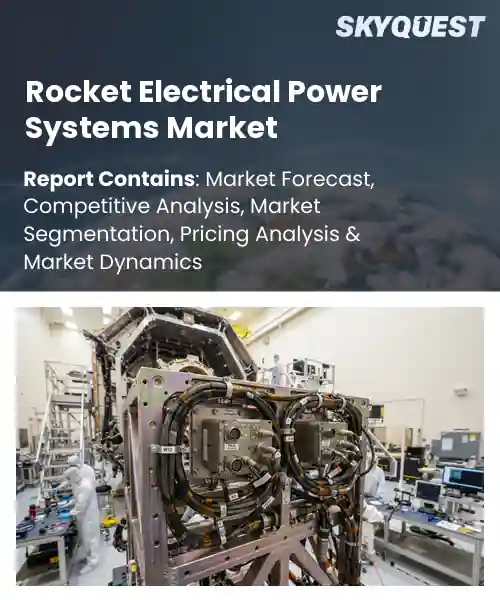
Rocket Electrical Power Systems Market
Report ID: SQMIG20A2911
Report ID: SQMIG20A2911
[email protected]
USA +1 351-333-4748
Report ID:
SQMIG20A2911 |
Region:
Global |
Published Date: August, 2026
Pages:
157
|Tables:
119
|Figures:
77


Global Rocket Electrical Power Systems Market size was valued at USD 2.43 Billion in 2024 and is poised to grow from USD 2.69 Billion in 2025 to USD 6.12 Billion by 2033, growing at a CAGR of 10.8% during the forecast period (2026-2033).
The global rocket electrical power systems market comprises design, manufacture, and integration of units that supply electricity to launch vehicles, spacecraft, and satellites. Its importance lies in enabling reliable thrust control, avionics operation, and payload activation during flight phases. Historically the market grew slowly with reliance on chemical batteries, but the emergence of high‑energy lithium‑ion cells and solid‑state converters in the early 2000s accelerated adoption. For example, SpaceX’s Falcon 9 shifted to reusable power modules that cut turnaround time, while NASA’s Artemis program adopted fuel‑cell arrays for lunar‑orbit missions. This evolution marks a shift toward lighter, more efficient, longer‑lasting power solutions.
The rise of reusable launch vehicles is the catalyst for growth in the rocket electrical power systems market because each reuse demands power units that retain performance over multiple cycles. When manufacturers replace expendable batteries with refurbishable modules, they lower per‑mission costs, encouraging investment in designs. United Launch Alliance exemplifies this shift with the Vulcan Centaur, where power racks cut refurbishment time by 30 percent. The surge in small‑satellite constellations pushes providers toward ultra‑light lithium‑sulphur cells delivering over 500 Wh/kg, reducing launch weight and expanding payload capacity. These efficiency gains attract commercial firms and space agencies, creating revenue streams and fueling R&D.
How are AI and IoT driving innovation in the rocket electrical power systems market?
AI is reshaping rocket electrical power systems by enabling predictive health monitoring and autonomous fault detection. Machine‑learning models analyze sensor streams to forecast component wear, allowing engineers to schedule maintenance before failures occur. IoT connectivity links power modules, batteries and converters, creating a real‑time data fabric that supports dynamic load balancing and efficient energy distribution across the vehicle. These technologies reduce weight, improve reliability and shorten development cycles, making rockets more responsive to mission demands. The market now sees tighter integration of digital twins, where virtual replicas of power subsystems are continuously updated with live telemetry, accelerating design validation and performance optimization.
Market snapshot - (2026-2033)
Global Market Size
USD 2.43 Billion
Largest Segment
Power Generation Systems
Fastest Growth
Energy Storage Systems
Growth Rate
10.8% CAGR
To get more insights on this market click here to Request a Free Sample Report
Global rocket electrical power systems market is segmented by component, power source, application, end user and region. Based on component, the market is segmented into Power Generation Systems, Energy Storage Systems, Power Distribution Units and Power Management & Control Systems. Based on power source, the market is segmented into Batteries, Fuel Cells and Solar Power Systems. Based on application, the market is segmented into Launch Vehicles, Sounding Rockets, Missile Systems and Reusable Launch Vehicles. Based on end user, the market is segmented into Commercial Space Companies, Government Space Agencies and Defense Organizations. Based on region, the market is segmented into North America, Europe, Asia Pacific, Latin America and Middle East & Africa.
Power Distribution Units segment dominates because they serve as the critical conduit linking generated electricity to every subsystem on a launch vehicle, ensuring reliable power flow under extreme vibration and thermal conditions. Their essential role in maintaining mission‑critical functionality drives manufacturers to prioritize robust designs, redundancy, and rigorous testing. Consequently, they become the foundational element that underpins overall system safety and performance in the Rocket Electrical Power Systems Market.
However, Power Management & Control Systems segment is witnessing the strongest growth momentum as advanced digital controllers and fault‑detection algorithms enable smarter power allocation and real‑time health monitoring. This innovation reduces weight and improves efficiency, attracting developers of next‑generation vehicles and expanding the market’s capability to support more complex missions.
Batteries segment dominates because they provide the most mature, high‑energy density solution for short‑duration thrust events and avionics power on launch vehicles, offering proven performance and straightforward integration. Their reliability under launch loads, extensive qualification heritage, and decreasing mass make them the default choice for mission‑critical power provisioning, anchoring the core architecture of rocket electrical power systems. Their scalability across vehicle sizes and compatibility with existing safety standards further reinforce their market leadership, driving continued investment and supplier focus.
Meanwhile, Fuel Cells segment is emerging as the key high growth area because breakthroughs in hydrogen storage and low temperature operation enable longer mission endurance and higher specific power. These advances open opportunities for reusable stages and deep space probes, driving heightened R&D investment and expanding the market’s capability to support extended flight profiles.
To get detailed segments analysis, Request a Free Sample Report
North America benefits from a mature aerospace ecosystem that integrates advanced research institutions, leading component manufacturers, and a robust supply chain focused on high‑performance propulsion. The regulatory landscape encourages innovation while ensuring safety, fostering collaboration between government agencies and private enterprises. Strong investment in next‑generation launch infrastructure and extensive testing facilities enable rapid prototyping and scale‑up of rocket power systems. A skilled engineering workforce coupled with a culture of technology commercialization accelerates the translation of breakthroughs into market‑ready solutions. These combined factors create a fertile environment that continuously reinforces North America’s leadership in the global arena.
Rocket Electrical Power Systems Market in the United States thrives on deep integration of defense research, private venture capital, and university spin‑offs that collectively drive cutting‑edge power conversion technologies. The presence of major launch service providers and a supportive policy framework ensures steady demand for high‑efficiency, reliable power solutions. Collaborative ecosystems across coastal hubs enable rapid iteration, while extensive testing ranges provide real‑world validation for emerging technologies, reinforcing the United States as a pivotal hub for innovation and deployment.
Rocket Electrical Power Systems Market in Canada leverages its strong background in cryogenic engineering and renewable energy technologies to support next‑generation power modules. Close partnerships between provincial research centers and aerospace firms foster tailored solutions for extreme environments. Government incentives encourage the development of low‑emission propulsion components, positioning Canada as a niche contributor to the broader North American supply chain. This synergy of expertise and collaborative funding mechanisms sustains a vibrant ecosystem for rocket power advancements.
Europe’s expansion is propelled by a coordinated emphasis on sustainability, cross‑border research initiatives, and a unified regulatory approach that streamlines certification processes. Collaborative programs among leading aerospace clusters encourage shared technology platforms and joint development of high‑efficiency power converters. The region’s commitment to green launch solutions drives investment in electric and hybrid propulsion concepts, while a robust industrial base supplies precision‑engineered components. Strong policy support for strategic autonomy and frequent public‑private partnerships amplify innovation cycles, positioning Europe as a dynamic force shaping the future of rocket electrical power systems.
Rocket Electrical Power Systems Market in Germany draws strength from its world‑renowned precision engineering heritage and dense network of specialised suppliers. Integrated research institutions collaborate closely with automotive and aerospace sectors to advance high‑density power modules. Government‑backed initiatives focus on reducing carbon footprints of launch activities, encouraging the development of electric propulsion technologies. This blend of technical expertise and sustainability focus cements Germany’s dominant role within the European landscape.
Rocket Electrical Power Systems Market in the United Kingdom is accelerated by an aggressive focus on commercial launch services and rapid prototyping environments. The country’s vibrant startup ecosystem, supported by dedicated venture funding, fosters innovative power‑management solutions tailored for small‑satellite missions. Synergies between university research hubs and established aerospace firms enable quick transitions from concept to flight testing. This dynamic environment fuels the United Kingdom’s status as the fastest growing market in Europe.
Rocket Electrical Power Systems Market in France benefits from a strategic alignment of aerospace heritage and emerging clean‑energy initiatives. Collaborative clusters bring together defense research agencies, civilian space operators, and specialized equipment manufacturers to explore hybrid power architectures. Targeted incentives promote the scaling of low‑emission propulsion technologies, positioning France as an emerging contributor to Europe’s overall market momentum.
The Asia Pacific region is intensifying its role through heightened governmental commitment to space exploration and a surge in domestic launch capabilities. National programs prioritize the development of indigenous power solutions that balance high performance with cost efficiency, fostering a self‑reliant supply chain. Collaboration between leading electronics manufacturers and aerospace firms accelerates the integration of advanced semiconductor technologies into rocket power systems. Regional trade agreements facilitate technology transfer and joint ventures, while growing demand for satellite constellations drives continuous refinement of power architectures. This concerted effort elevates the region’s influence in the global landscape.
Rocket Electrical Power Systems Market in Japan leverages its expertise in high‑precision manufacturing and advanced battery technologies to create compact, reliable power units for launch vehicles. Strong ties between research universities and major aerospace corporations encourage the co‑development of next‑generation power converters. Governmental space strategies emphasize sustainable propulsion, prompting investment in electric and hybrid power concepts that align with Japan’s broader environmental goals.
Rocket Electrical Power Systems Market in South Korea capitalises on its rapid electronics innovation cycle and growing launch infrastructure. Close cooperation between semiconductor giants and burgeoning launch service providers enables the creation of high‑efficiency, miniaturised power systems tailored for versatile payloads. National policies that promote technology export and strategic autonomy further reinforce South Korea’s emerging position as a key player in the regional market.
To know more about the market opportunities by region and country, click here to
Buy The Complete Report
Increasing Demand for Sustainable Power
Advancements in Energy Storage Technologies
High Development Costs and Complexity
Regulatory and Certification Challenges
Request Free Customization of this report to help us to meet your business objectives.
The rocket electrical power systems market is shaped by intense competition as manufacturers race to integrate high‑efficiency electric propulsion and advanced power storage into launch vehicles, driving strategic M&A, partnerships, and rapid technology rollouts. Recent SPAC transactions and joint ventures illustrate how firms are securing capital and expertise to accelerate next‑generation power module development and capture emerging launch demand.
SkyQuest’s ABIRAW (Advanced Business Intelligence, Research & Analysis Wing) is our Business Information Services team that Collects, Collates, Correlates, and Analyses the Data collected by means of Primary Exploratory Research backed by robust Secondary Desk research.
As per SkyQuest analysis, the rocket electrical power systems market is being propelled primarily by the rising demand for sustainable, low‑emission power that supports reusable launch vehicles, while rapid advances in high‑density energy storage such as lithium‑ion and solid‑state batteries further accelerate adoption across both commercial and government programs. The most prominent segment is Power Distribution Units, which act as the critical conduit ensuring reliable electricity flow to every subsystem, and North America remains the dominant region thanks to its mature aerospace supply chain and strong funding ecosystem. However, the high development costs and system‑level complexity of certifying these technologies act as a notable restraint on faster market penetration.
| Report Metric | Details |
|---|---|
| Market size value in 2024 | USD 2.43 Billion |
| Market size value in 2033 | USD 6.12 Billion |
| Growth Rate | 10.8% |
| Base year | 2024 |
| Forecast period | (2026-2033) |
| Forecast Unit (Value) | USD Billion |
| Segments covered |
|
| Regions covered | North America (US, Canada), Europe (Germany, France, United Kingdom, Italy, Spain, Rest of Europe), Asia Pacific (China, India, Japan, Rest of Asia-Pacific), Latin America (Brazil, Rest of Latin America), Middle East & Africa (South Africa, GCC Countries, Rest of MEA) |
| Companies covered |
|
| Customization scope | Free report customization with purchase. Customization includes:-
|
To get a free trial access to our platform which is a one stop solution for all your data requirements for quicker decision making. This platform allows you to compare markets, competitors who are prominent in the market, and mega trends that are influencing the dynamics in the market. Also, get access to detailed SkyQuest exclusive matrix.
Table Of Content
Executive Summary
Market overview
Parent Market Analysis
Market overview
Market size
KEY MARKET INSIGHTS
COVID IMPACT
MARKET DYNAMICS & OUTLOOK
Market Size by Region
KEY COMPANY PROFILES
Methodology
For the Rocket Electrical Power Systems Market, our research methodology involved a mixture of primary and secondary data sources. Key steps involved in the research process are listed below:
1. Information Procurement: This stage involved the procurement of Market data or related information via primary and secondary sources. The various secondary sources used included various company websites, annual reports, trade databases, and paid databases such as Hoover's, Bloomberg Business, Factiva, and Avention. Our team did 45 primary interactions Globally which included several stakeholders such as manufacturers, customers, key opinion leaders, etc. Overall, information procurement was one of the most extensive stages in our research process.
2. Information Analysis: This step involved triangulation of data through bottom-up and top-down approaches to estimate and validate the total size and future estimate of the Rocket Electrical Power Systems Market.
3. Report Formulation: The final step entailed the placement of data points in appropriate Market spaces in an attempt to deduce viable conclusions.
4. Validation & Publishing: Validation is the most important step in the process. Validation & re-validation via an intricately designed process helped us finalize data points to be used for final calculations. The final Market estimates and forecasts were then aligned and sent to our panel of industry experts for validation of data. Once the validation was done the report was sent to our Quality Assurance team to ensure adherence to style guides, consistency & design.
Analyst Support
Customization Options
With the given market data, our dedicated team of analysts can offer you the following customization options are available for the Rocket Electrical Power Systems Market:
Product Analysis: Product matrix, which offers a detailed comparison of the product portfolio of companies.
Regional Analysis: Further analysis of the Rocket Electrical Power Systems Market for additional countries.
Competitive Analysis: Detailed analysis and profiling of additional Market players & comparative analysis of competitive products.
Go to Market Strategy: Find the high-growth channels to invest your marketing efforts and increase your customer base.
Innovation Mapping: Identify racial solutions and innovation, connected to deep ecosystems of innovators, start-ups, academics, and strategic partners.
Category Intelligence: Customized intelligence that is relevant to their supply Markets will enable them to make smarter sourcing decisions and improve their category management.
Public Company Transcript Analysis: To improve the investment performance by generating new alpha and making better-informed decisions.
Social Media Listening: To analyze the conversations and trends happening not just around your brand, but around your industry as a whole, and use those insights to make better Marketing decisions.
REQUEST FOR SAMPLE
 REQUEST FREE CUSTOMIZATION
Global Rocket Electrical Power Systems Market size was valued at USD 2.43 Billion in 2024 and is poised to grow from USD 2.69 Billion in 2025 to USD 6.12 Billion by 2033, growing at a CAGR of 10.8% during the forecast period (2026-2033).
The rocket electrical power systems market is shaped by intense competition as manufacturers race to integrate high‑efficiency electric propulsion and advanced power storage into launch vehicles, driving strategic M&A, partnerships, and rapid technology rollouts. Recent SPAC transactions and joint ventures illustrate how firms are securing capital and expertise to accelerate next‑generation power module development and capture emerging launch demand. 'RTX Corporation', 'L3Harris Technologies, Inc.', 'Northrop Grumman Corporation', 'Lockheed Martin Corporation', 'The Boeing Company', 'Airbus SE', 'Thales S.A.', 'Leonardo S.p.A.', 'Safran S.A.', 'Honeywell International Inc.', 'Mitsubishi Electric Corporation', 'Moog Inc.', 'Teledyne Technologies Incorporated', 'Redwire Corporation', 'Rocket Lab USA, Inc.', 'Space Exploration Technologies Corp.', 'Blue Origin, LLC', 'Sierra Space Corporation', 'Maxar Technologies Inc.', 'Ball Corporation'
Growing interest in low‑emission launch operations is prompting agencies and commercial providers to prioritize electric propulsion, which reduces reliance on conventional chemical fuels. This shift encourages investment in advanced rocket electrical power systems, fostering innovation across components such as batteries, fuel cells, and power management units. As mission profiles evolve toward longer durations and higher energy efficiency, the perceived environmental benefits and operational cost savings reinforce the transition toward electric power architectures, thereby expanding market opportunities for future space endeavors.
Space‑Based Power Grid Integration: The rise of low‑Earth‑orbit constellations is prompting satellite operators to adopt modular electrical power systems that can be reconfigured in‑flight, enabling seamless load sharing across multiple spacecraft. Manufacturers are delivering scalable architectures that support rapid plug‑and‑play upgrades, reducing downtime and extending mission lifespans. This collaborative power network approach enhances resilience against single‑point failures and creates new revenue streams through shared energy services, positioning electrical power systems as a strategic enabler for the emerging space‑based energy marketplace and global commercial adoption.
Why does North America Dominate the Global Rocket Electrical Power Systems Market? |@12


Want to customize this report? This report can be personalized according to your needs. Our analysts and industry experts will work directly with you to understand your requirements and provide you with customized data in a short amount of time. We offer $1000 worth of FREE customization at the time of purchase.
Feedback From Our Clients


 USA (+1) 351-333-4748

