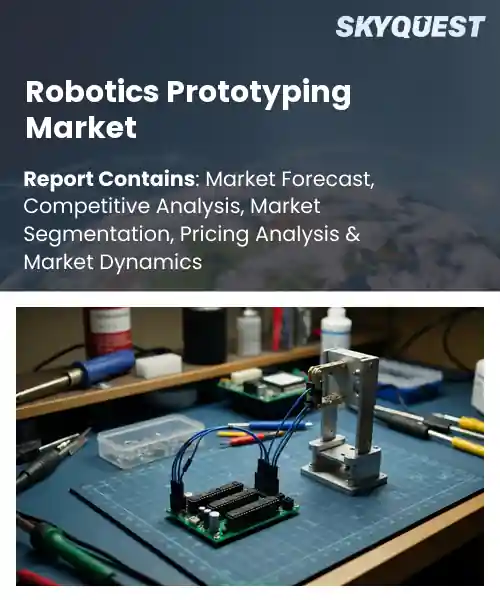
Robotics Prototyping Market
Report ID: SQMIG20I3401
Report ID: SQMIG20I3401
[email protected]
USA +1 351-333-4748
Report ID:
SQMIG20I3401 |
Region:
Global |
Published Date: July, 2026
Pages:
157
|Tables:
147
|Figures:
78


Global Robotics Prototyping Market size was valued at USD 3.24 Billion in 2024 and is poised to grow from USD 3.96 Billion in 2025 to USD 19.54 Billion by 2033, growing at a CAGR of 22.1% during the forecast period (2026-2033).
The global robotics prototyping market trends consists of services, software platforms, and hardware kits that allow engineers to develop, test, and iterate physical robot concepts before production. Its importance is the growing need for automation in manufacturing, logistics and healthcare where time-to-market and cost efficiency are key. The market has grown from simple hobbyist kits in the early 2000s to sophisticated modular platforms with integrated AI-ready sensors and simulation tools. For example, the launch of ROS-compatible development boards in 2015 reduced design cycles by 30 percent, sparking a spike in venture capital investment, and turning prototyping into an asset for incumbent OEMs.
One of the strongest growth drivers of the global robotics prototyping market growth is the growing need for customization in Industry 4.0 deployments, where companies are forced to iterate hardware and software quickly. With the widespread adoption of modular production lines, there is a need for flexible robot prototypes that can be reconfigured via plug-and-play modules, reducing downtime and capital expenditure. Real world examples include automotive suppliers using kits to test assembly sequences and pharmaceutical firms using 3-D printed grippers for validation of sterile handling. These efficiency gains are fueling investment in cloud-based simulation services that increase the market and create opportunities for startups specializing in AI-powered design.
How is AI-driven Automation Reshaping the Robotics Prototyping Market?
AI-powered automation is transforming the robotics prototyping market share by embedding intelligence into every step of the design. Generative algorithms can now provide structural layouts and predictive simulation can predict performance before a single part is printed. Cloud based platforms give engineers the ability to iterate in minutes rather than weeks, linking virtual models directly to rapid manufacturing equipment. This shift reduces material waste and shortens the feedback loop between concept and functional demo. Investors are pouring money into AI tools and startups and established companies alike are adopting these capabilities to accelerate product launches. The result is a more fluid prototyping ecosystem where data rich automation improves creativity.
In January 2026, the International Federation of Robotics launched an AI enhanced rapid prototyping suite, demonstrating how automated design cuts build time and drives market growth. The platform combines generative design and cloud simulation, enabling teams to virtually validate concepts before physical fabrication, thereby lowering costs and accelerating time to market for new robotic solutions.
Market snapshot - (2026-2033)
Global Market Size
USD 3.24 Billion
Largest Segment
Hardware
Fastest Growth
Software
Growth Rate
22.1% CAGR
To get more insights on this market click here to Request a Free Sample Report
Global robotics prototyping market is segmented by component, robot type, prototyping technology, end user, deployment and region. Based on component, the market is segmented into hardware, software and services. Based on robot type, the market is segmented into industrial robots, service robots, collaborative robots (cobots) and mobile robots. Based on prototyping technology, the market is segmented into 3D printing, CNC machining, simulation & digital twin and rapid electronics prototyping. Based on end user, the market is segmented into automotive, electronics, healthcare, aerospace & defense and research institutes. Based on deployment, the market is segmented into in-house and outsourced. Based on region, the market is segmented into North America, Europe, Asia Pacific, Latin America and Middle East & Africa.
Hardware segment dominates because it forms the physical foundation required to transform design concepts into functional robot prototypes. Mechanical structures, sensors, actuators, and power systems provide the tangible capabilities that enable iterative testing and validation. Without reliable hardware, software and services cannot be exercised, making manufacturers prioritize advanced materials, modular designs, and precision manufacturing to shorten development timelines and ensure performance reliability through integrated engineering workflows and robust quality assurance.
However, software segment is witnessing the strongest growth momentum as AI-driven development tools and cloud‑based simulation environments simplify code deployment and accelerate iteration. Enhanced programming frameworks, open‑source libraries, and collaborative debugging platforms attract a broader pool of engineers, spurring rapid innovation and expanding the capability set of prototype robots.
Simulation & digital twin segment dominates because it enables virtual replication of robotic systems, allowing engineers to assess performance, troubleshoot issues, and optimize designs without physical builds. By mirroring real‑world dynamics, these tools reduce material waste and shorten feedback loops, fostering concurrent engineering across mechanical, electrical, and control domains. The ability to run extensive scenario testing accelerates risk mitigation and enhances confidence before committing to costly modern hardware fabrication process.
On the other hand, rapid electronics prototyping segment emerges as the fastest growing area as modular PCB kits and additive manufacturing of circuitry lower entry barriers for innovators. The convergence of sensor modules with firmware flashing accelerates functional testing, drawing startups and research labs toward agile hardware development that expands the overall robotics prototyping ecosystem.
To get detailed segments analysis, Request a Free Sample Report
In North America, there is a deeply integrated innovation ecosystem where leading research universities work closely with established manufacturers and emerging startups. The region’s massive funding infrastructure is spurring rapid progress in advanced sensing, AI integration, and modular design concepts. Existing supply chains mean precision parts are immediately on hand and regulatory regimes promote experimentation and rapid market entry. Cultural emphasis on early adoption and a strong talent pipeline underpin the ability to commercialize prototype breakthroughs. These complementary advantages reinforce each other to keep North America at the forefront of robotics prototyping innovation and execution.
Robotics prototyping market outlook in the United States thrives on a blend of world‑class research institutions and a vibrant venture capital scene that supports bold experimentation. The presence of major technology hubs encourages cross‑disciplinary collaboration, accelerating the development of sophisticated control algorithms and novel actuation mechanisms. Industry clusters benefit from a deep pool of engineering talent and a culture that prizes rapid iteration, enabling firms to prototype complex systems with speed and precision.
Robotics prototyping market forecast in Canada are strongly supported by government programs that prioritize technology transfer and collaborative research. Proximity to leading academic centres fosters a steady flow of skilled graduates into the prototyping space, while a growing network of specialized labs offers access to state‑of‑the‑art testing facilities. Emphasis on sustainable design and collaborative ecosystems helps Canadian firms create innovative robotic concepts that meet emerging industrial and service sector needs.
Europe’s growth is driven by a shared focus on standardization, cross-border research projects and strong policy support for advanced manufacturing. Collaborative frameworks between universities, research institutes and industry also accelerate knowledge sharing, while a focus on modular, interoperable designs aligns with the region’s commitment to sustainability and circular economy principles. A strong intellectual property position and an experienced engineering workforce also allow firms to iterate quickly and commercialize sophisticated prototypes. The combined effect of these factors is an environment where innovative robotics solutions can be efficiently developed, tested and refined across national borders.
Robotics prototyping market regional outlook in Germany draw on a longstanding heritage of precision engineering and a dense network of technical universities. The country’s industrial clusters provide ready access to high‑quality component suppliers and testing facilities, enabling rapid iteration of complex robotic systems. Strong collaborative ties between large manufacturers and niche innovators foster an ecosystem where cutting‑edge prototypes can be scaled effectively.
Robotics prototyping market regional forecast in the United Kingdom is energized by a vibrant start‑up culture and substantial research funding that encourages bold experimentation. Leading universities and innovation hubs promote interdisciplinary projects, while a flexible regulatory approach supports swift testing of emerging robotic concepts. This dynamic environment positions the United Kingdom as a fast‑moving center for prototype development.
Robotics prototyping market penetration in France benefits from strategic national initiatives that prioritize digital transformation and advanced manufacturing. Close cooperation between research labs and emerging firms nurtures the creation of innovative robotic prototypes, particularly in sectors such as healthcare and logistics. Emphasis on collaborative ecosystems and skill development helps France cultivate a growing community of prototype developers.
Asia Pacific is upping its game through a combination of high-tech manufacturing capacity, strategic government incentives and a rapidly growing talent pool focused on automation and AI. The countries in the region are investing heavily in specialized research parks and are eager to apply the most advanced prototyping methods to maintain their competitive advantage in global supply chains. Cultural openness to technology adoption and strong partnerships between conglomerates and agile start-ups accelerate the translation of prototype concepts into market-ready solutions. The combination of manufacturing excellence, policy support and an innovative mindset, fortifies the growing role of the Asia Pacific in the robotics prototyping landscape.
Robotics prototyping market analysis in Japan are anchored by world‑renowned expertise in precision mechanics and sensor integration. A culture of meticulous craftsmanship dovetails with advanced research institutions, fostering the development of highly refined robotic prototypes. Government‑backed innovation programs and strong ties between large manufacturers and specialized suppliers enable swift progression from concept to functional prototype.
Robotics prototyping industry in South Korea is driven by a dynamic blend of cutting‑edge electronics expertise and aggressive investment in smart manufacturing. Collaborative ecosystems linking universities, technology parks and agile start‑ups encourage rapid iteration of robotic concepts, particularly in consumer and industrial automation. National initiatives that emphasize AI integration and high‑speed testing further accelerate prototype development across the sector.
To know more about the market opportunities by region and country, click here to
Buy The Complete Report
Rapid Development Of Collaborative Robots
Growing Demand For Custom Prototypes
High Initial Investment Costs
Limited Skilled Workforce Availability
Request Free Customization of this report to help us to meet your business objectives.
The competitive landscape in the global robotics prototyping market is shaped by intense rivalry for talent, funding and strategic alliances, driving firms to secure large capital injections and forge partnerships that accelerate technology roll‑outs. Skild AI’s $1.4 billion funding round exemplifies aggressive capital‑raising to scale its modular robot platform, while Toyota AI Ventures’ $200 million fund backs innovators such as Nauto and SLAMcore, illustrating how targeted investments and collaborations are used to outpace rivals and capture emerging market segments.
Top Player’s Company Profile
Recent Developments in the Robotics Prototyping Market
SkyQuest’s ABIRAW (Advanced Business Intelligence, Research & Analysis Wing) is our Business Information Services team that Collects, Collates, Correlates, and Analyses the Data collected by means of Primary Exploratory Research backed by robust Secondary Desk research. As per SkyQuest analysis the global robotics prototyping market is expanding rapidly, driven primarily by the swift development of collaborative robots that cut design time and lower expertise barriers, while a second strong catalyst is the rising demand for custom prototypes which push firms toward modular, low‑cost automation. The hardware segment remains dominant because physical components are essential to turn virtual concepts into working models. North America leads the market thanks to its deep innovation ecosystem, abundant funding and talent pipeline. However, high initial investment costs act as a significant restraint, limiting adoption among smaller companies and tempering growth potential.
| Report Metric | Details |
|---|---|
| Market size value in 2024 | USD 3.24 Billion |
| Market size value in 2033 | USD 19.54 Billion |
| Growth Rate | 22.1% |
| Base year | 2024 |
| Forecast period | (2026-2033) |
| Forecast Unit (Value) | USD Billion |
| Segments covered |
|
| Regions covered | North America (US, Canada), Europe (Germany, France, United Kingdom, Italy, Spain, Rest of Europe), Asia Pacific (China, India, Japan, Rest of Asia-Pacific), Latin America (Brazil, Rest of Latin America), Middle East & Africa (South Africa, GCC Countries, Rest of MEA) |
| Companies covered |
|
| Customization scope | Free report customization with purchase. Customization includes:-
|
To get a free trial access to our platform which is a one stop solution for all your data requirements for quicker decision making. This platform allows you to compare markets, competitors who are prominent in the market, and mega trends that are influencing the dynamics in the market. Also, get access to detailed SkyQuest exclusive matrix.
Table Of Content
Executive Summary
Market overview
Parent Market Analysis
Market overview
Market size
KEY MARKET INSIGHTS
COVID IMPACT
MARKET DYNAMICS & OUTLOOK
Market Size by Region
KEY COMPANY PROFILES
Methodology
For the Robotics Prototyping Market, our research methodology involved a mixture of primary and secondary data sources. Key steps involved in the research process are listed below:
1. Information Procurement: This stage involved the procurement of Market data or related information via primary and secondary sources. The various secondary sources used included various company websites, annual reports, trade databases, and paid databases such as Hoover's, Bloomberg Business, Factiva, and Avention. Our team did 45 primary interactions Globally which included several stakeholders such as manufacturers, customers, key opinion leaders, etc. Overall, information procurement was one of the most extensive stages in our research process.
2. Information Analysis: This step involved triangulation of data through bottom-up and top-down approaches to estimate and validate the total size and future estimate of the Robotics Prototyping Market.
3. Report Formulation: The final step entailed the placement of data points in appropriate Market spaces in an attempt to deduce viable conclusions.
4. Validation & Publishing: Validation is the most important step in the process. Validation & re-validation via an intricately designed process helped us finalize data points to be used for final calculations. The final Market estimates and forecasts were then aligned and sent to our panel of industry experts for validation of data. Once the validation was done the report was sent to our Quality Assurance team to ensure adherence to style guides, consistency & design.
Analyst Support
Customization Options
With the given market data, our dedicated team of analysts can offer you the following customization options are available for the Robotics Prototyping Market:
Product Analysis: Product matrix, which offers a detailed comparison of the product portfolio of companies.
Regional Analysis: Further analysis of the Robotics Prototyping Market for additional countries.
Competitive Analysis: Detailed analysis and profiling of additional Market players & comparative analysis of competitive products.
Go to Market Strategy: Find the high-growth channels to invest your marketing efforts and increase your customer base.
Innovation Mapping: Identify racial solutions and innovation, connected to deep ecosystems of innovators, start-ups, academics, and strategic partners.
Category Intelligence: Customized intelligence that is relevant to their supply Markets will enable them to make smarter sourcing decisions and improve their category management.
Public Company Transcript Analysis: To improve the investment performance by generating new alpha and making better-informed decisions.
Social Media Listening: To analyze the conversations and trends happening not just around your brand, but around your industry as a whole, and use those insights to make better Marketing decisions.
REQUEST FOR SAMPLE
 REQUEST FREE CUSTOMIZATION
Global Robotics Prototyping Market size was valued at USD 3.24 Billion in 2024 and is poised to grow from USD 3.96 Billion in 2025 to USD 19.54 Billion by 2033, growing at a CAGR of 22.1% during the forecast period (2026-2033).
The competitive landscape in the global robotics prototyping market is shaped by intense rivalry for talent, funding and strategic alliances, driving firms to secure large capital injections and forge partnerships that accelerate technology roll‑outs. Skild AI’s $1.4 billion funding round exemplifies aggressive capital‑raising to scale its modular robot platform, while Toyota AI Ventures’ $200 million fund backs innovators such as Nauto and SLAMcore, illustrating how targeted investments and collaborations are used to outpace rivals and capture emerging market segments. 'ABB Ltd.', 'FANUC Corporation', 'Yaskawa Electric Corporation', 'KUKA AG', 'Mitsubishi Electric Corporation', 'DENSO Corporation', 'Kawasaki Heavy Industries, Ltd.', 'Universal Robots A/S', 'Omron Corporation', 'Bosch Rexroth AG', 'Siemens AG', 'Rockwell Automation, Inc.', 'NVIDIA Corporation', 'NXP Semiconductors N.V.', 'STMicroelectronics N.V.', 'Autodesk, Inc.', 'PTC Inc.', 'Hexagon AB', 'Dassault Systèmes SE', 'Festo SE & Co. KG'
The rapid development of collaborative robots enables engineers to assemble and test mechanical concepts with greater speed and precision, reducing reliance on manual labor and shortening prototype cycles. By offering flexible payload capacities and intuitive programming interfaces, these systems lower the expertise barrier, allowing smaller firms to adopt advanced automation. Consequently, product development timelines shrink, innovation accelerates, and overall demand for robotics prototyping services expands across industries seeking competitive advantage in the global market, driving further investment and ecosystem growth.
Ai‑Driven Rapid Prototyping: Manufacturers are increasingly integrating advanced artificial intelligence algorithms into robotics prototyping platforms, enabling dynamic design adjustments and real‑time performance validation. This capability reduces iterative cycles, accelerates concept verification, and empowers engineers to explore unconventional configurations without extensive physical testing. As AI models become more intuitive, cross‑functional teams can collaboratively generate functional prototypes, shortening time‑to‑market and fostering innovation ecosystems that blend software simulation with tangible hardware outputs, ultimately reshaping product development paradigms for global manufacturers seeking competitive advantage worldwide in today
Why does North America Dominate the Global Robotics Prototyping Market? |@12


Want to customize this report? This report can be personalized according to your needs. Our analysts and industry experts will work directly with you to understand your requirements and provide you with customized data in a short amount of time. We offer $1000 worth of FREE customization at the time of purchase.
Feedback From Our Clients


 USA (+1) 351-333-4748

