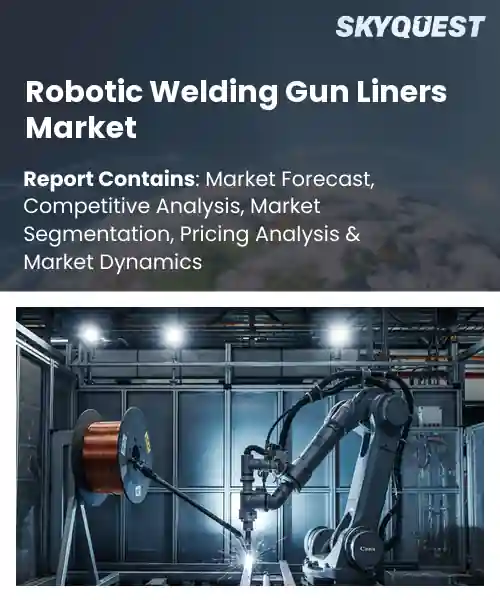
Robotic Welding Gun Liners Market
Report ID: SQMIG20I3362
Report ID: SQMIG20I3362
[email protected]
USA +1 351-333-4748
Report ID:
SQMIG20I3362 |
Region:
Global |
Published Date: July, 2026
Pages:
157
|Tables:
146
|Figures:
78


Global Robotic Welding Gun Liners Market size was valued at USD 341.6 Million in 2024 and is poised to grow from USD 356.97 Million in 2025 to USD 507.65 Million by 2033, growing at a CAGR of 4.5% during the forecast period (2026-2033).
The robotic welding gun liners market growth is driven because more industrial automation is being used and robotic welding systems keep getting adopted in heavy manufacturing , automotive , aerospace and construction. There is more demand for consistently high quality , dependable weld results and also better production efficiency , so solid welding gun liners in practice help cut down on wire feeding issues, and they also lower downtime. The production of electric vehicles and smart factories is increasing that further boosts the demand for robotic welding equipment and consumables.
Moreover, the market is growing due to advancements in liner material technology like low friction and wear-resistant designs that are improving performance and extending service life. Other drivers for the automation push include the need for precision welding and higher labor costs. The growth of the market for sophisticated robotic welding gun liners is also driven by other factors such as increased output in mass production environments, lower maintenance needs, and rising concern for the safety of the worker across the world.
How is AI-driven automation influencing demand for robotic welding gun liners?
AI-powered automation is transforming the robotic welding gun liners market outlook by extending service intervals and improving wear patterns. The controller can monitor heat, force and vibration in real-time and use sensors and machine-learning algorithms to adjust feed rates and reduce abrasive contact. Producers are now making tighter tolerances and using materials that are better suited to adaptive welding cycles. High performance liners are becoming more valuable as early adopters are reporting fewer liner changes and better production flow. Consequently, the market is moving toward smart-compatible liners that can communicate condition data to the robot controller.
Market snapshot - (2026-2033)
Global Market Size
USD 341.6 Million
Largest Segment
High Carbon Steel
Fastest Growth
Stainless Steel
Growth Rate
4.5% CAGR
To get more insights on this market click here to Request a Free Sample Report
The global robotic welding gun liners market is segmented by material type, welding process, wire diameter, end use industry, distribution channel and region. Based on material type, the market is segmented into High Carbon Steel, Stainless Steel, Teflon PTFE, Aluminum Bronze and Others. Based on welding process, the market is segmented into MIG Welding, Flux Cored and Laser Welding. Based on wire diameter, the market is segmented into Under 1.2 mm, 1.2 to 1.6 mm and Above 1.6 mm. Based on end use industry, the market is segmented into Automotive Assembly, Aerospace Manufacturing, Heavy Machinery and Shipyard Construction. Based on distribution channel, the market is segmented into OEMs Direct and Industrial Suppliers. Based on region, the market is segmented into North America, Europe, Asia Pacific, Latin America and Middle East & Africa.
As per the robotic welding gun liners market analysis, the Stainless steel segment dominated the market owing to its ability to withstand high temperature and corrosion resistance that meet the strict demands of automated welding cells by providing continuous liner life and reducing down time for maintenance. manufacturers prefer it for the efficiency and cost-effectiveness of robotic welding because it can withstand extreme heat cycles without losing its structural integrity. Secondly, the material has a high wear resistance that can lead to longer tool life in a wide range of production cycles and a smoother feed through guide mechanisms.
However, the Teflon PTFE segment is growing its robotic welding gun liners market share. Its low frictional properties allow for faster welding speeds and reduced wear on moving parts. This appeals to manufacturers who want to extend cycle times. The market is driven by ongoing advancements in coating technologies and the increasing demand for lightweight automotive components.
According to the robotic welding gun liners market forecast, the MIG welding segment is well suited for robotic applications due to its adaptability and reliable arc behavior and the need for accuracy. It can also be combined with conventional liner designs. The process’s enhanced material compatibility means less liner redesigns, boosting operating efficiency and allowing continuous manufacturing. The high consumption in various industries and strict safety regulations motivate suppliers to invest in optimal liner solutions to enhance durability and heat dissipation.
Whereas the laser welding category is the fastest growing segment because it is accurate and has a low heat-affected zone, which permits thinner, high-performance liners that enhance robot agility. The development of fiber laser technology and increasing demands for microfabricated parts supports the development of particular liner designs for ultra fine welding jobs.
To get detailed segments analysis, Request a Free Sample Report
As per the robotic welding gun liners market regional forecast, Asia Pacific with its rapid adoption of technological automation and strong industrial heritage is on the front line of the world stage. The region is home to a large number of OEMs who are focused on accuracy and efficiency, and there is a constant demand for high-performance welding gun liners. Research and development efforts continue to provide new liner designs for a variety of material and process requirements. Close collaboration between system integrators and component vendors allows for fast iteration and customisation. Also, the presence of a skilled engineering talent and well-developed logistical infrastructure supports the efficient distribution and after-sale service that helps sustain the region’s leading position. Smart industrial transformation is promoted by government programs to improve competitiveness.
Japan Robotic Welding Gun Liners Market
The Japanese Robotic Welding Gun Liners sector is the outcome of a concentration of large-scale automotive assemblers and a tradition of precision engineering. Liner suppliers are focusing on ultra-durable materials and tight tolerances; domestic manufacturers are looking for dependability and low maintenance. The cooperation between the end users and the component manufacturers is close resulting in short feedback loops to react to changing manufacturing requirements and a culture of continuous improvement through joint engineering projects.
South Korea Robotic Welding Gun Liners Market
The robotic welding gun liners industry in South Korea is being propelled by automation in heavy industries and the growing shipbuilding industry in South Korea. Korean manufacturers are targeting liner technologies that can resist high temperatures to comply with rigorous manufacturing processes. Tight collaboration between academic institutions and commercial businesses leads to accelerated uptake of novel coating techniques, improving wear resistance. The market enjoys flexible supply chains that offer quick delivery to large scale production lines and the nation’s top reputation for cutting-edge welding solutions.
North America is energized by high-value manufacturing and a never-ending quest for operational efficiency. Welding technologies that save cycle time and provide consistent quality are necessary for major automotive and aerospace assemblers. Advanced gun liners are therefore frequently used. The introduction of digital monitoring and predictive maintenance tools is designed to increase confidence in liner performance, as well as to support the region’s focus on data-driven decision making. A solid supply chain ensures the on-time delivery of specialized components, and close collaboration between equipment makers and research institutions ensures a steady stream of material innovation. The regulatory environment for worker safety and product reliability also drives investment in novel welding accessories, which increases the market momentum.
US Robotic Welding Gun Liners Market
The U.S. robotic welding gun liner market penetration is driven by many large manufacturers that need solutions with less downtime and great precision. By choosing flexible designs that can be slightly altered for different manufacturing runs, liner companies build a network of specialized suppliers. Integration with intelligent industrial systems and real-time tracking improve traceability and performance metrics. More funding for research leads to the creation of wear-resistant materials and improves the US’s reputation as a leader in the field of welding technology.
Canada Robotic Welding Gun Liners Market
Canada’s Robotic Welding Gun Liners Market is supported by a diverse industry base that includes mining, aerospace, and renewable energy industries, among others. Suppliers are looking at corrosion-resistant coatings and longer service life as stakeholders seek robust liner designs that can withstand tough operating conditions. Research groups and manufacturers’ joint ventures are accelerating the use of eco-friendly materials. Government support for innovative manufacturing shows Canada’s commitment to high-performance welding solutions.
The European scene is increasing its profile through a combination of tough quality requirements and a strong commitment to sustainable production. Leading automotive and aerospace companies require welding gun liners where material waste and tight tolerance requirements are critical. International research clusters are developing low-friction surface treatments and eco-friendly liner composites. Strong certification programs require ongoing performance and this drives usage in precision-driven markets such as medical device manufacturing. Europe is a centre of excellence for quality welding technology with a wealth of engineering talent and well-linked supply chains for rapid prototyping and local support.
Germany Robotic Welding Gun Liners Market
The German market for robotic welding gun liners is driven by an emphasis on precision engineering and high-speed integration on production lines. The German suppliers require high-class liner materials that work consistently under tight quality criteria, which is why suppliers have developed complex alloys. The car makers and research institutes work hand-in-glove to accelerate the deployment of low-wear, energy-efficient solutions. It has a good logistics system to deliver the market on time to the important industrial hubs.
UK Robotic Welding Gun Liners Market
The UK robotic welding gun liners market is being driven by the strong aerospace market and growing emphasis on advanced manufacturing techniques. The British user requires light and strong liners for complex assembly procedures. The metalworking industry is working with universities to develop new coating techniques for better wear resistance. A strong service network that provides fast technical support and customisation also helps the market, further strengthening the UK’s ability to deliver high-performance welding applications.
France Robotic Welding Gun Liners Market
The availability of production environments such as the automotive, nuclear, and high-speed rail industries supports the French market for robotic welding gun liners. French companies are focused on liners with good heat dissipation and corrosion prevention for demanding working conditions. Technical institutes run cooperative projects on energy-saving designs and environmentally friendly material formulations. Our distribution model is strong and allows us to deliver customized solutions quickly, which reinforces France’s ambition to remain at the forefront of precision welding technologies.
To know more about the market opportunities by region and country, click here to
Buy The Complete Report
Increasing Adoption Of Automation
Automation has been widely implemented in the manufacturing industry in the form of robotic welding systems to increase productivity and remain competitive. Automated welding gun liners eliminate the need for human involvement, resulting in consistent weld quality, and lower rework rates. Today’s manufacturers have the ability to increase throughput capabilities, while reducing occupational hazards and human error. Demand for robust, high-performance liners is growing. These are critical parts that keep complex robotic welders working properly in a variety of industries. The lifespan of liners is extended which means increased equipment uptime and less maintenance.
Growth In Advanced Material Technologies
Considerable advances have been made in material science in the development of liners for welding guns with improved wear characteristics and thermal resistance. The new liners can withstand abrasive particles and higher arc temperatures, allowing robotic welders to work at higher power levels without degradation. Longer service intervals mean less downtime, helping manufacturers to increase total production efficiency. “Market growth will also be propelled by increased adoption across industries as the need for tighter tolerances and faster cycle times in industries such as aerospace and automotive increases the need for high-performance liners.
High Initial Capital Investment
However, the initial cost of implementing robotic welding systems and the proper gun liners are still prohibitive for many manufacturers, especially smaller and medium-sized businesses. The requirements for large amounts of money in the form of specialist equipment, training and infrastructural changes may deter investment decisions. This may result in companies delaying the implementation of new liner solutions or sticking with traditional welding techniques, potentially hampering their overall market penetration. This financial hurdle slows down the pace of growth in the market especially in areas with tight budgets.
Limited Availability Of Skilled Technicians
The proper operation and maintenance of robotic welding equipment requires a personnel with specialized training that is currently missing in many manufacture facilities. Many employers struggle to find, develop and retain workers able to diagnose complex liner mechanics and guarantee optimal performance. This skills gap has made businesses reluctant to fully implement automated solutions, resulting in more downtime and less weld quality. The market is unable to grow due to a lack of skilled technicians.
Request Free Customization of this report to help us to meet your business objectives.
The robotic welding gun liners market is highly competitive as manufacturers strive to differentiate through sophisticated automation and AI integration. The stakes are raised by leaders like KUKA unveiling modular plug-and-play welding cells at FABTECH 2025 and upstarts like Novarc and Terafac on aggressive funding rounds to speed up AI-enabled liner technologies and strike strategic OEM collaborations.
Top Player’s Company Profile
Recent Developments in the Robotic Welding Gun Liners Market
Taylor Lincoln Electric Holdings Inc. said in January it will increase the number of robotic welding gun liners it offers by 2026. These liners would be more wear resistant and compatible with a greater range of welding robots. This will allow the company to meet the rising demand for precision welding components from the automotive and aerospace industries.
Miller Electric Mfg LLC in February 2026 introduced a new modular gun liner system that it said would improve thermal management and ease installation, helping manufacturers using advanced robotic welding systems to accelerate changeovers and reduce downtime.
SkyQuest’s ABIRAW (Advanced Business Intelligence, Research & Analysis Wing) is our Business Information Services team that Collects, Collates, Correlates, and Analyses the Data collected by means of Primary Exploratory Research backed by robust Secondary Desk research.
As per SkyQuest analysis, the market is driven by automation as the increasing adoption of automation is compelling the manufacturers to choose strong robotic welding gun liners. The large initial capital commitment prevents smaller firms from entering the market more quickly. Asia Pacific is anticipated to hold the largest market share owing to its strong manufacturing base and ambitious smart factory project. STAINLESS STEEL is resistant to corrosion and can withstand high temperatures, so it is expected to have the largest market share. Rapid advancements in advanced material technologies delivering increased wear-life and heat resistance are driving the demand for high-performance liners in automotive and aerospace industries globally. These improvements also help to improve current production.
| Report Metric | Details |
|---|---|
| Market size value in 2024 | USD 341.6 Million |
| Market size value in 2033 | USD 507.65 Million |
| Growth Rate | 4.5% |
| Base year | 2024 |
| Forecast period | (2026-2033) |
| Forecast Unit (Value) | USD Million |
| Segments covered |
|
| Regions covered | North America (US, Canada), Europe (Germany, France, United Kingdom, Italy, Spain, Rest of Europe), Asia Pacific (China, India, Japan, Rest of Asia-Pacific), Latin America (Brazil, Rest of Latin America), Middle East & Africa (South Africa, GCC Countries, Rest of MEA) |
| Companies covered |
|
| Customization scope | Free report customization with purchase. Customization includes:-
|
To get a free trial access to our platform which is a one stop solution for all your data requirements for quicker decision making. This platform allows you to compare markets, competitors who are prominent in the market, and mega trends that are influencing the dynamics in the market. Also, get access to detailed SkyQuest exclusive matrix.
Table Of Content
Executive Summary
Market overview
Parent Market Analysis
Market overview
Market size
KEY MARKET INSIGHTS
COVID IMPACT
MARKET DYNAMICS & OUTLOOK
Market Size by Region
KEY COMPANY PROFILES
Methodology
For the Robotic Welding Gun Liners Market, our research methodology involved a mixture of primary and secondary data sources. Key steps involved in the research process are listed below:
1. Information Procurement: This stage involved the procurement of Market data or related information via primary and secondary sources. The various secondary sources used included various company websites, annual reports, trade databases, and paid databases such as Hoover's, Bloomberg Business, Factiva, and Avention. Our team did 45 primary interactions Globally which included several stakeholders such as manufacturers, customers, key opinion leaders, etc. Overall, information procurement was one of the most extensive stages in our research process.
2. Information Analysis: This step involved triangulation of data through bottom-up and top-down approaches to estimate and validate the total size and future estimate of the Robotic Welding Gun Liners Market.
3. Report Formulation: The final step entailed the placement of data points in appropriate Market spaces in an attempt to deduce viable conclusions.
4. Validation & Publishing: Validation is the most important step in the process. Validation & re-validation via an intricately designed process helped us finalize data points to be used for final calculations. The final Market estimates and forecasts were then aligned and sent to our panel of industry experts for validation of data. Once the validation was done the report was sent to our Quality Assurance team to ensure adherence to style guides, consistency & design.
Analyst Support
Customization Options
With the given market data, our dedicated team of analysts can offer you the following customization options are available for the Robotic Welding Gun Liners Market:
Product Analysis: Product matrix, which offers a detailed comparison of the product portfolio of companies.
Regional Analysis: Further analysis of the Robotic Welding Gun Liners Market for additional countries.
Competitive Analysis: Detailed analysis and profiling of additional Market players & comparative analysis of competitive products.
Go to Market Strategy: Find the high-growth channels to invest your marketing efforts and increase your customer base.
Innovation Mapping: Identify racial solutions and innovation, connected to deep ecosystems of innovators, start-ups, academics, and strategic partners.
Category Intelligence: Customized intelligence that is relevant to their supply Markets will enable them to make smarter sourcing decisions and improve their category management.
Public Company Transcript Analysis: To improve the investment performance by generating new alpha and making better-informed decisions.
Social Media Listening: To analyze the conversations and trends happening not just around your brand, but around your industry as a whole, and use those insights to make better Marketing decisions.
REQUEST FOR SAMPLE
 REQUEST FREE CUSTOMIZATION
Global Robotic Welding Gun Liners Market size was valued at USD 341.6 Million in 2024 and is poised to grow from USD 356.97 Million in 2025 to USD 507.65 Million by 2033, growing at a CAGR of 4.5% during the forecast period (2026-2033).
Intense competition in the robotic welding gun liners market is driven by manufacturers seeking to differentiate through advanced automation and AI integration. Leaders such as KUKA have introduced modular plug‑and‑play welding cells at FABTECH 2025, while newcomers like Novarc and Terafac pursue aggressive funding rounds to accelerate AI‑enabled liner technologies and form strategic OEM alliances, intensifying rivalry. 'Lincoln Electric Holdings Inc', 'Miller Electric Mfg LLC', 'Illinois Tool Works Inc', 'Tregaskiss', 'Bernard', 'TBI Industries GmbH', 'Abicor Binzel USA Inc', 'Alexander Binzel Schweisstechnik GmbH & Co KG', 'Fronius International GmbH', 'Esab Corporation', 'Tokin Corporation', 'Dinse Gmbh', 'Kemppi Oy', 'SKS Welding Systems GmbH', 'EWM AG', 'American Torch Tip Company', 'Wire Wizard', 'National Torch Tip Co', 'OTC Daihen Inc', 'Panasonic Welding Systems Co Ltd'
The manufacturing sector is progressively integrating robotic welding systems to enhance production efficiency and maintain competitive advantage. Automated welding gun liners reduce manual intervention, leading to consistent weld quality and lower rework rates. This shift enables manufacturers to meet higher throughput demands while minimizing human error and occupational hazards. Consequently, demand for durable, high‑performance liners escalates as they become essential components ensuring reliable operation of sophisticated robotic welders across diverse industries, improving liner durability also extends equipment uptime, lowering maintenance frequency.
Advanced Composite Liners Adoption: The industry is rapidly embracing composite‑based welding gun liners that combine lightweight polymers with reinforced fibers, delivering superior thermal resistance and reduced wear. Manufacturers cite longer service intervals and lower replacement costs as key benefits, while end users appreciate the enhanced precision in high‑speed robotic applications. This shift also aligns with sustainability goals, as composites often contain recycled content and generate less scrap, supporting greener production pathways across automotive and aerospace sectors. Adoption rates are accelerating as supply chains mature globally.
Why does Asia Pacific Dominate the Global Robotic Welding Gun Liners Market? |@12


Want to customize this report? This report can be personalized according to your needs. Our analysts and industry experts will work directly with you to understand your requirements and provide you with customized data in a short amount of time. We offer $1000 worth of FREE customization at the time of purchase.
Feedback From Our Clients


 USA (+1) 351-333-4748

