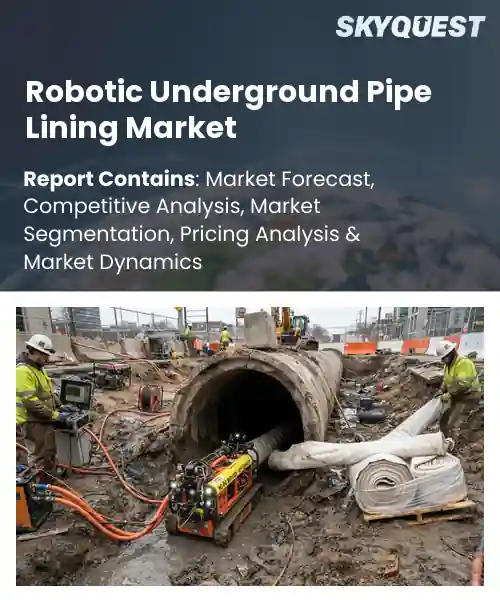
Robotic Underground Pipe Lining Market
Report ID: SQMIG20C2323
Report ID: SQMIG20C2323
[email protected]
USA +1 351-333-4748
Report ID:
SQMIG20C2323 |
Region:
Global |
Published Date: August, 2026
Pages:
157
|Tables:
144
|Figures:
78


Global Robotic Underground Pipe Lining Market size was valued at USD 1.96 Billion in 2024 and is poised to grow from USD 2.13 Billion in 2025 to USD 4.12 Billion by 2033, growing at a CAGR of 8.6% during the forecast period (2026-2033).
Building the robotic underground pipe lining market centers on the urgent need to rehabilitate aging water and sewer networks without excavating streets. As municipalities confront rising pipe failures, the primary driver becomes demand for trenchless solutions that minimize traffic disruption and labor costs. Over the past decade, robotic Cured‑In‑Place Pipe (CIPP) systems have moved from pilot projects in New York to large‑scale deployments across London, Tokyo, and São Paulo, showing faster installation and reduced environmental impact. This shift from manual relining to autonomous robots equipped with sensors allows precise navigation of complex geometries, extending asset life while preserving urban public critical services. Building on the foundation, the next key factor driving market growth is heightened regulatory pressure for sustainable water management amid urbanization. Governments worldwide now mandate stricter leakage limits and reward low‑impact repairs, which fuels adoption of robotic lining as a compliant alternative to open‑cut excavation. The City of Los Angeles, for example, allocated $45 million to retrofit storm‑drain conduits with autonomous CIPP units, projecting a 30 percent reduction in water loss. This policy push creates opportunities for manufacturers to offer modular robot platforms on a lease basis, lowering capital barriers and accelerating deployment in emerging markets where infrastructure expansion outpaces traditional construction.
How are AI and IoT automation reshaping the robotic underground pipe lining market?
AI and IoT are turning robotic underground pipe lining into a data rich, self optimizing process. AI algorithms analyze sensor streams from pressure, vibration and visual cameras to predict material behavior and adjust robot speed on the fly. IoT connectivity lets operators monitor multiple units from a cloud dashboard, schedule maintenance before wear becomes critical, and coordinate crews with precise location data. The integration reduces manual inspection, shortens project cycles and lowers labor exposure to confined spaces. As municipalities demand faster, less disruptive repairs, these smart robots are becoming the preferred tool for large scale relining projects, reshaping how the industry delivers value.In July 2024 a new AI driven control platform was rolled out for robotic pipe lining, enabling real time adjustments that cut downtime and improve placement accuracy, illustrating how automation fuels efficiency and supports market expansion.
Market snapshot - (2026-2033)
Global Market Size
USD 1.96 Billion
Largest Segment
Crawler Robots
Fastest Growth
Robotic Milling Systems
Growth Rate
8.6% CAGR
To get more insights on this market click here to Request a Free Sample Report
Global robotic underground pipe lining market is segmented by robot type, lining technology, pipe type, application, end user and region. Based on robot type, the market is segmented into Crawler Robots, Wheeled Robots and Robotic Milling Systems. Based on lining technology, the market is segmented into Cured-in-Place Pipe Lining, Spray-On Lining and Slip Lining. Based on pipe type, the market is segmented into Water Pipes, Sewer Pipes and Gas Pipes. Based on application, the market is segmented into Pipe Rehabilitation, Leak Repair and Corrosion Protection. Based on end user, the market is segmented into Municipal Utilities, Industrial Facilities and Commercial Infrastructure. Based on region, the market is segmented into North America, Europe, Asia Pacific, Latin America and Middle East & Africa.
Crawler Robots segment dominates because its ability to maneuver through confined irregular pipe geometries gives it unmatched versatility for underground lining tasks. The tracked design provides stable traction on wet or uneven surfaces, enabling continuous operation without frequent repositioning. This reliability reduces downtime and labor intensity, making it the preferred choice for municipal utilities and industrial facilities seeking efficient rehabilitation. Consequently, manufacturers prioritize enhanced sensor integration and modular tooling, reinforcing its market leadership.
On the other hand, Wheeled Robots segment is witnessing the strongest growth momentum because its lighter chassis and higher speeds suit longer straight run pipelines where efficiency is paramount. Emerging demand for rapid deployment in commercial infrastructure drives manufacturers to integrate advanced navigation algorithms, expanding the addressable market and unlocking revenue streams.
Cured in Place Pipe Lining segment leads because it creates a seamless monolithic barrier that conforms precisely to interior pipe contours, delivering superior structural integrity and long term durability. The process utilizes robotic applicators to deposit resin that cures in situ, eliminating joints and reducing leakage pathways. This reliability addresses critical performance criteria for utilities and industrial plants, fostering confidence in extensive rehabilitation programs and prompting vendors to refine automation, reinforcing its leadership position.
Meanwhile, Spray On Lining segment emerges as the fastest expanding area because its rapid application method suits time projects and irregular pipe profiles. The technology uses robotic spraying to form a coating that adheres quickly, minimizing service interruptions. Growing interest from commercial infrastructure owners seeking effective solutions drives innovation, broadening its applicability and accelerating market adoption in pipe networks.
To get detailed segments analysis, Request a Free Sample Report
North America retains a leading position because of a mature pipeline network that requires sophisticated rehabilitation, combined with deep investment in research and development across both academic and industrial sectors. The region benefits from a regulatory climate that encourages innovative, low‑disruption techniques and provides clear pathways for approval of robotic solutions. Strong financial capacity of municipalities and utility operators enables early adoption of costly automation equipment. A concentrated cluster of technology providers, engineering consultancies, and equipment manufacturers fosters rapid iteration and customization. Skilled labor pools and advanced digital infrastructure support integration of robotics with data‑driven asset management, reinforcing the competitive advantage of the market in this geography. Collaboration between government agencies and private innovators further accelerates deployment of next‑generation lining robots, establishing a robust ecosystem that other regions seek to emulate.
Robotic Underground Pipe Lining Market in the United States is shaped by a vast municipal network and a proactive stance toward sustainability. Leading manufacturers collaborate closely with utility firms to tailor robotic solutions for diverse pipe diameters and challenging soil conditions. Academic research centers contribute sensor integration, while federal programs provide support for pilot deployments. The emphasis on minimizing service disruption and extending asset life drives continuous refinement of automation technologies across the country.
Robotic Underground Pipe Lining Market in Canada reflects a strong environmental stewardship ethos and extensive experience in cold‑climate infrastructure. Provincial agencies partner with technology developers to address aging sewer systems in both urban centers and remote communities. Emphasis on low‑impact methods aligns with regulatory expectations for minimal ecological disturbance. Collaborative testing programs enable customization of robotic tools for varied pipe materials, while government incentives encourage adoption of non‑disruptive rehabilitation across the national network.
Europe’s expansion is propelled by a combination of rigorous environmental directives and a mature engineering culture that prioritizes sustainable infrastructure renewal. Public authorities across the region are committed to reducing excavation‑related disruptions, leading to strong endorsement of robotic lining technologies that offer precision and rapid deployment. Collaborative research initiatives funded by supranational bodies accelerate innovation, while harmonized standards simplify cross‑border adoption. The dense urban fabric of many European cities creates demand for low‑impact, high‑efficiency rehabilitation methods, and the emphasis on circular economy principles further encourages the reuse of pipe materials through robotic processes. Together, these factors establish a fertile environment for market growth and technological leadership.
Robotic Underground Pipe Lining Market in Germany benefits from a renowned precision engineering sector and strong industrial partnerships. Federal programs support pilot installations in dense metropolitan networks, emphasizing durability and energy efficiency. Collaboration between research institutes and equipment manufacturers drives integration of advanced sensor suites, enabling real‑time condition monitoring. The country’s focus on modular robotic platforms ensures adaptability to a wide range of pipe diameters, reinforcing Germany’s position as a benchmark for reliable, high‑performance underground rehabilitation.
Robotic Underground Pipe Lining Market in the United Kingdom is characterized by rapid adoption driven by government infrastructure renewal agendas and vibrant technology clusters in major cities. Emphasis on minimizing traffic disruption aligns with urban planning priorities, prompting utilities to invest in robotic solutions that reduce excavation time. Partnerships between academic research centers and startup innovators accelerate development of compact, maneuverable robots suited to narrow historic sewers. Policy incentives that reward sustainable repair methods further stimulate market momentum across the British network.
Robotic Underground Pipe Lining Market in France is emerging as municipalities pursue eco‑friendly renovation of aging water and sewer systems. National environmental policies encourage the use of low‑emission technologies, prompting early‑stage pilots of robotic lining in both urban and rural settings. Strategic collaborations between French engineering firms and robot manufacturers focus on customizing solutions for varied pipe materials prevalent in the region. Growing awareness of cost‑effective, non‑disruptive methods is fostering incremental adoption across the French utility landscape.
Asia Pacific is strengthening its role by leveraging rapid urbanization and a pressing need to modernize extensive underground networks without causing major service interruptions. The region’s strong manufacturing base supplies cost‑effective robotic components, while government policies encouraging smart infrastructure investment create a supportive environment for advanced lining solutions. Countries such as Japan and South Korea lead in miniaturizing robots to operate within narrow, congested sewers typical of densely populated cities. Integration of Internet‑of‑Things connectivity allows real‑time monitoring and predictive maintenance, enhancing the value proposition of robotic rehabilitation. Collaborative platforms that bring together utilities, technology providers, and research institutions accelerate knowledge transfer and foster localized innovation, positioning Asia Pacific as a dynamic hub for next‑generation underground pipeline solutions.
Robotic Underground Pipe Lining Market in Japan is driven by a long‑standing tradition of precision robotics and a critical need to address aging sewer infrastructure in high‑density urban zones. Government‑backed initiatives prioritize non‑disruptive repair methods to protect dense traffic flows, prompting utilities to adopt advanced robotic lining systems. Industry‑academic partnerships focus on enhancing robot dexterity and sensor accuracy for complex pipe geometries. The strong domestic component market ensures rapid availability of specialized parts, while a cultural emphasis on reliability reinforces rigorous testing standards that bolster confidence in robotic solutions nationwide.
Robotic Underground Pipe Lining Market in South Korea benefits from a tech‑savvy ecosystem and proactive public investment in smart city projects. The country’s leadership in semiconductor and robotics manufacturing supplies high‑performance actuators and control systems tailored for underground applications. Municipalities collaborate with innovation hubs to pilot compact robots capable of navigating tight sewer networks common in rapidly expanding urban districts. Regulatory encouragement of low‑impact refurbishment methods aligns with national sustainability goals, accelerating acceptance of robotic lining technologies across the Korean utilities sector.
To know more about the market opportunities by region and country, click here to
Buy The Complete Report
Increasing Urban Infrastructure Investment
Leveraging Data Analytics for Precision
High Initial Capital Expenditure
Regulatory Uncertainty and Compliance
Request Free Customization of this report to help us to meet your business objectives.
Competitive rivalry intensifies as incumbents and new entrants vie for municipal contracts and smart‑city projects. The push to reduce water‑loss targets has spurred collaborations such as Hong Kong’s HK$30 million partnership with local robot firms, while strategic moves like Toyota AI Ventures’ $200 million fund and Boston Dynamics’ $1.1 billion acquisition illustrate consolidation and investment aimed at faster tech roll‑out. These actions directly drive adoption of AI‑enabled lining robots.
Top Player’s Company Profile
Recent Developments
SkyQuest’s ABIRAW (Advanced Business Intelligence, Research & Analysis Wing) is our Business Information Services team that Collects, Collates, Correlates, and Analyses the Data collected by means of Primary Exploratory Research backed by robust Secondary Desk research. As per SkyQuest analysis the global robotic underground pipe lining market is being propelled primarily by rising urban infrastructure investment, which pushes municipalities toward low‑impact, trenchless repairs, while the integration of real‑time data analytics serves as a second driver that enhances precision and reduces project cycles. The market is led by North America, where mature pipeline networks and supportive regulations foster early adoption and encouraging further innovation across the sector, and the crawler‑robot segment dominates because its tracked design offers unmatched maneuverability in confined pipes. However, high initial capital expenditure remains a restraint, limiting uptake among budget‑constrained utilities and slowing broader penetration.
| Report Metric | Details |
|---|---|
| Market size value in 2024 | USD 1.96 Billion |
| Market size value in 2033 | USD 4.12 Billion |
| Growth Rate | 8.6% |
| Base year | 2024 |
| Forecast period | (2026-2033) |
| Forecast Unit (Value) | USD Billion |
| Segments covered |
|
| Regions covered | North America (US, Canada), Europe (Germany, France, United Kingdom, Italy, Spain, Rest of Europe), Asia Pacific (China, India, Japan, Rest of Asia-Pacific), Latin America (Brazil, Rest of Latin America), Middle East & Africa (South Africa, GCC Countries, Rest of MEA) |
| Companies covered |
|
| Customization scope | Free report customization with purchase. Customization includes:-
|
To get a free trial access to our platform which is a one stop solution for all your data requirements for quicker decision making. This platform allows you to compare markets, competitors who are prominent in the market, and mega trends that are influencing the dynamics in the market. Also, get access to detailed SkyQuest exclusive matrix.
Table Of Content
Executive Summary
Market overview
Parent Market Analysis
Market overview
Market size
KEY MARKET INSIGHTS
COVID IMPACT
MARKET DYNAMICS & OUTLOOK
Market Size by Region
KEY COMPANY PROFILES
Methodology
For the Robotic Underground Pipe Lining Market, our research methodology involved a mixture of primary and secondary data sources. Key steps involved in the research process are listed below:
1. Information Procurement: This stage involved the procurement of Market data or related information via primary and secondary sources. The various secondary sources used included various company websites, annual reports, trade databases, and paid databases such as Hoover's, Bloomberg Business, Factiva, and Avention. Our team did 45 primary interactions Globally which included several stakeholders such as manufacturers, customers, key opinion leaders, etc. Overall, information procurement was one of the most extensive stages in our research process.
2. Information Analysis: This step involved triangulation of data through bottom-up and top-down approaches to estimate and validate the total size and future estimate of the Robotic Underground Pipe Lining Market.
3. Report Formulation: The final step entailed the placement of data points in appropriate Market spaces in an attempt to deduce viable conclusions.
4. Validation & Publishing: Validation is the most important step in the process. Validation & re-validation via an intricately designed process helped us finalize data points to be used for final calculations. The final Market estimates and forecasts were then aligned and sent to our panel of industry experts for validation of data. Once the validation was done the report was sent to our Quality Assurance team to ensure adherence to style guides, consistency & design.
Analyst Support
Customization Options
With the given market data, our dedicated team of analysts can offer you the following customization options are available for the Robotic Underground Pipe Lining Market:
Product Analysis: Product matrix, which offers a detailed comparison of the product portfolio of companies.
Regional Analysis: Further analysis of the Robotic Underground Pipe Lining Market for additional countries.
Competitive Analysis: Detailed analysis and profiling of additional Market players & comparative analysis of competitive products.
Go to Market Strategy: Find the high-growth channels to invest your marketing efforts and increase your customer base.
Innovation Mapping: Identify racial solutions and innovation, connected to deep ecosystems of innovators, start-ups, academics, and strategic partners.
Category Intelligence: Customized intelligence that is relevant to their supply Markets will enable them to make smarter sourcing decisions and improve their category management.
Public Company Transcript Analysis: To improve the investment performance by generating new alpha and making better-informed decisions.
Social Media Listening: To analyze the conversations and trends happening not just around your brand, but around your industry as a whole, and use those insights to make better Marketing decisions.
REQUEST FOR SAMPLE
 REQUEST FREE CUSTOMIZATION


Want to customize this report? This report can be personalized according to your needs. Our analysts and industry experts will work directly with you to understand your requirements and provide you with customized data in a short amount of time. We offer $1000 worth of FREE customization at the time of purchase.
Feedback From Our Clients


 USA (+1) 351-333-4748

