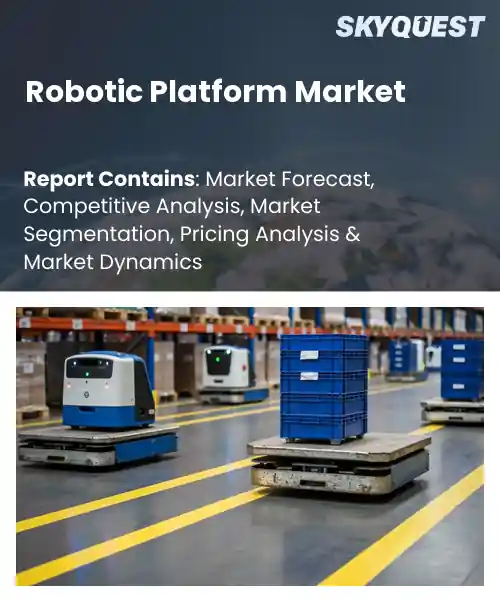
Robotic Platform Market
Report ID: SQMIG20I2718
Report ID: SQMIG20I2718
[email protected]
USA +1 351-333-4748
Report ID:
SQMIG20I2718 |
Region:
Global |
Published Date: February, 2026
Pages:
157
|Tables:
208
|Figures:
80


Global Robotic Platform Market size was valued at USD 10.60 Billion in 2024 and is poised to grow from USD 11.23 Billion in 2025 to USD 17.77 Billion by 2033, growing at a CAGR of 5.91% during the forecast period (2026-2033).
The global robotic platform industry includes complete systems which integrate hardware and software to enable robots to perceive their surroundings while creating solutions to navigate spaces and perform tasks in industrial and commercial and consumer applications. The main factor driving growth results from increased automation needs which businesses must meet because their workforce ages while employee shortages persist and their operations require continuous productivity increases; companies prefer modular systems which can be expanded because they want to achieve consistent operational results instead of selecting custom solutions.
In addition, the global robotic platform market outlook has evolved during the last fifty years from heavy industrial manipulators to collaborative arms and autonomous mobile robots and aerial drone platforms with Amazon warehouse fleets and da Vinci surgical systems and service robots serving as current market examples. The industrial momentum in perception and decision-making technology develops as onboard sensors and machine learning technology advances because these systems now operate unstructured areas while entering retail and healthcare and agricultural fields. The service providers now offer RaaS models because lower sensor costs and cloud connectivity decrease integration expenses which lead to reduced operational costs for their clients who need financial help to start their operations. The investment community now supports modular system designs and standardized API frameworks which create network effects that help both new and existing companies bring their products into the marketplace faster.
How is AI Enhancing Operational Efficiency in the Global Robotic Platform Market?
The global robotic platform market achieves improved operational efficiency through AI, which enhances perception together with planning and coordination and lifecycle management capabilities. The system uses vision-based sensing to enable precise object handling and model informed planning to create more efficient movement and predictive maintenance to decrease unplanned system failures. The current state has moved from using individual prototypes to deploying full systems which utilize cloud-based simulation for safe testing and validation of their shared learning. The market reports that robots operate with human workers in the warehouse and manufacturing and healthcare sectors at a faster rate than other industries. The reliability of autonomous mobile platforms which use vision to guide their pickup operation improves while vision guided arms which enhance their picking accuracy and better facilitate system growth.
Market snapshot - (2026-2033)
Global Market Size
USD 10.23 Billion
Largest Segment
Industrial Robots
Fastest Growth
Autonomous Mobile Robots (AMRs)
Growth Rate
6.3% CAGR
To get more insights on this market click here to Request a Free Sample Report
The global robotic platform market is segmented based on type of robot, component, deployment model, platform mobility, application, end-user industry, user type, and region. By type of robot, the market is categorized into industrial robots, service robots, collaborative robots (cobots), autonomous mobile robots (AMRs), and humanoid robots. In terms of components, it is divided into hardware, software, and services. Based on deployment models, the market includes on-premises, cloud, and hybrid solutions. By platform mobility, the segmentation comprises mobile platforms, stationary platforms, and others. Based on application, the market covers industrial automation, healthcare, logistics and warehousing, agriculture, defense and security, retail and e-commerce, and others. In terms of end-user industry, it includes manufacturing, automotive, healthcare, retail, e-commerce, defense, agriculture, and others. Based on user type, the market is segmented into B2B and B2C sectors. Regionally, the market is analyzed across North America, Europe, Asia Pacific, Latin America, and the Middle East & Africa.
As per the global robotic platform market analysis, manufacturers and integrators currently favor human-robot interaction as they choose collaborative robots which enable multiple operational settings and require less programming work for safe operations in their production facilities and service environments. Companies maintain their leadership position because its systems provide direct integration access while their user interfaces remain easy to understand, and their systems permit human workers to operate without needing to install substantial new systems.
Whereas the autonomous mobile robots section currently exhibits the fastest growth rate among sub-segments because companies need flexible material handling solutions while warehouses increasingly adopt automation technology and navigation systems and fleet management systems experience breakthroughs. The development of new service models along with improved perception capabilities allows companies to operate in dynamic environments, which leads to business growth opportunities and better workforce management.
According to the global robotic platform market forecast, the software segment remains dominant because advanced control and orchestration and analytics capabilities enable platforms to provide robot-specific modular features which enhance operational availability and product lifespan. The market requires software systems to deliver direct connections between different sectors of the business while updating processes and eliminating outdated systems.
However, the services category is predicted to achieve the maximum robotic platform market share because buyers need help with integration and deployment work, and they need lifecycle management services which help them handle their systems. Vendor companies now achieve business growth through their service bundles which contain training and maintenance and customization services to help clients achieve faster business results while creating vendor income streams which permit vendors to secure more extended client commitments through recurring service contracts.
To get detailed segments analysis, Request a Free Sample Report
As per the robotic platform market regional forecast, three factors enable Asia Pacific to achieve its leading position by combining advanced manufacturing ecosystems with dense electronics and automotive supply chains and its industrial sector's ability to connect with technology providers. Manufacturers and system integrators in the region use automation to boost productivity, which leads to faster adoption of modular robotic systems. Local component suppliers with strong capabilities decrease product launch times while they enable customized solutions for different use cases. Government-backed innovation networks promote their shared research projects, which create multiple opportunities to test new technologies through public-private partnerships. The Asia Pacific region achieves its competitive advantage through two factors which include its skilled engineering workforce and its ongoing research funding for sensor and machine vision technology development.
The robotic platform sector in Japan shows strong ties to manufacturing, engineering, and automation development fields. Local OEMs and system integrators emphasize reliability, safety, and long lifecycle performance, driving demand for modular and collaborative platforms. Research institutions and industrial partners work together to powerfully accelerate the creation of advanced control systems which use the latest sensor fusion technologies. The system generates premium products through its operational strategies which create high-end automotive and electrical and industrial product solutions.
The robotic platform market in South Korea benefits from three essential factors, which include strong electronics and semiconductor industries plus highly trained engineers and quick manufacturing technology adoption. Local conglomerates and startups engage in collaborative development of flexible platforms suited for varied production. Smart factory systems and value chain digitalization establish a connection to the internet which enables organizations to implement autonomous solutions. Local businesses receive support from market-friendly policies which help them create prototypes that develop into operational solutions for multiple industries.
North America experiences rapid robotic platform market growth because logistics, healthcare, and advanced manufacturing sectors create strong product demand along with an innovative ecosystem, promotingrobotic platform commercialization. The technology developers gain from the active venture market combined with their research institutions and entrepreneurial environment that enables them to turn new architectures into real-world applications. System integrators plus early adopter companies use their integration skills to lower implementation obstacles while promoting wider project implementation. The industry establishes operational safety standards which create systems that enable secure ecosystem connections through cloud-based orchestration. The defense and academic sectors work together to create dual-use technologies which become commercial products, while local manufacturing centers and workforce development programs reduce market entry barriers and help businesses grow.
Demand from logistics and advanced manufacturing and robotic design commercialization through the innovation ecosystem drive the United States robotic platform market. System integration excellence together with research institution partnerships and industry collaboration creates effective operational solutions. Defense and healthcare organizations together with other market players drive the need for specialized product development. The industry has a well-established maintenance market which provides software services for customers who need custom solutions in different operational environments.
The robotic platform market in Canada shows demand from two sectors, which are resource extraction and agriculture, because those industries require strong and versatile equipment. Research centers and technology clusters work together to develop new prototypes which enable systems to be integrated. The industrial sectors of dispersed locations require systems which can operate both from a distance and through remote control. Public institutions use their procurement power to support innovation while their partnerships with integrators assist in innovation development. Small and medium enterprises require systems which provide dependable performance combined with simplified installation procedures.
European nations are building their international standing through collaborative work which prioritizes exceptional research output and standardized practices and international research partnerships. The combination of industrial clusters and specialized suppliers enables sectors like automotive and aerospace and healthcare to create competitive advantages through their development of high precision energy efficient platforms which fulfill all safety and regulatory standards. The development of compatible software systems together with open access platforms enables businesses to create connections between their multiple manufacturing locations, which helps small and medium sized enterprises to start using these systems faster. The combination of public private partnerships and testbed systems which function as testing spaces enables organizations to evaluate their complicated systems multiple times while training programs create engineering professionals who can develop market-ready products based on laboratory research that meets European operational and environmental requirements. Organizations need to establish strong regional supply chains which use local production facilities because it helps them create solutions which meet specific needs of different national markets and lets them implement their solutions quickly.
The German robotic platform market focuses on creating high precision systems which serve the automotive industry and machinery manufacturing and electronics production. Companies engineering heritage and their system integration capabilities together with their supplier network connections empower them to handle difficult automation projects. The market chooses platforms based on three main factors of durability together with safety certification and requirements for energy efficiency. The two research institutes and Mittelstand firms work together to bring research products to market while local integrators and service providers handle industrial customer requirements through their existing lifecycle service and customization expertise.
The robotic platform market in the United Kingdom focuses on creating flexible service-based platforms which use AI technology and autonomous systems for healthcare and logistics purposes. The United Kingdom has strong academic institutions which work together with a vibrant startup ecosystem to develop adaptive control systems and perception technologies. The document supports responsible public and commercial implementation through its guidelines and ethical framework standards. The system integrators in the area along with their pilot programs provide evidence of value through their work in complicated environments which leads to customized solutions that meet industry requirements.
The robotic platform market in France relies on the aerospace and defense and manufacturing sectors which need platforms that can work together with other systems and change their configuration. Research institutes along with industrial partners work together to create certified solutions which use sensor technology and human robot collaboration capabilities. The platforms give operators multiple functions which can be used in both factory environments and laboratory spaces because of their focus on user interface design and operator protection standards. The system integrators together with local startups develop customized solutions which meet the industrial and service needs of their customers.
To know more about the market opportunities by region and country, click here to
Buy The Complete Report
Advancements in Sensor Technologies
The recent developments in sensor technology have enhanced the ability of robots to perceive their surroundings and maintain reliable operation during complex tasks which involve unstructured environments. The advanced sensing technology enables businesses to use robotic solutions because it simplifies integration while making the solution suitable for multiple industry sectors. The new sensors enable platforms to gather more detailed data which supports their software development capabilities and adaptive functions which increases their platform value and attracts more investments. The combination of these factors makes it easier to implement solutions, which leads to ongoing growth in the market.
Expansion of Collaborative Robots
The robotics platforms have improved their safety features, which now enable robots to operate without needing protective barriers and special operational zones. The new capability for dynamic human interaction with robots creates additional use options which extend to smaller production facilities and service environments. The flexible automation systems enable organizations to enhance their production capacity, which results in companies purchasing modular platforms with adjustable functions that meet their various operational needs.
High Initial Implementation Costs
Many businesses decide against adopting robotic platforms because they need to spend money on three main costs, which include buying the system and adjusting it and linking it to other systems. The high upfront costs of new products create financial barriers which prevent small and medium enterprises from accessing products while larger companies with more capital resources acquire most of the available market. The need for specialized implementation expertise together with businesses seeing uncertain return on investment leads to longer evaluation periods and selective implementation decisions. The market growth rate decreases because businesses avoid making purchases until they see positive financial results from their robotic purchase decisions.
Complex Regulatory Frameworks
The robotic platform market gets affected by different regulatory requirements because businesses need to meet these standards to operate their systems and supply their products. The multiple market environments require vendors to develop market-ready products through their design process which must meet multiple safety requirements and certification post-processing and liable framework mandates. The need for both investment and long-term planning get undone through regulatory uncertainty which makes providers and users unable to plan their future. Businesses need to handle complex approval requirements together with compliance demonstration obligations which creates operational overhead that reduces business agility while blocking market entry progress for onboarding and onboarding for new customers.
Request Free Customization of this report to help us to meet your business objectives.
The global robotic platform market sees heightened competition as established companies implement vertical integration while new companies develop modular software systems. Companies make strategic moves through M&A to achieve manufacturing scale which includes its acquisition of Boston Dynamics by Hyundai Motor Group and its partnership relations between AI platform vendors and logistics operators which include Robust.AI with DHL and the healthcare innovation which Cornerstone Robotics demonstrated through its clinical validation of an AI surgical platform.
Edge AI Integration: Robotic platforms now use on-device artificial intelligence and perception systems which enable their systems to make decisions in real-time while operating independently of cloud resources. The approach creates a secure operational environment through its dynamic data protection method which allows for custom solutions that meet industry-specific requirements. Edge AI enables the development of modular systems which improve collaboration between semiconductor firms and middleware companies and system integrators while enabling remote deployment in places with limited connectivity to achieve faster results for users who want robotic solutions that can adapt to their needs while making it easier for new users to adopt the system.
Collaborative Service Ecosystems: Robotic platform vendors are creating extended service and software ecosystems to establish ongoing value delivery through managed services and partnerships with developer platforms and third-party marketplaces after they have completed their initial hardware sale. These networks establish interoperability, using standardized interfaces which enable certified system components to work together, creating easier system assembly while decreasing the challenges of deployment. The ecosystem model enables partners to deliver specialized applications and maintenance services and training programs which increase customer retention while enabling functional growth and generating recurring revenue streams that support fast operational adjustments to changing business needs.
SkyQuest’s ABIRAW (Advanced Business Intelligence, Research & Analysis Wing) is our Business Information Services team that Collects, Collates, Correlates, and Analyses the Data collected by means ofPrimary Exploratory Research backed by robust Secondary Desk research.
As per SkyQuest analysis, the global robotic platform market experiences growth because businesses require automated systems to replace missing workers and maintain operational efficiency, while new sensor technology improves perception abilities and decreases integration difficulties. The high initial implementation costs present a major challenge which restricts small and medium enterprises from adopting technology. Asia Pacific dominates the current market because it has multiple manufacturing centers and active supply chains which support business operations, while collaborative robots take the lead in market expansion through their ability to work safely with humans and their straightforward installation process and their ability to be used in various settings. The market currently supports platforms that use modular software functions together with service models which decrease initial investment costs while enabling businesses to grow their operations.
| Report Metric | Details |
|---|---|
| Market size value in 2024 | USD 10.23 Billion |
| Market size value in 2033 | USD 17.73 Billion |
| Growth Rate | 6.3% |
| Base year | 2024 |
| Forecast period | (2026-2033) |
| Forecast Unit (Value) | USD Billion |
| Segments covered |
|
| Regions covered | North America (US, Canada), Europe (Germany, France, United Kingdom, Italy, Spain, Rest of Europe), Asia Pacific (China, India, Japan, Rest of Asia-Pacific), Latin America (Brazil, Rest of Latin America), Middle East & Africa (South Africa, GCC Countries, Rest of MEA) |
| Companies covered |
|
| Customization scope | Free report customization with purchase. Customization includes:-
|
To get a free trial access to our platform which is a one stop solution for all your data requirements for quicker decision making. This platform allows you to compare markets, competitors who are prominent in the market, and mega trends that are influencing the dynamics in the market. Also, get access to detailed SkyQuest exclusive matrix.
Table Of Content
Executive Summary
Market overview
Parent Market Analysis
Market overview
Market size
KEY MARKET INSIGHTS
COVID IMPACT
MARKET DYNAMICS & OUTLOOK
Market Size by Region
KEY COMPANY PROFILES
Methodology
For the Robotic Platform Market, our research methodology involved a mixture of primary and secondary data sources. Key steps involved in the research process are listed below:
1. Information Procurement: This stage involved the procurement of Market data or related information via primary and secondary sources. The various secondary sources used included various company websites, annual reports, trade databases, and paid databases such as Hoover's, Bloomberg Business, Factiva, and Avention. Our team did 45 primary interactions Globally which included several stakeholders such as manufacturers, customers, key opinion leaders, etc. Overall, information procurement was one of the most extensive stages in our research process.
2. Information Analysis: This step involved triangulation of data through bottom-up and top-down approaches to estimate and validate the total size and future estimate of the Robotic Platform Market.
3. Report Formulation: The final step entailed the placement of data points in appropriate Market spaces in an attempt to deduce viable conclusions.
4. Validation & Publishing: Validation is the most important step in the process. Validation & re-validation via an intricately designed process helped us finalize data points to be used for final calculations. The final Market estimates and forecasts were then aligned and sent to our panel of industry experts for validation of data. Once the validation was done the report was sent to our Quality Assurance team to ensure adherence to style guides, consistency & design.
Analyst Support
Customization Options
With the given market data, our dedicated team of analysts can offer you the following customization options are available for the Robotic Platform Market:
Product Analysis: Product matrix, which offers a detailed comparison of the product portfolio of companies.
Regional Analysis: Further analysis of the Robotic Platform Market for additional countries.
Competitive Analysis: Detailed analysis and profiling of additional Market players & comparative analysis of competitive products.
Go to Market Strategy: Find the high-growth channels to invest your marketing efforts and increase your customer base.
Innovation Mapping: Identify racial solutions and innovation, connected to deep ecosystems of innovators, start-ups, academics, and strategic partners.
Category Intelligence: Customized intelligence that is relevant to their supply Markets will enable them to make smarter sourcing decisions and improve their category management.
Public Company Transcript Analysis: To improve the investment performance by generating new alpha and making better-informed decisions.
Social Media Listening: To analyze the conversations and trends happening not just around your brand, but around your industry as a whole, and use those insights to make better Marketing decisions.
REQUEST FOR SAMPLE
 REQUEST FREE CUSTOMIZATION
Global Robotic Platform Market size was valued at USD 10.23 Billion in 2024 and is poised to grow from USD 10.87 Billion in 2025 to USD 17.73 Billion by 2033, growing at a CAGR of 6.3% during the forecast period (2026-2033).
Competition in the global robotic platform market is intensifying as incumbents pursue vertical integration and startups push modular software platforms. Strategic moves include M&A to gain manufacturing scale exemplified by Hyundai Motor Group acquiring Boston Dynamics, partnerships between AI platform vendors and logistics operators such as Robust.AI with DHL, and healthcare innovation showcased by Cornerstone Robotics clinical validation of an AI surgical platform. 'Boston Dynamics', 'DJI', 'KUKA', 'iRobot', 'Clearpath Robotics', 'Universal Robots', 'ABB Robotics', 'Fanuc', 'Yaskawa Electric Corporation', 'Omron Adept Technologies', 'Adept Technology', 'Denso Robotics', 'Rethink Robotics', 'Intuitive Surgical', 'Soft Robotics', 'Nippon Robotics', 'Autel Robotics', 'Cyberdyne', '3D Robotics', 'Fetch Robotics'
Advances in sensor technologies have improved robotic perception and reliability, enabling platforms to operate in more complex and unstructured environments with greater safety and precision. Enhanced sensing reduces integration complexity and broadens application suitability across industries, fostering vendor confidence and customer willingness to adopt robotic solutions. Improved sensors also enable richer data streams that support higher-level software capabilities and adaptive behaviors, which in turn increase platform value and encourage investment. Collectively, these factors lower barriers to deployment and stimulate sustained market expansion.
Edge Ai Integration: Robotic platforms increasingly incorporate on-device artificial intelligence and perception stacks to enable real-time decision making, local autonomy, and reduced dependency on cloud connectivity. This trend supports safer operations in dynamic environments, preserves data privacy, and allows customization for industry-specific tasks. Edge AI fosters modular architectures and closer collaboration among semiconductor, middleware, and systems integrators, enabling scalable deployment in remote or bandwidth-constrained settings and accelerating time-to-value for end users seeking responsive, adaptive robotic solutions while reducing integration complexity for adopters simultaneously.
As per the robotic platform market regional forecast, three factors enable Asia Pacific to achieve its leading position by combining advanced manufacturing ecosystems with dense electronics and automotive supply chains and its industrial sector's ability to connect with technology providers.


Want to customize this report? This report can be personalized according to your needs. Our analysts and industry experts will work directly with you to understand your requirements and provide you with customized data in a short amount of time. We offer $1000 worth of FREE customization at the time of purchase.
Feedback From Our Clients


 USA (+1) 351-333-4748

