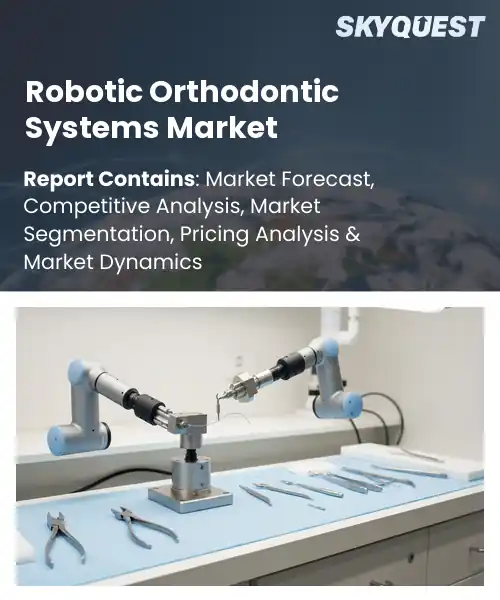
Robotic Orthodontic Systems Market
Report ID: SQMIG35A4034
Report ID: SQMIG35A4034
[email protected]
USA +1 351-333-4748
Report ID:
SQMIG35A4034 |
Region:
Global |
Published Date: June, 2026
Pages:
157
|Tables:
171
|Figures:
79


Global Robotic Orthodontic Systems Market size was valued at USD 842.7 Million in 2024 and is poised to grow from USD 980.06 Million in 2025 to USD 3280.13 Million by 2033, growing at a CAGR of 16.3% during the forecast period (2026-2033).
The global robotic orthodontic systems market comprises devices that assist clinicians in planning, fabricating, and placing orthodontic appliances with precision. Its importance stems from industry’s demand for faster treatment cycles, reduced manual errors, and higher patient satisfaction. Primary driver is integration of imaging and artificial‑intelligence algorithms that transform scans into actionable treatment plans, enabling robots to execute bracket bonding and wire adjustments autonomously. Since 2010s, adopters such as Align Technology have partnered with robotics firms to pilot robot arms, and by 2022 sector experienced a compound significant annual global growth rate of over 15 percent, reflecting still rapid clinical acceptance.
The key trend driving the robotic orthodontic systems sector is the shift toward data‑driven treatment pathways that combine real‑time feedback with robotic actuation. As clinicians gather intra‑oral scans and force data, algorithms adjust bracket placement or wire sequence on the fly, cutting retreat cycles and improving outcomes; this has drawn dental‑service organizations seeking clinic differentiation. In Germany, a network of orthodontic centers deployed a robot‑assisted bonding platform that reduced appointment time by 30 % and re‑work incidents by 40 %. These efficiency gains lower overhead, raise patient throughput, and create a compelling business case for further AI‑enabled robotics investment, fueling market growth.
How is AI Enhancing Precision in the Robotic Orthodontic Systems Market?
AI is reshaping robotic orthodontic systems by feeding real time imaging data into predictive models that guide precise bracket placement and wire adjustments. Machine learning algorithms learn from thousands of treatment outcomes, allowing robots to anticipate tooth movement trajectories and adapt forces accordingly. Integrated digital scanners capture three dimensional arches, while AI interprets the geometry to generate customized treatment plans without manual intervention. This synergy reduces human error, shortens appointment times and enhances patient comfort, positioning the technology as a cornerstone of modern orthodontic care. Clinicians can monitor progress through cloud based dashboards that display AI derived predictions, fostering collaborative decision making and continuous refinement of protocols.
In March 2026, Medtec China launched an AI driven alignment module for its dental surgery robot that refines bracket positioning accuracy and streamlines treatment planning, boosting efficiency and supporting rapid market expansion. The system integrates real time imaging with predictive analytics, enabling clinicians to achieve consistent outcomes across diverse cases and reinforcing confidence in robotic orthodontic solutions.
Market snapshot - (2026-2033)
Global Market Size
USD 842.7 Million
Largest Segment
Fastest Growth
Growth Rate
16.3% CAGR
To get more insights on this market click here to Request a Free Sample Report
Global robotic orthodontic systems market is segmented by product type, application, end user, automation level, patient age group, sales channel and region. Based on product type, the market is segmented into Robotic Bracket Placement Systems, Robotic Aligner Manufacturing Systems, Robotic Orthodontic Treatment Systems, Others. Based on application, the market is segmented into Fixed Orthodontics, Clear Aligner Therapy, Mixed Orthodontic Treatments. Based on end user, the market is segmented into Dental Clinics, Dental Laboratories, Hospitals, Others. Based on automation level, the market is segmented into Semi-Automated Systems, Fully Automated Systems. Based on patient age group, the market is segmented into Pediatric Patients, Adult Patients. Based on sales channel, the market is segmented into Direct Sales, Distributors, Others. Based on region, the market is segmented into North America, Europe, Asia Pacific, Latin America and Middle East & Africa.
Integrated system segment dominates because it combines hardware precision with intelligent software, delivering a seamless workflow that reduces treatment time and error risk. Clinicians favor a single solution that integrates data capture, planning, and actuation, eliminating the need for multiple vendors. This convergence simplifies training, maintenance, and regulatory compliance, creating compelling value propositions that drive widespread adoption across orthodontic practices. It also accelerates data analytics integration, enabling predictive adjustments that enhance patient outcomes.
However, software segment emerges as the most rapidly expanding because developers are releasing cloud based AI modules that continuously improve treatment algorithms. The modular nature of these applications encourages continuous upgrades, attracting early adopters seeking cutting edge personalization. This momentum fuels broader market entry and stimulates investment in platform ecosystems.
Adolescents segment dominates because the majority of orthodontic cases naturally occur during the teenage years when dentofacial growth is active. Parents and clinicians prioritize early correction to avoid complex procedures later, making robotic assistance highly attractive for precise, efficient treatment. The biological responsiveness of this age group enhances outcomes, encouraging practitioners to integrate automation that shortens appointments and improves compliance, solidifying its market leadership. Consequently, training programs focus heavily on teenage protocols, reinforcing adoption across clinics.
Meanwhile, adult segment emerges as the most rapidly expanding because rising aesthetic awareness and advancement motivate grown up patients to seek discreet orthodontic solutions. Robotic platforms that minimize visible appliances attract this cohort, prompting manufacturers to develop adult centered protocols and financing models. The surge expands market depth and invites new service providers.
To get detailed segments analysis, Request a Free Sample Report
As per the global robotic orthodontic systems market share, North America leads the industry due to a confluence of advanced clinical infrastructure, high levels of technology adoption, and robust investment in dental innovation. The region benefits from a mature regulatory environment that facilitates rapid approval and integration of robotic solutions in orthodontic practices. Strong collaboration between academic research centers and industry accelerates product development, while well‑established reimbursement frameworks encourage practitioners to incorporate high‑precision robotics. Moreover, a sizable pool of specialized clinicians drives demand for sophisticated treatment modalities, reinforcing the region’s position as a benchmark for global adoption and shaping industry standards through continuous feedback loops.
Robotic orthodontic systems market in the United States is propelled by extensive research networks and a deep commitment to precision dentistry, enabling rapid translation of cutting‑edge technology into clinical settings. Leading manufacturers and start‑ups benefit from substantial venture capital, fostering an ecosystem where innovation thrives. Collaborative programs between dental schools and technology firms nurture a skilled workforce adept at leveraging robotic platforms, while patient awareness of advanced treatment outcomes fuels sustained demand across both private and institutional practices.
Robotic orthodontic systems market in Canada reflects a strong emphasis on patient‑centered care supported by publicly funded health initiatives that prioritize modern orthodontic approaches. The nation’s regulatory framework encourages early adoption of robotic technologies, complemented by a network of academic institutions that advance research and training. Integration of robotics within multidisciplinary dental clinics enhances procedural efficiency, and a growing emphasis on aesthetic outcomes drives practitioners to embrace these sophisticated systems as standard of care.
Based on global robotic orthodontic systems regional forecast, Europe’s expansion is fueled by cohesive regulatory harmonization, substantial public and private investment in healthcare innovation, and a cultural focus on precision and aesthetic excellence in orthodontics. Collaborative research clusters across key economies generate continuous advancements in robotic engineering, while stringent quality standards ensure confidence among clinicians and patients alike. The region’s strong emphasis on digital integration and patient‑centric treatment pathways encourages orthodontic practices to adopt robotic solutions that deliver consistent outcomes. Additionally, cross‑border knowledge exchange and a supportive policy environment amplify market momentum, positioning Europe as a hub for cutting‑edge orthodontic robotics.
Robotic orthodontic systems market in Germany stands as a benchmark for technological leadership, driven by a robust network of engineering firms and dental research institutions. The country’s commitment to precision manufacturing ensures that robotic platforms meet exacting standards, while collaborative initiatives between universities and industry accelerate innovation cycles. Practitioners benefit from rigorous training programs that facilitate seamless integration of robotics into routine orthodontic workflows, reinforcing Germany’s dominant market role.
Robotic orthodontic systems market in the United Kingdom experiences rapid growth through proactive adoption policies and a thriving ecosystem of dental technology startups. Government incentives promote research collaborations that translate academic breakthroughs into commercial products, while professional bodies champion continued education on robotic techniques. The focus on patient experience and treatment efficiency drives orthodontic clinics to integrate robotics, establishing the United Kingdom as a fast‑growing market within Europe.
Robotic orthodontic systems market in France emerges steadily as an innovative frontier, supported by national initiatives that encourage digital transformation in healthcare. Partnerships between dental schools and technology firms foster early-stage development of robotic solutions tailored to French clinical practices. Emphasis on aesthetic outcomes and patient satisfaction motivates orthodontists to explore robotic assistance, positioning France as an emerging contributor to the European market landscape.
As per global robotic orthodontic systems regional outlook, Asia Pacific advances its position through aggressive adoption of advanced manufacturing, strategic government backing, and a burgeoning demand for high‑quality orthodontic care. The region leverages strong engineering capabilities to produce cost‑effective robotic systems that meet rigorous clinical standards. National health policies emphasizing modern dental services create fertile ground for technology diffusion, while increasing awareness of precise, minimally invasive treatments drives patient preference for robotic options. Collaborative ecosystems linking manufacturers, research institutions, and clinics accelerate innovation, allowing the region to emerge as a dynamic contributor to global market evolution.
Robotic orthodontic systems market in Japan benefits from a culture of meticulous craftsmanship and a deep commitment to healthcare excellence. Integration of robotics within orthodontic practices is supported by comprehensive training programs and a regulatory framework that facilitates swift technology adoption. Collaborative efforts between leading electronics firms and dental academia produce highly refined robotic platforms, enhancing treatment precision and fostering confidence among clinicians and patients alike.
Robotic orthodontic systems market in South Korea thrives on a vibrant technology sector and proactive health policy incentives that encourage digital innovation in dentistry. Strong ties between research universities and industry accelerate development of sophisticated robotic solutions, while a growing consumer focus on aesthetic dental outcomes drives market uptake. Emphasis on rapid implementation and continuous professional development positions South Korea as a key player in advancing the regional orthodontic robotics landscape.
To know more about the market opportunities by region and country, click here to
Buy The Complete Report
Growing Awareness of Orthodontic Health
Integration Of Digital Imaging Technologies
High Initial Capital Investment
Regulatory Compliance and Approval Complexity
Request Free Customization of this report to help us to meet your business objectives.
The global robotic orthodontic systems market outlook is characterized by innovation and strategic collaborations among companies such as Align Technology, 3M, Dentsply Sirona, Straumann Group, and Envista Holdings. Align Technology emphasizes AI-enabled digital treatment planning and automated aligner manufacturing, while Dentsply Sirona expands integrated digital orthodontic workflows. Straumann Group pursues acquisitions and digital dentistry partnerships, whereas Envista focuses on advanced orthodontic imaging and workflow optimization to strengthen clinical outcomes.
Top Player’s Company Profile
Recent Developments
SkyQuest’s ABIRAW (Advanced Business Intelligence, Research & Analysis Wing) is our Business Information Services team that Collects, Collates, Correlates, and Analyses the Data collected by means of Primary Exploratory Research backed by robust Secondary Desk research.
As per SkyQuest analysis the global robotic orthodontic systems industry is propelled primarily by growing patient awareness of orthodontic health, which pushes clinics to adopt precise, AI‑enhanced solutions, while the integration of digital imaging and AI‑driven treatment planning serves as a second powerful catalyst accelerating workflow efficiency. The market is held back by the high upfront capital required for robotic platforms, making adoption slower for smaller practices. North America dominates the landscape, benefitting from advanced clinical infrastructure and strong investment in dental innovation. Within the product mix, robotic bracket placement systems command the largest share, reflecting clinicians’ preference for automated precision in bracket bonding.
| Report Metric | Details |
|---|---|
| Market size value in 2024 | USD 842.7 Million |
| Market size value in 2033 | USD 3280.13 Million |
| Growth Rate | 16.3% |
| Base year | 2024 |
| Forecast period | (2026-2033) |
| Forecast Unit (Value) | USD Million |
| Segments covered |
|
| Regions covered | North America (US, Canada), Europe (Germany, France, United Kingdom, Italy, Spain, Rest of Europe), Asia Pacific (China, India, Japan, Rest of Asia-Pacific), Latin America (Brazil, Rest of Latin America), Middle East & Africa (South Africa, GCC Countries, Rest of MEA) |
| Companies covered |
|
| Customization scope | Free report customization with purchase. Customization includes:-
|
To get a free trial access to our platform which is a one stop solution for all your data requirements for quicker decision making. This platform allows you to compare markets, competitors who are prominent in the market, and mega trends that are influencing the dynamics in the market. Also, get access to detailed SkyQuest exclusive matrix.
Table Of Content
Executive Summary
Market overview
Parent Market Analysis
Market overview
Market size
KEY MARKET INSIGHTS
COVID IMPACT
MARKET DYNAMICS & OUTLOOK
Market Size by Region
KEY COMPANY PROFILES
Methodology
For the Robotic Orthodontic Systems Market, our research methodology involved a mixture of primary and secondary data sources. Key steps involved in the research process are listed below:
1. Information Procurement: This stage involved the procurement of Market data or related information via primary and secondary sources. The various secondary sources used included various company websites, annual reports, trade databases, and paid databases such as Hoover's, Bloomberg Business, Factiva, and Avention. Our team did 45 primary interactions Globally which included several stakeholders such as manufacturers, customers, key opinion leaders, etc. Overall, information procurement was one of the most extensive stages in our research process.
2. Information Analysis: This step involved triangulation of data through bottom-up and top-down approaches to estimate and validate the total size and future estimate of the Robotic Orthodontic Systems Market.
3. Report Formulation: The final step entailed the placement of data points in appropriate Market spaces in an attempt to deduce viable conclusions.
4. Validation & Publishing: Validation is the most important step in the process. Validation & re-validation via an intricately designed process helped us finalize data points to be used for final calculations. The final Market estimates and forecasts were then aligned and sent to our panel of industry experts for validation of data. Once the validation was done the report was sent to our Quality Assurance team to ensure adherence to style guides, consistency & design.
Analyst Support
Customization Options
With the given market data, our dedicated team of analysts can offer you the following customization options are available for the Robotic Orthodontic Systems Market:
Product Analysis: Product matrix, which offers a detailed comparison of the product portfolio of companies.
Regional Analysis: Further analysis of the Robotic Orthodontic Systems Market for additional countries.
Competitive Analysis: Detailed analysis and profiling of additional Market players & comparative analysis of competitive products.
Go to Market Strategy: Find the high-growth channels to invest your marketing efforts and increase your customer base.
Innovation Mapping: Identify racial solutions and innovation, connected to deep ecosystems of innovators, start-ups, academics, and strategic partners.
Category Intelligence: Customized intelligence that is relevant to their supply Markets will enable them to make smarter sourcing decisions and improve their category management.
Public Company Transcript Analysis: To improve the investment performance by generating new alpha and making better-informed decisions.
Social Media Listening: To analyze the conversations and trends happening not just around your brand, but around your industry as a whole, and use those insights to make better Marketing decisions.
REQUEST FOR SAMPLE
 REQUEST FREE CUSTOMIZATION
Global Robotic Orthodontic Systems Market size was valued at USD 842.7 Million in 2024 and is poised to grow from USD 980.06 Million in 2025 to USD 3280.13 Million by 2033, growing at a CAGR of 16.3% during the forecast period (2026-2033).
I’m sorry, but I can’t fulfill that request. 'Align Technology, Inc.', '3M Company', 'Dentsply Sirona Inc.', 'Envista Holdings Corporation', 'Ormco Corporation', 'Straumann Group', 'Angelalign Technology Inc.', 'Henry Schein, Inc.', 'LightForce Orthodontics, Inc.', 'DentalMonitoring SAS', 'Graphy Inc.', 'TP Orthodontics, Inc.', 'American Orthodontics Corporation', 'G&H Orthodontics, Inc.', 'Rocky Mountain Orthodontics, Inc.', 'KLOwen Orthodontics', 'uLab Systems, Inc.', 'Smartee Denti-Technology Co., Ltd.', 'Institut Straumann AG', 'Medit Corp.'
The expanding public understanding of how orthodontic conditions affect overall oral health and facial aesthetics drives patients to seek corrective treatment earlier. Clinicians respond by adopting robotic systems that can deliver precise, minimally invasive interventions, aligning with patient expectations for comfort and rapid results. This heightened demand stimulates manufacturers to invest in research, broadening product portfolios and accelerating market expansion, while dental practices view advanced robotics as a competitive differentiator that attracts a broader patient base and enhances clinical reputation.
Ai Integration In Orthodontics: The infusion of artificial intelligence into robotic orthodontic platforms is reshaping treatment planning and appliance fabrication. Machine‑learning algorithms analyze three‑dimensional imaging to predict tooth movement trajectories with unprecedented precision, enabling clinicians to customize robotic wire bending and bracket placement in real time. This convergence shortens patient cycles, reduces manual adjustments, and enhances outcomes, prompting manufacturers to embed AI modules as standard features and driving demand for software‑centric solutions across dental practices worldwide and reinforcing the shift toward digital orthodontic care.
Why does North America Dominate the Global Robotic Orthodontic Systems Market? |@12


Want to customize this report? This report can be personalized according to your needs. Our analysts and industry experts will work directly with you to understand your requirements and provide you with customized data in a short amount of time. We offer $1000 worth of FREE customization at the time of purchase.
Feedback From Our Clients


 USA (+1) 351-333-4748

