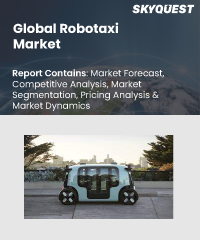
Robotaxi Market
Report ID: SQMIG25A2451
Report ID: SQMIG25A2451
sales@skyquestt.com
USA +1 351-333-4748
Report ID:
SQMIG25A2451 |
Region:
Global |
Published Date: November, 2025
Pages:
197
|Tables:
88
|Figures:
76


Robotaxi Market size was valued at USD 4.84 Billion in 2025 and is poised to grow from USD 5.76 Billion in 2026 to USD 693.84 Billion by 2033, growing at a CAGR of 86% during the forecast period (2025–2033).
The robotaxi market is undergoing significant transformation as autonomous vehicle technologies mature and begin to enter commercial deployment. These self-driving taxis are poised to redefine urban transportation by offering safer, more efficient, and eco-friendly mobility solutions.
Environmental sustainability is also a key factor fueling the robotaxi market. Many robotaxis are electric or hybrid, supporting global efforts to reduce greenhouse gas emissions and transition to cleaner transportation systems. This shift aligns well with government policies encouraging carbon neutrality and the adoption of zero-emission vehicles. As cities struggle with congestion and pollution, robotaxis offer an appealing alternative by potentially reducing the number of privately owned vehicles and optimizing traffic flow through shared mobility models.
Additionally, the Robotaxis' lower costs when compared to traditional taxi services or owning a private vehicle, as well as the growth of ridesharing and Mobility-as-a-Service (MaaS) trends, are enticing more people to use them. The growing focus on sustainability, the necessity for efficient urban transit, and better safety as a result of eliminating human error are further factors that are driving the need for robotaxis. In various aspects, robotaxis can potentially lower total operating costs and boost profit margins for ridesharing businesses.
How Is AI Driving Market Transformation Across Industries?
AI is significantly impacting markets across industries by enhancing efficiency, enabling personalization, driving innovation, and opening new revenue streams.
AI’s influence on markets is multifaceted, affecting everything from product innovation to customer experience and operational efficiency. By automating complex tasks, analyzing vast datasets, and enabling predictive insights, AI helps businesses reduce costs, increase agility, and unlock new revenue streams.
For instance, in April 2024, Waymo announced the expansion of its autonomous ride-hailing services to Los Angeles after successful operations in San Francisco and Phoenix. Similarly, Cruise, backed by General Motors, revealed its collaboration with Honda to deploy robotaxi services in Japan by 2026. These AI-powered vehicles use advanced machine learning models to interpret traffic data, pedestrian behavior, and road conditions in real time—reducing human error and enabling 24/7 operations.
Market snapshot - 2025-2033
Global Market Size
USD 1.4 Billion
Largest Segment
Car Rental
Fastest Growth
Station-based
Growth Rate
86% CAGR
To get more insights on this market click here to Request a Free Sample Report
The robotaxi market is segmented into component type, vehicle type, level of autonomy, application and region. Based on component type, the market is segmented into camera, radar, LIDAR and ultrasonic sensors. Based on vehicle type, the market is segmented into cars and shuttles/vans. Based on level of autonomy, the market is segmented into level 4 and level 5. Based on service type, the market is segmented into car rental and station-based. Based on application, the market is segmented into goods transportation and passenger transportation. Based on region, the market is segmented into North America, Asia-Pacific, Europe, Latin America, and Middle East & Africa.
Cameras are currently the dominant segment in the robotaxi market due to several compelling reasons. They provide high-resolution visual data essential for detecting and classifying objects like pedestrians, vehicles, and traffic signs, enabling safe and accurate navigation. Advances in artificial intelligence and computer vision have significantly enhanced the ability to process camera data, improving reliability even in complex environments. Additionally, cameras are versatile, performing multiple functions such as lane detection and traffic signal recognition simultaneously, which simplifies sensor integration.
As per the global robotaxi market forecast, LIDAR segment is the fastest growing in the market. LIDAR offers precise 3D mapping and distance measurement, enabling vehicles to detect objects and their spatial positions accurately, even in low-light or poor weather conditions where cameras may struggle. Recent advances have reduced LIDAR costs and size, accelerating its adoption. As autonomous vehicle systems require more reliable and robust perception capabilities, LIDAR’s role is expanding rapidly, particularly in high-level autonomy applications.
As per the global robotaxi market analysis, car rental segment currently dominates the market. This dominance is because car rental models offer greater flexibility and convenience to users, allowing them to book and use vehicles on-demand without needing to return them to fixed locations. This door-to-door service model aligns perfectly with modern urban mobility preferences, where convenience and time efficiency are critical. Additionally, car rental services reduce the need for extensive parking infrastructure since vehicles remain in use throughout the day, increasing fleet utilization rates and operator profitability.
As per the global robotaxi market outlook, the station-based segment is experiencing faster growth. As infrastructure for autonomous vehicles develops, station-based models benefit from centralized charging, maintenance, and easier fleet management. This makes station-based robotaxis more efficient and cost-effective for operators, especially in early adoption phases and controlled urban environments. The growth is driven by increasing investments in dedicated hubs and smart parking zones supporting these vehicles.
To get detailed segments analysis, Request a Free Sample Report
North America holds a significant market share in the robotaxi market, driven by advanced infrastructure, supportive regulatory frameworks, and substantial investment from technology firms. The region is home to some of the most prominent players in autonomous driving and benefits from a robust ecosystem of AI and mobility startups. Testing and deployment regulations are relatively mature, allowing for rapid innovation and early pilot deployments.
As per regional forecast, the U.S. leads the region, with cities like San Francisco, Phoenix, and Austin becoming key hubs for robotaxi trials. Companies are aggressively testing and gradually rolling out autonomous services. The U.S. government’s openness to innovation, coupled with consumer curiosity, fuels market momentum. Federal and state-level guidelines are becoming clearer, supporting the safe integration of robotaxis into public transportation.
As per regional outlook, Canada is emerging as a promising robotaxi market, particularly in cities like Toronto and Vancouver, where smart mobility projects are underway. The Canadian government supports clean and innovative transportation technologies, and partnerships between tech firms and universities are contributing to the development of advanced self-driving systems. Although deployment is in earlier stages compared to the U.S., the groundwork is being laid for future expansion.
As per industry analysis, Asia-Pacific is rapidly advancing in the robotaxi market due to rising urbanization, traffic congestion, and strong government backing for autonomous vehicle initiatives. The region's emphasis on technological leadership and smart city development makes it a strategic hub for autonomous mobility innovations.
Japan is investing heavily in robotaxi development to address its aging population and labor shortages. Trials are being conducted in both urban and rural areas. The government is actively shaping a policy to integrate autonomous vehicles into public transport, especially ahead of major global events like the Osaka Expo 2025.
South Korea is fast-tracking robotaxi adoption through government-funded pilot projects and smart mobility zones in cities like Seoul and Sejong. Leading tech companies are developing and testing autonomous vehicles, supported by 5G infrastructure and AI innovation. The government has prioritized autonomous vehicle technology as a key part of its future transportation strategy, investing heavily in infrastructure improvements such as widespread 5G network coverage and advanced AI research centers.
Europe is steadily advancing in the robotaxi sector with a strong emphasis on environmental sustainability, urban mobility solutions, and rigorous safety standards. EU-wide initiatives and funding are supporting research and early-stage deployment of autonomous transport solutions.
Germany stands out as a European leader in autonomous mobility, backed by its powerful automotive industry. The country is fostering innovation through collaboration between automakers, tech startups, and universities. Legal frameworks introduced in recent years allow for autonomous vehicles on certain public roads, facilitating real-world testing.
The UK is fostering a supportive ecosystem for autonomous driving through initiatives like CAM Testbed UK, offering comprehensive testing facilities. Government-backed trials are active in cities like London and Oxford. The UK's strategic approach to regulation and investment is enabling gradual commercialization of robotaxis.
Italy is making progress through smart mobility pilot projects and public-private collaborations. While it is a relatively nascent market for robotaxis, cities like Milan and Turin are participating in EU-funded AV projects. The focus is on integrating robotaxis into sustainable urban mobility plans to reduce congestion and emissions.
To know more about the market opportunities by region and country, click here to
Buy The Complete Report
Rapid Advances in Autonomous Driving Technology
Growing Urbanization and Demand for Efficient Mobility Solutions
Regulatory and Safety Concerns
High Operational and Infrastructure Costs
Request Free Customization of this report to help us to meet your business objectives.
The competitive landscape of the global robotaxi industry in 2024 is marked by intense rivalry among automotive manufacturers, technology giants, and innovative startups, all striving to establish leadership in autonomous mobility services. Major players like Waymo, Cruise, and Baidu continue to refine their autonomous driving technologies and expand pilot programs in key urban markets, focusing on safety enhancements and customer experience. In 2024, several companies have strategically formed partnerships to accelerate commercialization and scale operations efficiently.
As per market strategies, in March 2024, Cruise partnered with Walmart to integrate robotaxi services for last-mile delivery, blending passenger transport with logistics to maximize vehicle utilization.
The robotaxi market is being energized by a wave of innovative startups aiming to transform urban mobility through autonomous vehicle technology. These companies are leveraging breakthroughs in artificial intelligence, machine learning, and sensor fusion to develop self-driving taxi services that promise safer, more efficient, and cost-effective transportation. Focused on reducing human error and improving traffic flow, these startups are piloting services in both controlled and real-world environments.
SkyQuest’s ABIRAW (Advanced Business Intelligence, Research & Analysis Wing) is our Business Information Services team that Collects, Collates, Correlates, and Analyses the Data collected by means of Primary Exploratory Research backed by robust Secondary Desk research.
As per SkyQuest analysis, key drivers of market growth include rising demand for autonomous mobility solutions and technological advancements in AI and sensors. The growing need for convenient and secure transportation is the main factor propelling the robotaxi market. The growing adoption of fuel-efficient and emission-free vehicles is a major market trend witnessed in the global market. The increasing imposition of stringent emission norms has enabled manufacturers to develop fuel-cell-based and electric vehicles. Deploying a full-fledged robotaxi service requires high investments because components such as ultrasonic sensors, cameras, and LiDAR are expensive. Technological advancements and developed & supportive infrastructure have helped the fleet operators to test and deploy easily in this region. The European Commission encourages global technology standardization and provides funds for R&D to increase the competitiveness of the EU automobile industry and maintain its position as a technological leader worldwide. The utilization of these services for autonomous cars and robotaxis is expected to be one of the key attractions for consumers to accept their services.
| Report Metric | Details |
|---|---|
| Market size value in 2025 | USD 4.84 Billion |
| Market size value in 2033 | USD 693.84 Billion |
| Growth Rate | 86% |
| Base year | 2024 |
| Forecast period | 2025-2033 |
| Forecast Unit (Value) | USD Billion |
| Segments covered |
|
| Regions covered | North America (US, Canada), Europe (Germany, France, United Kingdom, Italy, Spain, Rest of Europe), Asia Pacific (China, India, Japan, Rest of Asia-Pacific), Latin America (Brazil, Rest of Latin America), Middle East & Africa (South Africa, GCC Countries, Rest of MEA) |
| Companies covered |
|
| Customization scope | Free report customization with purchase. Customization includes:-
|
To get a free trial access to our platform which is a one stop solution for all your data requirements for quicker decision making. This platform allows you to compare markets, competitors who are prominent in the market, and mega trends that are influencing the dynamics in the market. Also, get access to detailed SkyQuest exclusive matrix.
Table Of Content
Executive Summary
Market overview
Parent Market Analysis
Market overview
Market size
KEY MARKET INSIGHTS
COVID IMPACT
MARKET DYNAMICS & OUTLOOK
Market Size by Region
KEY COMPANY PROFILES
Methodology
For the Robotaxi Market, our research methodology involved a mixture of primary and secondary data sources. Key steps involved in the research process are listed below:
1. Information Procurement: This stage involved the procurement of Market data or related information via primary and secondary sources. The various secondary sources used included various company websites, annual reports, trade databases, and paid databases such as Hoover's, Bloomberg Business, Factiva, and Avention. Our team did 45 primary interactions Globally which included several stakeholders such as manufacturers, customers, key opinion leaders, etc. Overall, information procurement was one of the most extensive stages in our research process.
2. Information Analysis: This step involved triangulation of data through bottom-up and top-down approaches to estimate and validate the total size and future estimate of the Robotaxi Market.
3. Report Formulation: The final step entailed the placement of data points in appropriate Market spaces in an attempt to deduce viable conclusions.
4. Validation & Publishing: Validation is the most important step in the process. Validation & re-validation via an intricately designed process helped us finalize data points to be used for final calculations. The final Market estimates and forecasts were then aligned and sent to our panel of industry experts for validation of data. Once the validation was done the report was sent to our Quality Assurance team to ensure adherence to style guides, consistency & design.
Analyst Support
Customization Options
With the given market data, our dedicated team of analysts can offer you the following customization options are available for the Robotaxi Market:
Product Analysis: Product matrix, which offers a detailed comparison of the product portfolio of companies.
Regional Analysis: Further analysis of the Robotaxi Market for additional countries.
Competitive Analysis: Detailed analysis and profiling of additional Market players & comparative analysis of competitive products.
Go to Market Strategy: Find the high-growth channels to invest your marketing efforts and increase your customer base.
Innovation Mapping: Identify racial solutions and innovation, connected to deep ecosystems of innovators, start-ups, academics, and strategic partners.
Category Intelligence: Customized intelligence that is relevant to their supply Markets will enable them to make smarter sourcing decisions and improve their category management.
Public Company Transcript Analysis: To improve the investment performance by generating new alpha and making better-informed decisions.
Social Media Listening: To analyze the conversations and trends happening not just around your brand, but around your industry as a whole, and use those insights to make better Marketing decisions.
REQUEST FOR SAMPLE
 REQUEST FREE CUSTOMIZATION
Robotaxi Market size was valued at USD 2.6 Billion in 2024 and is poised to grow from USD 4.84 Billion in 2025 to USD 693.84 Billion by 2033, growing at a CAGR of 86% in the forecast period 86%.
The competitive landscape of the global robotaxi industry in 2024 is marked by intense rivalry among automotive manufacturers, technology giants, and innovative startups, all striving to establish leadership in autonomous mobility services. Major players like Waymo, Cruise, and Baidu continue to refine their autonomous driving technologies and expand pilot programs in key urban markets, focusing on safety enhancements and customer experience. In 2024, several companies have strategically formed partnerships to accelerate commercialization and scale operations efficiently. 'Uber', 'WeRide', 'Tesla, Inc.', 'Waymo (Alphabet Inc.)', 'Cruise (General Motors)', 'Baidu Apollo', 'Pony.ai', 'AutoX', 'Aurora Innovation Inc.', 'Zoox (Amazon)', 'WeRide', 'Motional (Aptiv & Hyundai joint venture)', 'DiDi Autonomous Driving', 'Nuro, Inc.'
Technological breakthroughs in artificial intelligence, machine learning, and sensor fusion are fundamentally transforming autonomous vehicles. Improvements in LiDAR, radar, and camera sensors now allow robotaxis to perceive their surroundings with high accuracy, enabling safe navigation even in complex urban environments with heavy traffic and pedestrians. Furthermore, sophisticated AI software processes massive data in real time, improving decision-making and route optimization.
Integration of AI with Ride-Hailing Platforms: An increasing number of autonomous vehicle developers are collaborating with established ride-hailing companies like Uber, Lyft, and Didi. This integration allows robotaxis to enter an existing user base with mature booking, payment, and customer service systems, accelerating adoption. Leveraging AI, these platforms optimize fleet dispatching, reduce wait times, and personalize the user experience based on data analytics. This synergy enhances operational efficiency, lowers costs, and improves scalability, making autonomous ride services more attractive to customers.
North America holds a significant market share in the robotaxi market, driven by advanced infrastructure, supportive regulatory frameworks, and substantial investment from technology firms. The region is home to some of the most prominent players in autonomous driving and benefits from a robust ecosystem of AI and mobility startups. Testing and deployment regulations are relatively mature, allowing for rapid innovation and early pilot deployments.


Want to customize this report? This report can be personalized according to your needs. Our analysts and industry experts will work directly with you to understand your requirements and provide you with customized data in a short amount of time. We offer $1000 worth of FREE customization at the time of purchase.
Feedback From Our Clients


 USA (+1) 351-333-4748

