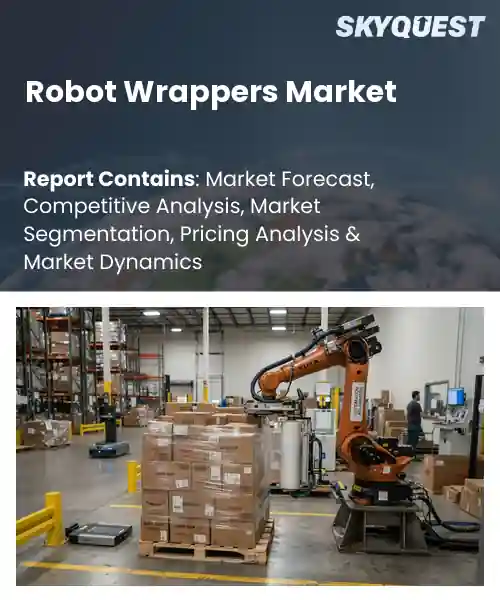
Robot Wrappers Market
Report ID: SQMIG20I3774
Report ID: SQMIG20I3774
[email protected]
USA +1 351-333-4748
Report ID:
SQMIG20I3774 |
Region:
Global |
Published Date: August, 2026
Pages:
157
|Tables:
173
|Figures:
79


Global Robot Wrappers Market size was valued at USD 2.14 Billion in 2024 and is poised to grow from USD 2.34 Billion in 2025 to USD 4.81 Billion by 2033, growing at a CAGR of 9.4% during the forecast period (2026-2033).
The global robot wrappers market comprises automated systems that encase products in protective films, a technology that has become essential for high‑speed assembly lines. Its importance stems from the ability to increase throughput while reducing labor costs and material waste, a combination that has driven manufacturers to replace manual wrapping stations. Originating in the early 2000s for food packaging, the sector expanded rapidly as vision‑guided robots and AI‑controlled grippers allowed precise tension control and quick changeovers. Companies such as Amada and ABB illustrate this evolution, moving from simple pneumatic wrappers to fully integrated solutions that synchronize with global planning systems. Another pivotal factor fueling growth is the surge in e‑commerce fulfillment centers that demand rapid, adaptable packaging to meet variable order sizes. As online retailers push for same‑day delivery, robot wrappers enable flexible changeover times and maintain consistent seal quality, directly reducing order‑processing bottlenecks. This capability has attracted logistics giants such as Amazon, which deploys collaborative robots to wrap heterogeneous SKUs without halting conveyor flow. The resulting efficiency gains translate into lower per‑unit labor expense and heightened product protection, encouraging further investment in IoT‑connected wrappers that feed real‑time performance data into supply‑chain analytics platforms to enable continuous improvement across operations.
How is AI-driven automation influencing growth in the robot wrappers market?
AI-driven automation is reshaping the robot wrappers market by enabling faster decision‑making, adaptive handling of varied product shapes, and continuous optimization of stretch tension. Machine‑learning algorithms analyze sensor data in real time, allowing robots to adjust wrapping patterns without manual reprogramming. This reduces downtime and improves consistency across high‑volume lines. As factories adopt smarter vision systems and predictive maintenance, the technology not only boosts throughput but also extends equipment life, making automation more attractive to manufacturers seeking lean operations. The convergence of AI with robotics is therefore a key catalyst for expanding market adoption and driving competitive differentiation.In March 2026, a leading robot wrapper manufacturer introduced an AI‑enhanced control platform, demonstrating how intelligent automation can streamline packaging cycles and improve overall efficiency.
Market snapshot - (2026-2033)
Global Market Size
USD 2.14 Billion
Largest Segment
Automatic Robot Wrappers
Fastest Growth
Autonomous Mobile Robot Wrappers
Growth Rate
9.4% CAGR
To get more insights on this market click here to Request a Free Sample Report
Global robot wrappers market is segmented by product type, application, end user, film type, mobility, sales channel and region. Based on product type, the market is segmented into Semi-Automatic Robot Wrappers, Automatic Robot Wrappers, Autonomous Mobile Robot Wrappers and Others. Based on application, the market is segmented into Pallet Wrapping, Industrial Packaging, Warehouse Logistics and Others. Based on end user, the market is segmented into Manufacturing, Food & Beverage, Logistics & Warehousing and Others. Based on film type, the market is segmented into Stretch Film, Pre-Stretched Film and Others. Based on mobility, the market is segmented into Battery Powered and Electric Powered. Based on sales channel, the market is segmented into Direct Sales, Packaging Equipment Distributors and Others. Based on region, the market is segmented into North America, Europe, Asia Pacific, Latin America and Middle East & Africa.
Automatic Robot Wrappers segment dominates because it combines high speed operation with precise load handling, meeting the efficiency demands of modern production lines. Its integration with advanced control systems allows seamless coordination with existing packaging equipment, reducing downtime and labor costs. By delivering consistent wrap quality and supporting a wide range of load sizes, it addresses core operational challenges, making it the preferred choice for manufacturers seeking reliability and scalability.
However, Autonomous Mobile Robot Wrappers segment is witnessing the strongest growth momentum because its flexibility enables on demand wrapping across dispersed workstations without fixed infrastructure. Emerging adoption of collaborative fleets and AI driven navigation enhances responsiveness to fluctuating demand, unlocking new efficiency gains and expanding the market’s reach into dynamic production environments.
Pre Stretched Film segment dominates because it eliminates the need for on machine stretching, delivering faster cycle times and lower energy consumption. By providing consistent tension, it enhances wrap integrity and reduces material waste, aligning with sustainability targets. Its compatibility with diverse load shapes and seamless integration with both semi automatic and automatic wrappers make it a strategic choice for operations focused on throughput and cost efficiency.
Meanwhile, Stretch Film segment is emerging as the key high growth area because its simplicity and upfront cost attract small to medium enterprises seeking quick deployment. Advances in film elasticity and adhesive technologies extend its applicability to heavier loads, while rising awareness of automation drives demand, positioning it as a catalyst for broader market adoption.
To get detailed segments analysis, Request a Free Sample Report
Asia Pacific leverages a confluence of advanced manufacturing ecosystems, strong industrial automation cultures, and proactive research collaborations that together elevate its leadership in robot wrappers. The region benefits from a deep engineering talent pool that drives continuous innovation in adaptive gripping technologies and intelligent control software. Strategic government initiatives encourage adoption of smart packaging across diverse sectors, reinforcing demand for flexible robotic solutions. Moreover, close proximity of component suppliers and system integrators accelerates time‑to‑market for new designs, fostering a dynamic environment where customization and rapid iteration thrive. These synergistic strengths position Asia Pacific as the epicenter of technological advancement and market influence in robot wrappers.
Robot Wrappers Market in Japan thrives on a heritage of precision engineering coupled with a forward‑looking industrial policy that champions automation in high‑value sectors. Collaborative networks among universities, technology firms, and legacy manufacturers accelerate the development of sophisticated sensor integration and AI‑driven packaging solutions. The emphasis on quality and reliability drives adoption of robot wrappers in electronics and automotive packaging, reinforcing Japan’s reputation for dependable automation. Continuous investment in workforce upskilling ensures a pipeline of expertise that sustains innovation and maintains competitive advantage.
Robot Wrappers Market in South Korea is propelled by a vibrant technology sector that seamlessly blends hardware excellence with cutting‑edge software platforms. Strong governmental support for smart factories encourages enterprises to integrate collaborative robots for flexible packaging operations. The country’s focus on high‑speed manufacturing and lean production principles fuels demand for adaptable robot wrapper systems that can handle varied product geometries. Close ties between semiconductor manufacturers and automation specialists foster rapid prototyping, enabling South Korean firms to swiftly respond to evolving market needs and maintain a robust presence in the global arena.
North America experiences rapid expansion of robot wrappers due to a confluence of consumer‑centric packaging demands, robust investment in automation, and a culture of technological entrepreneurship. Companies prioritize efficiency and consistency, prompting adoption of robotic solutions that can seamlessly integrate with existing production lines. The region’s strong emphasis on data‑driven optimization encourages the deployment of intelligent wrappers equipped with real‑time monitoring and predictive maintenance capabilities. Collaborative ecosystems involving research institutions, equipment manufacturers, and end users foster continuous refinement of flexible gripping mechanisms and vision systems. These dynamics, combined with a proactive regulatory environment that supports innovative packaging, create fertile ground for sustained growth and market leadership in robot wrappers across North America.
Robot Wrappers Market in the United States is characterized by a vigorous ecosystem of innovators that blend advanced robotics with sophisticated software analytics. Leading consumer brands seek scalable solutions that can adapt to diverse product lines, driving demand for versatile robotic wrappers capable of high throughput. Strong venture capital activity fuels the emergence of niche firms specializing in AI‑enhanced gripping and vision technologies, while major manufacturers invest in integrating these advances into large‑scale operations. Collaborative research initiatives between universities and industry accelerate the translation of cutting‑edge concepts into practical packaging systems, reinforcing the United States’ position at the forefront of robotic automation.
Robot Wrappers Market in Canada benefits from a balanced mix of manufacturing expertise and a supportive innovation framework that encourages automation adoption. Industries ranging from food processing to pharmaceuticals value the consistency and hygiene advantages offered by robotic wrapping solutions. Government incentives aimed at enhancing productivity and environmental sustainability motivate firms to transition toward energy‑efficient robot wrappers with smart material handling capabilities. Collaborative clusters linking technology developers, system integrators, and end users nurture a culture of shared learning, enabling Canadian companies to tailor solutions to specific market requirements and reinforce their competitive stance in the robot wrappers landscape.
Europe strengthens its position through a strategic focus on sustainability, collaborative standards, and cross‑border innovation networks that elevate robot wrapper technologies. Emphasis on circular economy principles drives demand for flexible, waste‑reducing packaging solutions, prompting manufacturers to adopt robots that can handle diverse materials with precision. Harmonized regulatory frameworks across member states facilitate the seamless deployment of standardized robotic systems, fostering economies of scale. Robust research collaborations among universities, technology hubs, and industry leaders accelerate advancements in sensor fusion and adaptive control algorithms. This integrated approach, combined with a commitment to high‑quality engineering, consolidates Europe’s role as a key influencer in the evolution of robot wrappers.
Robot Wrappers Market in Germany is underpinned by a legacy of engineering excellence and a strong industrial base that prioritizes precision and reliability. Automotive and chemical sectors drive demand for robust robot wrappers capable of handling complex geometries and high‑speed production environments. Collaborative research institutions partner closely with equipment manufacturers to develop advanced gripping solutions and real‑time quality inspection systems. The German focus on modular design enables seamless integration of robotic wrappers into existing assembly lines, supporting a transition toward highly automated, low‑error packaging processes.
Robot Wrappers Market in the United Kingdom is propelled by a vibrant ecosystem of startups and established manufacturers committed to digital transformation in packaging. The emphasis on smart manufacturing and data analytics encourages the adoption of robot wrappers equipped with predictive monitoring and adaptive control features. Strong ties between academic research centers and industry accelerate the development of innovative vision‑guided systems that enhance accuracy and speed. Collaborative industry forums promote the sharing of best practices, enabling UK firms to implement scalable robotic solutions that meet evolving consumer expectations.
Robot Wrappers Market in France benefits from a strong tradition of design innovation combined with a focus on environmentally responsible packaging. Luxury goods and food industries seek robotic wrappers that can handle delicate products while minimizing material waste. Partnerships between technology clusters and manufacturing firms drive the creation of flexible robotic systems featuring advanced tactile sensing and AI‑driven decision making. Governmental support for sustainable automation further incentivizes the integration of robot wrappers that align with France’s commitment to ecological stewardship and high‑quality production standards.
To know more about the market opportunities by region and country, click here to
Buy The Complete Report
Automation Demand Driving Growth
Adopting Collaborative Robots In Production
High Initial Investment Costs
Regulatory Compliance Challenges
Request Free Customization of this report to help us to meet your business objectives.
The robot wrappers arena is fiercely competitive, driven by rapid AI‑powered automation advances and sizable funding rounds that accelerate product differentiation. Leaders such as Figure AI are injecting advanced vision and adaptive control into stretch‑wrapper systems, while Skild AI is scaling its AI‑optimized robotic platforms, intensifying pressure on incumbents to upgrade hardware and software capabilities. High‑profile investments and strategic alliances are reshaping market share, prompting established manufacturers to pursue joint‑development projects and technology licensing to maintain relevance.
Top Player’s Company Profile
Recent Developments
SkyQuest’s ABIRAW (Advanced Business Intelligence, Research & Analysis Wing) is our Business Information Services team that Collects, Collates, Correlates, and Analyses the Data collected by means of Primary Exploratory Research backed by robust Secondary Desk research. As per SkyQuest analysis, the robot wrappers market is propelled primarily by rising automation demand, as manufacturers seek higher throughput and lower labor costs, while AI‑driven adaptive wrapping provides a second boost by allowing real‑time geometry adjustments and waste reduction. The Automatic Robot Wrappers segment leads the market because it blends speed with precise load handling, delivering reliable performance across diverse lines. Asia Pacific dominates globally, driven by strong engineering talent, supportive policies and dense supply chains. However, high initial investment costs remain a significant restraint, especially for SMEs that must justify long payback periods before committing to advanced wrapper systems.
| Report Metric | Details |
|---|---|
| Market size value in 2024 | USD 2.14 Billion |
| Market size value in 2033 | USD 4.81 Billion |
| Growth Rate | 9.4% |
| Base year | 2024 |
| Forecast period | (2026-2033) |
| Forecast Unit (Value) | USD Billion |
| Segments covered |
|
| Regions covered | North America (US, Canada), Europe (Germany, France, United Kingdom, Italy, Spain, Rest of Europe), Asia Pacific (China, India, Japan, Rest of Asia-Pacific), Latin America (Brazil, Rest of Latin America), Middle East & Africa (South Africa, GCC Countries, Rest of MEA) |
| Companies covered |
|
| Customization scope | Free report customization with purchase. Customization includes:-
|
To get a free trial access to our platform which is a one stop solution for all your data requirements for quicker decision making. This platform allows you to compare markets, competitors who are prominent in the market, and mega trends that are influencing the dynamics in the market. Also, get access to detailed SkyQuest exclusive matrix.
Table Of Content
Executive Summary
Market overview
Parent Market Analysis
Market overview
Market size
KEY MARKET INSIGHTS
COVID IMPACT
MARKET DYNAMICS & OUTLOOK
Market Size by Region
KEY COMPANY PROFILES
Methodology
For the Robot Wrappers Market, our research methodology involved a mixture of primary and secondary data sources. Key steps involved in the research process are listed below:
1. Information Procurement: This stage involved the procurement of Market data or related information via primary and secondary sources. The various secondary sources used included various company websites, annual reports, trade databases, and paid databases such as Hoover's, Bloomberg Business, Factiva, and Avention. Our team did 45 primary interactions Globally which included several stakeholders such as manufacturers, customers, key opinion leaders, etc. Overall, information procurement was one of the most extensive stages in our research process.
2. Information Analysis: This step involved triangulation of data through bottom-up and top-down approaches to estimate and validate the total size and future estimate of the Robot Wrappers Market.
3. Report Formulation: The final step entailed the placement of data points in appropriate Market spaces in an attempt to deduce viable conclusions.
4. Validation & Publishing: Validation is the most important step in the process. Validation & re-validation via an intricately designed process helped us finalize data points to be used for final calculations. The final Market estimates and forecasts were then aligned and sent to our panel of industry experts for validation of data. Once the validation was done the report was sent to our Quality Assurance team to ensure adherence to style guides, consistency & design.
Analyst Support
Customization Options
With the given market data, our dedicated team of analysts can offer you the following customization options are available for the Robot Wrappers Market:
Product Analysis: Product matrix, which offers a detailed comparison of the product portfolio of companies.
Regional Analysis: Further analysis of the Robot Wrappers Market for additional countries.
Competitive Analysis: Detailed analysis and profiling of additional Market players & comparative analysis of competitive products.
Go to Market Strategy: Find the high-growth channels to invest your marketing efforts and increase your customer base.
Innovation Mapping: Identify racial solutions and innovation, connected to deep ecosystems of innovators, start-ups, academics, and strategic partners.
Category Intelligence: Customized intelligence that is relevant to their supply Markets will enable them to make smarter sourcing decisions and improve their category management.
Public Company Transcript Analysis: To improve the investment performance by generating new alpha and making better-informed decisions.
Social Media Listening: To analyze the conversations and trends happening not just around your brand, but around your industry as a whole, and use those insights to make better Marketing decisions.
REQUEST FOR SAMPLE
 REQUEST FREE CUSTOMIZATION


Want to customize this report? This report can be personalized according to your needs. Our analysts and industry experts will work directly with you to understand your requirements and provide you with customized data in a short amount of time. We offer $1000 worth of FREE customization at the time of purchase.
Feedback From Our Clients


 USA (+1) 351-333-4748

