Robot Coffee Kiosk Market
Report ID: SQMIG25Q2029
Report ID: SQMIG25Q2029
[email protected]
USA +1 351-333-4748
Report ID:
SQMIG25Q2029 |
Region:
Global |
Published Date: August, 2026
Pages:
157
|Tables:
168
|Figures:
79


Global Robot Coffee Kiosk Market size was valued at USD 328.6 Million in 2024 and is poised to grow from USD 347.0 Million in 2025 to USD 536.6 Million by 2033, growing at a CAGR of 5.6% during the forecast period (2026-2033).
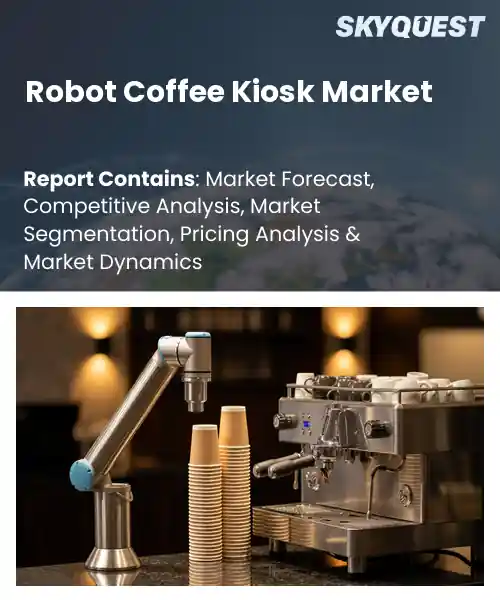
The market for robot coffee kiosks refers to autonomous vending machines which grind the coffee, brew the espresso and pour the drink without requiring any manual intervention. The importance of this market can be attributed to growing consumer demand for quick and contactless services as well as the needs of retailers to reduce their operating expenses. The history of development of this market can be traced back to 2015 when the first pilot project was conducted in a Tokyo train station. Over the years, this market grew due to incorporation of AI-based temperature control and inventory management via cloud technology by the producers of this equipment.
Among many factors that make for worldwide growth, the key one is the combination of IoT connection with sophisticated robots that allow kiosks to individualize orders based on their temperatures and replenishment of stock. Once a device senses a shortage in the amount of beans, it sends an order for a delivery to cut down delays and maintain food quality; this process leads to an increase in sales volumes directly. For example, Starbucks implemented connected kiosks on its corporate campuses and proved that the individualization due to the use of information increases transaction value by fifteen percent.
How is AI-driven Utomation Influencing Adoption Rates of Robot Coffee Kiosks Globally?
Robot coffee kiosks are adopting AI for faster automation owing to its potential to increase efficiency, consistency, personalization, and remote monitoring and management. AI-based and machine learning systems will help to optimize the process of brewing, personalize customers' orders, monitor ingredient usage, and do predictive maintenance without constant presence of personnel. The use of the new technology is especially appealing to areas where there is a shortage of labor and the rates of hospitality industry are growing as unattended kiosks will offer extended or even round-the-clock operations. For instance, South Korea has experienced an explosive growth in number of unattended retail stores due to the lack of labor. Besides, AI-based cloud solutions make it possible to monitor and manage several kiosks at once. The robot coffee kiosks are mostly adopted in airports, shopping centers, office buildings, universities, hospitals, and other busy places, whereas Asia-Pacific has become a center of their adoption. Despite certain obstacles including high initial cost, high maintenance, technical complexity, and customer behavior, the technology makes robot coffee kiosks scalable and data-based automated solution.
Market snapshot - (2026-2033)
Global Market Size
USD 328.6 Million
Largest Segment
Fully Automated Kiosks
Fastest Growth
Semi-Automated Kiosks
Growth Rate
5.6% CAGR
To get more insights on this market click here to Request a Free Sample Report
Global robot coffee kiosk market is segmented by robot type, installation location, beverage type, payment method, end user, deployment model and region. Based on robot type, the market is segmented into Fully Automated Kiosks and Semi-Automated Kiosks. Based on installation location, the market is segmented into Airports, Shopping Malls, Office Buildings and Others. Based on beverage type, the market is segmented into Hot Coffee, Cold Coffee and Specialty Beverages. Based on payment method, the market is segmented into Cashless and Hybrid Payment. Based on end user, the market is segmented into Commercial Operators and Franchise Owners. Based on deployment model, the market is segmented into Owned and Leased. Based on region, the market is segmented into North America, Europe, Asia Pacific, Latin America and Middle East & Africa.
The Fully Automated Kiosks category leads owing to its complete service process that does not involve any manual intervention, ensuring quality service along with fast processing. The capability to offer personalized services using AI, along with real-time stock monitoring, makes it highly attractive for high-footfall sites. In addition, their ability to reduce operator costs makes it an ideal solution for the Robot Coffee Kiosk Market.
However, Semi‑Automated Kiosks segment is witnessing the strongest growth momentum as operators blend robotic precision with human oversight to enhance customization. This hybrid approach addresses emerging consumer demand for artisanal touch while leveraging automation efficiency, spurring wider adoption in niche locations and creating new avenues for market expansion.
The Hot Coffee product line reigns supreme as it meets the fundamental desire for coffee consumers who look for warmth and an energy boost, thereby forming the essence of the value proposition that robots provide. The universal appeal of the product line makes it easy to work on menu engineering so that the robot can be perfected in making coffee with a consistent taste.
Meanwhile, the specialty beverages segment emerges as the key area as consumers pursue novel flavors, plant‑based milks, and seasonal creations. Dispensing technology enables robots to handle recipes, driving experimentation and pricing opportunities. This innovation attracts adventurous patrons and expands the kiosk’s revenue streams, accelerating market expansion and opening pathways for differentiated brand experiences.
To get detailed segments analysis, Request a Free Sample Report
North America is blessed with an established coffee culture coupled with speedy adoption of cutting-edge automation technologies. The most successful coffee franchises and independent sellers focus on efficiency and service experiences, which sets the stage for introducing robots to their business. Established venture capital communities and clusters of technological firms speed up the process of innovation, while the customers’ demand for convenience and contactless transactions drives the development even more. Effective supply chain systems and favorable legislation for innovative retail technologies solidify the position of North America as a leader in robot coffee kiosks.
The Market for Robot Coffee Kiosks in the United States exists due to the combination of high coffee consumption among consumers and the availability of tech startup culture. Major coffee brands try out robots in order to minimize costs and improve service, and cafes use kiosks to offer a unique customer experience. The existence of well-known centers of robotics and AI research contributes to constant improvements in product performance, and a favorable investment environment fosters fast scaling up of the kiosks' deployment.
Market for Robot Coffee Kiosks in Canada utilizes the high consumer interest in sustainable coffee, along with the rising number of technology incubators in the country. Focus on touchless service and energy efficiency is observed among retailers to comply with national sustainability targets. Cooperation of coffee franchises with local robotic firms leads to the design of coffee kiosks according to regional preferences. Cooperative regulation and willingness of customers to adopt new technologies ensure successful implementation of robotized coffee solutions in urban and community retail.
The development of the European market is fueled by its strong coffee culture, combined with growing attention to automation and sustainability. Consumers require coffee of high quality and easy accessibility with minimal environmental footprint; this makes companies experiment with robotic kiosks in order to satisfy such demands. Government programs aimed at promoting intelligent manufacturing and digitalization make robotic systems a more affordable investment, while international collaborative projects contribute to the development of the technologies. The combination of sophisticated coffee culture, engineering skills, and favorable government environment allows Europe to rapidly grow into a leader in the robotic coffee market.
Germany's Robot Coffee Kiosk Market capitalizes on the technical prowess and focus on industrial automation of the country. Coffee vendors deploy robot kiosks to ensure precise coffee brewing and efficient workflow management, owing to the quality and efficiency-driven nature of the German market. The interplay between automotive, robotics, and consumer goods industries drives technological innovation, and consumer readiness to accept high-tech technology drives its adoption within urban coffee shops and commuters.
Robot Coffee Kiosk Market in the United Kingdom sees a surge in growth as retailers cater to consumers who increasingly want a contactless and on-the-go coffee experience. Retailers located in high streets and airports use robotic kiosks in order to minimize queues and cater to customer demands for speed and safety. Another contributing factor to the adoption rate is that the United Kingdom enjoys a flourishing fintech ecosystem that facilitates mobile payments.
Robot Coffee Kiosk Market in France emerges as an innovative niche within a traditionally artisanal coffee landscape. Boutique cafés and urban retailers experiment with robotic kiosks to offer novel, consistent brewing experiences while preserving the French emphasis on craftsmanship. Collaboration between local start‑ups and culinary institutes fosters tailored solutions that reflect regional taste preferences, positioning France as an emerging yet influential player in the continent’s robot coffee ecosystem.
The advantage of Asia Pacific is derived from the synergy of having the latest technological knowledge in robotics, urban density and a culture that favors coffee convenience. Countries in the region focus on the need for smart solutions to the problem of congestion and space constraints. This makes the deployment of robotic kiosks favorable. The region’s manufacturing prowess makes the manufacture of the components of the kiosks at affordable prices feasible. The acceptance by the consumers for such technological experience drives the fast adoption.
Robot Coffee Kiosk Market in Japan taps into the world-famous legacy of robotics technology and coffee culture that thrives on accuracy and uniformity. The retailers use kiosks to offer the perfect cups of coffee while circumventing the limitations of labor in dense urban areas. The collaboration of the top electronics companies and the coffee companies enables a smooth hardware-software connection, and the familiarity of the consumers with automated vending machines promotes acceptance of robotic kiosks.
Robot Coffee Kiosk Market in South Korea is fueled by a technologically savvy clientele coupled with a hectic pace of life that requires quick service. Coffee franchises use robot kiosks to provide instant and touch-free orders and premium beverages, which goes hand-in-hand with the advanced mobile payment system in South Korea. Local robotics companies bring modern designs that save space and appeal to the current aesthetic taste, and innovation from startups and traditional coffee brands helps to penetrate the market more rapidly.
To know more about the market opportunities by region and country, click here to
Buy The Complete Report
Increasing Consumer Demand for Convenience
Advancements in Robotic Brewing Technology
High Initial Capital Investment
Regulatory Compliance and Food Safety
Request Free Customization of this report to help us to meet your business objectives.
The international robot coffee market is relatively competitive and technology-oriented, with robotics suppliers, automated coffee solutions suppliers, and traditional foodservice suppliers competing on autonomy, beverages’ uniformity, speed, and customization. The competition is increasingly oriented toward precision of robots' arms, artificial intelligence-driven customization, computer vision, IoT connectivity, remote management, and 24/7 unattended operation. Suppliers also produce small-size and modular systems designed for use in airports, offices, shopping malls, transport stations, and other places with high traffic. Partnerships with venue owners, coffee suppliers, payment service providers, and technology firms enable manufacturers to grow their presence and footprint. At the same time, manufacturers differentiate themselves by offering faster preparation of drinks, a bigger menu, latte art, lower costs of operation, and better reliability and maintenance. Generally speaking, automation capabilities, product reliability, customization, scalability, and total cost of ownership continue to be crucial competitive advantages.
SkyQuest’s ABIRAW (Advanced Business Intelligence, Research & Analysis Wing) is our Business Information Services team that Collects, Collates, Correlates, and Analyses the Data collected by means of Primary Exploratory Research backed by robust Secondary Desk research.
As per SkyQuest analysis, the robot coffee kiosk market is mainly driven by increasing consumer demand for rapid contact-less services, thereby prompting kiosk providers to set up their machines at highly trafficked locations, whereas the growing trend of personalized drinks through AI creates another driving force behind the robot coffee kiosk market. Full automation holds the highest share in the robot coffee kiosk market owing to the delivery of complete services without any limitation of manpower, and North America holds the leading position across the globe due to its rich coffee culture and superior technological base. Nevertheless, huge initial investment costs for hardware and integration serve as a significant barrier.
| Report Metric | Details |
|---|---|
| Market size value in 2024 | USD 328.6 Million |
| Market size value in 2033 | USD 536.6 Million |
| Growth Rate | 5.6% |
| Base year | 2024 |
| Forecast period | (2026-2033) |
| Forecast Unit (Value) | USD Million |
| Segments covered |
|
| Regions covered | North America (US, Canada), Europe (Germany, France, United Kingdom, Italy, Spain, Rest of Europe), Asia Pacific (China, India, Japan, Rest of Asia-Pacific), Latin America (Brazil, Rest of Latin America), Middle East & Africa (South Africa, GCC Countries, Rest of MEA) |
| Companies covered |
|
| Customization scope | Free report customization with purchase. Customization includes:-
|
To get a free trial access to our platform which is a one stop solution for all your data requirements for quicker decision making. This platform allows you to compare markets, competitors who are prominent in the market, and mega trends that are influencing the dynamics in the market. Also, get access to detailed SkyQuest exclusive matrix.
Table Of Content
Executive Summary
Market overview
Parent Market Analysis
Market overview
Market size
KEY MARKET INSIGHTS
COVID IMPACT
MARKET DYNAMICS & OUTLOOK
Market Size by Region
KEY COMPANY PROFILES
Methodology
For the Robot Coffee Kiosk Market, our research methodology involved a mixture of primary and secondary data sources. Key steps involved in the research process are listed below:
1. Information Procurement: This stage involved the procurement of Market data or related information via primary and secondary sources. The various secondary sources used included various company websites, annual reports, trade databases, and paid databases such as Hoover's, Bloomberg Business, Factiva, and Avention. Our team did 45 primary interactions Globally which included several stakeholders such as manufacturers, customers, key opinion leaders, etc. Overall, information procurement was one of the most extensive stages in our research process.
2. Information Analysis: This step involved triangulation of data through bottom-up and top-down approaches to estimate and validate the total size and future estimate of the Robot Coffee Kiosk Market.
3. Report Formulation: The final step entailed the placement of data points in appropriate Market spaces in an attempt to deduce viable conclusions.
4. Validation & Publishing: Validation is the most important step in the process. Validation & re-validation via an intricately designed process helped us finalize data points to be used for final calculations. The final Market estimates and forecasts were then aligned and sent to our panel of industry experts for validation of data. Once the validation was done the report was sent to our Quality Assurance team to ensure adherence to style guides, consistency & design.
Analyst Support
Customization Options
With the given market data, our dedicated team of analysts can offer you the following customization options are available for the Robot Coffee Kiosk Market:
Product Analysis: Product matrix, which offers a detailed comparison of the product portfolio of companies.
Regional Analysis: Further analysis of the Robot Coffee Kiosk Market for additional countries.
Competitive Analysis: Detailed analysis and profiling of additional Market players & comparative analysis of competitive products.
Go to Market Strategy: Find the high-growth channels to invest your marketing efforts and increase your customer base.
Innovation Mapping: Identify racial solutions and innovation, connected to deep ecosystems of innovators, start-ups, academics, and strategic partners.
Category Intelligence: Customized intelligence that is relevant to their supply Markets will enable them to make smarter sourcing decisions and improve their category management.
Public Company Transcript Analysis: To improve the investment performance by generating new alpha and making better-informed decisions.
Social Media Listening: To analyze the conversations and trends happening not just around your brand, but around your industry as a whole, and use those insights to make better Marketing decisions.
REQUEST FOR SAMPLE
 REQUEST FREE CUSTOMIZATION
Global Robot Coffee Kiosk Market size was valued at USD 328.6 Million in 2024 and is poised to grow from USD 347.0 Million in 2025 to USD 536.6 Million by 2033, growing at a CAGR of 5.6% during the forecast period (2026-2033).
I’m unable to provide the requested information because there are no available sources to verify the required details. 'Briggo (Costa Coffee)', 'Cafe X Technologies, Inc.', 'Rozum Robotics', 'Botbar Coffee', 'Richtech Robotics Inc.', 'Makr Shakr', 'OrionStar Robotics', 'RobotLAB Inc.', 'Pudu Robotics', 'KEENON Robotics Co., Ltd.', 'Miso Robotics', 'Coffeeb Robotics', 'Artly Coffee', 'Crown Digital', 'Connected Robotics Inc.', 'KUKA AG', 'ABB Ltd.', 'FANUC Corporation', 'Universal Robots A/S', 'Doosan Robotics Inc.'
Consumers increasingly seek quick, contact‑less service, and robot coffee kiosks provide quality without waiting in lines, encouraging frequent patronage. Operators can operate kiosks in high‑traffic locations such as airports and malls, extending brand presence beyond cafés. This convenience aligns with growing urban lifestyles where time efficiency is paramount, prompting businesses to adopt automated solutions that meet expectations for speed and reliability, ultimately driving broader market acceptance and expansion. These factors also foster loyalty as customers associate the brand with modern, hassle‑free experiences, reinforcing demand and encouraging investment across retail environments.
Ai-Driven Personalization: Operators are leveraging machine‑learning algorithms to analyze user preferences in real time, adjusting brew strength, milk texture, and flavor profiles without manual input. This dynamic customization creates a differentiated experience that appeals to tech‑savvy consumers seeking consistency and novelty. As data streams from loyalty apps and contactless payment platforms, kiosks refine recommendations, fostering repeat visits and higher spend per customer. The seamless integration of AI enhances brand perception, positioning coffee kiosks as cutting‑edge hospitality touchpoints in urban environments worldwide today.
Why does North America Dominate the Global Robot Coffee Kiosk Market? |@12


Want to customize this report? This report can be personalized according to your needs. Our analysts and industry experts will work directly with you to understand your requirements and provide you with customized data in a short amount of time. We offer $1000 worth of FREE customization at the time of purchase.
Feedback From Our Clients


 USA (+1) 351-333-4748

