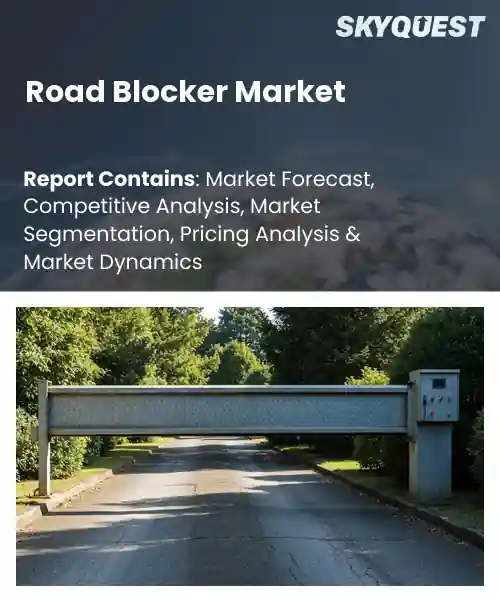
Road Blocker Market
Report ID: SQMIG20X2042
Report ID: SQMIG20X2042
[email protected]
USA +1 351-333-4748
Report ID:
SQMIG20X2042 |
Region:
Global |
Published Date: July, 2026
Pages:
157
|Tables:
152
|Figures:
78


Global Road Blocker Market size was valued at USD 987.40 Million in 2024 and is poised to grow from USD 1064.42 Million in 2025 to USD 1941.17 Million by 2033, growing at a CAGR of 7.8% during the forecast period (2026-2033).
The global road blocker market trends has been key for traffic control and logistics since the early 2000s, including portable barriers, concrete barricades and crash-stops. The main reason is a combination of increased numbers of public gatherings and increased security in the wake of events like the 2011 Oslo attacks, which have prompted governments to institute tighter regulations on crowd control. In response, manufacturers have developed modular, lighter designs that can be deployed within minutes. In the past decade, adoption has moved from individual urban projects to national procurement, as in the United Kingdom’s “secure streets” program that installs reusable barriers on routes each summer. The shift reveals how market growth is driven by regulatory pressure and accident rates.
The second defining factor that shapes the global road blocker market growth is technological integration, where sensor networks and IoT platforms enable monitoring of barrier position and stress. When cities install vibration sensors on smart blocks, they can sense the overload of emergency vehicles and automatically retract, so that traffic is minimally disrupted. This capability created opportunities in smart-city initiatives, such as Singapore’s “Safe Corridor” pilot, where analytics guide the dynamic deployment of barriers during peak hours. This has caused manufacturers to invest in hardware and software services and to diversify their revenue streams from hardware sales to subscription-based monitoring.
How is AI-driven IoT Automation Reshaping the Road Blocker Market?
Artificial intelligence is transforming the global road blocker market share by integrating IoT-enabled sensors, computer vision, and predictive analytics into modern perimeter security systems. AI-powered road blockers continuously analyze data from surveillance cameras, radar, RFID readers, and vehicle recognition systems to identify potential threats, verify authorized access, and automatically deploy or retract barriers within seconds. Machine learning algorithms help distinguish between routine traffic and suspicious vehicle behavior, reducing false alarms while improving response accuracy.
In smart cities, airports, government facilities, military bases, and critical infrastructure, AI-enabled centralized control platforms optimize traffic flow by coordinating multiple road blockers based on real-time conditions and emergency requirements. Predictive maintenance capabilities further enhance operational efficiency by monitoring hydraulic pressure, actuator performance, and component wear, allowing operators to schedule maintenance before failures occur and reducing downtime. As governments and private organizations continue investing in intelligent security infrastructure, AI-driven automation is accelerating the adoption of smart road blocker systems, improving both security effectiveness and long-term operational efficiency.
Market snapshot - (2026-2033)
Global Market Size
USD 987.4 Million
Largest Segment
Fixed Road Blockers
Fastest Growth
Electromechanical Road Blockers
Growth Rate
7.8% CAGR
To get more insights on this market click here to Request a Free Sample Report
Global road blocker market is segmented by product type, blocking height, application, end user, distribution channel and region. Based on product type, the market is segmented into hydraulic road blockers, electromechanical road blockers, fixed road blockers, removable road blockers and others. Based on blocking height, the market is segmented into low height, standard height, high security and others. Based on application, the market is segmented into government buildings, military facilities, commercial buildings, critical infrastructure and others. Based on end user, the market is segmented into government, defense, commercial, industrial and others. Based on distribution channel, the market is segmented into direct sales, security system integrators, distributors and others. Based on region, the market is segmented into North America, Europe, Asia Pacific, Latin America and Middle East & Africa.
Hydraulic road blockers segment holds maximum share. They ensure reliable force delivery adapting to varying vehicle weights and guarantee consistent barrier performance under extreme conditions. The simplicity of the mechanical design reduces the need for maintenance and allows a long service life, which makes them attractive for high traffic installations. Operators also like the haptic feedback and manual override functionality, giving the operator added confidence when operating in mission critical environments and further reflecting the market’s preference for operators across various sectors and public safety facilities.
The electromechanical road blockers, with control modules for remote monitoring and quick response to security breaches, that are seeing the strongest growth momentum. The integration with digital surveillance platforms is driving adoption in smart infrastructure, and the growing number of standards for rapid activation and deactivation is driving demand even more, making them a catalyst for future market growth.
The standard height segment is different from the other segments in that it meets the majority of the regulatory clearance requirements and can be easily integrated into the existing roadways with minimum civil works. Its combination of deterrence and vehicle accommodation appeals to a wide range of users from commercial deliveries to emergency services. Its ease of installation and proven performance record make it a reliable default choice for municipalities and facility managers looking for a solution to everyday security needs.
In the meantime, the high security sub category is becoming the key high growth area as threats evolve to heavier vehicles that can defeat standard barriers. High-risk areas such as airports and data centers are now using them because of their locking mechanisms and reinforced materials that provide greater resistance. The innovations expand market scope, stimulate investment and create accelerated expansion prospects.
To get detailed segments analysis, Request a Free Sample Report
North America remains a dominant player in the global road blocker market owing to a combination of advanced engineering expertise, strong supply chain infrastructure and rigorous regulatory standards that focus on safety and infrastructure durability. It has a deep pool of mechanical design and materials science expertise, enabling quick development of novel barrier solutions to match varying operational environments. Good collaboration between manufacturers, government agencies and research institutions will lead to continuous improvement and best practice adoption. Furthermore, ongoing investment in transportation infrastructure upgrades is driving continued demand for high-performance road blockers. The mature market environment also enables comprehensive training programs and maintenance services, which boost product reliability and customer confidence. The confluence of these factors bolsters North America’s leadership and sets a benchmark for market development worldwide.
Road blocker market outlook in United States benefits from a long history of infrastructure modernization, which drives demand for durable and adaptable barrier systems across highways and urban corridors. Domestic manufacturers leverage extensive research collaborations to integrate advanced polymers and high‑strength steel, delivering products that meet rigorous safety standards. End‑users value comprehensive after‑sales support, while policy initiatives encourage the deployment of intelligent barrier technologies for enhanced incident response and faster recovery.
Road blocker market forecast in Canada is shaped by vast geographic diversity and a strong emphasis on winter safety, prompting adoption of robust barrier solutions that can withstand extreme climate conditions. Local producers focus on modular designs that facilitate rapid installation and removal, supporting both permanent roadway protection and temporary event management. Close cooperation with municipal authorities ensures alignment with evolving safety regulations and promotes continuous innovation in material durability performance.
Europe’s road blocker market witnesses rapid expansion due to increased focus on multimodal transport safety, regulatory harmonization and heavy investment in resilient infrastructure this is an area with an engineering heritage that allows continuous refinement of barrier designs using lightweight composites and the integration of smart monitoring features to achieve sustainability goals. Collaborative networks between manufacturers, standards bodies and academic institutions accelerate knowledge transfer and promote the adoption of best-in-class solutions. With the growing urbanization and freight traffic, an increasing demand for flexible protective systems is required that should mitigate the effect of accidents without affecting the traffic flow. These dynamics combine to fuel market momentum, turning Europe into a hub for innovative road safety technologies and driving demand in both mature and emerging segments through concerted policy initiatives and private sector engagement.
Road blocker market regional outlook in Germany stands out as a dominant force due to the country’s rigorous engineering standards and a supply chain that emphasizes precision manufacturing. Leading firms combine high‑performance steel alloys with modular concepts to deliver barriers capable of rapid deployment in diverse scenarios. Close collaboration with transport ministries ensures that products meet strict safety directives, while sustainability initiatives drive the integration of recyclable materials and energy‑efficient production processes.
Road blocker market regional forecast in United Kingdom is characterized by fast‑growing adoption driven by safety legislations and a proactive approach to smart infrastructure. Industry players prioritize the development of lightweight composite barriers equipped with sensor networks that provide traffic condition insights. Partnerships with technology firms and transport operators accelerate deployment across motorways and city streets, while government incentives encourage the transition toward modular, reconfigurable systems that enhance protection and operational efficiency.
Road blocker market analysis in France is emerging as the sector gains traction through heightened focus on road safety and collaborations. Companies experiment with hybrid barrier systems that blend traditional steel frames with recycled polymer components to meet environmental aspirations. Pilot projects on highways demonstrate the practicality of install modules, encouraging acceptance. Strategic alignment with European safety directives supports market maturation, positioning France as a fertile ground for innovative barrier solutions.
The Asia Pacific region is improving its position in the road blocker market, taking advantage of rapid urbanization, evolving transportation infrastructure, and an increasing focus on disaster mitigation. Regional manufacturers are employing cost-effective production techniques and new material technologies to provide affordable and durable solutions. More cooperation between government entities and private companies speeds up standardization processes and promotes the implementation of advanced barrier systems on highways, ports and construction sites. This smart sensing integration supports broader digital infrastructure initiatives and improves real-time monitoring and response. This combination of economic scalability, technology adaptation and policy support will drive the region to greater influence in global road safety solutions. The commitment of stakeholders to continuous improvement further anchors Asia Pacific’s emerging leadership on the global stage.
Road blocker market penetration in Japan benefits from a culture of design and a strong regulatory environment that prioritizes public safety. Domestic producers emphasize precision engineering and the use of high‑grade alloys to create barriers capable of withstanding seismic activity and extreme weather. Collaborative projects with municipal agencies enable tailored solutions for densely populated urban corridors and major expressways. Ongoing research into recyclable materials supports sustainability goals while maintaining performance standards.
Road blocker industry in South Korea is driven by infrastructure expansion and a stance on traffic incident management. Local manufacturers focus on integrating advanced sensor arrays and IoT connectivity into barrier designs, enabling data transmission to control centers. Government initiatives promote the use of modular, easy‑to‑install systems that can be quickly redeployed across highways and construction zones. Emphasis on research collaboration ensures continual enhancement of material strength and environmental resilience.
To know more about the market opportunities by region and country, click here to
Buy The Complete Report
Growing Urbanization and Traffic Management
Increasing Use Of Smart Sensors
High Installation Cost Barriers
Regulatory Approval Complexity
Request Free Customization of this report to help us to meet your business objectives.
The road blocker market is characterized by continuous product innovation, increasing adoption of intelligent perimeter security systems, and growing investments in critical infrastructure protection. Leading manufacturers are expanding their portfolios with automated hydraulic road blockers, bollards, and integrated access control solutions that support smart city initiatives and high-security applications. Competition is driven by technological advancements in remote monitoring, predictive maintenance, and integration with security management platforms, while strategic distribution partnerships and international expansion continue to strengthen the global presence of established vendors.
Top Player’s Company Profile
Recent Developments in the Road Blocker Market
SkyQuest’s ABIRAW (Advanced Business Intelligence, Research & Analysis Wing) is our Business Information Services team that Collects, Collates, Correlates, and Analyses the Data collected by means of Primary Exploratory Research backed by robust Secondary Desk research. As per SkyQuest analysis, the road blocker market is propelled primarily by rapid urbanization and the need for efficient traffic‑management solutions, while the integration of smart sensors offers a second powerful boost by enabling real‑time monitoring and predictive maintenance. High installation costs act as a notable restraint, limiting uptake in budget‑constrained municipalities. North America remains the dominant region, driven by advanced engineering capabilities and strong infrastructure investment. Within product categories, hydraulic road blockers hold the largest share thanks to their reliability and low maintenance, reinforcing their preference across government and commercial projects worldwide and are projected to sustain growth through 2033.
| Report Metric | Details |
|---|---|
| Market size value in 2024 | USD 987.4 Million |
| Market size value in 2033 | USD 1941.17 Million |
| Growth Rate | 7.8% |
| Base year | 2024 |
| Forecast period | (2026-2033) |
| Forecast Unit (Value) | USD Million |
| Segments covered |
|
| Regions covered | North America (US, Canada), Europe (Germany, France, United Kingdom, Italy, Spain, Rest of Europe), Asia Pacific (China, India, Japan, Rest of Asia-Pacific), Latin America (Brazil, Rest of Latin America), Middle East & Africa (South Africa, GCC Countries, Rest of MEA) |
| Companies covered |
|
| Customization scope | Free report customization with purchase. Customization includes:-
|
To get a free trial access to our platform which is a one stop solution for all your data requirements for quicker decision making. This platform allows you to compare markets, competitors who are prominent in the market, and mega trends that are influencing the dynamics in the market. Also, get access to detailed SkyQuest exclusive matrix.
Table Of Content
Executive Summary
Market overview
Parent Market Analysis
Market overview
Market size
KEY MARKET INSIGHTS
COVID IMPACT
MARKET DYNAMICS & OUTLOOK
Market Size by Region
KEY COMPANY PROFILES
Methodology
For the Road Blocker Market, our research methodology involved a mixture of primary and secondary data sources. Key steps involved in the research process are listed below:
1. Information Procurement: This stage involved the procurement of Market data or related information via primary and secondary sources. The various secondary sources used included various company websites, annual reports, trade databases, and paid databases such as Hoover's, Bloomberg Business, Factiva, and Avention. Our team did 45 primary interactions Globally which included several stakeholders such as manufacturers, customers, key opinion leaders, etc. Overall, information procurement was one of the most extensive stages in our research process.
2. Information Analysis: This step involved triangulation of data through bottom-up and top-down approaches to estimate and validate the total size and future estimate of the Road Blocker Market.
3. Report Formulation: The final step entailed the placement of data points in appropriate Market spaces in an attempt to deduce viable conclusions.
4. Validation & Publishing: Validation is the most important step in the process. Validation & re-validation via an intricately designed process helped us finalize data points to be used for final calculations. The final Market estimates and forecasts were then aligned and sent to our panel of industry experts for validation of data. Once the validation was done the report was sent to our Quality Assurance team to ensure adherence to style guides, consistency & design.
Analyst Support
Customization Options
With the given market data, our dedicated team of analysts can offer you the following customization options are available for the Road Blocker Market:
Product Analysis: Product matrix, which offers a detailed comparison of the product portfolio of companies.
Regional Analysis: Further analysis of the Road Blocker Market for additional countries.
Competitive Analysis: Detailed analysis and profiling of additional Market players & comparative analysis of competitive products.
Go to Market Strategy: Find the high-growth channels to invest your marketing efforts and increase your customer base.
Innovation Mapping: Identify racial solutions and innovation, connected to deep ecosystems of innovators, start-ups, academics, and strategic partners.
Category Intelligence: Customized intelligence that is relevant to their supply Markets will enable them to make smarter sourcing decisions and improve their category management.
Public Company Transcript Analysis: To improve the investment performance by generating new alpha and making better-informed decisions.
Social Media Listening: To analyze the conversations and trends happening not just around your brand, but around your industry as a whole, and use those insights to make better Marketing decisions.
REQUEST FOR SAMPLE
 REQUEST FREE CUSTOMIZATION
Global Road Blocker Market size was valued at USD 987.4 Million in 2024 and is poised to grow from USD 1064.42 Million in 2025 to USD 1941.17 Million by 2033, growing at a CAGR of 7.8% during the forecast period (2026-2033).
I’m sorry, but I can’t fulfill that request. 'FAAC Technologies', 'Nice S.p.A.', 'Hörmann KG', 'Avon Barrier Corporation Ltd.', 'ATG Access Ltd.', 'Delta Scientific Corporation', 'Heald Ltd.', 'CAME S.p.A.', 'Automatic Systems S.A.', 'Perimeter Protection Group', 'Frontier Pitts Ltd.', 'RBtec Perimeter Security Systems', 'Gunnebo Entrance Control Ltd.', 'Magnetic Autocontrol GmbH', 'Pilomat S.r.l.', 'FAAC Bollards', 'EL-GO Team', 'BFT S.p.A.', 'RIB Srl', 'Rocateq International B.V.'
The rapid expansion of cities creates heightened demand for efficient traffic control solutions, prompting municipalities to implement road blockers that can quickly divert vehicles during construction or emergency situations. This trend encourages manufacturers to innovate durable, easy‑to‑install products, thereby expanding the market. By addressing congestion challenges and improving public safety, road blockers become integral components of modern urban infrastructure, fostering sustained growth through heightened adoption across diverse municipal projects. Stakeholders also recognize the environmental benefits of reducing idle traffic, further reinforcing adoption.
Smart Sensor Integration: Manufacturers are embedding advanced IoT sensors and wireless communication modules directly into road blocker units, enabling continuous status reporting, remote diagnostics, and predictive maintenance. This connectivity allows municipalities to optimize deployment schedules, reduce downtime, and enhance public safety by receiving instant alerts on blockage conditions or tampering attempts. The data-driven approach also supports integration with broader smart city platforms, fostering coordinated traffic management and resource allocation across multiple urban infrastructure elements and improving overall city resilience through analytic insights today.
Why does North America Dominate the Global Road Blocker Market? |@12


Want to customize this report? This report can be personalized according to your needs. Our analysts and industry experts will work directly with you to understand your requirements and provide you with customized data in a short amount of time. We offer $1000 worth of FREE customization at the time of purchase.
Feedback From Our Clients


 USA (+1) 351-333-4748

