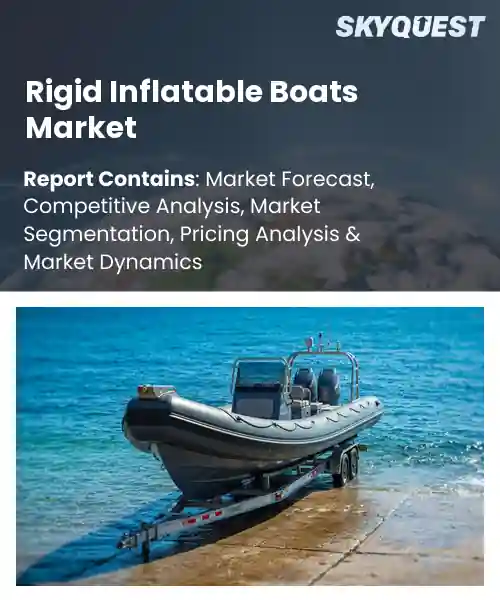
Rigid Inflatable Boats Market
Report ID: SQMIG25J2232
Report ID: SQMIG25J2232
[email protected]
USA +1 351-333-4748
Report ID:
SQMIG25J2232 |
Region:
Global |
Published Date: June, 2026
Pages:
157
|Tables:
144
|Figures:
78


Global Rigid Inflatable Boats Market size was valued at USD 1.52 Billion in 2024 and is poised to grow from USD 1.61 Billion in 2025 to USD 2.52 Billion by 2033, growing at a CAGR of 5.81% during the forecast period (2026-2033).
The Global Rigid Inflatable Boats (RIB) market is made up of light-weight, high-performance craft with a solid hull and inflatable tubes, used for applications such as rescue, defense, tourism and offshore energy. It is important because of the better stability, speed and low draft that allows it to operate in shallow or rough waters where normal vessels cannot. The market began in the 1960s, when the military adopted the technology. In the 1990s, tourism operators were looking for fast and safe sightseeing platforms and the market grew. In the 2010s, the market accelerated, when offshore wind farms required support vessels. This evolution is a reflection of a continuous trend towards vessels offering flexibility and operational efficiency.
RIB demand is primarily driven by increasing offshore renewable projects, where rapid deployment and maneuverability minimize downtime for wind turbine installation and maintenance crews. Operators are looking for ships to transport personnel, gear and emergency response equipment along sea lanes and manufacturers are responding with modular designs that feature electric propulsion and navigation suites to reduce fuel costs and emissions. This synergy allows for partnership opportunities, for example, a European utility contracting a hybrid RIB fleet to support its floating solar farms and adhere to tight environmental targets. This means operational efficiency results in tangible cost savings and compliance, and the market is expanding.
How is AI-driven navigation automation impacting the rigid inflatable boats market?
AI-driven navigation automation is transforming the rigid inflatable boats market by including real-time sensor fusion, predictive routing and autonomous piloting to boats that otherwise were manually operated. These systems improve safety by detecting obstacles and changing course without the driver’s input, and also reduce fuel consumption by taking the most efficient paths. For commercial rescue, tourism and leisure applications, operators benefit from easier handling in rough seas, making RIBs attractive. The technology is being packaged with modern hull designs and light weight materials, creating a strong value proposition that fits with the market’s desire for higher performance and lower operating costs. As manufacturers start to integrate these smart controls, the overall appeal of RIBs grows across new user categories and geographic areas.
Boats.com February 2026, highlighted the introduction of AI navigation packages on a number of new RIB models, demonstrating the automation’s operational efficiency and support of ongoing market growth.
Market snapshot - (2026-2033)
Global Market Size
USD 1.52 Billion
Largest Segment
Below 5m
Fastest Growth
Above 8m
Growth Rate
5.81% CAGR
To get more insights on this market click here to Request a Free Sample Report
Global rigid inflatable boats market is segmented by length, application, tube material, end-user, distribution and region. Based on length, the market is segmented into Below 5m, 5-8m and Above 8m. Based on application, the market is segmented into Military & Coast Guard, Recreational/Leisure, Commercial (Pilot, Survey) and Rescue Operations. Based on tube material, the market is segmented into Hypalon (CSM), PVC and Polyurethane. Based on end-user, the market is segmented into Military & Government and Private Consumers. Based on distribution, the market is segmented into Marine Dealers and Direct Sales. Based on region, the market is segmented into North America, Europe, Asia Pacific, Latin America and Middle East & Africa.
Segment leader in Military & Government due to defense procurement focus on durability, mission critical performance and lifecycle cost efficiency. This client base is a target for manufacturers as these buyers want boats that can operate in hostile environments, with sophisticated communication and navigation suites and that have undergone rigorous testing. Maritime security and coastal surveillance are strategically important, driving investment, and directing product development, supply chain allocation, and marketing efforts to meet demanding government specifications.
Based on application, the Rigid Inflatable Boats market is segmented into: Rescue Operations, Increased awareness of maritime safety, along with advancements in rapid deployment systems and rescue specific equipment, are driving demand from emergency services. This expansion provides opportunities for manufacturers to develop lightweight, high-performance models for life-saving missions.
Polyurethane segment is dominant as it provides better strength to weight ratios, abrasion resistance and life span than other materials. Manufacturers and end-users appreciate that this material can retain its structural integrity under high-speed impacts and severe marine conditions, thereby reducing maintenance periods and enhancing safety. It is also compatible with advanced coating technologies to tailor for specialized missions, and is a preferred choice for premium-grade RIBs and discerning buyers.
The PVC segment, on the other hand, is growing with the highest growth momentum in the Rigid Inflatable Boats market. The growing demand for cheap solutions from recreational and commercial users has led manufacturers to use PVC more and more because it is easy to mold and has low production costs. This trend creates market access and promotes broader adoption and innovation of affordable boat designs.
To get detailed segments analysis, Request a Free Sample Report
North America has a developed maritime infrastructure, a long tradition of recreational boating and a wide range of coastal and inland waterways supporting extensive uses. Law enforcement, coastal rescue and offshore services are examples of commercial segments with strong demand, underwriting the market's depth. An innovative culture ensures continuous product improvement and high performance designs. Established distribution networks and the concentration of leading manufacturers help to achieve economies of scale and strong brand loyalty. Furthermore, the region's regulatory framework and focus on safety standards make it a benchmark for quality and reliability, attracting both local users and international buyers seeking tried-and-tested solutions.
The United States Rigid Inflatable Boats (RIB) market is driven by a large enthusiast base and mature commercial fleet. Demand is stable and customers are diverse, ranging from rescue agencies to tourism operators. Advanced research institutions are collaborating with manufacturers to create cutting-edge materials. Its leadership role is further enhanced by the presence of major ports and a dynamic export orientation.
Strong government support towards marine safety and growing interest in green tourism ventures is supporting the growth of Canadian Rigid Inflatable Boats market. The nation's long coastline and countless lakes are natural proving grounds, encouraging manufacturers to develop hardy cold-weather solutions. Industry and research centers work together in joint ventures encouraging innovation . Emphasis on safety training increases user confidence in both the recreational and professional sectors .
Europe’s growth is underpinned by a potent combination of rigorous safety standards, a thriving maritime tourism industry and a strong culture of environmental responsibility. They use sophisticated engineering skills to build lightweight, fuel-efficient ships that meet exacting performance standards. Collaboration between research centres and industrial clusters improves the transfer of technologies. Training and certification focus helps to improve the skill of the users . Coastal patrol, offshore support and recreation are increasingly being demanded by affluent consumers. Europe is the centre of premium, high quality rigid inflatable boats.
The German rigid inflatable boat market is characterized by engineering precision and industrial scale. Advanced composite technologies are employed by manufacturers to satisfy high standards of durability and performance. It works with maritime academies to ensure a skilled workforce and continuous product improvement and its high export orientation means its effect spreads across Europe and beyond.
The United Kingdom Rigid Inflatable Boats Market The growth of the market is attributed to the booming coastal leisure culture and increased investments in rescue operations. Innovation hubs are optimized for light-weight design and modular configurations for hobbyist and professional users. Regulatory frameworks and proactive industry bodies are critical to build trust in the market and accelerate adoption across a wide range of industries.
France Rigid Inflatable Boats Market is witnessing a combination of coastal tourism development and renewed interest in marine sports. Manufacturers market attractive customizable solutions for lifestyle consumers and partnerships with naval training institutions enhance professional application. A positive policy environment allows market dynamics and ensures a sustainable use of materials.
Asia Pacific is leveraging its fast economic growth, increasing coastal infrastructure and growing appetite for water-based recreation to build its market position. Countries are investing heavily in maritime safety programmes and offshore sector support and this is creating a fertile environment for the uptake of high-end rigid inflatable boats. Strong local ties to global players in the tech industry are helping to push innovation, especially in lightweight construction and energy-efficient propulsion. Increasing awareness of environmental impact is driving the use of greener materials. Demand is also driven by government incentives for marine tourism and security in commercial and leisure sectors.
The Japan Rigid Inflatable Boats Market boasts a refined manufacturing base and a culture that embraces precision engineering. Companies work on high performance hull designs , adjusted to various sea states . Partnerships with research institutes also push material innovation . Strong domestic sailing and rescue community ensures steady consumption and export activities extend the influence across the region.
The South Korea Rigid Inflatable Boats Market is driven by the rising industrialization in the country and the strategic focus on maritime safety. Manufacturers are using the latest in composite technology to provide lightweight strength for commercial patrol vessels and recreational users alike. Initiatives in support of the government also strengthen support for offshore energy, cementing the market’s growing role in regional marine operations.
To know more about the market opportunities by region and country, click here to
Buy The Complete Report
Rising Demand For Search Rescue
Advancements In Hull Materials
High Production Cost Constraints
Stringent Safety Certification Requirements
Request Free Customization of this report to help us to meet your business objectives.
RIB builders are scrambling to make their products stand out. Zodiac bought a specialist in niche European designs for inflatable hulls to boost its product range, Saturn has partnered with a marine-electronics leader to integrate advanced navigation systems, Intex has unveiled a deep-V hull series designed for rescue applications, AB Inflatables has rolled out hybrid-propulsion RIBs, and ASIS has formed a joint venture with a defense supplier to pursue government contracts.
SkyQuest’s ABIRAW (Advanced Business Intelligence, Research & Analysis Wing) is our Business Information Services team that Collects, Collates, Correlates, and Analyses the Data collected by means of Primary Exploratory Research backed by robust Secondary Desk research.
As per SkyQuest analysis the global RIB market is expanding at a healthy pace driven primarily by rising demand for search‑and‑rescue operations which favour fast, stable vessels, while advancements in lightweight hull materials provide a second boost by enhancing durability and fuel efficiency. The most important restraint remains the high production cost of premium composites that limits adoption among price‑sensitive buyers. North America continues to dominate the market thanks to its mature boating infrastructure and strong commercial demand. The military and government segment leads in volume as defense contracts prioritize robust, mission‑critical boats. Together these forces shape a market poised for steady growth.
| Report Metric | Details |
|---|---|
| Market size value in 2024 | USD 1.52 Billion |
| Market size value in 2033 | USD 2.52 Billion |
| Growth Rate | 5.81% |
| Base year | 2024 |
| Forecast period | (2026-2033) |
| Forecast Unit (Value) | USD Billion |
| Segments covered |
|
| Regions covered | North America (US, Canada), Europe (Germany, France, United Kingdom, Italy, Spain, Rest of Europe), Asia Pacific (China, India, Japan, Rest of Asia-Pacific), Latin America (Brazil, Rest of Latin America), Middle East & Africa (South Africa, GCC Countries, Rest of MEA) |
| Companies covered |
|
| Customization scope | Free report customization with purchase. Customization includes:-
|
To get a free trial access to our platform which is a one stop solution for all your data requirements for quicker decision making. This platform allows you to compare markets, competitors who are prominent in the market, and mega trends that are influencing the dynamics in the market. Also, get access to detailed SkyQuest exclusive matrix.
Table Of Content
Executive Summary
Market overview
Parent Market Analysis
Market overview
Market size
KEY MARKET INSIGHTS
COVID IMPACT
MARKET DYNAMICS & OUTLOOK
Market Size by Region
KEY COMPANY PROFILES
Methodology
For the Rigid Inflatable Boats Market, our research methodology involved a mixture of primary and secondary data sources. Key steps involved in the research process are listed below:
1. Information Procurement: This stage involved the procurement of Market data or related information via primary and secondary sources. The various secondary sources used included various company websites, annual reports, trade databases, and paid databases such as Hoover's, Bloomberg Business, Factiva, and Avention. Our team did 45 primary interactions Globally which included several stakeholders such as manufacturers, customers, key opinion leaders, etc. Overall, information procurement was one of the most extensive stages in our research process.
2. Information Analysis: This step involved triangulation of data through bottom-up and top-down approaches to estimate and validate the total size and future estimate of the Rigid Inflatable Boats Market.
3. Report Formulation: The final step entailed the placement of data points in appropriate Market spaces in an attempt to deduce viable conclusions.
4. Validation & Publishing: Validation is the most important step in the process. Validation & re-validation via an intricately designed process helped us finalize data points to be used for final calculations. The final Market estimates and forecasts were then aligned and sent to our panel of industry experts for validation of data. Once the validation was done the report was sent to our Quality Assurance team to ensure adherence to style guides, consistency & design.
Analyst Support
Customization Options
With the given market data, our dedicated team of analysts can offer you the following customization options are available for the Rigid Inflatable Boats Market:
Product Analysis: Product matrix, which offers a detailed comparison of the product portfolio of companies.
Regional Analysis: Further analysis of the Rigid Inflatable Boats Market for additional countries.
Competitive Analysis: Detailed analysis and profiling of additional Market players & comparative analysis of competitive products.
Go to Market Strategy: Find the high-growth channels to invest your marketing efforts and increase your customer base.
Innovation Mapping: Identify racial solutions and innovation, connected to deep ecosystems of innovators, start-ups, academics, and strategic partners.
Category Intelligence: Customized intelligence that is relevant to their supply Markets will enable them to make smarter sourcing decisions and improve their category management.
Public Company Transcript Analysis: To improve the investment performance by generating new alpha and making better-informed decisions.
Social Media Listening: To analyze the conversations and trends happening not just around your brand, but around your industry as a whole, and use those insights to make better Marketing decisions.
REQUEST FOR SAMPLE
 REQUEST FREE CUSTOMIZATION
Global Rigid Inflatable Boats Market size was valued at USD 1.52 Billion in 2024 and is poised to grow from USD 1.61 Billion in 2025 to USD 2.52 Billion by 2033, growing at a CAGR of 5.81% during the forecast period (2026-2033).
Competition among established RIB manufacturers drives rapid product differentiation, with Zodiac acquiring a niche European inflatable‑hull specialist to broaden its portfolio, Saturn striking a partnership with a marine‑electronics leader to embed advanced navigation systems, Intex launching a deep‑V hull series targeting rescue operations, AB Inflatables rolling out hybrid‑propulsion RIBs, and ASIS forming a joint venture with a defense supplier to secure governmental contracts. 'Zodiac Nautic (Groupe Zodiac)', 'RIBCRAFT', 'Highfield Boats', 'Brig Enterprise', 'GRAND Marine Inflatables', 'Ribmaster Marine Group', 'Avon Marine (Survitec)', 'Gemini Marine Products', 'Narwhal (AB Inflatables)', 'Lomac SpA', 'BWA Yachts', 'ASIS Boats', 'Osprey Ribs', 'Armstrong Marine', 'Selcraft Group', 'Winboat', 'Scorpion RIB', 'Bombard (Zodiac)', 'Honda Marine (Honwave)', 'Mercury Marine (Brunswick)'
Growing interest from coastal authorities and humanitarian agencies is driving procurement of rigid inflatable boats for rapid response missions, as their speed and stability enable effective coverage of extensive water areas. Operators value the ability to launch quickly, maneuver in rough conditions, and provide safe extraction for victims. This functional advantage encourages fleets to expand, prompting manufacturers to prioritize design enhancements that meet evolving rescue protocols, thereby reinforcing market expansion through sustained demand across multiple geographic regions.
Hybrid Propulsion Adoption: Operators are increasingly integrating hybrid and electric drive systems into rigid inflatable boats to meet environmental regulations and client expectations for lower emissions. These powertrains combine conventional engines with battery modules, delivering quieter operation, reduced fuel consumption, and extended range for offshore missions. Manufacturers are responding by designing modular chassis that accommodate multiple propulsion options, enabling customers to tailor performance characteristics while preserving the vessel’s lightweight advantages. This shift is fostering partnerships with component suppliers and accelerating the adoption of sustainable practices across segments.
Why does North America Dominate the Global Rigid Inflatable Boats Market? |@12


Want to customize this report? This report can be personalized according to your needs. Our analysts and industry experts will work directly with you to understand your requirements and provide you with customized data in a short amount of time. We offer $1000 worth of FREE customization at the time of purchase.
Feedback From Our Clients


 USA (+1) 351-333-4748

