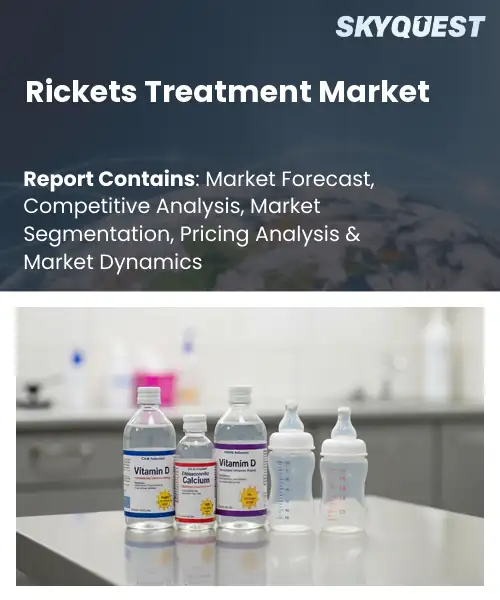
Rickets Treatment Market
Report ID: SQMIG35F2029
Report ID: SQMIG35F2029
[email protected]
USA +1 351-333-4748
Report ID:
SQMIG35F2029 |
Region:
Global |
Published Date: June, 2026
Pages:
157
|Tables:
176
|Figures:
79


Global Rickets Treatment Market size was valued at USD 1.51 Billion in 2024 and is poised to grow from USD 1.63 Billion in 2025 to USD 3.04 Billion by 2033, growing at a CAGR of 8.1% during the forecast period (2026-2033).
One decisive driver of the global rickets treatment market is heightened awareness of vitamin D deficiency among clinicians, parents, and policy makers, which directly fuels demand for preventive supplements and early‑stage therapies. This awareness leads schools and prenatal clinics to adopt routine screening, prompting manufacturers to introduce fortified foods and pediatric multivitamins that pair vitamin D with calcium and phosphorus. Consequently, distributors see rising sales, particularly in emerging regions where government‑backed programs target at‑risk children.
For instance, India’s public‑private initiative subsidizes vitamin D drops for infants, while the EU’s updated labeling standards streamline entry for novel analogues, opening growth avenues for biotech firms. A pivotal factor shaping the global rickets treatment market today is the growing awareness of vitamin D insufficiency among healthcare providers and parents, which fuels demand for preventive supplementation and early‑stage therapeutics. This awareness triggers increased screening programs in schools and prenatal clinics, prompting manufacturers to launch fortified foods and pediatric multivitamins that combine vitamin D with calcium and phosphorus, thereby expanding product pipelines.
As a consequence, regional distributors experience heightened turnover, especially in emerging economies where government vaccination‑style campaigns target at‑risk populations. Real‑world examples include India’s public‑private partnership that subsidizes vitamin D drops for infants, and the EU’s adoption of new labeling standards that accelerate market entry for novel analogues, creating both revenue growth and investment opportunities for biotech firms.
How is AI-driven drug discovery shaping the global rickets treatment market?
AI driven drug discovery is reshaping the rickets treatment market by accelerating target identification, optimizing molecular design, and shortening preclinical timelines. Machine learning models analyze genetic data and metabolic pathways associated with vitamin D metabolism, enabling researchers to pinpoint novel enzyme modulators. This technology reduces reliance on trial and error chemistry and allows companies to generate candidate therapies faster. As a result, the pipeline of rickets treatments is expanding, with several biotech firms integrating AI platforms into their research workflows. The heightened efficiency is attracting investment and fostering collaborations between technology providers and pharmaceutical developers, thereby strengthening the overall market outlook.
BioMarin in May 2026, reported Phase 3 data for a subcutaneous therapy that raised PPi levels, illustrating how AI driven discovery can bring advanced candidates to late stage testing faster and support market growth.
Market snapshot - (2026-2033)
Global Market Size
USD 1.51 Billion
Largest Segment
Vitamin D Therapy
Fastest Growth
Surgical Treatment
Growth Rate
8.1% CAGR
To get more insights on this market click here to Request a Free Sample Report
Global rickets treatment market is segmented by treatment type, rickets type, route of administration, end user, patient type, distribution channel and region. Based on treatment type, the market is segmented into Vitamin D Therapy, Calcium Supplementation Therapy, Phosphate Replacement Therapy, Surgical Treatment and Others. Based on rickets type, the market is segmented into Nutritional Rickets, Hypophosphatemic Rickets, Vitamin D-Dependent Rickets, Renal Rickets and Others. Based on route of administration, the market is segmented into Oral and Injectable. Based on end user, the market is segmented into Hospitals, Specialty Clinics, Pediatric Care Centers, Ambulatory Care Centers and Others. Based on patient type, the market is segmented into Infants, Children and Adolescents. Based on distribution channel, the market is segmented into Hospital Pharmacies, Retail Pharmacies and Online Pharmacies. Based on region, the market is segmented into North America, Europe, Asia Pacific, Latin America and Middle East & Africa.
Vitamin D therapy segment dominates with large rickets treatment market share because it directly addresses the primary cause of most rickets cases, restoring deficient levels and promoting calcium absorption. Clinicians favor it due to its well established efficacy, ease of prescribing, and extensive clinical guidelines. Its long history of use builds physician confidence, and patients appreciate oral formulations that fit daily routines, driving sustained demand across care settings. These attributes also support reimbursement approval and broad adoption in treatment protocols.
As per rickets treatment market outlook, phosphate replacement therapy segment emerges as the fastest growing area because novel formulations improve bioavailability and target hypophosphatemic rickets more effectively. Emerging clinical data and expanding indications drive physician interest, while supportive regulatory pathways encourage investment. This momentum expands market scope, creating new opportunities for manufacturers to differentiate and capture value in specialized patient populations.
As per rickets treatment market forecast, oral route segment dominates because it aligns with the preferences of pediatric patients and caregivers, offering non invasive convenience and simplifying adherence. The ease of integrating tablets or liquids into daily routines reduces clinic visits for injections, and established supply chains ensure consistent availability. Consequently, clinicians prioritize oral options, reinforcing a broad base of use across treatment settings. This suitability also supports insurance coverage and promotes long term therapy compliance among families.
As per rickets treatment market analysis, injectable route segment is witnessing rapid growth because advances in formulation stability reduce pain and enable home administration. Increased acceptance among caregivers seeking faster symptom relief, coupled with emerging combination products, fuels demand. This trend broadens therapeutic options and encourages manufacturers to invest in novel delivery devices, accelerating market expansion and diversifying care pathways.
To get detailed segments analysis, Request a Free Sample Report
As per rickets treatment market regional forecast, North America leads due to a combination of well‑established clinical networks, high awareness of vitamin D deficiency, and accelerated approval pathways that favor innovative therapies. The region benefits from extensive payer coverage that supports broader patient access, while leading academic and industry partnerships drive continuous research and product pipeline enrichment. Strategic investment in patient education and early diagnostic programs further consolidates market leadership, creating a self‑reinforcing environment that sustains demand and encourages entry of advanced treatment options.
As per rickets treatment market regional outlook, United States is propelled by a mature healthcare system that integrates specialist care with preventive screening programs. Strong engagement of pediatric endocrinologists and nutrition experts facilitates early detection, while comprehensive insurance frameworks ensure coverage for both conventional supplements and emerging pharmaceutical solutions. Collaborative initiatives between research institutions and biotechnology firms accelerate clinical trials, fostering a pipeline of novel interventions that address unmet patient needs and reinforce the market’s depth.
As per rickets treatment industry analysis, Canada reflects a coordinated public health approach emphasizing routine childhood nutrition monitoring and accessible supplementation programs. Provincial health authorities prioritize education on sunlight exposure and dietary intake, which enhances early awareness and intervention. Integration of multidisciplinary care teams supports seamless treatment pathways, while government‑funded research grants stimulate domestic development of therapeutic options. This supportive ecosystem nurtures market stability and encourages adoption of innovative solutions across the healthcare continuum.
Europe’s expansion is driven by harmonized regulatory standards that streamline product introductions across member states, paired with a growing emphasis on preventive pediatric health initiatives. National health services increasingly adopt evidence‑based guidelines that integrate vitamin D optimization into routine care, boosting demand for both traditional and novel therapies. Strong academic networks and cross‑border collaborations propel research breakthroughs, while patient advocacy groups raise awareness, creating a fertile environment for market growth and diversification.
Germany benefits from a robust universal health coverage system that ensures broad patient access to diagnostic and therapeutic services. Leading university hospitals and research institutes spearhead clinical trials, fostering rapid adoption of cutting‑edge treatments. Continuous professional education for pediatricians and dietitians reinforces guideline adherence, while government‑backed prevention campaigns elevate public consciousness about bone health, collectively strengthening market momentum.
United Kingdom is accelerated by proactive public health policies that integrate vitamin D supplementation into prenatal and early childhood programs. The National Health Service provides comprehensive coverage for essential treatments, enabling equitable access across regions. Collaborative research hubs and industry partnerships drive innovation, while heightened media focus on nutritional deficiencies fuels consumer demand for both over‑the‑counter and prescription solutions, positioning the market for swift expansion.
France is emerging through concerted efforts to embed nutritional screening within primary care consultations. Reimbursement pathways support a range of therapeutic options, encouraging clinicians to tailor interventions to individual patient profiles. Academic institutions lead exploratory studies on novel formulations, and targeted awareness campaigns enhance parental understanding of bone health. This combination of policy support and scientific inquiry cultivates a budding market landscape.
Asia Pacific is strengthening its position by leveraging rapid urbanization, evolving dietary patterns, and increasing health literacy that together heighten awareness of micronutrient deficiencies. Regional regulatory bodies are adopting streamlined approval processes, facilitating quicker market entry for innovative therapies. Investment in local research infrastructure and collaborations with multinational firms amplify development of region‑specific formulations, while emerging distribution networks expand reach to underserved populations. These dynamics collectively elevate the region’s contribution to the global market.
Japan is supported by an advanced medical infrastructure that incorporates routine pediatric screening for vitamin deficiencies. Public health initiatives promote balanced nutrition and safe sun exposure, reinforcing preventive care measures. Strong collaboration between biotechnology companies and academic hospitals accelerates clinical evaluation of novel agents, while comprehensive insurance coverage ensures patient affordability, fostering a resilient market environment.
South Korea reflects a proactive approach that integrates nutritional education into school curricula and community health programs. Government health schemes provide coverage for essential supplements and emerging therapies, encouraging broader adoption. Partnerships between local research centers and global pharmaceutical players drive innovation, while digital health platforms enhance patient monitoring and adherence, strengthening overall market performance.
To know more about the market opportunities by region and country, click here to
Buy The Complete Report
Rising Pediatric Vitamin D Awareness
Expanding Access to Oral Therapies
Limited Availability of Injectable Forms
High Cost of Novel Treatments
Request Free Customization of this report to help us to meet your business objectives.
The global rickets treatment industry is moderately fragmented, with a mix of multinational pharmaceutical companies and specialized biotechnology firms competing in the market with vitamin D formulations, calcium supplements, and focused medicines for uncommon genetic variants of rickets. Major companies include Pfizer Inc., F. Hoffmann-La Roche AG, Sanofi, Novartis AG, Amgen Inc., and Kyowa Kirin Co., Ltd.. Companies are focusing on the expansion of nutritional supplement portfolios, establishing distribution networks, and research in genetic and hypophosphatemic rickets therapies. Strategic partnerships, regulatory approvals, geographical development in emerging markets and attempts to promote patient access to novel medications remain major competitive tactics influencing the market landscape.
SkyQuest’s ABIRAW (Advanced Business Intelligence, Research & Analysis Wing) is our Business Information Services team that Collects, Collates, Correlates, and Analyses the Data collected by means of Primary Exploratory Research backed by robust Secondary Desk research.
As per SkyQuest analysis the global rickets treatment market growth is projected to grow driven first by rising pediatric vitamin‑D awareness that fuels early screening and demand for supplementation, and second by expanding access to oral therapies that improve compliance and reach underserved areas. The market is led by North America, where strong payer coverage and research infrastructure sustain demand. Vitamin‑D therapy remains the dominating segment due to its direct role in correcting the deficiency at the core of most cases. A key restraint is the limited availability of injectable forms, which disrupts supply and curtails use of potentially more potent options. The global rickets treatment market trend driven by increasing awareness of vitamin D deficiency, rising incidence of nutritional rickets in developing regions and expanding government initiatives promoting child nutrition and bone health.
| Report Metric | Details |
|---|---|
| Market size value in 2024 | USD 1.51 Billion |
| Market size value in 2033 | USD 3.04 Billion |
| Growth Rate | 8.1% |
| Base year | 2024 |
| Forecast period | (2026-2033) |
| Forecast Unit (Value) | USD Billion |
| Segments covered |
|
| Regions covered | North America (US, Canada), Europe (Germany, France, United Kingdom, Italy, Spain, Rest of Europe), Asia Pacific (China, India, Japan, Rest of Asia-Pacific), Latin America (Brazil, Rest of Latin America), Middle East & Africa (South Africa, GCC Countries, Rest of MEA) |
| Companies covered |
|
| Customization scope | Free report customization with purchase. Customization includes:-
|
To get a free trial access to our platform which is a one stop solution for all your data requirements for quicker decision making. This platform allows you to compare markets, competitors who are prominent in the market, and mega trends that are influencing the dynamics in the market. Also, get access to detailed SkyQuest exclusive matrix.
Table Of Content
Executive Summary
Market overview
Parent Market Analysis
Market overview
Market size
KEY MARKET INSIGHTS
COVID IMPACT
MARKET DYNAMICS & OUTLOOK
Market Size by Region
KEY COMPANY PROFILES
Methodology
For the Rickets Treatment Market, our research methodology involved a mixture of primary and secondary data sources. Key steps involved in the research process are listed below:
1. Information Procurement: This stage involved the procurement of Market data or related information via primary and secondary sources. The various secondary sources used included various company websites, annual reports, trade databases, and paid databases such as Hoover's, Bloomberg Business, Factiva, and Avention. Our team did 45 primary interactions Globally which included several stakeholders such as manufacturers, customers, key opinion leaders, etc. Overall, information procurement was one of the most extensive stages in our research process.
2. Information Analysis: This step involved triangulation of data through bottom-up and top-down approaches to estimate and validate the total size and future estimate of the Rickets Treatment Market.
3. Report Formulation: The final step entailed the placement of data points in appropriate Market spaces in an attempt to deduce viable conclusions.
4. Validation & Publishing: Validation is the most important step in the process. Validation & re-validation via an intricately designed process helped us finalize data points to be used for final calculations. The final Market estimates and forecasts were then aligned and sent to our panel of industry experts for validation of data. Once the validation was done the report was sent to our Quality Assurance team to ensure adherence to style guides, consistency & design.
Analyst Support
Customization Options
With the given market data, our dedicated team of analysts can offer you the following customization options are available for the Rickets Treatment Market:
Product Analysis: Product matrix, which offers a detailed comparison of the product portfolio of companies.
Regional Analysis: Further analysis of the Rickets Treatment Market for additional countries.
Competitive Analysis: Detailed analysis and profiling of additional Market players & comparative analysis of competitive products.
Go to Market Strategy: Find the high-growth channels to invest your marketing efforts and increase your customer base.
Innovation Mapping: Identify racial solutions and innovation, connected to deep ecosystems of innovators, start-ups, academics, and strategic partners.
Category Intelligence: Customized intelligence that is relevant to their supply Markets will enable them to make smarter sourcing decisions and improve their category management.
Public Company Transcript Analysis: To improve the investment performance by generating new alpha and making better-informed decisions.
Social Media Listening: To analyze the conversations and trends happening not just around your brand, but around your industry as a whole, and use those insights to make better Marketing decisions.
REQUEST FOR SAMPLE
 REQUEST FREE CUSTOMIZATION
Global Rickets Treatment Market size was valued at USD 1.51 Billion in 2024 and is poised to grow from USD 1.63 Billion in 2025 to USD 3.04 Billion by 2033, growing at a CAGR of 8.1% during the forecast period (2026-2033).
Top Player’s Company Profile 'Pfizer Inc.', 'AbbVie Inc.', 'Novartis AG', 'Sanofi S.A.', 'F. Hoffmann-La Roche Ltd.', 'Takeda Pharmaceutical Company Limited', 'Amgen Inc.', 'Kyowa Kirin Co., Ltd.', 'Recordati S.p.A.', 'Ultragenyx Pharmaceutical Inc.', 'BioMarin Pharmaceutical Inc.', 'Teva Pharmaceutical Industries Ltd.', 'Viatris Inc.', 'Sun Pharmaceutical Industries Ltd.', 'Dr. Reddy's Laboratories Ltd.', 'Cipla Limited', 'Zydus Lifesciences Limited', 'Torrent Pharmaceuticals Ltd.', 'AstraZeneca PLC', 'Bausch Health Companies Inc.'
Healthcare providers are increasingly emphasizing preventive nutrition, leading to broader recognition of vitamin D deficiency as a primary cause of rickets; this heightened awareness drives proactive screening and early intervention, encouraging families to seek effective treatments promptly, thereby expanding the patient base for approved therapies and stimulating demand across both urban and rural settings. Such initiatives also facilitate collaboration between pediatric specialists and community health workers, ensuring consistent messaging and fostering trust in therapeutic options, which further elevates market penetration and supports sustained growth.
Increasing Preventive Screening Initiatives: Healthcare systems worldwide are expanding routine vitamin D and calcium screening programs for at‑risk populations, integrating these checks into primary care visits and school health assessments. This proactive approach aims to identify early biochemical deficiencies before radiographic changes appear, enabling clinicians to prescribe oral supplementation and lifestyle counseling promptly. As awareness grows among parents, educators, and policymakers, demand for accessible diagnostic kits and community outreach intensifies, driving market participants to develop point‑of‑care testing solutions aligned with telehealth platforms globally effectively.
Why does North America Dominate the Global Rickets Treatment Market? |@12


Want to customize this report? This report can be personalized according to your needs. Our analysts and industry experts will work directly with you to understand your requirements and provide you with customized data in a short amount of time. We offer $1000 worth of FREE customization at the time of purchase.
Feedback From Our Clients


 USA (+1) 351-333-4748

