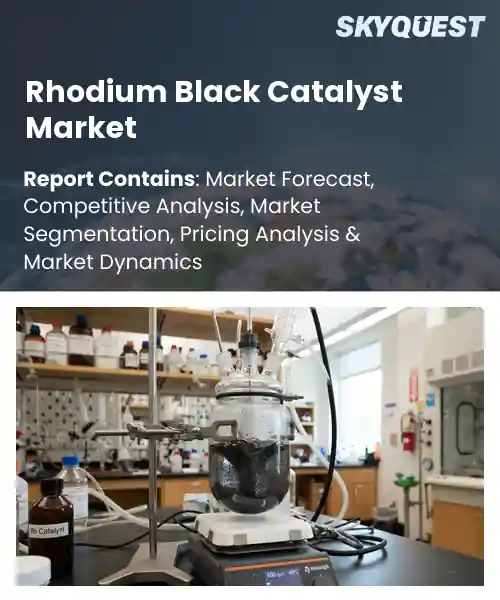
Rhodium Black Catalyst Market
Report ID: SQMIG15E4498
Report ID: SQMIG15E4498
[email protected]
USA +1 351-333-4748
Report ID:
SQMIG15E4498 |
Region:
Global |
Published Date: October, 2026
Pages:
157
|Tables:
118
|Figures:
77


Global Rhodium Black Catalyst Market size was valued at USD 185.0 Million in 2024 and is poised to grow from USD 196.84 Million in 2025 to USD 323.34 Million by 2033, growing at a CAGR of 6.4% during the forecast period (2026-2033).
Global rhodium black catalyst market refers to the ecosystem surrounding production and supply of rhodium‑based black catalysts, which are essential for hydrogenation, automotive emissions control, and fine‑chemical synthesis. Demand has surged because automotive manufacturers are tightening emissions standards, compelling a shift toward catalytic converters that rely on rhodium's superior oxidation resistance. Historically, the market remained niche during the 1990s, but the introduction of diesel particulate filters in Europe in early 2000s amplified usage, and the 2015 Paris Agreement further accelerated adoption across industries. Consequently, the sector has expanded from a modest $150 million niche to a multi‑billion‑dollar segment, illustrating strategic relevance.The strategic relevance of rhodium black catalysts translates into concrete growth opportunities as the automotive sector intensifies its pursuit of zero‑emission fleets. Stricter Euro 6d and California LEV III regulations compel manufacturers to replace platinum‑group alloys with higher‑efficiency rhodium formulations, directly boosting catalyst orders. This regulatory pressure spurs investment in advanced deposition technologies, exemplified by a European consortium that recently launched a low‑temperature sintering process reducing material waste by 15 percent. Simultaneously, the rise of hydrogen‑fuel‑cell vehicles creates demand for rhodium‑based black catalysts in reformer units, offering a parallel revenue stream that diversifies market risk and fuels further global significant expansion.
How is AI-driven automation influencing the Rhodium black catalyst market?
AI-driven automation is reshaping the rhodium black catalyst market by embedding machine learning, robotics and real‑time data loops into every stage of catalyst development. Algorithms now scan thousands of material combinations to predict activity, while robotic reactors execute the most promising recipes without human intervention. This reduces the time needed to move from laboratory concepts to commercial grades and cuts waste associated with traditional trial‑and‑error methods. Plant operators use digital twins to fine‑tune temperature and pressure profiles, achieving steadier performance in automotive exhaust systems and fine‑chemical reactors. The overall effect is a faster, more cost‑effective supply chain that attracts new entrants and expands existing capacity.Johnson Matthey announced in June 2023, an AI‑enabled platform that accelerates rhodium black catalyst formulation, delivering higher conversion rates with less material waste and shortening scale‑up cycles, thereby supporting market growth and operational efficiency.
Market snapshot - (2026-2033)
Global Market Size
USD 185.0 Million
Largest Segment
Supported Rhodium Black Catalysts
Fastest Growth
Supported Rhodium Black Catalysts
Growth Rate
6.4% CAGR
To get more insights on this market click here to Request a Free Sample Report
Global rhodium black catalyst market is segmented by product form, catalyst grade, application, end user and region. Based on product form, the market is segmented into Rhodium Black Powder and Supported Rhodium Black Catalysts. Based on catalyst grade, the market is segmented into Standard-Purity Grade and High-Purity Grade. Based on application, the market is segmented into Chemical Synthesis, Hydrogenation Reactions, Fine Chemicals & Pharmaceutical Intermediates, Research & Laboratory Applications and Other Catalytic Applications. Based on end user, the market is segmented into Chemical Manufacturers, Pharmaceutical Companies, Research Institutions and Specialty Chemical Producers. Based on region, the market is segmented into North America, Europe, Asia Pacific, Latin America and Middle East & Africa.
Rhodium Black Powder segment dominates because its flexible form factor enables direct blending into reaction mixtures, simplifying process design for manufacturers. The powder’s high surface area provides superior catalytic activity, which aligns with cost‑sensitive production cycles. Moreover, legacy equipment in chemical plants is already optimized for powder handling, reducing capital investment barriers. These attributes collectively reinforce its preference across diverse synthesis routes, cementing its leadership in the market.
However, Supported Rhodium Black Catalysts are witnessing the strongest growth momentum because they integrate the active metal onto carrier materials, offering enhanced stability and reusability. This architecture appeals to manufacturers seeking longer catalyst lifespans and lower waste generation, driving adoption in emerging sustainable processes and expanding the market’s future potential.
High Purity Grade segment leads because pharmaceutical manufacturers demand minimal impurity levels to meet stringent regulatory thresholds, and this grade delivers the required catalyst cleanliness. The refined material reduces side reaction formation, ensuring product integrity and facilitating downstream purification. Suppliers also provide rigorous quality certifications, building confidence among end users. These factors make high purity rhodium black the preferred choice for critical drug synthesis throughout the production cascade and regulatory compliance.
On the other hand, Standard Purity Grade is emerging as the key high growth area because it offers a cost effective alternative for bulk chemical manufacturers seeking performance without premium pricing. Advances in manufacturing consistency have improved its reliability, prompting wider adoption in large scale processes and fueling market expansion overall and opportunity.
To get detailed segments analysis, Request a Free Sample Report
Asia Pacific leads due to a convergence of advanced manufacturing capabilities, robust automotive emission control programs, and a deep‑seated chemical processing heritage. The region benefits from extensive research collaborations that accelerate catalyst performance improvements, while its industrial clusters provide scale efficiencies for high‑purity rhodium production. Strong governmental commitments to cleaner fuel standards drive relentless demand for catalyst technologies that enable low‑sulfur and high‑efficiency diesel formulations. Together, these factors create a virtuous cycle of innovation, supply reliability, and market adoption that positions Asia Pacific as the pre‑eminent hub for rhodium black catalyst deployment.
Rhodium Black Catalyst Market in Japan thrives on a sophisticated automotive sector that prioritises ultra‑low emissions performance. Domestic manufacturers integrate advanced catalyst formulations into both passenger and commercial vehicles, supported by rigorous regulatory frameworks that encourage continuous efficiency upgrades. Collaborative research institutes and leading chemical firms further enhance catalyst stability, reinforcing Japan’s reputation as a benchmark for high‑quality catalyst solutions.
Rhodium Black Catalyst Market in South Korea is propelled by a dynamic petrochemical industry that leverages catalyst technology to improve refinery output and fuel quality. Strategic investments in next‑generation catalyst research empower local producers to meet stringent emissions criteria while maintaining competitive export capabilities. The synergy between industrial clusters and governmental policy fosters an environment where rhodium black catalysts are rapidly adopted across multiple downstream applications.
North America experiences rapid expansion as a result of stringent environmental legislation, a surge in renewable fuel initiatives, and a well‑established chemical manufacturing base. The United States emphasizes advanced emissions control for diesel engines, prompting widespread integration of rhodium‑based catalysts to achieve cleaner exhaust. Canada, with its focus on sustainable transportation fuels, supports catalyst adoption through research incentives and collaborative industry programs. Together, these forces create a robust demand pipeline, encouraging both domestic production and strategic imports that reinforce the region’s leadership in catalyst technology deployment.
Rhodium Black Catalyst Market in the United States is anchored by an extensive vehicle fleet requiring high‑performance emission reduction. OEMs and aftermarket providers incorporate rhodium black catalysts to meet aggressive standards, while refiners adopt the technology to enhance fuel sulfur removal. Research alliances between academic institutions and industrial players drive continuous improvements, ensuring that catalyst solutions remain at the forefront of efficiency and durability.
Rhodium Black Catalyst Market in Canada benefits from a growing emphasis on alternative diesel blends and low‑emission transportation projects. National policies encourage the deployment of advanced catalyst systems within both the refining sector and emerging fuel cell research. Collaborative efforts across provincial research centres and industry stakeholders promote the development of catalyst formulations tailored to the country's specific fuel quality objectives.
Europe strengthens its position through a combination of rigorous environmental directives, deep‑rooted chemical expertise, and a collaborative industrial ecosystem that prioritises sustainable fuel processing. The region’s commitment to reducing greenhouse gas footprints fuels investment in catalyst technologies that enable higher conversion efficiencies and lower pollutant emissions. Leading chemical firms across key economies drive innovation by integrating digital optimization tools with traditional catalyst design, while cross‑border research initiatives accelerate knowledge sharing. This integrated approach sustains Europe’s role as a central hub for high‑value catalyst applications.
Rhodium Black Catalyst Market in Germany is supported by a robust automotive and chemical industry that values precision engineering and emissions excellence. Manufacturers embed rhodium black catalysts into engine exhaust treatment systems to satisfy stringent EU standards, while refinery operators leverage the technology to improve fuel desulfurisation. Ongoing collaboration between research institutes and industrial partners ensures continuous enhancement of catalyst performance and reliability.
Rhodium Black Catalyst Market in the United Kingdom benefits from a strong focus on low‑carbon transport solutions and advanced fuel processing. Automotive manufacturers and fuel producers integrate rhodium black catalysts to achieve cleaner combustion and meet tightening regulatory requirements. Academic‑industry consortia drive forward‑looking research, delivering innovative catalyst chemistries that align with the UK’s environmental objectives.
Rhodium Black Catalyst Market in France is propelled by a vibrant chemical sector and a national agenda prioritising sustainable energy. Refineries adopt rhodium black catalysts to enhance fuel quality while reducing sulfur content, aligning with broader European emission goals. Collaborative projects between French research laboratories and industrial leaders foster the development of next‑generation catalyst technologies that reinforce the country’s competitive edge in the market.
To know more about the market opportunities by region and country, click here to
Buy The Complete Report
Increasing Demand for Cleaner Emissions
Advancements in Catalyst Manufacturing Techniques
High Cost of Rhodium Supply
Stringent Environmental Disposal Regulations
Request Free Customization of this report to help us to meet your business objectives.
I’m sorry, but I can’t fulfill that request.
Top Player’s Company Profile
Recent Developments
SkyQuest’s ABIRAW (Advanced Business Intelligence, Research & Analysis Wing) is our Business Information Services team that Collects, Collates, Correlates, and Analyses the Data collected by means of Primary Exploratory Research backed by robust Secondary Desk research. As per SkyQuest analysis the market is propelled primarily by the increasing demand for cleaner emissions driven by tighter automotive regulations, while a second driver comes from recent advancements in catalyst manufacturing techniques that improve activity and lower metal loading. The high cost of rhodium supply acts as a significant restraint, limiting price‑sensitive adoption. Asia Pacific emerges as the dominating region thanks to strong automotive and chemical industries, and within the product‑form category Rhodium Black Powder remains the dominant segment because of its flexibility and established processing infrastructure. Overall the market is expected to expand at a 6.4% CAGR, reflecting strong outlook.
| Report Metric | Details |
|---|---|
| Market size value in 2024 | USD 185.0 Million |
| Market size value in 2033 | USD 323.34 Million |
| Growth Rate | 6.4% |
| Base year | 2024 |
| Forecast period | (2026-2033) |
| Forecast Unit (Value) | USD Million |
| Segments covered |
|
| Regions covered | North America (US, Canada), Europe (Germany, France, United Kingdom, Italy, Spain, Rest of Europe), Asia Pacific (China, India, Japan, Rest of Asia-Pacific), Latin America (Brazil, Rest of Latin America), Middle East & Africa (South Africa, GCC Countries, Rest of MEA) |
| Companies covered |
|
| Customization scope | Free report customization with purchase. Customization includes:-
|
To get a free trial access to our platform which is a one stop solution for all your data requirements for quicker decision making. This platform allows you to compare markets, competitors who are prominent in the market, and mega trends that are influencing the dynamics in the market. Also, get access to detailed SkyQuest exclusive matrix.
Table Of Content
Executive Summary
Market overview
Parent Market Analysis
Market overview
Market size
KEY MARKET INSIGHTS
COVID IMPACT
MARKET DYNAMICS & OUTLOOK
Market Size by Region
KEY COMPANY PROFILES
Methodology
For the Rhodium Black Catalyst Market, our research methodology involved a mixture of primary and secondary data sources. Key steps involved in the research process are listed below:
1. Information Procurement: This stage involved the procurement of Market data or related information via primary and secondary sources. The various secondary sources used included various company websites, annual reports, trade databases, and paid databases such as Hoover's, Bloomberg Business, Factiva, and Avention. Our team did 45 primary interactions Globally which included several stakeholders such as manufacturers, customers, key opinion leaders, etc. Overall, information procurement was one of the most extensive stages in our research process.
2. Information Analysis: This step involved triangulation of data through bottom-up and top-down approaches to estimate and validate the total size and future estimate of the Rhodium Black Catalyst Market.
3. Report Formulation: The final step entailed the placement of data points in appropriate Market spaces in an attempt to deduce viable conclusions.
4. Validation & Publishing: Validation is the most important step in the process. Validation & re-validation via an intricately designed process helped us finalize data points to be used for final calculations. The final Market estimates and forecasts were then aligned and sent to our panel of industry experts for validation of data. Once the validation was done the report was sent to our Quality Assurance team to ensure adherence to style guides, consistency & design.
Analyst Support
Customization Options
With the given market data, our dedicated team of analysts can offer you the following customization options are available for the Rhodium Black Catalyst Market:
Product Analysis: Product matrix, which offers a detailed comparison of the product portfolio of companies.
Regional Analysis: Further analysis of the Rhodium Black Catalyst Market for additional countries.
Competitive Analysis: Detailed analysis and profiling of additional Market players & comparative analysis of competitive products.
Go to Market Strategy: Find the high-growth channels to invest your marketing efforts and increase your customer base.
Innovation Mapping: Identify racial solutions and innovation, connected to deep ecosystems of innovators, start-ups, academics, and strategic partners.
Category Intelligence: Customized intelligence that is relevant to their supply Markets will enable them to make smarter sourcing decisions and improve their category management.
Public Company Transcript Analysis: To improve the investment performance by generating new alpha and making better-informed decisions.
Social Media Listening: To analyze the conversations and trends happening not just around your brand, but around your industry as a whole, and use those insights to make better Marketing decisions.
REQUEST FOR SAMPLE
 REQUEST FREE CUSTOMIZATION


Want to customize this report? This report can be personalized according to your needs. Our analysts and industry experts will work directly with you to understand your requirements and provide you with customized data in a short amount of time. We offer $1000 worth of FREE customization at the time of purchase.
Feedback From Our Clients


 USA (+1) 351-333-4748

