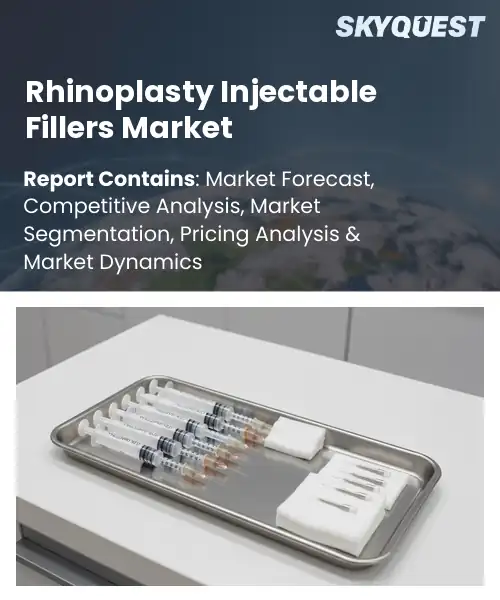
Rhinoplasty Injectable Fillers Market
Report ID: SQMIG35H2439
Report ID: SQMIG35H2439
[email protected]
USA +1 351-333-4748
Report ID:
SQMIG35H2439 |
Region:
Global |
Published Date: March, 2026
Pages:
157
|Tables:
118
|Figures:
77


Global Rhinoplasty Injectable Fillers Market size was valued at USD 6.9 Billion in 2024 and is poised to grow from USD 7.49 Billion in 2025 to USD 14.38 Billion by 2033, growing at a CAGR of 8.5% during the forecast period (2026-2033).
Rhinoplasty injectable fillers market encompasses non-surgical nasal contouring procedures using temporary or semi-permanent fillers, with primary driver the shift toward minimally invasive aesthetic interventions that balance efficacy, cost, and downtime. This market matters because it expands access to nasal reshaping for patients unwilling or unable to undergo surgical rhinoplasty, and it has evolved from off-label use of hyaluronic acid products to dedicated formulations and protocols supported by clinical training. Over the past decade clinicians adopted liquid rhinoplasty techniques in markets including the United States, South Korea, and Brazil, while manufacturers refined cross-linked gels and reversibility options exemplified by hyaluronidase-compatible products.Following these developments the principal market driver becomes technological and clinical confidence in hyaluronic acid and resorbable fillers, which produces measurable growth because improved safety and predictability encourage broader provider adoption and patient acceptance. When manufacturers introduce more cohesive gels and training programs clinicians expand indications beyond temporary dorsal augmentation to correction of post-surgical deformities and ethnic contouring, and as clinics document consistent outcomes social channels amplify demand. Consequently clinics can offer lower-cost, same-day rhinoplasty alternatives that shorten recovery and attract younger, image-conscious consumers, while emerging-market uptake and bundled aesthetic services create scalable revenue streams for suppliers and providers globally.
How is AI improving safety and customization in the rhinoplasty injectable fillers market?
AI enhances safety and customization in rhinoplasty injectable filler treatments through better imaging, risk detection and individualized planning. By combining three dimensional facial scans, ultrasound mapping and predictive algorithms clinicians can identify vascular anatomy, choose the optimal filler type and rehearse injection vectors for each patient. The current market favors minimally invasive solutions and practitioners are adopting AI tools to reduce adverse events and improve aesthetic predictability. Real world instances include AI driven skin analysis, virtual outcome simulations and practice level analytics that refine techniques and training, which together boost patient confidence and standardize results.Galderma February 2026, announced regulatory approval of a new syringe for its Restylane NASHA lidocaine range, and when combined with AI enabled imaging and training this device innovation supports safer, more precise injections and faster clinic adoption, helping drive market efficiency and growth.
Market snapshot - (2026-2033)
Global Market Size
USD 6.9 Billion
Largest Segment
Hyaluronic Acid (HA) Based
Fastest Growth
Hyaluronic Acid (HA) Based
Growth Rate
8.5% CAGR
To get more insights on this market click here to Request a Free Sample Report
Global rhinoplasty injectable fillers market is segmented by filler composition, procedure type, treatment duration, end-user and region. Based on filler composition, the market is segmented into Hyaluronic Acid (HA) Based, Calcium Hydroxylapatite, Permanent/Liquid Silicone Fillers and Poly-L-lactic Acid (PLLA). Based on procedure type, the market is segmented into Primary Liquid Rhinoplasty, Post-Surgical Revision/Touch-up and Dorsal Hump Correction & Tip Contouring. Based on treatment duration, the market is segmented into Temporary, Semi-Permanent and Long-lasting/Permanent. Based on end-user, the market is segmented into Medical Spas & Cosmetic Clinics, Dermatology Centers and Plastic Surgery Hospitals. Based on region, the market is segmented into North America, Europe, Asia Pacific, Latin America and Middle East & Africa.
Hyaluronic Acid (HA) Based segment dominates because its biochemical compatibility and reversibility with hyaluronidase create a favorable safety profile that reduces practitioner risk and patient anxiety. Its malleability allows precise dorsal shaping and tip refinement while producing natural tactile outcomes, encouraging broad clinician adoption and consistent patient preference. High availability of product varieties and established training frameworks further reinforce routine selection in rhinoplasty injectable practice.
However, Calcium Hydroxylapatite is witnessing the strongest growth momentum as clinicians seek longer structural support for dorsal augmentation and tip projection, enabling reduced retreatment frequency and improved contour stability. Product refinements and expanded off-label applications in rhinoplasty have increased clinician confidence, opening opportunities for premium procedural offerings and widening adoption across practice settings.
Plastic Surgery Hospitals segment dominates because their integrated surgical infrastructure and multidisciplinary teams enable complex procedural planning, risk management and combined surgical-injectable workflows that appeal to high-acuity patients. Established clinical governance, access to advanced imaging and anesthesia support allow clinicians to tackle revisions and challenging anatomy with confidence, promoting the use of premium injectable products and consolidating referrals from lower acuity providers into hospital-led rhinoplasty injectable services.
Meanwhile, Medical Spas & Cosmetic Clinics are emerging as the key high-growth area due to expanding consumer demand for minimally invasive nasal reshaping, increasing availability of trained injectors outside hospital settings and aggressive aesthetic marketing, which lower barriers to entry and scale procedural volumes, catalyzing broader market penetration and creating opportunities for novel product lines and delivery techniques.
To get detailed segments analysis, Request a Free Sample Report
North America dominates the global rhinoplasty injectable fillers market due to a convergence of favorable clinical, regulatory and commercial factors. High awareness among aesthetic consumers and a mature network of specialist clinics and cosmetic surgeons facilitate widespread adoption. Well established regulatory pathways and payer models support product availability and reimbursement in many care settings. Robust investment in research and development and early adoption of innovative formulations provide a competitive edge. Strong marketing channels and established distribution networks ensure reliable supply and professional training programs enhance practitioner confidence and procedural uptake. Collaborations between industry and academic centers further accelerate evidence generation and broaden clinical acceptance.
Rhinoplasty Injectable Fillers Market in the United States benefits from concentrated specialist networks, high consumer demand for non surgical nasal contouring, and advanced clinical training programs for injectors. Strong relationships between manufacturers and professional societies support guideline development and product education. A dense private clinic landscape and widespread acceptance among cosmetic practitioners drive consistent procedural practice and early adoption of novel filler formulations and techniques across major metropolitan centers nationwide.
Rhinoplasty Injectable Fillers Market in Canada features a growing clinician base with focused aesthetic training and regulatory oversight that promotes safe product use. Urban clinics and academic collaborations support clinician skill development and practitioner confidence. Patient interest in minimally invasive nasal refinement aligns with manufacturer supported educational initiatives. Regional networks and cross border professional exchanges help disseminate best practices and expand access to range of filler options within metropolitan clinics.
Europe is experiencing rapid expansion in the rhinoplasty injectable fillers market driven by a blend of evolving aesthetic preferences, progressive clinical practice, and robust healthcare ecosystems. Increasing patient demand for non surgical nasal contouring and a strong culture of aesthetic innovation encourage practitioners to adopt advanced filler techniques. Well defined regulatory frameworks and proactive professional societies promote safe practice standards and comprehensive training. A competitive landscape among manufacturers stimulates product differentiation and targeted educational outreach. Cross country collaboration in clinical research and widespread access to specialized clinics support diffusion of best practices. Investment in localized training and patient education initiatives further accelerates acceptance among practitioners and consumers alike.
Rhinoplasty Injectable Fillers Market in Germany benefits from a strong clinical research base and a network of specialist centers that prioritize evidence based practice. High medical training standards and active professional societies encourage adoption of advanced techniques. Manufacturers partner with clinicians through targeted educational programs and investigator led studies. A regulated environment with informed patient demand fosters preference for validated products and structured practitioner training, supporting leadership in filler applications.
Rhinoplasty Injectable Fillers Market in United Kingdom features dynamic practitioner adoption and increasing consumer interest in minimally invasive nasal enhancement. Networks of private clinics and specialist training providers accelerate diffusion of novel techniques. Professional associations promote continuing education and clinical standards. Manufacturers engage in targeted educational outreach and collaborative research to build practitioner confidence. Urban patient demand and a competitive clinic landscape drive rapid implementation of filler approaches and protocols.
Rhinoplasty Injectable Fillers Market in France is emerging with growing clinician expertise in injectable techniques and rising patient interest in non surgical nasal refinement. Specialized urban clinics and training academies support dissemination of technique focused education. Regulatory oversight and professional guidelines underpin safe clinical practice. Manufacturers and clinical leaders collaborate on practitioner training and research. Cultural preference for subtle aesthetic outcomes encourages adoption of conservative, technique driven approaches among practitioners.
Asia Pacific is strengthening its position in the rhinoplasty injectable fillers market through a combination of rising clinical expertise, tailored product development, and concentrated investment in practitioner education. Growing acceptance of minimally invasive aesthetic procedures among diverse patient groups drives demand for nasal contouring options. Local manufacturers and multinational companies collaborate on formulations suited to regional anatomical preferences and aesthetic ideals. Expanding networks of specialized clinics, training academies, and peer to peer professional forums accelerate technique transfer. Regulatory maturation in several markets increases confidence in product standards while centers of clinical excellence produce region specific evidence that supports clinical adoption. Focused marketing, culturally informed patient education, and strategic partnerships between industry and clinicians are reinforcing the region role in the global market.
Rhinoplasty Injectable Fillers Market in Japan benefits from advanced clinical research and strict regulatory standards that support product safety and injector training. Consumer interest in subtle nasal refinement drives development of formulations and techniques tailored to local aesthetic preferences. Specialized training centers and aesthetic societies offer structured education. Manufacturers collaborate on clinical programs to demonstrate efficacy. Emphasis on patient counseling and clinic accreditation fosters responsible adoption of innovative filler approaches.
Rhinoplasty Injectable Fillers Market in South Korea is supported by widespread cultural acceptance of aesthetic procedures and concentrated clinical expertise in nasal contouring. Clinics prioritize advanced injector training and technique refinement. Manufacturers tailor products to regional anatomical profiles and collaborate with leading centers on clinical investigations. Patient education and practitioner skill build informed demand. A competitive clinic environment incentivizes continual refinement of procedural approaches and elevated standards of practitioner training.
To know more about the market opportunities by region and country, click here to
Buy The Complete Report
Rising Preference For Minimally Invasive Procedures
Advancements In Filler Formulations
Regulatory Heterogeneity And Approval Barriers
Safety Concerns And Adverse Events
Request Free Customization of this report to help us to meet your business objectives.
Competitive intensity in the global rhinoplasty injectable fillers market is driven by consolidation and tactical differentiation, with large strategic M and A and carveouts reshaping product portfolios and route to market, for example AbbVie's acquisition of Allergan and Galderma's carve out from Nestle. Companies pursue acquisitions, licensing partnerships, formulation innovation, and service platform expansion to secure clinical positioning and faster market access.
Top Player’s Company Profile
Recent Developments
SkyQuest’s ABIRAW (Advanced Business Intelligence, Research & Analysis Wing) is our Business Information Services team that Collects, Collates, Correlates, and Analyses the Data collected by means of Primary Exploratory Research backed by robust Secondary Desk research. As per SkyQuest analysis, the global rhinoplasty injectable fillers market is propelled by rising preference for minimally invasive procedures as a key driver, while regulatory heterogeneity and approval barriers act as a restraint. North America remains the dominating region and the Hyaluronic Acid (HA) Based segment is the dominating segment. A second driver is advancements in filler formulations that improve safety, longevity and clinician confidence, supporting broader adoption and novel service models. Together these forces, tempered by regulatory complexity, are shaping product innovation, training initiatives and hybrid treatment pathways which expand access to non surgical nasal contouring and stimulate competitive differentiation among manufacturers.
| Report Metric | Details |
|---|---|
| Market size value in 2024 | USD 6.9 Billion |
| Market size value in 2033 | USD 14.38 Billion |
| Growth Rate | 8.5% |
| Base year | 2024 |
| Forecast period | (2026-2033) |
| Forecast Unit (Value) | USD Billion |
| Segments covered |
|
| Regions covered | North America (US, Canada), Europe (Germany, France, United Kingdom, Italy, Spain, Rest of Europe), Asia Pacific (China, India, Japan, Rest of Asia-Pacific), Latin America (Brazil, Rest of Latin America), Middle East & Africa (South Africa, GCC Countries, Rest of MEA) |
| Companies covered |
|
| Customization scope | Free report customization with purchase. Customization includes:-
|
To get a free trial access to our platform which is a one stop solution for all your data requirements for quicker decision making. This platform allows you to compare markets, competitors who are prominent in the market, and mega trends that are influencing the dynamics in the market. Also, get access to detailed SkyQuest exclusive matrix.
Table Of Content
Executive Summary
Market overview
Parent Market Analysis
Market overview
Market size
KEY MARKET INSIGHTS
COVID IMPACT
MARKET DYNAMICS & OUTLOOK
Market Size by Region
KEY COMPANY PROFILES
Methodology
For the Rhinoplasty Injectable Fillers Market, our research methodology involved a mixture of primary and secondary data sources. Key steps involved in the research process are listed below:
1. Information Procurement: This stage involved the procurement of Market data or related information via primary and secondary sources. The various secondary sources used included various company websites, annual reports, trade databases, and paid databases such as Hoover's, Bloomberg Business, Factiva, and Avention. Our team did 45 primary interactions Globally which included several stakeholders such as manufacturers, customers, key opinion leaders, etc. Overall, information procurement was one of the most extensive stages in our research process.
2. Information Analysis: This step involved triangulation of data through bottom-up and top-down approaches to estimate and validate the total size and future estimate of the Rhinoplasty Injectable Fillers Market.
3. Report Formulation: The final step entailed the placement of data points in appropriate Market spaces in an attempt to deduce viable conclusions.
4. Validation & Publishing: Validation is the most important step in the process. Validation & re-validation via an intricately designed process helped us finalize data points to be used for final calculations. The final Market estimates and forecasts were then aligned and sent to our panel of industry experts for validation of data. Once the validation was done the report was sent to our Quality Assurance team to ensure adherence to style guides, consistency & design.
Analyst Support
Customization Options
With the given market data, our dedicated team of analysts can offer you the following customization options are available for the Rhinoplasty Injectable Fillers Market:
Product Analysis: Product matrix, which offers a detailed comparison of the product portfolio of companies.
Regional Analysis: Further analysis of the Rhinoplasty Injectable Fillers Market for additional countries.
Competitive Analysis: Detailed analysis and profiling of additional Market players & comparative analysis of competitive products.
Go to Market Strategy: Find the high-growth channels to invest your marketing efforts and increase your customer base.
Innovation Mapping: Identify racial solutions and innovation, connected to deep ecosystems of innovators, start-ups, academics, and strategic partners.
Category Intelligence: Customized intelligence that is relevant to their supply Markets will enable them to make smarter sourcing decisions and improve their category management.
Public Company Transcript Analysis: To improve the investment performance by generating new alpha and making better-informed decisions.
Social Media Listening: To analyze the conversations and trends happening not just around your brand, but around your industry as a whole, and use those insights to make better Marketing decisions.
REQUEST FOR SAMPLE
 REQUEST FREE CUSTOMIZATION


Want to customize this report? This report can be personalized according to your needs. Our analysts and industry experts will work directly with you to understand your requirements and provide you with customized data in a short amount of time. We offer $1000 worth of FREE customization at the time of purchase.
Feedback From Our Clients


 USA (+1) 351-333-4748

