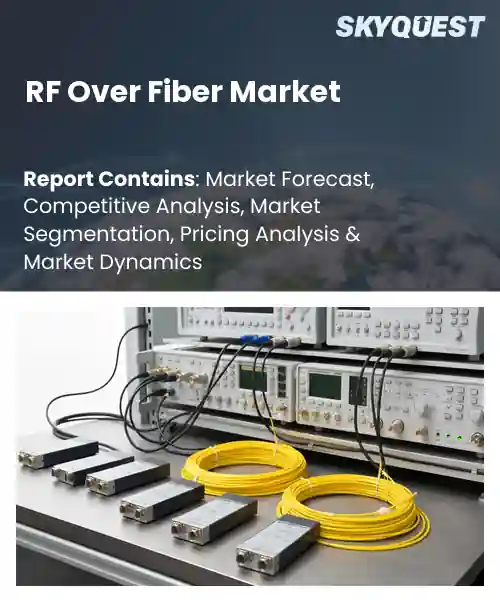
RF Over Fiber Market
Report ID: SQMIG45H2160
Report ID: SQMIG45H2160
[email protected]
USA +1 351-333-4748
Report ID:
SQMIG45H2160 |
Region:
Global |
Published Date: February, 2026
Pages:
157
|Tables:
127
|Figures:
77


Global RF Over Fiber Market size was valued at USD 690 Million in 2024 and is poised to grow from USD 750 Million in 2025 to USD 1400 Million by 2033, growing at a CAGR of 8.2% during the forecast period (2026-2033).
Robust increase in mobile data consumption, rapid 5G deployment, expansion into millimeter-wave bands, and increasing network densification are driving sales of RF over fiber solutions.
Efforts of overcoming copper cable limitations such as signal loss, distance constraints, and electromagnetic interference are prompting investments in RF over fiber technology. Growing demand for high-speed connectivity and network virtualization coupled with expansion of small cells and distributed antenna systems are expected to primarily drive RF over fiber market growth. Network densification and centralized baseband architectures are accelerating adoption, as operators require flexible and high throughput fronthaul to support urban hotspots and large venues. Real-world deployments such as stadium distributed antenna systems and optical headend distribution networks demonstrate cost efficiency and improved spectral performance. Opportunities are expanding in integrated photonics, wavelength division multiplexing scaling, and pluggable interoperable fronthaul modules.
On the contrary, high initial deployment costs, technical integration complexity with legacy systems, signal linearity challenges over long distances, and competition from alternative fronthaul technologies are estimated to impede RF over fiber market penetration over the coming years.
How is AI Transforming the RF Over Fiber Market?
AI is transforming the RF over fiber market by converting traditional passive analog links into intelligent, software-driven infrastructure that can adapt in real time. AI-powered telemetry and orchestration systems help keep remote radio units aligned with centralized baseband systems, improving overall network stability and performance. The market is evolving with higher-bandwidth optical modules combined with machine learning-enabled management platforms. These solutions support dynamic fronthaul and satellite applications while simplifying calibration, testing, and maintenance in the field.
Market snapshot - 2026-2033
Global Market Size
USD 0.69 Billion
Largest Segment
Transmitters
Fastest Growth
Cables
Growth Rate
8.2% CAGR
To get more insights on this market click here to Request a Free Sample Report
Global RF over fiber market is segmented by component, frequency band, application, end user, and region. Based on component, the market is segmented into transmitters, receivers, amplifiers, cables, and others. Based on frequency band, the market is segmented into L Band (Up to 2 GHz), S Band (2–4 GHz), C Band (4–8 GHz), X Band (8–12 GHz), Ku Band (12–18 GHz), and Ka Band (26.5–40 GHz). Based on application, the market is segmented into telecommunication, broadcasting, military & defense, medical, commercial, and others. Based on end user, the market is segmented into service providers, telecom operators, government & defense, healthcare institutions, and others. Based on region, the market is segmented into North America, Europe, Asia Pacific, Latin America, and Middle East & Africa.
The transmitters segment is slated to spearhead the global RF over fiber market revenue generation in the long run. The essential role of transmitters in converting RF signals into optical signals for long-distance transmission over fiber networks is helping cement the high share of this segment. Increasing deployment of small cells and centralized radio architectures is also expected to bolster the dominance of this segment.
The receivers segment is slated to expand at a rapid pace as per this RF over fiber industry analysis. As network densification increases and fronthaul bandwidth requirements expand the need for advanced receivers is also rising, which creates new business scope for market players.
The telecommunications segment is slated to hold the highest global RF over fiber market share in the future. Growing deployment of 5G networks and adoption of fiber-based backhaul solutions are helping this segment hold sway over others. Increasing mobile data consumption around the world is also supporting the dominance of this segment in the long run.
The military and defense segment is slated to emerge as the fastest expanding segment over the coming years. Surge in demand for secure, low-latency, and interference-resistant RF signal transmission solutions across military of different countries is creating new business scope going forward.
To get detailed segments analysis, Request a Free Sample Report
Presence of concentrated industrial ecosystems, widespread technology adoption, and coordinated infrastructure investments are helping Asia Pacific lead global RF over fiber adoption. Availability of robust logistical and supply chain networks is also estimated to help this region maintain its dominant stance. Continuing investments in the deployment of RF over fiber systems have also been received from various government regulators, and this is continuing to create significant demand for RF over fiber systems as well as additional demand for RF over fiber systems in the commercial sector. Growing research and development activities related to the use of RF over fiber in conjunction with other optical transport technologies, as well as the development of cost-effective architectures.
RF over fiber Market Japan benefits from advanced manufacturing clusters, close integration with semiconductor and telecom suppliers, and a strong focus on system miniaturization and quality assurance. Deployment emphasis centers on high density urban coverage and reliable transport for carrier grade applications. Collaboration between equipment vendors and research institutions accelerates prototype validation and operational testing, while procurement practices prioritize proven interoperability and lifecycle support, and regional supply continuity considerations also.
RF over fiber Market South Korea is characterized by proactive carrier modernization efforts, agile vendor ecosystems, and focused research collaborations that prioritize low latency and spectral efficiency. Urban rollout strategies focus on densification and simple remote radio head integration to ensure coverage consistency. Local manufacturers and system integrators are aiding rapid configuration cycles and validation. Procurement is favoring modular architectures and interoperability between vendors, as well as dialogue between governments and the industry on standardized interfaces and trials.
Investment trends in network modernization and a well-established fiber infrastructure are driving demand for RF over fiber services in the region. The focus is on open interfaces and interoperability to simplify operations as various vendors' equipment is being deployed. A robust increase in demand for wireless access across transportation and campus networks is also forecasted to present new opportunities for RF over fiber vendors. Collaborative relationships between service providers and hyperscale cloud providers supporting the integration of optical transport with virtualized radio functions are also creating new business scope in the region.
Telecom carriers, enterprise, and government networks seeking resilient high capacity networks are driving RF over fiber adoption in the United States. The open architecture, vendor interoperability, and integration with virtualized radio platforms features of RF over fiber systems are driving their preference in the country. Moreover, established ecosystem of equipment vendors, integrators, and research organizations also fosters opportunity for RF over fiber innovation.
High demand for reliable, long distance transport, rural connectivity solutions, and integration with existing fiber networks are shaping RF over fiber demand in Canada. RF over fiber companies focusing on reliable lifecycle management and interoperability are expected to be popular in the country. Procurement choices emphasize proven interoperability, maintainability, and scalable design choices that align with network modernization objectives.
Coordination emphasis of the European Union on infrastructure upgrades and cross border collaboration is shaping RF over fiber adoption in Europe. Investments in dense urban fiber backbones and urban testbeds enable operators is also expanding the demand for advanced RF over fiber systems. Improving energy-efficient designs and lifecycle sustainability will help meet the EU's regulatory agenda and procurement standards. Reducing barriers to cross-border deployment through harmonized regulations is also a popular opportunity for RF over fiber companies in the long run. Developing workforce skill sets and emphasizing resilient supply chains assist in the continued commercial scaling and decreased risk associated with deploying technology.
Robust engineering excellence and advanced manufacturing capabilities are governing RF over fiber demand in Germany. Use of RF over fiber systems is slated to be highest in automotive, transport, and industrial automation industries going forward. Adoption of procurement strategies that focus on optimized energy consumption and life service contracts are also influencing the sales of RF over fiber solutions in the long run.
Robust service provider initiatives and interest from broadcasting and financial sectors are shaping RF over fiber demand in the country. Urban pilots and consortium trials are playing a crucial role in boosting scope of commercialization for novel RF over fiber systems. Energy efficiency and maintainability are key considerations. Integration with metropolitan optical networks and flexibility in architecture are useful for rapid scalability in carrier and enterprise networks in the United Kingdom.
RF over fiber Market France features active operator engagement in urban densification, strong focus on interoperable architectures, and collaboration with equipment suppliers on energy conscious deployments. Prototype evaluation and compliance with standards is governed by research institutions in the country. Demand for maintainable RF over fiber solutions and emphasis on sustainability are shaping procurement decisions across France.
To know more about the market opportunities by region and country, click here to
Buy The Complete Report
Expansion Of 5G Infrastructure
The ongoing development of 5G networks creates a growing need for RF over fiber solutions which deliver high capacity and low latency radio signal transmission between baseband units and remote radio heads while minimizing network equipment needs. Service providers choose RF over fiber solutions because they help operators reduce equipment needs and power usage at cell sites while speeding up their small cell network rollouts. This preference drives procurement of fiber based RF transport as operators modernize networks and seek scalable, interoperable solutions for next generation mobile services.
Increasing Demand For Distributed Antenna Systems
RF over fiber system uses multiple antennas to improve coverage and capacity at large indoor venues which use distributed antenna systems. RF over fiber creates a flexible and efficient solution for transmitting radio frequency signals over extended distances throughout these facilities. Fiber-based radio frequency links improve direct access system deployment because they permit central signal processing while reducing system interference. RF over fiber systems provide high efficiency to network operators and system integrators who perform complex coverage projects which creates new business opportunities for vendors that provide combined direct access systems and fiber radio frequency products.
High Initial Deployment Costs
The high initial expenses required for fiber installation and RF over fiber equipment and site setup work act as a barrier that prevents smaller operators and enterprises from using RF over fiber technology although it provides benefits throughout its operational lifetime. Decision makers need to allocate resources between different projects which results in them selecting small system updates or existing system improvements instead of complete fiber network installation. The planning process creates an impression of expensive ownership which results in delayed purchasing procedures and decreased market distribution while confining vendors to major projects and restricting adoption in budget-conscious markets.
Complex Regulatory and Standardization Challenges
Inconsistent regional regulations, spectrum allocation strategies, and the absence of widely adopted technical standards for RF over fiber can cause confusion for vendors and service providers, which can make the process of product development more difficult. The need for certification and interoperability issues can cause delays in the time required for product solutions providers to get into the market. This inconsistent regulatory environment can cause vendors to invest more time and money in product development, which can discourage new vendors and slow the overall adoption of the technology.
Request Free Customization of this report to help us to meet your business objectives.
Competitive dynamics in the global RF over fiber market are intensifying as 5G and 6G fronthaul demands and defense electronic warfare needs push component vendors toward consolidation, targeted partnerships and faster product commercialization; industry examples include recent strategic acquisitions, specialist product launches and entrants pursuing novel photonics and terahertz approaches.
Next-Generation Fronthaul Adoption: Shift towards centralized radio architectures is emerging as a popular RF over fiber industry trend for the future. RFoF can be an answer to the extension of radio placement with waveform integrity. Increasing emphasis on extending radio placement, preserving waveform integrity and reducing onsite complexity are also expected to generate new business scope in the long run.
Cloud Edge Convergence: The integration of RF over fiber with cloud and edge computing is emerging as a key RF over fiber market trend. Disaggregated architectures are being used by operators to place signal processing closer to the user while maintaining centralized control. This integration is allowing operators to orchestrate services flexibly and simplify the management of heterogeneous networks. Vendors and operators are building interoperable platforms and access modules to enable seamless handoff between edge nodes and centralized facilities, unlocking enterprise offerings and accelerating shift to software driven mobile and fixed connectivity models.
SkyQuest’s ABIRAW (Advanced Business Intelligence, Research & Analysis Wing) is our Business Information Services team that Collects, Collates, Correlates, and Analyses the Data collected by means of Primary Exploratory Research backed by robust Secondary Desk research.
As per SkyQuest analysis, growing demand for high-capacity mobile networks and rapid 5G deployment are anticipated to drive the demand for RF over fiber solutions going forward. However, high initial deployment costs and technical integration complexities with legacy telecom infrastructure are slated to slow down the adoption of RF over fiber solutions in the future. North America is slated to spearhead the demand for RF over fiber owing to strong 5G rollouts, high concentration of data centers, and significant investments in small cell and fronthaul infrastructure. The presence of advanced telecom operators and early adoption of millimeter-wave deployments further supports regional growth. Development of integrated photonics, pluggable fronthaul modules, and scalable wavelength division multiplexing solutions are anticipated to be key trends driving the RF over fiber sector through 2033 and beyond.
| Report Metric | Details |
|---|---|
| Market size value in 2024 | USD 690 Million |
| Market size value in 2033 | USD 1400 Million |
| Growth Rate | 8.2% |
| Base year | 2024 |
| Forecast period | 2026-2033 |
| Forecast Unit (Value) | USD Million |
| Segments covered |
|
| Regions covered | North America (US, Canada), Europe (Germany, France, United Kingdom, Italy, Spain, Rest of Europe), Asia Pacific (China, India, Japan, Rest of Asia-Pacific), Latin America (Brazil, Rest of Latin America), Middle East & Africa (South Africa, GCC Countries, Rest of MEA) |
| Companies covered |
|
| Customization scope | Free report customization with purchase. Customization includes:-
|
To get a free trial access to our platform which is a one stop solution for all your data requirements for quicker decision making. This platform allows you to compare markets, competitors who are prominent in the market, and mega trends that are influencing the dynamics in the market. Also, get access to detailed SkyQuest exclusive matrix.
Table Of Content
Executive Summary
Market overview
Parent Market Analysis
Market overview
Market size
KEY MARKET INSIGHTS
COVID IMPACT
MARKET DYNAMICS & OUTLOOK
Market Size by Region
KEY COMPANY PROFILES
Methodology
For the RF Over Fiber Market, our research methodology involved a mixture of primary and secondary data sources. Key steps involved in the research process are listed below:
1. Information Procurement: This stage involved the procurement of Market data or related information via primary and secondary sources. The various secondary sources used included various company websites, annual reports, trade databases, and paid databases such as Hoover's, Bloomberg Business, Factiva, and Avention. Our team did 45 primary interactions Globally which included several stakeholders such as manufacturers, customers, key opinion leaders, etc. Overall, information procurement was one of the most extensive stages in our research process.
2. Information Analysis: This step involved triangulation of data through bottom-up and top-down approaches to estimate and validate the total size and future estimate of the RF Over Fiber Market.
3. Report Formulation: The final step entailed the placement of data points in appropriate Market spaces in an attempt to deduce viable conclusions.
4. Validation & Publishing: Validation is the most important step in the process. Validation & re-validation via an intricately designed process helped us finalize data points to be used for final calculations. The final Market estimates and forecasts were then aligned and sent to our panel of industry experts for validation of data. Once the validation was done the report was sent to our Quality Assurance team to ensure adherence to style guides, consistency & design.
Analyst Support
Customization Options
With the given market data, our dedicated team of analysts can offer you the following customization options are available for the RF Over Fiber Market:
Product Analysis: Product matrix, which offers a detailed comparison of the product portfolio of companies.
Regional Analysis: Further analysis of the RF Over Fiber Market for additional countries.
Competitive Analysis: Detailed analysis and profiling of additional Market players & comparative analysis of competitive products.
Go to Market Strategy: Find the high-growth channels to invest your marketing efforts and increase your customer base.
Innovation Mapping: Identify racial solutions and innovation, connected to deep ecosystems of innovators, start-ups, academics, and strategic partners.
Category Intelligence: Customized intelligence that is relevant to their supply Markets will enable them to make smarter sourcing decisions and improve their category management.
Public Company Transcript Analysis: To improve the investment performance by generating new alpha and making better-informed decisions.
Social Media Listening: To analyze the conversations and trends happening not just around your brand, but around your industry as a whole, and use those insights to make better Marketing decisions.
REQUEST FOR SAMPLE
 REQUEST FREE CUSTOMIZATION
Global Rf Over Fiber Market size was valued at USD 0.69 Billion in 2024 and is poised to grow from USD 0.75 Billion in 2025 to USD 1.4 Billion by 2033, growing at a CAGR of 8.2% during the forecast period (2026-2033).
Competitive dynamics in the global RF over fiber market are intensifying as 5G and 6G fronthaul demands and defense electronic warfare needs push component vendors toward consolidation, targeted partnerships and faster product commercialization; industry examples include recent strategic acquisitions, specialist product launches and entrants pursuing novel photonics and terahertz approaches. 'Optical Zonu Corp', 'ViaLite', 'Foxcom', 'RFOptic Ltd.', 'Huber+Suhner', 'Dev Systemtechnik', 'Apic Corporation', 'Syntonics LLC', 'Gooch & Housego', 'Broadcom', 'Zonu Mezzanine', 'ACORDE', 'Erebus', 'Calian (SED)', 'Lumentum Operations LLC', 'PPM Test', 'Viavi Solutions Inc.', 'Radiall', 'COHERENT CORP.', 'EMCORE CORPORATION'
The rapid expansion of 5G infrastructure increases demand for RF over fiber solutions because they enable high capacity and low latency transport of radio signals between centralized baseband units and remote radio heads, simplifying network architecture and reducing site requirements. Service providers favor RF over fiber to consolidate equipment, reduce power consumption at cell sites, and accelerate deployment of dense small cell networks. This preference drives procurement of fiber based RF transport as operators modernize networks and seek scalable, interoperable solutions for next generation mobile services.
Next-Generation Fronthaul Adoption: Operators are shifting toward centralized radio architectures that demand transparent, low-loss transport of wideband analog signals. RF over fiber provides a path to extend radio placement, preserving waveform integrity and reducing onsite complexity. Growing emphasis on spectral agility and compatibility with diverse radio platforms drives vendor innovation in modular, low-power transceivers and simplified management. Ecosystem collaboration is accelerating to ensure interoperability and widespread deployment, positioning RF over fiber as a strategic element of modern mobile fronthaul and urban coverage strategies.
Presence of concentrated industrial ecosystems, widespread technology adoption, and coordinated infrastructure investments are helping Asia Pacific lead global RF over fiber adoption.


Want to customize this report? This report can be personalized according to your needs. Our analysts and industry experts will work directly with you to understand your requirements and provide you with customized data in a short amount of time. We offer $1000 worth of FREE customization at the time of purchase.
Feedback From Our Clients


 USA (+1) 351-333-4748

