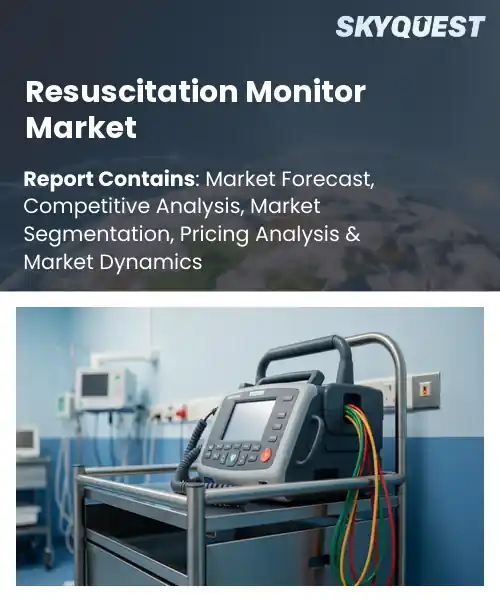
Resuscitation Monitor Market
Report ID: SQMIG35A4266
Report ID: SQMIG35A4266
[email protected]
USA +1 351-333-4748
Report ID:
SQMIG35A4266 |
Region:
Global |
Published Date: July, 2026
Pages:
157
|Tables:
144
|Figures:
78


Global Resuscitation Monitor Market size was valued at USD 728.4 Million in 2024 and is poised to grow from USD 780.12 Million in 2025 to USD 1350.44 Million by 2033, growing at a CAGR of 7.1% during the forecast period (2026-2033).
The global resuscitation monitor market revolves around devices that combine electrocardiographic analysis, defibrillation, and physiological monitoring to guide emergency cardiac care. Its primary driver is the rising prevalence of out‑of‑hospital cardiac arrests, which has spurred hospitals and EMS agencies to adopt integrated solutions that improve survival rates. Historically, standalone defibrillators dominated the field, but the past decade witnessed a shift toward multifunctional platforms that incorporate capnography, pulse oximetry, and decision‑support software. For example, the introduction of the Zoll X Series in 2018 unified waveform analysis with automated CPR feedback, illustrating how technology convergence has expanded market scope and clinical relevance. Building on the integration trend, the market’s next catalyst is cloud‑based analytics that enable performance monitoring and remote training for responders. When hospitals link monitors to centralized platforms, they aggregate outcome metrics, spot protocol deviations, and instantly update algorithms, which reduces time‑to‑defibrillation and improves neurological preservation. Real‑world deployments such as the Philips HeartStart™ 12‑lead system connected to the HealthSuite ecosystem have shown a 12 % rise in ROSC (return of spontaneous circulation) rates across participating EMS districts. This feedback loop creates a virtuous cycle: better data drives smarter device features, attracting investment and expanding market reach into emerging economies where tele‑medicine infrastructure is maturing.
What role does AI play in advancing the resuscitation monitor market?
AI enhances resuscitation monitors by interpreting complex physiological signals in real time and guiding clinicians through automated decision support. Machine‑learning models detect early signs of cardiac arrest, predict shockable rhythms and recommend optimal defibrillation timing. Integrated analytics reduce manual data entry and enable seamless connectivity with hospital information systems. The market is responding to growing demand for smarter devices that improve survival outcomes while easing clinician workload. Vendors are embedding AI chips directly into monitors, allowing edge processing that maintains performance even when network connectivity is limited. This shift is making resuscitation equipment more intuitive and reliable across diverse care settings.Philips June 2026, introduced an AI‑powered resuscitation monitor that automatically analyses rhythm patterns and suggests treatment actions, accelerating response times and supporting market growth.
Market snapshot - (2026-2033)
Global Market Size
USD 728.4 Million
Largest Segment
Defibrillator Monitors
Fastest Growth
CPR Feedback Monitors
Growth Rate
7.1% CAGR
To get more insights on this market click here to Request a Free Sample Report
Global resuscitation monitor market is segmented by product type, application, end user, patient group, connectivity and region. Based on product type, the market is segmented into Defibrillator Monitors, Multiparameter Resuscitation Monitors and CPR Feedback Monitors. Based on application, the market is segmented into Cardiac Arrest, Emergency Medicine, Critical Care and Ambulance Services. Based on end user, the market is segmented into Hospitals, Emergency Medical Services and Ambulatory Surgical Centers. Based on patient group, the market is segmented into Adult, Pediatric and Neonatal. Based on connectivity, the market is segmented into Wired and Wireless. Based on region, the market is segmented into North America, Europe, Asia Pacific, Latin America and Middle East & Africa.
Defibrillator Monitors segment dominates because they combine life saving defibrillation with continuous vital sign tracking, meeting the core clinical requirement of immediate rhythm correction during cardiac arrest. Their integrated functionality simplifies workflow for clinicians, reducing equipment footprint and training complexity. This convergence of therapeutic and monitoring capabilities aligns with hospital procurement preferences for multifunctional devices, reinforcing their central role in resuscitation protocols across diverse care settings.
However, CPR Feedback Monitors are witnessing the strongest growth momentum because they provide real time compression quality metrics that directly improve survival outcomes. Advances in sensor accuracy and integration with mobile platforms drive broader adoption in pre hospital and in hospital training programs, creating new revenue streams and expanding the overall market potential for resuscitation technologies.
Cardiac Arrest segment dominates because it represents the most critical scenario where immediate physiological monitoring and defibrillation are indispensable. The urgency of this condition drives hospitals to prioritize advanced resuscitation monitors that deliver rapid rhythm analysis, shock delivery, and comprehensive vitals. Consequently, procurement budgets allocate substantial resources to devices optimized for cardiac arrest, cementing this application as the primary driver of market demand and product development focus.
On the other hand, Emergency Medicine is emerging as the key high growth area because expanding pre hospital services and trauma centers demand portable, rugged monitors that can operate in diverse environments. Integration with tele medicine platforms and the push for rapid decision making accelerate adoption, opening new channels for manufacturers and fueling market expansion beyond traditional hospital settings.
To get detailed segments analysis, Request a Free Sample Report
North America enjoys a confluence of advanced healthcare delivery systems, robust research institutions, and a deep concentration of technology innovators that together create a fertile environment for resuscitation monitor adoption. Health providers prioritize cutting‑edge patient safety solutions, and reimbursement frameworks encourage investment in high‑performance monitoring equipment. The presence of leading manufacturers within the region accelerates product development cycles and ensures rapid integration of emerging functionalities. Collaborative networks among hospitals, emergency services, and academic centers foster continuous clinical validation, reinforcing confidence in sophisticated monitoring platforms. This ecosystem of strong financial support, regulatory clarity, and a culture of clinical excellence sustains North America’s leading position in the global landscape.
Resuscitation Monitor Market activity in the United States is propelled by an extensive network of tertiary care centers that actively seek advanced monitoring capabilities for critical interventions. Integration of real‑time data analytics into emergency protocols enhances decision‑making speed, while deep‑rooted partnerships between device makers and clinical researchers accelerate innovation pipelines. Emphasis on training programs for emergency personnel ensures proficient use of complex monitor features, reinforcing adoption across both urban and suburban healthcare facilities.
Resuscitation Monitor Market dynamics in Canada reflect a strong public health orientation that values equitable access to life‑saving technology. Provincial health agencies drive procurement strategies that emphasize reliability and interoperability, aligning with national standards for patient safety. Collaborative initiatives between universities and industry partners support localized research, fostering adaptations of monitor systems to meet specific regional care pathways. Continuous professional development for emergency responders further embeds advanced monitoring tools within the Canadian healthcare fabric.
European expansion is fueled by harmonized regulatory frameworks that streamline market entry for innovative monitoring solutions across multiple jurisdictions. Health systems with universal coverage place a premium on patient outcomes, prompting investment in technology that enhances rapid response and precision in cardiac emergencies. Strong public funding for medical research cultivates cross‑border collaborations, resulting in shared clinical insights and accelerated adoption of best practices. Integration of digital health records with monitoring devices supports seamless data flow, empowering clinicians with actionable information. Collectively, these factors create a conducive environment for robust market growth throughout Europe.
Resuscitation Monitor Market presence in Germany is anchored by a rigorous engineering tradition and hospitals that demand high reliability and compliance with exacting standards. Leading research hospitals engage closely with device manufacturers to customize functionalities that align with German clinical protocols. The country’s well‑established emergency medical services network leverages sophisticated monitoring tools to optimize pre‑hospital care, while strong vocational training ensures personnel are adept at utilizing advanced features.
Resuscitation Monitor Market progression in the United Kingdom accelerates under national health initiatives that prioritize rapid intervention and standardized care pathways. The integrated nature of the public health system facilitates coordinated adoption of monitoring technologies across primary, secondary, and tertiary facilities. Investment in clinical training modules enhances practitioner confidence, while collaborative pilots with technology partners demonstrate tangible improvements in patient outcomes, spurring broader rollout.
Resuscitation Monitor Market activity in France is emerging as hospitals modernize emergency departments and seek alignment with European safety directives. Growing emphasis on digital transformation encourages the deployment of monitors that interface seamlessly with national health information exchanges. Partnerships between academic institutions and device firms support localized validation studies, reinforcing confidence in new technologies. Expanding training programs for emergency clinicians further drive acceptance across the French healthcare landscape.
Asia Pacific advances its market stance through a combination of rising demand for sophisticated cardiac care and strategic investments in healthcare infrastructure. Nations within the region are increasingly recognizing the critical role of real‑time monitoring in improving survival rates for emergency cardiac events. Collaborative ventures between regional technology hubs and global manufacturers accelerate the introduction of innovative monitor designs tailored to local clinical environments. Government health policies that emphasize rapid response capabilities and support research initiatives create a conducive climate for adoption. Additionally, focused educational programs equip emergency personnel with the expertise needed to operate complex monitoring systems effectively.
Resuscitation Monitor Market growth in Japan is driven by a technologically progressive medical community that emphasizes precision and safety in emergency care. Aging demographics heighten the need for reliable cardiac monitoring, prompting hospitals to integrate advanced devices into their critical care pathways. Strong collaboration between medical universities and device innovators fosters customization of monitor features to suit Japanese clinical practices. Ongoing professional development ensures that emergency responders are proficient in leveraging these sophisticated tools.
Resuscitation Monitor Market expansion in South Korea reflects the nation’s high‑tech orientation and government support for cutting‑edge medical solutions. Integration of artificial intelligence and connectivity features into monitoring devices aligns with national priorities for smart healthcare delivery. Public and private hospitals alike pursue rapid deployment of these systems to enhance emergency response efficiency. Structured training initiatives for clinicians and emergency staff reinforce effective utilization, positioning South Korea as a burgeoning hub for advanced resuscitation monitoring technologies.
To know more about the market opportunities by region and country, click here to
Buy The Complete Report
Increasing Adoption Of Advanced Sensors
Growing Emphasis on Patient Safety
High Cost Of Integrated Systems
Regulatory Complexity Across Regions
Request Free Customization of this report to help us to meet your business objectives.
The resuscitation monitor market is intensely competitive, with legacy leaders such as ZOLL, Philips and Medtronic defending market share while agile newcomers leverage AI and sensor innovations. Recent M&A activity includes ZOLL’s acquisition of a cardiac analytics firm to enhance data-driven CPR feedback. Philips has partnered with major hospital networks to embed AI‑enabled monitoring into emergency departments, and startups are rolling out cloud‑based, real‑time performance platforms.
Top Player’s Company Profile
Recent Developments
SkyQuest’s ABIRAW (Advanced Business Intelligence, Research & Analysis Wing) is our Business Information Services team that Collects, Collates, Correlates, and Analyses the Data collected by means of Primary Exploratory Research backed by robust Secondary Desk research. As per SkyQuest analysis, the global resuscitation monitor market is propelled primarily by the rising adoption of advanced sensors that deliver precise physiological data, while AI‑driven clinical decision support serves as a second catalyst by offering real‑time rhythm interpretation and treatment recommendations. The Defibrillator Monitors segment leads the market because it merges life‑saving defibrillation with continuous vital‑sign tracking, meeting core clinical needs. North America dominates the landscape, supported by strong healthcare infrastructure, robust reimbursement and a concentration of innovative manufacturers. However, the high cost of integrated systems restrains adoption, especially in resource‑constrained settings, tempering the pace of market penetration despite the clear clinical benefits.
| Report Metric | Details |
|---|---|
| Market size value in 2024 | USD 728.4 Million |
| Market size value in 2033 | USD 1350.44 Million |
| Growth Rate | 7.1% |
| Base year | 2024 |
| Forecast period | (2026-2033) |
| Forecast Unit (Value) | USD Million |
| Segments covered |
|
| Regions covered | North America (US, Canada), Europe (Germany, France, United Kingdom, Italy, Spain, Rest of Europe), Asia Pacific (China, India, Japan, Rest of Asia-Pacific), Latin America (Brazil, Rest of Latin America), Middle East & Africa (South Africa, GCC Countries, Rest of MEA) |
| Companies covered |
|
| Customization scope | Free report customization with purchase. Customization includes:-
|
To get a free trial access to our platform which is a one stop solution for all your data requirements for quicker decision making. This platform allows you to compare markets, competitors who are prominent in the market, and mega trends that are influencing the dynamics in the market. Also, get access to detailed SkyQuest exclusive matrix.
Table Of Content
Executive Summary
Market overview
Parent Market Analysis
Market overview
Market size
KEY MARKET INSIGHTS
COVID IMPACT
MARKET DYNAMICS & OUTLOOK
Market Size by Region
KEY COMPANY PROFILES
Methodology
For the Resuscitation Monitor Market, our research methodology involved a mixture of primary and secondary data sources. Key steps involved in the research process are listed below:
1. Information Procurement: This stage involved the procurement of Market data or related information via primary and secondary sources. The various secondary sources used included various company websites, annual reports, trade databases, and paid databases such as Hoover's, Bloomberg Business, Factiva, and Avention. Our team did 45 primary interactions Globally which included several stakeholders such as manufacturers, customers, key opinion leaders, etc. Overall, information procurement was one of the most extensive stages in our research process.
2. Information Analysis: This step involved triangulation of data through bottom-up and top-down approaches to estimate and validate the total size and future estimate of the Resuscitation Monitor Market.
3. Report Formulation: The final step entailed the placement of data points in appropriate Market spaces in an attempt to deduce viable conclusions.
4. Validation & Publishing: Validation is the most important step in the process. Validation & re-validation via an intricately designed process helped us finalize data points to be used for final calculations. The final Market estimates and forecasts were then aligned and sent to our panel of industry experts for validation of data. Once the validation was done the report was sent to our Quality Assurance team to ensure adherence to style guides, consistency & design.
Analyst Support
Customization Options
With the given market data, our dedicated team of analysts can offer you the following customization options are available for the Resuscitation Monitor Market:
Product Analysis: Product matrix, which offers a detailed comparison of the product portfolio of companies.
Regional Analysis: Further analysis of the Resuscitation Monitor Market for additional countries.
Competitive Analysis: Detailed analysis and profiling of additional Market players & comparative analysis of competitive products.
Go to Market Strategy: Find the high-growth channels to invest your marketing efforts and increase your customer base.
Innovation Mapping: Identify racial solutions and innovation, connected to deep ecosystems of innovators, start-ups, academics, and strategic partners.
Category Intelligence: Customized intelligence that is relevant to their supply Markets will enable them to make smarter sourcing decisions and improve their category management.
Public Company Transcript Analysis: To improve the investment performance by generating new alpha and making better-informed decisions.
Social Media Listening: To analyze the conversations and trends happening not just around your brand, but around your industry as a whole, and use those insights to make better Marketing decisions.
REQUEST FOR SAMPLE
 REQUEST FREE CUSTOMIZATION


Want to customize this report? This report can be personalized according to your needs. Our analysts and industry experts will work directly with you to understand your requirements and provide you with customized data in a short amount of time. We offer $1000 worth of FREE customization at the time of purchase.
Feedback From Our Clients


 USA (+1) 351-333-4748

