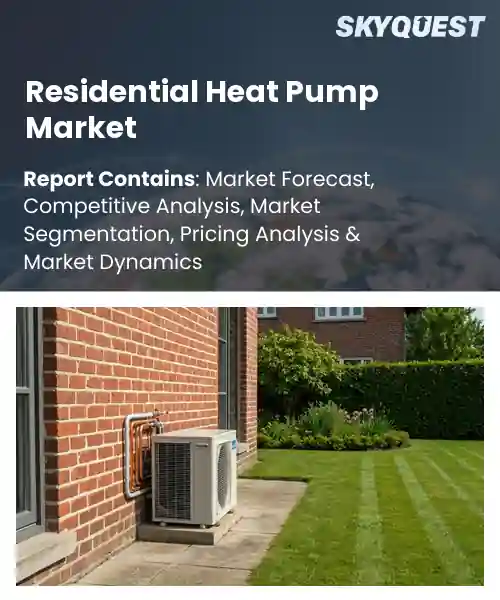
Residential Heat Pump Market
Report ID: SQMIG20I3092
Report ID: SQMIG20I3092
[email protected]
USA +1 351-333-4748
Report ID:
SQMIG20I3092 |
Region:
Global |
Published Date: June, 2026
Pages:
157
|Tables:
140
|Figures:
78


Global Residential Heat Pump Market size was valued at USD 6.7 Billion in 2024 and is poised to grow from USD 7.22 Billion in 2025 to USD 13.17 Billion by 2033, growing at a CAGR of 7.8% during the forecast period (2026-2033).
The primary driver of the residential heat pump market as the global push for decarbonization and energy efficiency that compels electrification of space and water heating formerly powered by fossil fuels. The market covers air source, ground source and hybrid systems for single family and multi family homes and matters because residential heating accounts for a large share of building sector emissions and household energy costs. Adoption moved from niche use in cold climate leaders such as Sweden and Japan to broad penetration across Europe with momentum in United States aided by standards, innovation.
As capital costs decline and performance improves, homeowners find payback periods acceptable and lenders finance retrofits, accelerating adoption, exemplified by state rebate programs in California and rooftop solar plus heat pump pairings in Germany. Those deployments increase installer experience and reduce commissioning failures, which lowers operating risk, also expands market confidence, and creates opportunities for grid interactive products and services tied to demand response and seasonal storage at scale.
How is AI optimizing energy efficiency in the residential heat pump market?
AI optimizes residential heat pump efficiency by combining predictive control, adaptive set points and anomaly detection to keep systems close to optimal operation. Key aspects are model predictive control that forecasts thermal response and weather, machine learning that learns occupant routines, and cloud analytics that coordinate devices with grid signals. The market now mixes improved inverter hardware with software first approaches so existing installations can gain from continuous tuning. Smart thermostats and vendor cloud platforms are enabling retrofits and automated fault detection which makes efficiency improvements more durable and widely accessible.
Quilt in December 2025, the company issued an over the air software and firmware update that improved performance on installed units. This example shows how software driven and AI enabled tuning can boost real world efficiency and support market growth by enabling continuous improvement without hardware replacement.
Market snapshot - (2026-2033)
Global Market Size
USD 6.7 Billion
Largest Segment
Air Source Heat Pumps
Fastest Growth
Air Source Heat Pumps
Growth Rate
7.8% CAGR
To get more insights on this market click here to Request a Free Sample Report
Global residential heat pump market is segmented by product type, system type, end user, installation type, sales channel and region. Based on product type, the market is segmented into Air Source Heat Pumps, Ground Source Heat Pumps and Water Source Heat Pumps. Based on system type, the market is segmented into Split Systems and Packaged Systems. Based on end user, the market is segmented into Residential Buildings and Commercial Buildings. Based on installation type, the market is segmented into New Installations and Retrofit Installations. Based on sales channel, the market is segmented into Direct Sales and Distributors. Based on region, the market is segmented into North America, Europe, Asia Pacific, Latin America and Middle East & Africa.
Air source heat pumps segment dominates with large residential heat pump market share because their lower upfront cost and installation flexibility make them the practical choice for most homeowners. Broad manufacturer focus and mature supply chains have improved product variety and installer availability, reducing adoption barriers. Incremental efficiency gains and compatibility with existing ductwork and controls further drive preference, so market momentum concentrates around air source solutions as they convert retrofit opportunities and attract mainstream consumer demand.
As per residential heat pump market outlook, ground source heat pumps are emerging as the fastest growing area due to superior efficiency and lower lifecycle operating costs that attract buyers focused on long term savings. Advances in ground loop installation, financing options, and growing installer expertise are widening applications and creating high value opportunities that drive future market expansion.
As per residential heat pump market analysis, retrofit Installations segment dominates because the existing housing stock represents the primary opportunity for heat pump penetration, prompting manufacturers and installers to prioritize retrofit compatibility. Product designs, adapter kits, and installer training have evolved to minimize disruption and integrate with legacy systems, lowering technical barriers. Policy incentives and financing for upgrades further encourage homeowners to replace aging equipment rather than pursue full scale replacements, concentrating market activity on retrofit projects.
As per residential heat pump market forecast, new installations are rapidly expanding as builders include heat pumps at design stage, enabling optimized sizing and lower incremental costs. Strengthening building standards and developer demand for efficient homes drive adoption, prompting manufacturer collaboration and streamlined installation workflows that create scalable, long term growth opportunities.
To get detailed segments analysis, Request a Free Sample Report
As per residential heat pump market regional outlook, Asia Pacific dominates because to a mix of huge manufacturing ecosystems, strong policy encouragement, and quick consumer acceptance of electrified heating solutions. Regional leadership in component production provides cost competitive supply and continual product innovation. High urban density and vast retrofit opportunities generate ongoing replacement and installation activity. National programs and utility engagement in major areas boost market penetration, while local original equipment makers and suppliers expand distribution across residential channels. The region also benefits from a diverse climate profile that fosters development of versatile heat pump technologies and from collaborative partnerships between manufacturers, energy utilities, and construction sectors that streamline installation pathways and reinforce long term service ecosystems.
Japan is defined by technological leadership, a dense network of producers, and significant consumer awareness of efficient heating. Local businesses emphasize on compact, quiet designs adapted to restricted living space and cold climate performance. Product refinement, wide service networks, and interaction with smart energy systems enhance uptake across new builds and retrofit projects, while regulatory frameworks and utility programs encourage efficiency in residential heating choices.
As per residential heat pump market regional forecast, South Korea benefits from strong industrial integration, advanced electronics supply chains, and energy policies that encourage electrification. Manufacturers employ knowledge in small system design and inverter technology to ensure efficient and dependable performance in urban and suburban environments. Effective distribution networks, tailored incentive programs, and partnership with construction firms ease retrofits and installations, while emphasis on smart connection and local service offering strengthens consumer confidence.
As per residential heat pump industry analysis, rapid expansion in Europe is supported by effective regulatory frameworks, strong policy focus on decarbonization of buildings, and growing customer preference for low carbon heating alternatives. Incentive schemes and supported funding methods minimize adoption barriers while progressive building standards and renovation plans promote ongoing demand for replacement and upgrade projects. A maturing installation ecosystem, targeted training, and heightened manufacturer focus on cold climate performance and noise reduction improve market preparedness. Cross border collaboration on standards and testing, combined with urban retrofit possibilities and emphasis on integrating heat pumps with district energy and smart control systems, strengthens volume growth and product diversification across varied European markets. Enhanced aftersales service models and rising availability of licensed installers decrease risk for households, while manufacturers and utilities combine to test flexible operating integration. Local supply chain growth and marketing initiatives further speed acceptance, enabling different product configurations to address apartment and detached dwelling markets.
Germany is anchored by strong OEM presence, developed distribution channels, and complete regulatory support that promotes building decarbonization. Manufacturers and installers engage with trade associations to develop training, standards, and finance that reduce adoption friction. Demand is fueled by widespread retrofit activity and a diverse housing stock, promoting product versions that emphasize resilience, low noise, and compatibility with existing heating systems and good aftersales service.
United Kingdom is emerging as policy emphasis on building decarbonization and retrofit incentives mobilize early adopter segments. Installer availability and certification programs are expanding to meet growing interest, while manufacturers tailor compact, low noise units for varied housing types. Pilot projects with utilities and targeted financing options help address upfront cost concerns, and evolving consumer education alongside aftersales support is strengthening market confidence and uptake.
France is expanding driven by renovation programs, incentives, and a strong focus on replacing fossil fuel systems. Manufacturers introduce models suited to diverse housing types, while installer training and certification programs scale to support growing demand. Collaboration between utilities, local authorities, and builders streamlines deployment in urban renovation projects, and marketing efforts raise homeowner awareness of energy savings and comfort benefits and technical aftersales support.
North America is strengthening its position through coordinated legislative interventions, rising utility engagement, and expanding installer and manufacturing capabilities that promote larger use of residential heat pumps. Focus on cold temperature performance and hybrid systems has encouraged product adaption suitable for varied regional climates, while finance options and point of sale incentives remove upfront obstacles. Training activities for contractors and certification systems increase installation quality and consumer confidence. Collaboration between manufacturers, utilities, and contractors promotes demonstration projects and grid integration pilots, while rising emphasis on retrofits in existing housing stock produces ongoing demand and opportunity for service and maintenance ecosystems. Local manufacture and supply chain localization boost availability, while developments in control systems and refrigerant technology enhance performance and compliance. Workforce development and focused marketing improve installation capacity and homeowner awareness across urban and rural regions, strengthening demand and service ecosystems.
United States is shaped by diverse regional climates, strong utility incentive programs, and an expanding installer network that supports retrofit and construction projects. Manufacturers offer systems optimized for cold performance and compatibility with existing heating configurations. Financing options and pilot programs with utilities lower adoption barriers, while workforce training and consumer education drive confidence in heat pump reliability and operational savings and stronger aftersales support.
Canada emphasizes cold climate solutions, driven by provincial incentive programs, utility partnerships and focus on urban and remote communities. Manufacturers and distributors adapt technologies for severe winter operation and ease of installation in varied dwelling types. Programs to develop installer skills and certification reduce deployment risk, while pilot initiatives with local utilities and targeted consumer outreach enhance awareness and acceptance, supporting growth in retrofit segments.
To know more about the market opportunities by region and country, click here to
Buy The Complete Report
Energy Efficiency Regulations
Consumer Environmental Awareness
High Upfront Installation Costs
Technical Skill Gaps
Request Free Customization of this report to help us to meet your business objectives.
Competitive landscape in the global residential heat pump industry is driven by policy incentives and installer network control, prompting incumbents to pursue joint ventures, factory investments, and utility partnerships. Examples include Daikin’s compressor joint venture to secure supply, Vaillant’s Derby R290 monobloc plant and Octopus Energy’s Kraken integration partnership with LG, all aimed at shortening delivery cycles and bundling services.
SkyQuest’s ABIRAW (Advanced Business Intelligence, Research & Analysis Wing) is our Business Information Services team that Collects, Collates, Correlates, and Analyses the Data collected by means of Primary Exploratory Research backed by robust Secondary Desk research.
As per SkyQuest analysis, one key driver is the global push for decarbonization and energy efficiency, and a second driver is falling lifetime costs versus gas and oil driven by scale, incentives and technology improvements. One restraint is high upfront installation costs that deter many homeowners despite operating savings. The dominating region is Asia Pacific, benefiting from manufacturing scale, policy support and rapid consumer uptake, and the dominating segment is air source heat pumps given their lower upfront cost and installation flexibility. Continued policy alignment, installer training and smart home integration should sustain momentum across retrofit and new build markets.
| Report Metric | Details |
|---|---|
| Market size value in 2024 | USD 6.7 Billion |
| Market size value in 2033 | USD 13.17 Billion |
| Growth Rate | 7.8% |
| Base year | 2024 |
| Forecast period | (2026-2033) |
| Forecast Unit (Value) | USD Billion |
| Segments covered |
|
| Regions covered | North America (US, Canada), Europe (Germany, France, United Kingdom, Italy, Spain, Rest of Europe), Asia Pacific (China, India, Japan, Rest of Asia-Pacific), Latin America (Brazil, Rest of Latin America), Middle East & Africa (South Africa, GCC Countries, Rest of MEA) |
| Companies covered |
|
| Customization scope | Free report customization with purchase. Customization includes:-
|
To get a free trial access to our platform which is a one stop solution for all your data requirements for quicker decision making. This platform allows you to compare markets, competitors who are prominent in the market, and mega trends that are influencing the dynamics in the market. Also, get access to detailed SkyQuest exclusive matrix.
Table Of Content
Executive Summary
Market overview
Parent Market Analysis
Market overview
Market size
KEY MARKET INSIGHTS
COVID IMPACT
MARKET DYNAMICS & OUTLOOK
Market Size by Region
KEY COMPANY PROFILES
Methodology
For the Residential Heat Pump Market, our research methodology involved a mixture of primary and secondary data sources. Key steps involved in the research process are listed below:
1. Information Procurement: This stage involved the procurement of Market data or related information via primary and secondary sources. The various secondary sources used included various company websites, annual reports, trade databases, and paid databases such as Hoover's, Bloomberg Business, Factiva, and Avention. Our team did 45 primary interactions Globally which included several stakeholders such as manufacturers, customers, key opinion leaders, etc. Overall, information procurement was one of the most extensive stages in our research process.
2. Information Analysis: This step involved triangulation of data through bottom-up and top-down approaches to estimate and validate the total size and future estimate of the Residential Heat Pump Market.
3. Report Formulation: The final step entailed the placement of data points in appropriate Market spaces in an attempt to deduce viable conclusions.
4. Validation & Publishing: Validation is the most important step in the process. Validation & re-validation via an intricately designed process helped us finalize data points to be used for final calculations. The final Market estimates and forecasts were then aligned and sent to our panel of industry experts for validation of data. Once the validation was done the report was sent to our Quality Assurance team to ensure adherence to style guides, consistency & design.
Analyst Support
Customization Options
With the given market data, our dedicated team of analysts can offer you the following customization options are available for the Residential Heat Pump Market:
Product Analysis: Product matrix, which offers a detailed comparison of the product portfolio of companies.
Regional Analysis: Further analysis of the Residential Heat Pump Market for additional countries.
Competitive Analysis: Detailed analysis and profiling of additional Market players & comparative analysis of competitive products.
Go to Market Strategy: Find the high-growth channels to invest your marketing efforts and increase your customer base.
Innovation Mapping: Identify racial solutions and innovation, connected to deep ecosystems of innovators, start-ups, academics, and strategic partners.
Category Intelligence: Customized intelligence that is relevant to their supply Markets will enable them to make smarter sourcing decisions and improve their category management.
Public Company Transcript Analysis: To improve the investment performance by generating new alpha and making better-informed decisions.
Social Media Listening: To analyze the conversations and trends happening not just around your brand, but around your industry as a whole, and use those insights to make better Marketing decisions.
REQUEST FOR SAMPLE
 REQUEST FREE CUSTOMIZATION
Global Residential Heat Pump Market size was valued at USD 6.7 Billion in 2024 and is poised to grow from USD 7.22 Billion in 2025 to USD 13.17 Billion by 2033, growing at a CAGR of 7.8% during the forecast period (2026-2033).
Competitive landscape in the global residential heat pump market is driven by policy incentives and installer network control, prompting incumbents to pursue joint ventures, factory investments, and utility partnerships. Examples include Daikin’s compressor joint venture to secure supply, Vaillant’s Derby R290 monobloc plant and Octopus Energy’s Kraken integration partnership with LG, all aimed at shortening delivery cycles and bundling services. 'Trane Technologies', 'Daikin North America', 'Carrier Global Corporation', 'Mitsubishi Electric', 'Lennox International', 'Rheem Manufacturing Company', 'Bosch Thermotechnology', 'Fujitsu General', 'Goodman Manufacturing', 'American Standard Heating and Air Conditioning', 'York International Corporation', 'Heat Controller, Inc.', 'Panasonic Corporation', 'NIBE Industrier AB', 'Arcoaire', 'Comfortmaker', 'Bryant Heating and Cooling Systems', 'Gree Electric Appliances', 'Hoval', 'Swegon AB'
Smart Home Integration: Residential heat pumps are designed to interface seamlessly with home energy management systems, connected thermostats and voice assistants, enhancing user convenience and enabling coordinated control of heating and cooling. Manufacturers prioritize interoperable communication standards and software platforms to support predictive scheduling, remote diagnostics and software updates. This trend strengthens value propositions for consumers seeking comfort, energy optimization and integrated services, and encourages partnerships between heat pump suppliers, smart device vendors and energy service providers to deliver holistic home climate solutions.
Why does Asia Pacific Dominate the Global Residential Heat Pump Market? |@12


Want to customize this report? This report can be personalized according to your needs. Our analysts and industry experts will work directly with you to understand your requirements and provide you with customized data in a short amount of time. We offer $1000 worth of FREE customization at the time of purchase.
Feedback From Our Clients


 USA (+1) 351-333-4748

