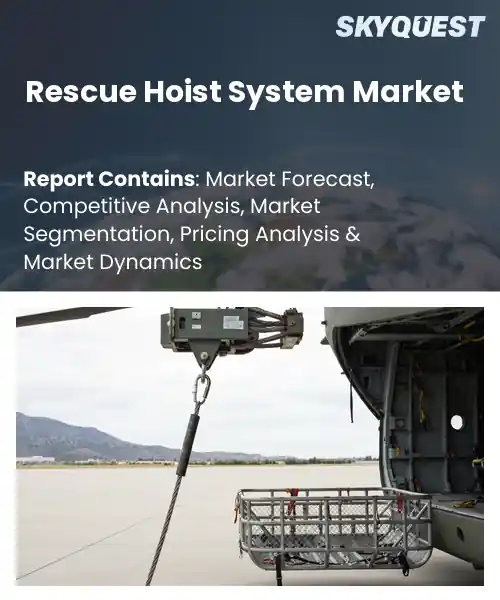
Rescue Hoist System Market
Report ID: SQMIG20A2809
Report ID: SQMIG20A2809
[email protected]
USA +1 351-333-4748
Report ID:
SQMIG20A2809 |
Region:
Global |
Published Date: July, 2026
Pages:
157
|Tables:
145
|Figures:
78


Global Rescue Hoist System Market size was valued at USD 500.55 Million in 2024 and is poised to grow from USD 528.08 Million in 2025 to USD 810.44 Million by 2033, growing at a CAGR of 5.5% during the forecast period (2026-2033).
The rescue hoist system market encompasses gear that lifts personnel from hazardous environments such as high-rise buildings, offshore platforms, and mountainous terrain. Its significance stems from the increasing demand for safe extraction in emergency response, where traditional rope techniques prove insufficient. Historically, the market was niche, dominated by specialized manufacturers serving fire departments and oil‑gas operators. Over the past decade, urbanization, stricter safety regulations, and high‑profile incidents such as the 2021 Shanghai tower fire have accelerated adoption, prompting manufacturers to integrate advanced hydraulics and monitoring. Consequently, the sector has evolved from manual winches to smart, remotely‑controlled hoists that improve survivability.
Regulatory pressure emerges as the key trend driving the global rescue hoist system sector because governments mandate certified extraction equipment for high‑rise construction and offshore drilling sites. When authorities impose stricter standards, manufacturers must redesign products to meet capacity certifications and integrate for verification, which in turn stimulates R&D spending and opens avenues for pricing. For example, the 2023 Directive on vertical evacuation has compelled fire‑service agencies to replace legacy winches with hoists equipped with GPS tracking, leading to a 12 % surge in orders for suppliers. This demand fuels partnerships between OEMs and telematics firms, expanding market reach into rescue networks.
How are AI and IoT Reshaping the Rescue Hoist System Market?
AI is embedding predictive analytics into rescue hoist controllers, allowing real‑time assessment of load conditions and early fault detection. IoT connectivity links each hoist to a central command platform, enabling remote monitoring of battery health, cable tension and environmental factors. Together these technologies create a closed‑loop system where data from sensors feed machine‑learning models that suggest optimal lift speeds and automatically adjust safety limits. The result is faster response times, reduced downtime and higher operator confidence during emergencies. As agencies adopt smarter equipment, the market is shifting from purely mechanical solutions toward integrated digital platforms that support training, maintenance scheduling and performance reporting.
In May 2026, VINCORION Advanced Systems GmbH introduced its next-generation ERH premierV electrical rescue hoist featuring wireless remote-control capability and advanced digital control architecture to support safer, more efficient helicopter rescue missions. The intelligent control system improves operator precision, mission flexibility, and operational reliability, advancing next-generation rescue hoist technologies for civil and military applications.
Market snapshot - (2026-2033)
Global Market Size
USD 500.55 Million
Largest Segment
Hydraulic Rescue Hoists
Fastest Growth
Electric Rescue Hoists
Growth Rate
5.5% CAGR
To get more insights on this market click here to Request a Free Sample Report
Global rescue hoist system market is segmented by product type, mounting platform, application, end user, capacity and region. Based on product type, the market is segmented into electric rescue hoists and hydraulic rescue hoists. Based on mounting platform, the market is segmented into helicopters, fixed-wing aircraft and marine vessels. Based on application, the market is segmented into search & rescue, medical evacuation, military operations and firefighting. Based on end user, the market is segmented into defense, coast guard, emergency medical services and law enforcement. Based on capacity, the market is segmented into below 300 kg, 300–600 kg and above 600 kg. Based on region, the market is segmented into North America, Europe, Asia Pacific, Latin America and Middle East & Africa.
Based on the global rescue hoist system market growth, electric rescue hoists segment dominates because operators prioritize lower weight, reduced maintenance, and seamless integration with modern aircraft power systems. The silent electric drive eliminates acoustic signatures, enhancing stealth for tactical missions while delivering precise speed control for delicate extractions. Reliability gains and lower lifecycle costs attract both civilian and military users, reinforcing its preference across diverse platforms and encouraging manufacturers to focus R&D on battery technology and smart diagnostics.
Meanwhile, hydraulic rescue hoists segment emerges as the most rapidly expanding area because its high load capacity and ruggedness meet growing heavy‑lift demands. Innovations in compact pumps and adaptable mounts allow installation on larger aircraft and vessels, driving fresh procurement and broadening mission capabilities that accelerate market expansion.
Medical evacuation segment dominates because lifesaving extractions prioritize swift, gentle lift capabilities that protect patients during transport. Systems designed for smooth acceleration and controlled descent reduce physiological stress, meeting stringent healthcare protocols. Integration with onboard medical equipment and compatibility with a range of aircraft reinforce its appeal, prompting agencies to standardize hoist solutions that align with advanced trauma care guidelines and enhance overall mission success and operational efficiency.
On the other hand, firefighting segment is witnessing the strongest growth momentum as megastructures increase exposure to high‑rise blazes. Specialized hoists with heat‑resistant components and rapid deployment mechanisms enable firefighters to access elevated fire zones safely. This emerging need fuels new product development and expands market opportunities across civilian rescue services.
To get detailed segments analysis, Request a Free Sample Report
As per the global rescue hoist system market share, North America benefits from a mature emergency response infrastructure and a long‑standing emphasis on occupational safety that drives demand for sophisticated rescue hoist solutions. The region’s extensive industrial and construction activities create a steady need for reliable lifting equipment, while advanced research institutions and manufacturers collaborate to deliver cutting‑edge technology. Strong procurement standards and rigorous certification processes ensure high product reliability, fostering confidence among municipal, airport, and offshore operators. Additionally, robust supply chains and a skilled workforce support rapid deployment and maintenance, reinforcing the market’s leadership position.
United States Rescue Hoist System Market
Rescue hoist system market in the United States thrives on widespread adoption across fire departments, law enforcement agencies, and offshore platforms, where safety and speed are paramount. A culture of continuous innovation fuels the development of lightweight, high‑capacity hoists that integrate digital monitoring and remote operation. Close collaboration between manufacturers and end‑users accelerates product refinement, while a well‑established distribution network ensures rapid availability. Regulatory frameworks that prioritize worker protection further entrench demand across diverse sectors.
Canada Rescue Hoist System Market
Rescue hoist system market in Canada is shaped by a strong governmental commitment to safety in rugged and remote environments, prompting investment in durable hoist solutions for mining, forestry, and wilderness rescue. Emphasis on indigenous participation and local manufacturing enhances supply chain resilience, while collaboration with provincial emergency services drives tailored product specifications. Harsh climatic conditions demand robust designs, leading innovators to focus on reliability and ease of maintenance, reinforcing the market’s growth trajectory.
Based on global rescue hoist system regional forecast, Europe expansion is propelled by stringent occupational safety directives and a proactive approach to emergency preparedness that prioritize advanced rescue hoist technologies. Collaborative research initiatives across the continent foster innovation, delivering systems that combine precision control with ergonomic design. Growing awareness of the need for rapid evacuation in complex urban and industrial settings fuels demand, while public‑private partnerships accelerate deployment in critical infrastructure. An integrated market characterized by cross‑border standards and a skilled engineering workforce further amplifies the region’s rapid growth.
Germany Rescue Hoist System Market
Rescue hoist system market in Germany is anchored by a strong engineering tradition and extensive investment in high‑performance manufacturing. Leading firms focus on precision engineering, embedding advanced safety features and real‑time diagnostics into hoist designs. Close alignment with rigorous national safety regulations ensures that products meet exacting quality benchmarks, supporting widespread use in aviation, construction, and offshore sectors. Collaborative networks between industry and research institutions sustain continuous product enhancement, reinforcing Germany’s dominant market position.
United Kingdom Rescue Hoist System Market
Rescue hoist system market in the United Kingdom is experiencing accelerated adoption driven by a heightened focus on public safety and rapid response capabilities. Emerging standards promote the integration of intelligent monitoring and remote control, encouraging manufacturers to develop versatile hoist solutions for emergency services and industrial sites. Strong governmental support for modernization programs fuels procurement, while the presence of specialized training centers enhances operator proficiency, positioning the United Kingdom as a leading growth market within Europe.
France Rescue Hoist System Market
Rescue hoist system market in France is emerging as a dynamic segment, buoyed by increasing investment in safety infrastructure across urban and coastal zones. French manufacturers are prioritizing lightweight, modular designs that cater to diverse rescue scenarios, while collaborative efforts with European research bodies stimulate technology transfer. Growing awareness of disaster readiness among municipal authorities drives demand for reliable hoist systems, laying the groundwork for rapid market development.
As per global rescue hoist system regional outlook, Asia Pacific is expanding its influence through strategic investment in safety technologies and a surge in infrastructure projects that require robust lifting solutions. The region’s manufacturing hubs excel at delivering cost‑effective yet high‑quality hoists, while evolving regulatory frameworks emphasize compliance and performance. Growing demand from maritime, mining, and disaster‑prone coastal areas underscores the need for adaptable rescue equipment. Partnerships between local firms and global innovators accelerate technology adoption, enhancing overall market resilience and competitiveness across the region.
Japan Rescue Hoist System Market
Rescue hoist system market in Japan is driven by a culture of precision engineering and a proactive stance on disaster preparedness, leading to the development of highly reliable hoist systems for urban rescue and industrial applications. Collaboration between leading manufacturers and government agencies ensures that product designs meet stringent safety criteria, while continuous innovation focuses on compact, high‑capacity units suited for limited space environments. The market benefits from an established distribution network that supports rapid deployment and maintenance.
South Korea Rescue Hoist System Market
Rescue hoist system market in South Korea benefits from strong government initiatives that promote safety technology integration across construction, shipbuilding, and emergency response sectors. Local manufacturers leverage advanced electronics and smart control systems to produce agile hoist solutions capable of rapid deployment. Emphasis on research and development within industrial clusters drives continuous improvement, while partnerships with international partners expand technology access, positioning South Korea as a rising contributor to the regional market landscape.
To know more about the market opportunities by region and country, click here to
Buy The Complete Report
Increasing Safety Regulations
Advancements In Hoist Technology
High Initial Capital Investment
Limited Operator Training Programs
Request Free Customization of this report to help us to meet your business objectives.
The competitive landscape in the global rescue hoist system market outlook is shaped by manufacturers accelerating M&A activity to broaden product portfolios, forming strategic partnerships with fire‑rescue agencies to embed advanced telemetry, and investing in lightweight composite hoist designs that improve load capacity while reducing deployment time. Recent joint ventures between leading equipment firms and specialized sensor providers illustrate how technology integration is becoming a decisive market differentiator.
Top Player’s Company Profile
Recent Developments
SkyQuest’s ABIRAW (Advanced Business Intelligence, Research & Analysis Wing) is our Business Information Services team that Collects, Collates, Correlates, and Analyses the Data collected by means of Primary Exploratory Research backed by robust Secondary Desk research.
As per SkyQuest analysis the global rescue hoist system industry is driven primarily by stricter safety regulations that compel industries to equip crews with certified hoists, while recent advancements in hoist technology such as lightweight electric drives and smart telemetry provide a second boost by improving reliability and lowering operating costs. The electric rescue hoist segment leads the market because users value lower weight, silent operation and integrated diagnostics. North America remains the dominant region thanks to mature emergency‑response infrastructure and strong procurement standards. However, the high upfront capital required for sophisticated systems restrains adoption, especially among smaller agencies, tempering overall growth.
| Report Metric | Details |
|---|---|
| Market size value in 2024 | USD 500.55 Million |
| Market size value in 2033 | USD 810.44 Million |
| Growth Rate | 5.5% |
| Base year | 2024 |
| Forecast period | (2026-2033) |
| Forecast Unit (Value) | USD Million |
| Segments covered |
|
| Regions covered | North America (US, Canada), Europe (Germany, France, United Kingdom, Italy, Spain, Rest of Europe), Asia Pacific (China, India, Japan, Rest of Asia-Pacific), Latin America (Brazil, Rest of Latin America), Middle East & Africa (South Africa, GCC Countries, Rest of MEA) |
| Companies covered |
|
| Customization scope | Free report customization with purchase. Customization includes:-
|
To get a free trial access to our platform which is a one stop solution for all your data requirements for quicker decision making. This platform allows you to compare markets, competitors who are prominent in the market, and mega trends that are influencing the dynamics in the market. Also, get access to detailed SkyQuest exclusive matrix.
Table Of Content
Executive Summary
Market overview
Parent Market Analysis
Market overview
Market size
KEY MARKET INSIGHTS
COVID IMPACT
MARKET DYNAMICS & OUTLOOK
Market Size by Region
KEY COMPANY PROFILES
Methodology
For the Rescue Hoist System Market, our research methodology involved a mixture of primary and secondary data sources. Key steps involved in the research process are listed below:
1. Information Procurement: This stage involved the procurement of Market data or related information via primary and secondary sources. The various secondary sources used included various company websites, annual reports, trade databases, and paid databases such as Hoover's, Bloomberg Business, Factiva, and Avention. Our team did 45 primary interactions Globally which included several stakeholders such as manufacturers, customers, key opinion leaders, etc. Overall, information procurement was one of the most extensive stages in our research process.
2. Information Analysis: This step involved triangulation of data through bottom-up and top-down approaches to estimate and validate the total size and future estimate of the Rescue Hoist System Market.
3. Report Formulation: The final step entailed the placement of data points in appropriate Market spaces in an attempt to deduce viable conclusions.
4. Validation & Publishing: Validation is the most important step in the process. Validation & re-validation via an intricately designed process helped us finalize data points to be used for final calculations. The final Market estimates and forecasts were then aligned and sent to our panel of industry experts for validation of data. Once the validation was done the report was sent to our Quality Assurance team to ensure adherence to style guides, consistency & design.
Analyst Support
Customization Options
With the given market data, our dedicated team of analysts can offer you the following customization options are available for the Rescue Hoist System Market:
Product Analysis: Product matrix, which offers a detailed comparison of the product portfolio of companies.
Regional Analysis: Further analysis of the Rescue Hoist System Market for additional countries.
Competitive Analysis: Detailed analysis and profiling of additional Market players & comparative analysis of competitive products.
Go to Market Strategy: Find the high-growth channels to invest your marketing efforts and increase your customer base.
Innovation Mapping: Identify racial solutions and innovation, connected to deep ecosystems of innovators, start-ups, academics, and strategic partners.
Category Intelligence: Customized intelligence that is relevant to their supply Markets will enable them to make smarter sourcing decisions and improve their category management.
Public Company Transcript Analysis: To improve the investment performance by generating new alpha and making better-informed decisions.
Social Media Listening: To analyze the conversations and trends happening not just around your brand, but around your industry as a whole, and use those insights to make better Marketing decisions.
REQUEST FOR SAMPLE
 REQUEST FREE CUSTOMIZATION
Global Rescue Hoist System Market size was valued at USD 500.55 Million in 2024 and is poised to grow from USD 528.08 Million in 2025 to USD 810.44 Million by 2033, growing at a CAGR of 5.5% during the forecast period (2026-2033).
The competitive landscape is shaped by manufacturers accelerating M&A activity to broaden product portfolios, forming strategic partnerships with fire‑rescue agencies to embed advanced telemetry, and investing in lightweight composite hoist designs that improve load capacity while reducing deployment time. Recent joint ventures between leading equipment firms and specialized sensor providers illustrate how technology integration is becoming a decisive market differentiator. 'Collins Aerospace', 'Safran S.A.', 'Parker-Hannifin Corporation', 'Liebherr-International AG', 'The Boeing Company', 'Airbus SE', 'Leonardo S.p.A.', 'Curtiss-Wright Corporation', 'RTX Corporation', 'Honeywell International Inc.', 'KONG S.p.A.', 'Bucher Industries AG', 'Onboard Systems International, LLC', 'Hensoldt AG', 'Moog Inc.', 'Mitsubishi Electric Corporation', 'Eaton Corporation plc', 'General Dynamics Corporation', 'Cargotec Corporation', 'Cargotec Oyj'
The implementation of stricter safety regulations across industries such as construction, mining, and offshore oil and gas mandates the availability of reliable rescue equipment, directly encouraging the adoption of advanced hoist systems. Organizations are compelled to integrate these devices into emergency response plans to ensure worker protection and to avoid regulatory penalties. This compliance driven demand stimulates procurement cycles, reinforces market confidence, and establishes long‑term growth opportunities for manufacturers providing certified, high‑performance rescue hoists. Such regulatory pressure also fosters partnerships with safety consultants, enhancing market penetration.
Integrated Digital Monitoring: Manufacturers are embedding IoT sensors and real‑time telemetry within rescue hoist systems, enabling continuous performance monitoring, predictive maintenance alerts, and remote diagnostics. This connectivity enhances operational safety by identifying component wear before failure, reduces downtime through scheduled servicing, and provides end‑users with actionable data via cloud dashboards. As emergency response agencies prioritize reliability, the demand for smart, networked hoists is accelerating, driving suppliers to invest in software platforms that complement hardware offerings and create new service revenue streams for customers.
Why does North America Dominate the Global Rescue Hoist System Market? |@12


Want to customize this report? This report can be personalized according to your needs. Our analysts and industry experts will work directly with you to understand your requirements and provide you with customized data in a short amount of time. We offer $1000 worth of FREE customization at the time of purchase.
Feedback From Our Clients


 USA (+1) 351-333-4748

