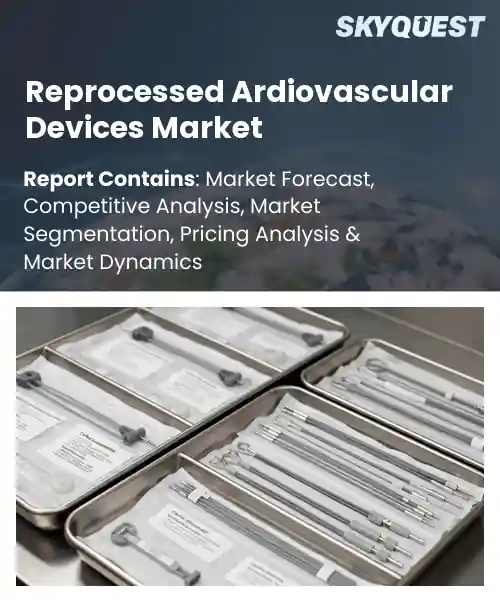
Reprocessed Ardiovascular Devices Market
Report ID: SQMIG35A3319
Report ID: SQMIG35A3319
[email protected]
USA +1 351-333-4748
Report ID:
SQMIG35A3319 |
Region:
Global |
Published Date: March, 2026
Pages:
157
|Tables:
119
|Figures:
77


Global Reprocessed Ardiovascular Devices Market size was valued at USD 1.6 Billion in 2024 and is poised to grow from USD 1.83 Billion in 2025 to USD 5.41 Billion by 2033, growing at a CAGR of 14.5% during the forecast period (2026-2033).
The primary driver of the reprocessed cardiovascular devices market is cost containment within healthcare systems, which has propelled hospitals and clinics to seek safe, economically viable alternatives to single-use instruments. As an established segment of medical device services, this market focuses on sterilizing, testing and certifying devices such as electrophysiology catheters, introducers and diagnostic catheters for reuse, which reduces procurement expenses and medical waste. It matters because stretched hospital budgets and growing procedure volumes in aging populations necessitate affordability without compromising patient safety; historical development shifted from informal in-house reprocessing in the 1990s to regulated third-party services by the 2010s globally.Building on this regulated evolution, a key factor driving global expansion is robust regulatory harmonization and payer acceptance, because clear safety standards and reimbursement pathways lower institutional risk and incentivize adoption. When regulators publish guidance and reprocessors obtain third-party validation, hospitals translate those assurances into procurement decisions that favor reprocessed electrophysiology catheters and diagnostic tools, resulting in measurable cost savings per procedure and higher procedure throughput. For example, a cardiac center using validated reprocessed catheters reduced device spend, enabling expansion of structural heart programs and prompting suppliers to offer bundled remanufacturing contracts with data driven quality monitoring, yielding better outcomes.
How is AI improving safety and cost-efficiency in the reprocessed cardiovascular devices market?
AI is improving safety and cost efficiency in the reprocessed cardiovascular devices market by making inspection, process control and lifecycle management more consistent and predictive. Computer vision and anomaly detection automate visual checks that were once subjective, reducing the chance that a damaged or worn device reaches a procedure. AI monitors sterilization parameters and flags out of range cycles so non compliant batches are caught before use. Predictive maintenance and demand forecasting help hospitals rely on validated reprocessed stock and avoid emergency purchases. The market context favors certified reprocessors and data driven service offerings that make adoption easier and more defensible for purchasers.Stryker June 2025, Stryker’s Sustainability Solutions highlighted data driven reprocessing achievements that can be paired with AI enabled inspection and lifecycle analytics to strengthen validation and traceability. That combination improves device safety and makes reprocessed inventory more cost effective and attractive to hospitals.
Market snapshot - (2026-2033)
Global Market Size
USD 1.6 Billion
Largest Segment
Catheters
Fastest Growth
Catheters
Growth Rate
14.5% CAGR
To get more insights on this market click here to Request a Free Sample Report
Global reprocessed ardiovascular devices market is segmented by device type, material type, application, end user and region. Based on device type, the market is segmented into Stents, Catheters, Pacemakers and Others. Based on material type, the market is segmented into Metallic, Polymeric and Others. Based on application, the market is segmented into Coronary Intervention, Peripheral Intervention and Others. Based on end user, the market is segmented into Hospitals, Clinics, Ambulatory Surgical Centers and Others. Based on region, the market is segmented into North America, Europe, Asia Pacific, Latin America and Middle East & Africa.
Catheters segment dominates because reprocessed catheters represent a broad, reusable device family that aligns with clinical workflows and cost containment priorities; their relatively uniform geometry and established sterilization protocols reduce technical barriers to safe reuse, enabling suppliers and hospitals to scale programs. Clinical familiarity, high procedure volumes that rely on catheter based diagnostics and interventions, and manufacturer focus on validated reprocessing pathways drive widespread adoption and operational integration.
However, Stents are emerging as the most rapidly expanding device because innovations in delivery systems, material biocompatibility, and focused reprocessing protocols are increasing clinical confidence. Growing interest in minimally invasive vascular therapies and clearer reprocessing guidance encourage investment, expanding provider willingness to adopt reprocessed stents and creating revenue and cost savings opportunities.
Polymeric segment dominates because polymer based components in cardiovascular devices are especially amenable to validated cleaning, sterilization, and performance retention during reprocessing, enabling consistent clinical outcomes and provider confidence. Their lighter weight and compatibility with flexible device architectures reduce mechanical stress during repeated cycles, while manufacturers and reprocessors invest in material specific protocols and testing, creating a repeatable pathway that facilitates broader adoption across care settings.
On the other hand, Metallic materials are experiencing the strongest growth momentum as advances in corrosion resistant alloys and precise reconditioning techniques enable reliable mechanical performance after multiple cycles. Clinical demand for durable, load bearing devices and regulatory pathways recognizing validated metallic reprocessing encourage investment, expanding suppliers' service offerings and stimulating new application areas.
To get detailed segments analysis, Request a Free Sample Report
North America dominates the global reprocessed cardiovascular devices market due to an advanced regulatory framework that balances safety with pathways for validated reprocessing, an established culture of hospital cost management, and extensive investment in reprocessing infrastructure. Mature provider networks and centralized contracting encourage adoption of validated reprocessed catheters and related devices, while robust quality assurance programs and third party reprocessors offer standardized services. Reimbursement environments that recognize cost containment create incentives for health systems to integrate reprocessing into purchasing strategies. Large academic medical centers and integrated delivery networks act as early adopters and validation sites, while industry collaboration on safety protocols supports scale and supply chain reliability.
Reprocessed Ardiovascular Devices Market in United States is characterized by broad institutional adoption within tertiary hospitals and integrated delivery networks, supported by established third party reprocessors and robust quality management systems. Clinical stakeholders in high-volume centers often collaborate on validation protocols and post-market surveillance. Procurement teams align reprocessing strategies with supply chain initiatives to reduce procedural costs while maintaining safety standards, driving utilization across complex cardiovascular interventions and procedural suites.
Reprocessed Ardiovascular Devices Market in Canada reflects growing interest among provincial health authorities and hospitals in validated reuse programs that emphasize safety and cost efficiency. Collaborative networks among hospital systems promote standardized protocols and centralized reprocessing services. Governance frameworks and procurement alignment encourage cautious expansion into cardiovascular device reprocessing, focusing on harmonized quality controls, supplier partnerships and operational training to support institutional acceptance and protect patient safety and clinical outcomes.
Rapid expansion of the reprocessed cardiovascular devices market in Europe is driven by harmonizing regulatory initiatives, growing emphasis on sustainable procurement, and increasing awareness among hospital networks of value-based purchasing. Health systems and group purchasing organizations promote validated reprocessing as a route to control procedural expenditures while maintaining safety through standardized validation and surveillance practices. Strong clinical advocacy from cardiology specialists and collaborative pilot programs accelerate acceptance across hospital tiers. Suppliers and third party reprocessors respond with tailored service models and platform-specific protocols that align with national health priorities. Cross-border knowledge sharing and public procurement incentives further encourage broader uptake. Investment in local reprocessing capabilities and partnerships with academic centers for outcome research strengthen clinical confidence, while tailored reimbursement mechanisms in some jurisdictions support operational scale and long term program sustainability.
Reprocessed Ardiovascular Devices Market in Germany benefits from strong hospital networks, procurement entities and rigorous technical standards that support validated reuse programs. Clinical leadership at cardiac centers endorses selective reprocessing of compatible devices, reinforced by centralized quality assurance and third party services. Policy dialogues with payers and providers emphasize safety and environmental considerations, prompting integrated approaches that combine standardized validation, staff training and post-procedure monitoring to sustain credibility and uptake.
Reprocessed Ardiovascular Devices Market in United Kingdom is marked by adoption among trusts and payer interest in device management. Pilot initiatives and collaborative procurement models foster implementation of validated reprocessing workflows, supported by clinical governance and safety reporting mechanisms. Suppliers tailor solutions for compatibility and traceability, while training programs and services reduce operational barriers. Alignment between clinical leadership and procurement drives momentum and wider consideration of reprocessing within care pathways.
Reprocessed Ardiovascular Devices Market in France is emerging as hospitals explore validated reprocessing to support stewardship and environmental goals. Early adopter centers collaborate with regulators to define safety pathways and harmonized validation practices. Pilot programs emphasize traceability and clinical oversight, while reprocessing partnerships address operational constraints. Growing dialogue among clinicians, procurement professionals and policymakers is building the foundation for structured programs that balance patient safety with cost and sustainability considerations.
Asia Pacific is strengthening its position in the reprocessed cardiovascular devices market through targeted investments in centralized reprocessing facilities, adoption of international quality standards, and increasing collaboration between hospitals and specialist reprocessors. Growing clinical research and pilot programs demonstrate operational feasibility and safety in diverse care settings, encouraging larger hospital groups to consider validated reuse strategies. Regional manufacturers and service providers adapt offerings to meet device compatibility and traceability needs, while training initiatives enhance local technical capabilities. Policy discussions around sustainable procurement and cost containment further motivate adoption. Regulatory harmonization efforts foster confidence among institutional buyers, while localized service models address logistical challenges across varied healthcare infrastructures. Growing clinician engagement and outcome reporting strengthen the evidence base, supporting wider program implementation and helping bridge gaps between metropolitan centers and smaller hospitals.
Reprocessed Ardiovascular Devices Market in Japan reflects careful assessment by hospital networks and regulatory bodies, prioritizing validated processes and harmonized quality controls. Advanced tertiary centers evaluate compatibility and clinical outcomes through structured pilot programs, while suppliers work on traceability systems and sterilization protocols adapted to local device formats. Emphasis on clinician engagement, technical training and centralized service offerings supports gradual nationwide expansion of reprocessing practices in complex cardiovascular care settings.
Reprocessed Ardiovascular Devices Market in South Korea is advancing through collaborations between specialized reprocessing providers and hospital networks that emphasize efficiency and safety. Pilot initiatives focus on device compatibility, sterilization validation and traceability to build clinician confidence. Government and professional bodies engage in defining technical guidance, while partners develop services adapted to high-volume cardiac centers. Training and quality systems integration support scalability and encourage ongoing institutional consideration of validated reuse.
To know more about the market opportunities by region and country, click here to
Buy The Complete Report
Increasing Adoption Of Reprocessing Practices
Regulatory Support For Reprocessed Devices
Limited Clinical Acceptance Among Clinicians
Liability and Reimbursement Uncertainties
Request Free Customization of this report to help us to meet your business objectives.
I cannot verify two startups founded in or after 2019 that specifically focus on reprocessed cardiovascular devices. Do you want me to (a) include established reprocessors founded before 2019 that have recent cardiovascular activity, or (b) broaden to newer circular medtech startups that target related reuse and sterilization workflows?
Top Player’s Company Profile
Recent Developments
SkyQuest’s ABIRAW (Advanced Business Intelligence, Research & Analysis Wing) is our Business Information Services team that Collects, Collates, Correlates, and Analyses the Data collected by means of Primary Exploratory Research backed by robust Secondary Desk research. As per SkyQuest analysis, the global reprocessed cardiovascular devices market is being propelled primarily by healthcare cost containment that drives hospitals toward validated reuse programs, with regulatory harmonization and growing payer acceptance providing a second major impetus by lowering institutional risk and enabling reimbursement pathways. Adoption is led by North America and the catheter segment, where uniform geometry and established sterilization protocols support scale. However, persistent clinician skepticism about device integrity remains a meaningful restraint that slows formulary adoption and clinical use. Market momentum is reinforced by advances in sterilization, AI-enabled inspection and third-party validation, which together improve traceability, safety and the business case for reprocessing.
| Report Metric | Details |
|---|---|
| Market size value in 2024 | USD 1.6 Billion |
| Market size value in 2033 | USD 5.41 Billion |
| Growth Rate | 14.5% |
| Base year | 2024 |
| Forecast period | (2026-2033) |
| Forecast Unit (Value) | USD Billion |
| Segments covered |
|
| Regions covered | North America (US, Canada), Europe (Germany, France, United Kingdom, Italy, Spain, Rest of Europe), Asia Pacific (China, India, Japan, Rest of Asia-Pacific), Latin America (Brazil, Rest of Latin America), Middle East & Africa (South Africa, GCC Countries, Rest of MEA) |
| Companies covered |
|
| Customization scope | Free report customization with purchase. Customization includes:-
|
To get a free trial access to our platform which is a one stop solution for all your data requirements for quicker decision making. This platform allows you to compare markets, competitors who are prominent in the market, and mega trends that are influencing the dynamics in the market. Also, get access to detailed SkyQuest exclusive matrix.
Table Of Content
Executive Summary
Market overview
Parent Market Analysis
Market overview
Market size
KEY MARKET INSIGHTS
COVID IMPACT
MARKET DYNAMICS & OUTLOOK
Market Size by Region
KEY COMPANY PROFILES
Methodology
For the Reprocessed Ardiovascular Devices Market, our research methodology involved a mixture of primary and secondary data sources. Key steps involved in the research process are listed below:
1. Information Procurement: This stage involved the procurement of Market data or related information via primary and secondary sources. The various secondary sources used included various company websites, annual reports, trade databases, and paid databases such as Hoover's, Bloomberg Business, Factiva, and Avention. Our team did 45 primary interactions Globally which included several stakeholders such as manufacturers, customers, key opinion leaders, etc. Overall, information procurement was one of the most extensive stages in our research process.
2. Information Analysis: This step involved triangulation of data through bottom-up and top-down approaches to estimate and validate the total size and future estimate of the Reprocessed Ardiovascular Devices Market.
3. Report Formulation: The final step entailed the placement of data points in appropriate Market spaces in an attempt to deduce viable conclusions.
4. Validation & Publishing: Validation is the most important step in the process. Validation & re-validation via an intricately designed process helped us finalize data points to be used for final calculations. The final Market estimates and forecasts were then aligned and sent to our panel of industry experts for validation of data. Once the validation was done the report was sent to our Quality Assurance team to ensure adherence to style guides, consistency & design.
Analyst Support
Customization Options
With the given market data, our dedicated team of analysts can offer you the following customization options are available for the Reprocessed Ardiovascular Devices Market:
Product Analysis: Product matrix, which offers a detailed comparison of the product portfolio of companies.
Regional Analysis: Further analysis of the Reprocessed Ardiovascular Devices Market for additional countries.
Competitive Analysis: Detailed analysis and profiling of additional Market players & comparative analysis of competitive products.
Go to Market Strategy: Find the high-growth channels to invest your marketing efforts and increase your customer base.
Innovation Mapping: Identify racial solutions and innovation, connected to deep ecosystems of innovators, start-ups, academics, and strategic partners.
Category Intelligence: Customized intelligence that is relevant to their supply Markets will enable them to make smarter sourcing decisions and improve their category management.
Public Company Transcript Analysis: To improve the investment performance by generating new alpha and making better-informed decisions.
Social Media Listening: To analyze the conversations and trends happening not just around your brand, but around your industry as a whole, and use those insights to make better Marketing decisions.
REQUEST FOR SAMPLE
 REQUEST FREE CUSTOMIZATION


Want to customize this report? This report can be personalized according to your needs. Our analysts and industry experts will work directly with you to understand your requirements and provide you with customized data in a short amount of time. We offer $1000 worth of FREE customization at the time of purchase.
Feedback From Our Clients


 USA (+1) 351-333-4748

