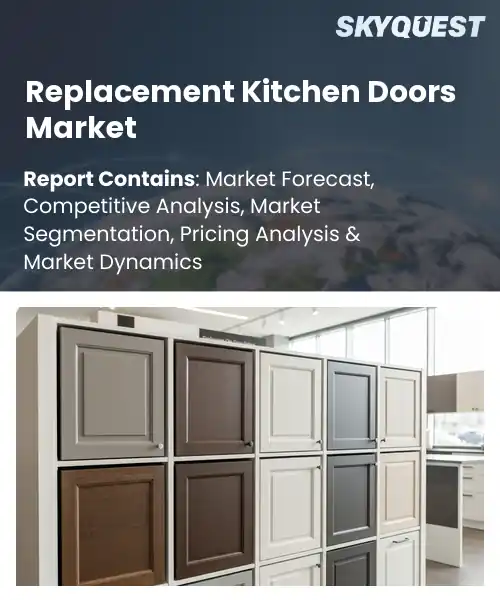
Replacement Kitchen Doors Market
Report ID: SQMIG25Y2005
Report ID: SQMIG25Y2005
[email protected]
USA +1 351-333-4748
Report ID:
SQMIG25Y2005 |
Region:
Global |
Published Date: February, 2026
Pages:
157
|Tables:
142
|Figures:
78


Global Replacement Kitchen Doors Market size was valued at USD 2.8 Billion in 2024 and is poised to grow from USD 3.21 Billion in 2025 to USD 9.62 Billion by 2033, growing at a CAGR of 14.7% during the forecast period (2026-2033).
The demand for inexpensive renovation projects that provide an eye-catching appearance with minimal structural changes is one of the key factors driving replacement kitchen doors market growth. Replacement kitchen doors represent the sale of kitchen cabinetry fronts to homeowners, remodelers and retailers to replace the door front of a cabinet that does not require replacing the actual cabinet itself. Historically the market evolved from bespoke carpentry to mass-produced modular fronts as laminate, thermofoil and painted MDF manufacturing scaled; examples include retail chains offering ready-to-fit shaker doors and online platforms providing custom-sized acrylic options.
A key trend driving the global replacement kitchen doors sector is increased customization enabled by digital tools, which causes consumer willingness to replace doors rather than cabinets because bespoke sizing, finishes and quick lead times reduce perceived risk. Online configurators and augmented reality apps allow homeowners to preview finishes on existing layouts, prompting higher conversion rates for manufacturers and installers; for example a mid-market cabinet maker converted 30% of consultations into orders after adding an AR visualizer. Concurrently sustainability concerns have pushed demand for door-only refurbishments since retaining carcasses lowers embodied carbon, creating opportunities for recycled materials, modular hinge systems and trade partnerships with refurbishment contractors.
How is Automation Improving Production Efficiency in the Replacement Kitchen Doors Market?
The production of replacement kitchen doors is being transformed by using robotics, CNC machining and digital workflows in order to combine various tasks that were previously completed manually into one automated process. As the market has evolved to require more customized products and quicker lead times, flexible manufacturing cells provide manufacturers with an ability to produce smaller production runs while still being able to deliver a consistent high quality product. Examples include linked nesting and edge banding lines that sort parts by unit and robot assisted cutting that enables near continuous operation while freeing skilled staff for finishing. These systems also cut material waste and simplify order tracking.
Howdens in December 2025 began a major Runcorn expansion to install new production machines for doors and panels which brings more automated capacity in house. This move leverages automation to shorten lead times and support a wider range of finishes while improving throughput and consistency.
Market snapshot - (2026-2033)
Global Market Size
USD 2.8 Billion
Largest Segment
Wood
Fastest Growth
Plastic
Growth Rate
14.7% CAGR
To get more insights on this market click here to Request a Free Sample Report
Global replacement kitchen doors market is segmented by material type, design style, surface finish, customization options, end-user and region. Based on material type, the market is segmented into wood, metal and plastic. Based on design style, the market is segmented into modern, traditional and contemporary. Based on surface finish, the market is segmented into matte, glossy and textured. Based on customization options, the market is segmented into pre-finished and custom sizes. Based on end-user, the market is segmented into residential and commercial. Based on region, the market is segmented into North America, Europe, Asia Pacific, Latin America and Middle East & Africa.
As per the global replacement kitchen doors market forecast, wood segment dominates because consumers associate natural timber with premium aesthetics and long term value, which drives preference for replacements that can be refinished and repaired rather than fully replaced. By establishing supply chains, using known methods of fabrication and providing a wide range of species, manufacturers can continue to provide a broad range of options for customers and custom work for accessible prices which will help support and maintain wood as the number one product in the Replacement Kitchen Doors Market and provide consistent demand throughout all channels.
However, metal segment is witnessing the strongest growth momentum as durable, low maintenance finishes and sleek profiles appeal to modern kitchens and commercial projects. The use of new coatings and lighter weight alloys is increasing the variety of ways in which they can be used, which will help to encourage their acceptance by designers and builders.
Pre-finished segment leads because ready applied coatings deliver consistent color and surface quality while shortening lead times and simplifying installation, making replacement projects more accessible for retailers and DIY consumers. The predictable finish reduces onsite labor and warranty concerns, enabling mass distribution through big box channels and online platforms, which strengthens manufacturing throughput, cost efficiencies, and the overall appeal of pre-finished solutions in the replacement kitchen doors market.
However, custom sizes segment is emerging as the most rapidly expanding area in the replacement kitchen doors market as homeowners and designers demand exact fits for nonstandard cabinetry. Digital ordering, real-time cutting and easy logistics, make it feasible to personalize at scale, open new premium pricing opportunities and expand the use of retrofit for manufacturers and speciality fabricators by providing additional options to manufacturers and speciality fabricators.
To get detailed segments analysis, Request a Free Sample Report
As per the global replacement kitchen doors market analysis, Europe leads the industry due to concentrated demand for renovation and high standards for design, material quality, and sustainability. The depth of the market is enhanced by the solid culture of home improvements and extensive renovations occurring in the urban and suburban housing markets combined with a well-established network of specialised retailers and local artisans. The ability of brands to deliver products quickly and customize them to attract different groups of consumers through the use of strong supply chains is a result of well-established product brands. Manufacturers are encouraged by the regulatory focus on the safety of the materials being used and on their environmental impacts to create products such as engineered wood, coatings and finishes that are premium products. Well-developed e-commerce systems have been developed to complement traditional distribution processes, allowing consumers to easily purchase custom made and "off the shelf" products.
Replacement kitchen doors market in Germany benefits from discerning consumers who prioritize precision manufacturing and durable finishes. A dense network of kitchen specialists and renovators supports retrofit solutions, while installers ensure high quality outcomes. German manufacturers emphasize sustainable materials and efficient production methods, appealing to trade and retail channels. Design preferences favor understated functional aesthetics that drive demand for bespoke doors and specialist surface treatments in urban and rural areas.
Replacement kitchen doors market in the United Kingdom is shaped by demand for style updates and practical refurbishments in older housing. Retail chains, independent specialists and online configurators provide a wide range of materials and finishes. Installers and kitchen fitters convert interest into completed projects. The demand for replacement doors and related installation services remains high throughout many regions as consumers prioritize an efficient transformation and have a taste for both modern and classic door styles.
Replacement kitchen doors market in France is influenced by interest in craftsmanship, refined finishes and regional design traditions. A network of independent ateliers and specialised retailers supports bespoke and premium offerings. Consumers seek doors that align with local aesthetic preferences while meeting expectations for material quality and surface treatments. Model formulation relies heavily on decorative details (ornamentation) and patina. Suppliers provide variety of finishes & customization through trade channels; some have choice of distribution channel.
North American market expansion is propelled by a combination of renovation trends, strong remodelling activity in varied housing types, and a growing preference for cost effective kitchen updates that extend the life of existing cabinetry. Consumers value quick, transformative solutions that deliver visible improvement without full replacement, encouraging adoption of replacement doors and professional installation services. A dynamic retail environment, including big box retailers, speciality outlets, and online platforms, provides extensive product choice and supply chain flexibility. Increasing emphasis on convenience, modular offerings, and a mix of traditional and contemporary designs supports market penetration. Manufacturers develop a series of modular materials/components that match local markets (taste and installation practices). Manufacturers also develop procurement options to adapt to local area/country requirements.
Replacement kitchen doors market in the United States reflects wide consumer interest in rapid aesthetic upgrades that avoid full cabinet replacement. A mature installer network and retail channels make varied materials and finishes available. Digital design tools and home improvement platforms assist selection and coordination with fitters. Manufacturers focus on modular series and installation friendly components to meet regional style trends and are able to deliver consistent quality with their distribution partners regardless of the type of housing being built.
Replacement kitchen doors market in Canada is driven by renovation activity in established neighbourhoods and urban centres where consumers prioritize practical aesthetic improvements. The eclectic mix of community-based workshops; unique specialty stores, and national distribution of merchandise, can provide customized or pre-made solutions for the esteems of residential renovations. Focus on durable finishes suited to varying climates motivates suppliers to present resilient coatings and purpose door constructions.
Asia Pacific is strengthening its role in the replacement kitchen doors market through a mix of manufacturing scale, rising urban renovation activity, and rapid adoption of new materials and finishes tailored to local tastes. Regional suppliers are creating a competitive edge through the combination of affordable production methods, investments in surface technologies, and modular equipment for easy installation. Increased demand from consumers for a wide variety of designs will provide suppliers with opportunities to deliver both custom and ready-made designs. Suppliers are emphasizing design education and development of partnerships with global brands in order to drive innovation and quality.
Replacement kitchen doors market in Japan is shaped by meticulous craftsmanship, compact living solutions and demand for high quality finishes that endure heavy use. Manufacturers and workshops provide precise fabrication and custom sizing to fit varied cabinet formats. Consumers favor durable surfaces and easy maintenance paired with subtle design language. Close collaboration between manufacturers, vendors, and installers ensures a seamless retrofit process. Working closely together also results in coatings and engineered materials that meet your design expectations with the newest technologies available.
Replacement kitchen doors market in South Korea is driven by strong appetite for contemporary finishes, compact modular solutions and rapid renovations in urban apartments. Through the use of surface technology and using an efficient production process, manufacturers produce high-performance doors that accommodate local and design preferences. Consumers can search online with a number of retailers and specialist retailers for their desired options. Through the use of an installation network, all products are available to the consumer in a responsive, fast timeframe.
To know more about the market opportunities by region and country, click here to
Buy The Complete Report
Rising Home Renovation Demand
Increasing demand for affordable aesthetic changes (like replacement kitchen cabinet doors) has resulted from growing consumer interest in home improvement and renovation projects. Many homeowners are now considering replacing their kitchen doors as an effective way to refresh the look and feel of their kitchens without the expense of a complete remodel, resulting in a pattern of repeat purchases and customized products. As a result of consumers' desire for replacement doors, retailers and manufacturers will continue to expand their product lines and promote a wide variety of design options for consumers, ultimately leading to increased product development and improved distribution of replacement doors.
Advancements In Material Technology
Advancements in material innovations and finishes have provided a greater range of durability, elegance, and ease of care, which creates an appealing product that is desirable by a larger group of homeowners and design professionals for replacement kitchen doors. Improved material options allow manufacturers to offer varied textures and colors while addressing concerns about wear and moisture, which expands application across housing types. These developments support product differentiation and enable suppliers to introduce premium and value segments, encouraging retailers to promote upgrades and encouraging consumers to choose door replacement as a practical, long lasting improvement to kitchen aesthetics.
Supply Chain Disruptions Persist
Due to ongoing supply chain disruptions, there is an increase in lead time and a decrease in the ability to coordinate with component suppliers, manufacturers, and retailers to satisfy increasing demand for replacement kitchen doors. Supply chain disruptions can limit the availability of products and reduce the selection of sizes, finishes, or custom options that manufacturers can provide, which may lead to lost sales for manufacturers and consumer confidence. If supply chain uncertainties impact the inventory planning or showroom display at the retailer's, then retailers may not be as interested in promoting replacement doors aggressively, and the global replacement kitchen doors market growth may lag, even though consumers are still interested in buying replacement doors.
High Perceived Replacement Costs
The perception of replacing kitchen doors being such a financial burden has led some homeowners to not make the changes they would like to, even though there are other ways to update your kitchen that would be less disruptive than a complete remodel, such as doing partial updates. The financial concerns associated with this type of project affect a buyer's decision to purchase and/or invest in custom options or/and higher end finishes. As a result, many of those who would normally think about doing replacement projects delay or completely skip out on them all together.
Request Free Customization of this report to help us to meet your business objectives.
The global replacement kitchen doors market outlook features a competitive landscape characterized by specialized renovation providers, custom manufacturing firms, and kitchen remodeling brands focusing on cost-effective refurbishment solutions. Dream Doors, Kitchen Magic, Reface Scotland and Howdens are among some of the largest global companies. Their most common strategies to attract renovation customers is through made-to-order door systems and fast installation services. Companies such as Dream Doors are expanding their networks of showrooms and offering franchises, while kitchen magic offers refacing of cabinets as a full transformation of the kitchen at an affordable price.
Sustainable Materials Adoption: Manufacturers and retailers are more focused than ever before on offering eco-friendly products like low-VOC finishes and recycled kitchen doors instead of traditional materials. Homeowners want to buy environmentally friendly products because of government regulations that encourage these practices as well as their own personal preferences. As a result of this demand, many manufacturers are using recycled substrates, responsibly sourced wood, and durable water-based finishes. Many manufacturers are able to use these sustainable materials to create distinction in the marketplace based on sustainability credentials. Sustainable products have become a value proposition and will be necessary for continued growth in our industry.
Customization And Ecommerce Growth: The global replacement kitchen doors market trends is shifting toward personalized replacement kitchen doors driven by online configurators, virtual room visualizers, and flexible manufacturing that supports small production runs. As consumers have begun to expect options in both color/finish/size via direct-to-consumer channels and physical retail locations, it has become necessary for supplier companies to consolidate their ordering, picking and storage, shipping, and installation processes. This evolution reduces friction for remodeling projects, strengthens brand-consumer relationships, and encourages investment in digital tools and supply chain agility to capture demand for bespoke, fast-turnaround solutions.
SkyQuest’s ABIRAW (Advanced Business Intelligence, Research & Analysis Wing) is our Business Information Services team that Collects, Collates, Correlates, and Analyses the Data collected by means of Primary Exploratory Research backed by robust Secondary Desk research.
As per SkyQuest analysis, the global replacement kitchen doors industry is being driven primarily by rising demand for cost-effective renovations that refresh kitchens without full replacements and is further supported by growing customization enabled by digital tools and online configurators that shorten lead times and boost conversions. One important restraint is ongoing disruptions to supply chains that lead to longer lead times and limited product availability resulting in reducing the ability for manufacturers to respond to the market. Europe is currently the leading region for home renovation due to its established renovation industry culture, an extensive retailer/installer network and strong regulatory requirements for product quality. In terms of materials used for home renovations, wood is the leading material used due to its perceived high-end look, ability to be repaired (unlike many other types of materials) and having an established supply chain which provides for a steady flow of wood into the market.
| Report Metric | Details |
|---|---|
| Market size value in 2024 | USD 2.8 Billion |
| Market size value in 2033 | USD 9.62 Billion |
| Growth Rate | 14.7% |
| Base year | 2024 |
| Forecast period | (2026-2033) |
| Forecast Unit (Value) | USD Billion |
| Segments covered |
|
| Regions covered | North America (US, Canada), Europe (Germany, France, United Kingdom, Italy, Spain, Rest of Europe), Asia Pacific (China, India, Japan, Rest of Asia-Pacific), Latin America (Brazil, Rest of Latin America), Middle East & Africa (South Africa, GCC Countries, Rest of MEA) |
| Companies covered |
|
| Customization scope | Free report customization with purchase. Customization includes:-
|
To get a free trial access to our platform which is a one stop solution for all your data requirements for quicker decision making. This platform allows you to compare markets, competitors who are prominent in the market, and mega trends that are influencing the dynamics in the market. Also, get access to detailed SkyQuest exclusive matrix.
Table Of Content
Executive Summary
Market overview
Parent Market Analysis
Market overview
Market size
KEY MARKET INSIGHTS
COVID IMPACT
MARKET DYNAMICS & OUTLOOK
Market Size by Region
KEY COMPANY PROFILES
Methodology
For the Replacement Kitchen Doors Market, our research methodology involved a mixture of primary and secondary data sources. Key steps involved in the research process are listed below:
1. Information Procurement: This stage involved the procurement of Market data or related information via primary and secondary sources. The various secondary sources used included various company websites, annual reports, trade databases, and paid databases such as Hoover's, Bloomberg Business, Factiva, and Avention. Our team did 45 primary interactions Globally which included several stakeholders such as manufacturers, customers, key opinion leaders, etc. Overall, information procurement was one of the most extensive stages in our research process.
2. Information Analysis: This step involved triangulation of data through bottom-up and top-down approaches to estimate and validate the total size and future estimate of the Replacement Kitchen Doors Market.
3. Report Formulation: The final step entailed the placement of data points in appropriate Market spaces in an attempt to deduce viable conclusions.
4. Validation & Publishing: Validation is the most important step in the process. Validation & re-validation via an intricately designed process helped us finalize data points to be used for final calculations. The final Market estimates and forecasts were then aligned and sent to our panel of industry experts for validation of data. Once the validation was done the report was sent to our Quality Assurance team to ensure adherence to style guides, consistency & design.
Analyst Support
Customization Options
With the given market data, our dedicated team of analysts can offer you the following customization options are available for the Replacement Kitchen Doors Market:
Product Analysis: Product matrix, which offers a detailed comparison of the product portfolio of companies.
Regional Analysis: Further analysis of the Replacement Kitchen Doors Market for additional countries.
Competitive Analysis: Detailed analysis and profiling of additional Market players & comparative analysis of competitive products.
Go to Market Strategy: Find the high-growth channels to invest your marketing efforts and increase your customer base.
Innovation Mapping: Identify racial solutions and innovation, connected to deep ecosystems of innovators, start-ups, academics, and strategic partners.
Category Intelligence: Customized intelligence that is relevant to their supply Markets will enable them to make smarter sourcing decisions and improve their category management.
Public Company Transcript Analysis: To improve the investment performance by generating new alpha and making better-informed decisions.
Social Media Listening: To analyze the conversations and trends happening not just around your brand, but around your industry as a whole, and use those insights to make better Marketing decisions.
REQUEST FOR SAMPLE
 REQUEST FREE CUSTOMIZATION
Global Replacement Kitchen Doors Market size was valued at USD 2.8 Billion in 2024 and is poised to grow from USD 3.21 Billion in 2025 to USD 9.62 Billion by 2033, growing at a CAGR of 14.7% during the forecast period (2026-2033).
Competition in the global replacement kitchen doors market is shaped by consolidation, retailer partnerships and digital direct to consumer challengers offering custom fronts. Targeted M&A such as UAP acquiring Armadillo Metal Coatings in December 2024 coexist with designer collaborations and online ordering and measurement services from DTC suppliers like Superfront and Semihandmade, driving product differentiation and faster product to market cycles. Note: I could not verify two pure replacement kitchen door startups founded in 2019 or later that publicly disclose both founding year and recent market moves; the two verified firms above are adjacent, supply chain and finish technology players that materially influence competitive dynamics in the replacement kitchen doors market. 'Howdens Joinery', 'IKEA', 'B&Q', 'Wickes', 'Magnet', 'DIY Kitchens', 'B&Q TradePoint', 'Benchmarx Kitchens', 'MFI Kitchens', 'Homebase', 'John Lewis', 'Sheraton Interiors', 'Schmidt Küchen', 'Anglian Home Improvements', 'Wren Kitchens', 'Dunelm', 'Custom Cabinetry', 'RTA Cabinet Store', 'Cabinets To Go', 'Better Homes and Gardens Cabinetry'
Growing consumer interest in home improvement and renovation projects has increased demand for cost effective aesthetic upgrades such as replacement kitchen doors. Homeowners view door replacement as a practical approach to refresh kitchen appearance without comprehensive remodeling, encouraging frequent purchases and customization. This preference leads retailers and manufacturers to expand offerings and promote design options, stimulating product development and distribution. The resulting market responsiveness strengthens availability and choice, making replacement doors an attractive option for consumers seeking visual transformation with lower disruption.
Sustainable Materials Adoption: Manufacturers and retailers are increasingly prioritizing eco-friendly materials and low-VOC finishes for replacement kitchen doors, responding to homeowner preferences and regulatory emphasis on environmental performance. This trend encourages use of recycled substrates, responsibly sourced woods, and durable water-based coatings, enabling brands to differentiate through sustainability credentials. It also stimulates product innovation across supply chains, fosters longer-term customer loyalty, and opens partnerships with green certifiers, positioning sustainable offerings as a value proposition and competitive necessity for future growth.
As per the global replacement kitchen doors market analysis, Europe leads the industry due to concentrated demand for renovation and high standards for design, material quality, and sustainability.


Want to customize this report? This report can be personalized according to your needs. Our analysts and industry experts will work directly with you to understand your requirements and provide you with customized data in a short amount of time. We offer $1000 worth of FREE customization at the time of purchase.
Feedback From Our Clients


 USA (+1) 351-333-4748

