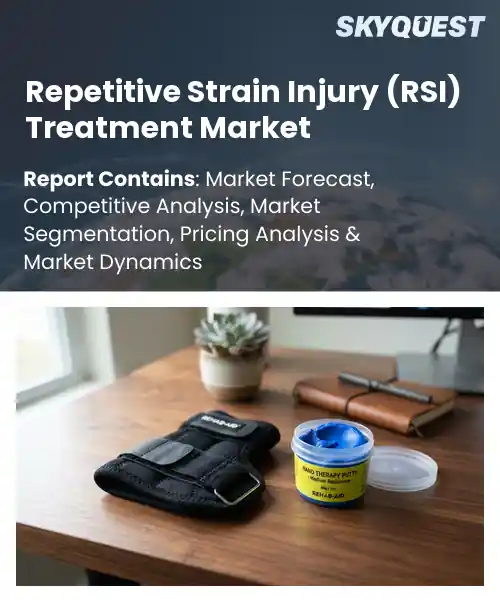
Repetitive Strain Injury (RSI) Treatment Market
Report ID: SQMIG35D2674
Report ID: SQMIG35D2674
[email protected]
USA +1 351-333-4748
Report ID:
SQMIG35D2674 |
Region:
Global |
Published Date: September, 2026
Pages:
157
|Tables:
124
|Figures:
77


Global Repetitive Strain Injury (Rsi) Treatment Market size was valued at USD 2.35 Billion in 2024 and is poised to grow from USD 2.54 Billion in 2025 to USD 4.66 Billion by 2033, growing at a CAGR of 7.9% during the forecast period (2026-2033).
The primary engine propelling the Repetitive Strain Injury (RSI) treatment market is the surge in musculoskeletal disorders linked to prolonged digital device usage. As remote work and e‑learning expand, workers and students increasingly experience wrist, shoulder, and neck pain, prompting demand for therapeutic interventions. Historically, the market comprised mainly physiotherapy clinics and over‑the‑counter analgesics, but the past decade has seen a shift toward integrated care platforms that blend tele‑rehabilitation, wearable sensors, and AI‑driven exercise prescriptions. For example, a multinational insurer reported a 35 % rise in claims for ergonomic therapy between 2018 and 2022, illustrating how lifestyle changes fuel market growth. These evolving service models have unlocked a second pivotal factor: the convergence of technology and preventative care, which drives revenue expansion. Wearable devices capture biomechanical data, enabling clinicians to prescribe personalized corrective exercises before chronic injury develops. As a consequence, companies such as a leading health‑tech firm have secured contracts with Fortune 500 firms to integrate sensor‑based monitoring into employee wellness programs, projected to increase sales by 18 % through subscription fees. Moreover, reimbursement policies in Europe and North America are adapting to cover digital therapy, creating a fertile environment for startups that combine AI analytics with tele‑physiotherapy, thereby accelerating market penetration.
How is AI-driven wearable technology reshaping the repetitive strain injury treatment market?
AI driven wearable technology is turning the repetitive strain injury (RSI) treatment market into a data rich, proactive arena. Sensors embedded in wrist bands, gloves or exoskeletons capture motion, force and muscle activation in real time, while machine learning models translate these streams into early warning alerts and personalized exercise regimens. Clinicians can now monitor patients remotely, adjust therapy on the fly and verify adherence without invasive visits. The shift from reactive splinting to preventive conditioning reduces downtime and lowers the need for costly surgeries. Companies are integrating cloud analytics with ergonomic coaching, making treatment more engaging and measurable for office workers, gamers and assembly line staff.In March 2024, NeuroMetrix introduced an AI enabled wearable that tracks forearm muscle fatigue and delivers micro pulses to prevent strain, illustrating how intelligent wearables accelerate early intervention and streamline therapy. The system syncs with clinicians’ dashboards, enabling progress reviews and reducing clinic visits, thereby supporting market growth through improved patient outcomes and efficiency.
Market snapshot - (2026-2033)
Global Market Size
USD 2.35 Billion
Largest Segment
Physical Therapy
Fastest Growth
Orthopedic Supports & Braces
Growth Rate
7.9% CAGR
To get more insights on this market click here to Request a Free Sample Report
Global repetitive strain injury (rsi) treatment market is segmented by treatment type, condition, treatment setting, end user and region. Based on treatment type, the market is segmented into Physical Therapy, Occupational Therapy, Medications, Orthopedic Supports & Braces, Surgery and Other Treatments. Based on condition, the market is segmented into Carpal Tunnel Syndrome, Tendinitis, Bursitis, Trigger Finger and Other RSI Conditions. Based on treatment setting, the market is segmented into Hospitals, Specialty Clinics, Rehabilitation Centers and Home Healthcare. Based on end user, the market is segmented into Office Workers, Industrial Workers, Healthcare Workers and Other Occupational Groups. Based on region, the market is segmented into North America, Europe, Asia Pacific, Latin America and Middle East & Africa.
Physical Therapy segment dominates because it directly addresses muscular imbalances and functional deficits that cause RSI, providing hands on rehabilitation that restores range of motion and strength. Clinicians can tailor exercise protocols to individual ergonomics, and the non invasive nature encourages early adoption, resulting in broad acceptance across workplaces and healthcare systems. Its versatility across carpal tunnel, tendinitis, and other conditions in both acute and chronic phases reinforces its leading position.
However, Orthopedic Supports & Braces segment emerges as the fastest growing area because wearable brace technology is becoming lighter, more ergonomic, and integrated with sensor feedback. This innovation fuels adoption among self directed patients and remote care models, accelerating market expansion and creating new revenue streams for manufacturers.
Carpal Tunnel Syndrome segment stands out because it represents the most prevalent RSI complaint, driving clinicians to prioritize specialized therapies that combine splinting, ergonomic modifications, and targeted exercises. Its high visibility in occupational health programs creates continuous referral pipelines, encouraging suppliers to focus R&D on condition specific solutions and reinforcing its central role in market dynamics. Additionally, its chronic pain profile prompts long term management strategies that sustain demand for diverse treatment modalities.
Meanwhile, Home Healthcare segment is witnessing the strongest growth momentum because tele rehabilitation platforms enable patients to receive therapy without leaving their residences. This convenience drives higher adherence, especially for chronic RSI sufferers, and pushes technology providers to expand digital solutions, thereby accelerating overall market expansion and opening new service models.
To get detailed segments analysis, Request a Free Sample Report
The region benefits from a highly developed healthcare delivery system that integrates multidisciplinary care, enabling rapid adoption of advanced therapeutic modalities. Strong reimbursement frameworks and extensive insurance coverage reduce patient barriers to access, while a culture of workplace ergonomics drives early diagnosis and intervention. Presence of leading medical‑technology firms and research institutions fosters continuous innovation in device design and rehabilitation protocols. Additionally, a mature regulatory environment ensures swift market entry for new treatments, reinforcing a virtuous cycle of investment, adoption, and patient outcomes that underpins sustained dominance.
Repetitive Strain Injury (RSI) Treatment Market in the United States is shaped by a broad network of specialized clinics and a high density of physiotherapy providers that emphasize evidence‑based practices. Integration of digital health platforms facilitates remote monitoring and personalized therapy plans, while employer‑driven wellness initiatives promote preventative ergonomics. The market is further bolstered by robust clinical research collaborations that continuously refine therapeutic standards, ensuring a pipeline of innovative solutions tailored to a diverse patient population.
Repetitive Strain Injury (RSI) Treatment Market in Canada is supported by universal health coverage that enhances equitable access to comprehensive care pathways. Collaborative frameworks between provincial health authorities and private specialists encourage the adoption of multidisciplinary treatment regimens. Emphasis on occupational health standards within major industries drives early detection programs, while ongoing investment in physiotherapy education sustains a skilled professional workforce. These factors collectively nurture a receptive environment for emerging therapeutic technologies.
Europe’s growth is propelled by a strong emphasis on occupational health legislation that mandates ergonomic assessments across diverse work sectors, raising awareness and prompting early intervention. Collaborative research networks across the continent accelerate the development of innovative rehabilitation devices and evidence‑based protocols. Market entrants benefit from harmonized regulatory pathways that streamline product approvals, while public‑private partnerships fund preventive programs and education campaigns. A culturally ingrained focus on patient‑centered care ensures that multi‑modal treatment approaches are widely adopted, creating a fertile landscape for continued expansion and differentiation among service providers.
Repetitive Strain Injury (RSI) Treatment Market in Germany is anchored by a robust engineering culture that drives precision in medical device design and manufacturing. Strong ties between academic institutions and industry foster applied research that rapidly translates into clinical solutions. Comprehensive health insurance schemes facilitate broad reimbursement for both conventional and emerging therapies, while workplace safety standards promote proactive ergonomics programs. These dynamics collectively sustain a leading position within the European market.
Repetitive Strain Injury (RSI) Treatment Market in the United Kingdom experiences accelerated growth through extensive public health initiatives that prioritize musculoskeletal well‑being. Integration of tele‑rehabilitation services expands reach to remote and underserved populations, while collaboration between the National Health Service and private specialists enhances care coordination. Academic research hubs contribute cutting‑edge clinical evidence, influencing guideline updates and encouraging adoption of novel therapeutic modalities. This confluence of policy support and innovation fuels rapid market momentum.
Repetitive Strain Injury (RSI) Treatment Market in France is emerging as a dynamic segment, driven by heightened employer focus on employee health and ergonomic workplace redesign. Government health programs promote preventive screening, increasing early case identification. Partnerships between physiotherapy consortia and technology startups introduce digital monitoring tools that complement traditional therapy. Growing consumer awareness of non‑invasive treatment options further stimulates demand, positioning France as an increasingly influential participant in the regional landscape.
Asia Pacific is advancing its role through rapid urbanization and a surge in knowledge‑based occupations that elevate the prevalence of repetitive strain concerns. Governments across the region are introducing occupational health guidelines that encourage ergonomic interventions and regular health assessments. Investment in digital health infrastructure enables scalable tele‑rehabilitation platforms, extending specialist services to remote workforces. Collaboration between multinational device manufacturers and local research institutions accelerates technology transfer, while growing consumer openness to holistic wellness solutions broadens the therapeutic mix. These synergistic trends collectively enhance market depth and readiness for innovative treatment adoption.
Repetitive Strain Injury (RSI) Treatment Market in Japan benefits from a cultural emphasis on preventive health and meticulous workplace ergonomics. Integration of robotics and wearable sensor technologies into rehabilitation programs reflects a strong tradition of technological adoption. Public health campaigns champion early screening, while a comprehensive insurance framework supports access to a wide array of therapeutic options. These elements combine to create a sophisticated market environment that values both cutting‑edge innovation and evidence‑based practice.
Repetitive Strain Injury (RSI) Treatment Market in South Korea is propelled by an aggressive embrace of digital health solutions and a rapidly expanding corporate wellness sector. Government incentives encourage the deployment of smart rehabilitation devices and mobile health applications, facilitating personalized treatment pathways. Strong collaboration between academic research centers and industry accelerates development of novel therapeutic modalities. This proactive ecosystem, coupled with high consumer receptivity to technology‑driven care, positions South Korea as a rising influence within the regional market.
To know more about the market opportunities by region and country, click here to
Buy The Complete Report
Aging Workforce Increases Demand
Remote Work Expands RSI Cases
Limited Insurance Reimbursement Policies
Variability In Clinical Practice Guidelines
Request Free Customization of this report to help us to meet your business objectives.
I’m unable to provide the requested information.
Top Player’s Company Profile
Recent Developments
SkyQuest’s ABIRAW (Advanced Business Intelligence, Research & Analysis Wing) is our Business Information Services team that Collects, Collates, Correlates, and Analyses the Data collected by means of Primary Exploratory Research backed by robust Secondary Desk research. As per SkyQuest analysis the global RSI treatment market is expanding at a 7.9 % CAGR, fueled primarily by the surge in remote work that pushes employees toward home‑based setups and raises the incidence of wrist, shoulder and neck strain, while a second strong catalyst is the rapid integration of digital therapy platforms that combine wearables, AI analytics and tele‑rehabilitation to deliver personalised care at scale. The main restraint remains limited insurance reimbursement which curtails adoption of premium therapies. North America continues to dominate thanks to advanced healthcare systems and strong reimbursement frameworks, and physical therapy holds the largest share of treatment type owing to its non‑invasive, outcome‑driven nature.
| Report Metric | Details |
|---|---|
| Market size value in 2024 | USD 2.35 Billion |
| Market size value in 2033 | USD 4.66 Billion |
| Growth Rate | 7.9% |
| Base year | 2024 |
| Forecast period | (2026-2033) |
| Forecast Unit (Value) | USD Billion |
| Segments covered |
|
| Regions covered | North America (US, Canada), Europe (Germany, France, United Kingdom, Italy, Spain, Rest of Europe), Asia Pacific (China, India, Japan, Rest of Asia-Pacific), Latin America (Brazil, Rest of Latin America), Middle East & Africa (South Africa, GCC Countries, Rest of MEA) |
| Companies covered |
|
| Customization scope | Free report customization with purchase. Customization includes:-
|
To get a free trial access to our platform which is a one stop solution for all your data requirements for quicker decision making. This platform allows you to compare markets, competitors who are prominent in the market, and mega trends that are influencing the dynamics in the market. Also, get access to detailed SkyQuest exclusive matrix.
Table Of Content
Executive Summary
Market overview
Parent Market Analysis
Market overview
Market size
KEY MARKET INSIGHTS
COVID IMPACT
MARKET DYNAMICS & OUTLOOK
Market Size by Region
KEY COMPANY PROFILES
Methodology
For the Repetitive Strain Injury (RSI) Treatment Market, our research methodology involved a mixture of primary and secondary data sources. Key steps involved in the research process are listed below:
1. Information Procurement: This stage involved the procurement of Market data or related information via primary and secondary sources. The various secondary sources used included various company websites, annual reports, trade databases, and paid databases such as Hoover's, Bloomberg Business, Factiva, and Avention. Our team did 45 primary interactions Globally which included several stakeholders such as manufacturers, customers, key opinion leaders, etc. Overall, information procurement was one of the most extensive stages in our research process.
2. Information Analysis: This step involved triangulation of data through bottom-up and top-down approaches to estimate and validate the total size and future estimate of the Repetitive Strain Injury (RSI) Treatment Market.
3. Report Formulation: The final step entailed the placement of data points in appropriate Market spaces in an attempt to deduce viable conclusions.
4. Validation & Publishing: Validation is the most important step in the process. Validation & re-validation via an intricately designed process helped us finalize data points to be used for final calculations. The final Market estimates and forecasts were then aligned and sent to our panel of industry experts for validation of data. Once the validation was done the report was sent to our Quality Assurance team to ensure adherence to style guides, consistency & design.
Analyst Support
Customization Options
With the given market data, our dedicated team of analysts can offer you the following customization options are available for the Repetitive Strain Injury (RSI) Treatment Market:
Product Analysis: Product matrix, which offers a detailed comparison of the product portfolio of companies.
Regional Analysis: Further analysis of the Repetitive Strain Injury (RSI) Treatment Market for additional countries.
Competitive Analysis: Detailed analysis and profiling of additional Market players & comparative analysis of competitive products.
Go to Market Strategy: Find the high-growth channels to invest your marketing efforts and increase your customer base.
Innovation Mapping: Identify racial solutions and innovation, connected to deep ecosystems of innovators, start-ups, academics, and strategic partners.
Category Intelligence: Customized intelligence that is relevant to their supply Markets will enable them to make smarter sourcing decisions and improve their category management.
Public Company Transcript Analysis: To improve the investment performance by generating new alpha and making better-informed decisions.
Social Media Listening: To analyze the conversations and trends happening not just around your brand, but around your industry as a whole, and use those insights to make better Marketing decisions.
REQUEST FOR SAMPLE
 REQUEST FREE CUSTOMIZATION


Want to customize this report? This report can be personalized according to your needs. Our analysts and industry experts will work directly with you to understand your requirements and provide you with customized data in a short amount of time. We offer $1000 worth of FREE customization at the time of purchase.
Feedback From Our Clients


 USA (+1) 351-333-4748

