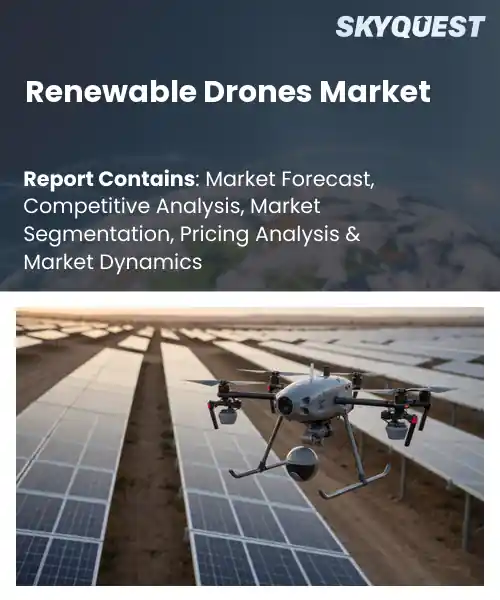
Renewable Drones Market
Report ID: SQMIG20A2566
Report ID: SQMIG20A2566
[email protected]
USA +1 351-333-4748
Report ID:
SQMIG20A2566 |
Region:
Global |
Published Date: February, 2026
Pages:
157
|Tables:
149
|Figures:
78


Global Renewable Drones Market size was valued at USD 66.3 Billion in 2024 and is poised to grow from USD 85.13 Billion in 2025 to USD 628.92 Billion by 2033, growing at a CAGR of 28.4% during the forecast period (2026-2033).
The demand for global renewable drones market continues to grow rapidly, as businesses integrate drone technology with renewable energy infrastructure (e.g. solar farms, wind farms, geothermal facilities). The demand for drones grows quickly because of the many sectors that increasingly leverage drone technology for inspections, monitoring, surveying and maintenance operations. Drones offer substantial opportunities to drive down the costs of operations, improve worker safety, and enhance operational efficiencies over traditional manual methods. Drones that use advanced technologies (e.g. thermal imaging cameras, LiDAR, AI-based analytics) enable real-time data collection and predictive maintenance. As a result, drones have become essential elements of the renewable energy value chain.
One of the main drivers for growth is the shift from fossil fuels to clean energy globally, supported through government programs, sustainability targets, and increased investments in developing renewable energy infrastructure. The worldwide growth and deployment of additional clean energy generation capacity, especially in the solar and wind sectors, continues to drive greater demand for more advanced drones to service vast amounts of land and difficult-to-access areas. Furthermore, innovation in drones, including solar-powered, longer-lasting and battery-efficient; autonomous navigation; and AI integration technologies are increasing drone capabilities greatly increased their operational ranges; hence, they are rapidly being embraced by numerous industries.
How is AI Improving Inspection Efficiency in the Renewable Drones Market?
The use of AI to enhance the efficiency of inspection in the renewable drones market, via autonomous data capture combined with machine vision and analytics for inspection, is a key area of focus. Areas of focus for the AI-enhanced autonomous drone solution include automated flight planning, high resolution imaging, AI-powered defect detection and prioritization, and integration with existing asset management systems. The transition from manual inspection to scheduled autonomous surveys of wind turbines and solar arrays is reducing risk and accelerating decision-making cycles.
The use of blade inspections and the auditing of large-scale solar farms demonstrate how consistent image quality and standardized scoring by AI allows for rework to be reduced, repairs to occur more quickly, predictive maintenance on assets to take place sooner, and increased asset life. The FAA authorized vHive in January 2025 to utilize coordinated multi-drone autonomous operations for inspection of solar farms. By being able to coordinate the collection of data that AI will analyze at scale, the FAA has enabled operators to reduce the time it takes to complete inspections and improve consistency in defect investigation and proactive maintenance.
Market snapshot - (2026-2033)
Global Market Size
USD 66.3 Billion
Largest Segment
Multi-Rotor
Fastest Growth
Hybrid
Growth Rate
28.4% CAGR
To get more insights on this market click here to Request a Free Sample Report
Global renewable drones market is segmented into drone type, range, propulsion system, payload capacity, application and region. Based on drone type, the market is segmented into fixed-wing, multi-rotor and hybrid. Based on range, the market is segmented into Up to 50 KM, 50-100 KM, 100-200 KM and Over 200 KM. Based on propulsion system, the market is segmented into solar, wind and hybrid. Based on payload capacity, the market is segmented into up to 5 kg, 5-15 kg, 15-25 kg and over 25 kg. Based on application, the market is segmented into aerial surveying, delivery & logistics, inspection & monitoring, agriculture, security & surveillance and others. Based on region, the market is segmented into North America, Europe, Asia Pacific, Latin America and Middle East & Africa.
Multi-rotor segment dominates because its vertical takeoff and landing capability, high maneuverability, and payload modularity make it ideally suited for dense, low-altitude renewable drone tasks. The inherent advantages of the platform result in lower complexity in the way that these operations are conducted and allow operators to deploy multi-rotor platforms quickly for inspection, surveillance, or agricultural monitoring purposes, thus driving operators to prefer multi-rotor platforms and develop services around them. These network effects will result in enhanced investment in Ecologies, tooling and the development of specialized payloads contributing further to the dominance of multi-rotor platforms in the renewable drones market.
As per renewable drones market forecast, fixed-wing segment has the greatest opportunity for growth due to their superior range and energy efficiency, which provide complete solutions for long duration survey and logistics missions. The trend of using lightweight materials in conjunction with autonomous platforms, and increased demand for wide-area mapping and persistent. Long-range surveillance, has created a strong impetus for certification, and thus adoption of Fixed-Wing platforms and has created new technology/business service models for renewable drone operations.
As per renewable drones market outlook, the solar segment is showing the most growth because of how efficiently it can collect energy from the environment. This will allow for more time between required charges from the ground, as well as more economical ways to provide continuous surveillance and long-term environmental observations. This segment is also appealing to investors because of its connection to large-scale renewable energy objectives and there are also many advocates at the regulatory level for this segment. In addition, due to many of these same factors, there has been an increased ability to develop light-weight energy storage, such as photovoltaic systems, and to provide innovative autonomous operations and continuous data collection services via this type of system.
As per renewable drones market analysis, hybrid segment which incorporate both solar and traditional energy into one system, have been identified as a potential area of significant growth since they can provide reliable endurance and flexibility in performance as an energy source. Adoption has increased due to improved power management systems and increasing demand for flexibility in mission types. This will facilitate extended scope for applications, such as beyond line of sight logistics and extended inspections, and will lead to new commercial applications.
To get detailed segments analysis, Request a Free Sample Report
North America is the leader in the renewable drones market due to its combination of advanced technology, strong industry capability, and established energy infrastructure. The abundance of manufacturers, service providers, and research institutions help speed up innovation in sensor technology, autonomy, and data analysis. Also, the partnerships between utilities and technology companies have created valid operational demonstrations of renewable on-site asset inspection and maintenance, as well as established procedures for procurement and logistical resources.
In the U.S. renewable drones market, drones are used extensively to assist project developers in the inspections, maintenance, and environmental assessments of the projects they are developing. The industrial base for drones includes numerous manufacturers and software companies involved with advanced sensor integration and analytics to support the use of drones in their respective industries. The partnerships between regulators, research institutions, and investors will drive the creation of practical deployment models that can be used to provide commercial drone services. The focus on safety and operations training will ensure reliability among renewable assets.
In Canada, the market for renewable drones is focused primarily on using drones for inspection and monitoring of both onshore and offshore renewable energy assets, particularly in remote and difficult-to-access geographical areas. Canadian businesses specialize in cold weather and rugged terrain installations of renewable energy assets and apply advanced sensors and analytics to support those installations. Collaboration with regional stakeholders supports the creation of practical drone operational models.
The renewable drones market in Europe is growing very fast to many factors, including the alignment of policy, the deployment of renewable energy assets in concentrated locations, and the development of a very strong ecosystem of industrial services that create a strong preference for the use of drones in operations. Harmonization of regulations across many jurisdictions has reduced barriers to delivering cross-border services, while public-sector procurement and utility engagement have established a stable demand for inspection and maintenance workflows in the marketplace. Both traditional manufacturers and specialized service providers have also taken advantage of recent developments in autonomous systems and imaging technology, as well as their ability to integrate with existing asset management systems. In addition, many collaborative research initiatives between the private and public sectors are being pursued through industry consortia, which will help to accelerate technology transfer and standards development in the sector. This will allow the efficient scaling of commercial renewable drone operations.
As per renewable drones market regional forecast, Germany benefits from a mature industrial infrastructure and strong relationships with large renewable asset operators. The German manufacturers have taken significant steps towards the precision of sensors used in autonomous inspections, which follow stringent safety and quality standards. The cooperation between the research institutions and utilities in Germany has enabled the development of innovative predictive maintenance and condition monitoring processes. The preferences of the German public sector for fruits of proven technologies, has validated their use of drones as part of everyday asset maintenance in various sectors. Therefore, as a result, there will be increased efficiencies gained from the utilization of drones in the management of assets.
The UK renewables drones market are seeing accelerated commercialisation due to strong governmental initiatives for innovation and an engaged private sector transformation of offshore wind inspection solutions through the generation of technology start-ups and service providers, evolving around conditional maintenance models. Furthermore, there is a strong emphasis on cross-industry interoperability and established data standards in support of the growth of offshore wind drones.
As per renewable drones market regional outlook, France market are emerging primarily as a result of specific targeted pilot projects from technology partners and renewable energy providers as well as through the assistance from universities and precision engineered drone solutions for both solar and seabed wind applications. The renewable drones ecosystem is evolving through the integration of advanced technologies originally adapted from the aerospace and defence industries, bringing high levels of precision, reliability, and operational efficiency. At the same time, local and regional partnerships are emerging to support the deployment of drone rental fleets and provide maintenance services, leveraging established operating procedures and best practices. This has led to the growth of service-based models such as Drone-as-a-Service (DaaS), improving accessibility and scalability for end users.
The renewable drones industry is experiencing a growing presence in Asia Pacific through investments in manufacturing capabilities, development of autonomy for drones and solutions designed specifically for various types of renewable assets in the region. Original Equipment Manufacturers (OEMs) and systems integrators based in the region modify drone platforms to suit tropical, marine and high-density urban environments. Research Institutions are working to enhance the robustness of the drones and develop their autonomous capabilities.
As per renewable drones industry analysis, Japan market leverages advanced manufacturing processes and systems engineering principles to produce reliable solutions to inspect and monitor complex renewable assets, including offshore projects. Collaboration among industrial players and research institutes translates into rapid progress in developing autonomous systems, sensors, and the integration of robotics into renewable energy.
The renewable drones market in South Korea relies heavily on the country's strong electronics and systems integration industry to produce reliable and compact platforms for coastal renewable energy construction. The research activities of academic research institutes, combined with collaboration among utility companies and technical vendors, has resulted in innovative automation, data analytics, and other tools being developed for the effective management of assets. Government/private sector partnerships and test facilities provide critical resources for interfacing these autonomous systems into the larger smart grid and establishing South Korean companies as key regional players in providing services.
To know more about the market opportunities by region and country, click here to
Buy The Complete Report
Supportive Government Policies and Incentives
Governments around the globe have begun offering supportive regulatory structures and incentive programs to help lower the barriers to adoption of renewable drone technology and encourage investment in this industry. Subsidizing drone operations through various incentive programs, such as tax credits and tax deductions, and streamlining the approval process for drone technologies/solutions, will stimulate the private sector to participate in the development of renewable drone solutions. Furthermore, the provision of these clear regulatory incentives and the development of regulatory policies will also reduce uncertainty in the market, generating additional opportunities for investors to invest in solutions based on renewable energy.
Advances In Battery Technology
By developing renewable energy-powered drones using next-generation batteries with higher energy density than previous generations of battery technologies and implementing new lightweight materials. In addition to enabling longer flight times, carrying larger payloads and operating more reliably, advances in battery technologies will also reduce the costs associated with maintaining and repairing renewable energy powered drones. As these barriers to longer flight times, heavier payloads and more reliable operation continue to be removed, potential customers will start to view renewable energy powered drones as viable replacement solutions for their current drone needs; as this perception increases, manufacturers will continue to invest in the development of renewable energy powered drone products and the future deployment of these products in the market.
Regulatory Uncertainty and Restrictions
Developers and operators have limited ability to deploy large-scale renewable drones because of fragmented regulations, varying levels of safety, and complex integration requirements for the airspace they will operate in. Independent certification processes, the combined effect increases compliance burdens and complicates long-term operational planning for operators, discouraging investment and delaying commercial viability. Operators experience long wait times to gain regulatory approval to commercially operate, as well as operational restrictions that hinder route planning and expansion of their service offerings. The absence of harmonized regulations increases perceived risk, decreases market confidence, and inhibits the establishment of partnerships between manufacturers, service providers and end-users, thereby delaying market momentum.
High Initial Cost and Infrastructure Requirements
Specialized systems or platforms for renewable drone applications require a high level of initial investment, as do the charging or energy harvesting systems and maintenance facilities. The development and reliability of ground support systems, training programs and compatible energy supply systems required for operations create operational complexities that result in long payback timelines. The degree of capital and logistical expenditures required to establish renewable drones, and their associated infrastructure will limit the pace at which operators can grow their fleets and the difficulty. They will have established broad-based adoption across industries where cost-conscious customers already have demonstrated preference for established low-capital alternatives.
Request Free Customization of this report to help us to meet your business objectives.
The global renewable drones industry has seen a significant transformation due to strategic acquisitions, real-life proof of concept demonstrations, utility partnerships, and differentiating products with AI-based analytics and autonomous deployments. Companies such as DroneBase have completed several acquisitions to add solar AI capabilities, Cyberhawk has demonstrated various aerial solutions to end-users at multiple sites, and startup companies like Hummingdrone INSPECT are creating digital twin inspection solutions for sensor-less aerial platforms.
SkyQuest’s ABIRAW (Advanced Business Intelligence, Research & Analysis Wing) is our Business Information Services team that Collects, Collates, Correlates, and Analyses the Data collected by means of Primary Exploratory Research backed by robust Secondary Desk research.
As per SkyQuest analysis, the global renewable drones market is poised for rapid expansion driven primarily by improvements in energy density and power management that extend endurance and enable commercial missions, and secondly by AI driven autonomous inspection and analytics that increase efficiency and unlock value added services. Multi rotor platforms dominate due to VTOL capability and payload modularity, while North America leads the market due to technological maturity, supportive infrastructure and progressive regulatory pathways. Renewable drones market growth is tempered by regulatory uncertainty and fragmented airspace rules that slow approvals and cross border scale up. Overall, technological gains and service innovation are creating durable commercial pathways for renewable drone adoption. Multirotor drones dominate the renewable drones market share, while solar-powered systems and inspection & monitoring applications hold the leading share across segments, with Europe leading regionally and wind energy companies as the primary end users.
| Report Metric | Details |
|---|---|
| Market size value in 2024 | USD 66.3 Billion |
| Market size value in 2033 | USD 628.92 Billion |
| Growth Rate | 28.4% |
| Base year | 2024 |
| Forecast period | (2026-2033) |
| Forecast Unit (Value) | USD Billion |
| Segments covered |
|
| Regions covered | North America (US, Canada), Europe (Germany, France, United Kingdom, Italy, Spain, Rest of Europe), Asia Pacific (China, India, Japan, Rest of Asia-Pacific), Latin America (Brazil, Rest of Latin America), Middle East & Africa (South Africa, GCC Countries, Rest of MEA) |
| Companies covered |
|
| Customization scope | Free report customization with purchase. Customization includes:-
|
To get a free trial access to our platform which is a one stop solution for all your data requirements for quicker decision making. This platform allows you to compare markets, competitors who are prominent in the market, and mega trends that are influencing the dynamics in the market. Also, get access to detailed SkyQuest exclusive matrix.
Table Of Content
Executive Summary
Market overview
Parent Market Analysis
Market overview
Market size
KEY MARKET INSIGHTS
COVID IMPACT
MARKET DYNAMICS & OUTLOOK
Market Size by Region
KEY COMPANY PROFILES
Methodology
For the Renewable Drones Market, our research methodology involved a mixture of primary and secondary data sources. Key steps involved in the research process are listed below:
1. Information Procurement: This stage involved the procurement of Market data or related information via primary and secondary sources. The various secondary sources used included various company websites, annual reports, trade databases, and paid databases such as Hoover's, Bloomberg Business, Factiva, and Avention. Our team did 45 primary interactions Globally which included several stakeholders such as manufacturers, customers, key opinion leaders, etc. Overall, information procurement was one of the most extensive stages in our research process.
2. Information Analysis: This step involved triangulation of data through bottom-up and top-down approaches to estimate and validate the total size and future estimate of the Renewable Drones Market.
3. Report Formulation: The final step entailed the placement of data points in appropriate Market spaces in an attempt to deduce viable conclusions.
4. Validation & Publishing: Validation is the most important step in the process. Validation & re-validation via an intricately designed process helped us finalize data points to be used for final calculations. The final Market estimates and forecasts were then aligned and sent to our panel of industry experts for validation of data. Once the validation was done the report was sent to our Quality Assurance team to ensure adherence to style guides, consistency & design.
Analyst Support
Customization Options
With the given market data, our dedicated team of analysts can offer you the following customization options are available for the Renewable Drones Market:
Product Analysis: Product matrix, which offers a detailed comparison of the product portfolio of companies.
Regional Analysis: Further analysis of the Renewable Drones Market for additional countries.
Competitive Analysis: Detailed analysis and profiling of additional Market players & comparative analysis of competitive products.
Go to Market Strategy: Find the high-growth channels to invest your marketing efforts and increase your customer base.
Innovation Mapping: Identify racial solutions and innovation, connected to deep ecosystems of innovators, start-ups, academics, and strategic partners.
Category Intelligence: Customized intelligence that is relevant to their supply Markets will enable them to make smarter sourcing decisions and improve their category management.
Public Company Transcript Analysis: To improve the investment performance by generating new alpha and making better-informed decisions.
Social Media Listening: To analyze the conversations and trends happening not just around your brand, but around your industry as a whole, and use those insights to make better Marketing decisions.
REQUEST FOR SAMPLE
 REQUEST FREE CUSTOMIZATION
Global Renewable Drones Market size was valued at USD 66.3 Billion in 2024 and is poised to grow from USD 85.13 Billion in 2025 to USD 628.92 Billion by 2033, growing at a CAGR of 28.4% during the forecast period (2026-2033).
The competitive landscape in the global renewable drones market is defined by consolidation through targeted acquisitions, field demonstrations and utility partnerships, and product differentiation via AI driven analytics and autonomous deployments. Examples include DroneBase’s acquisitions to add solar AI capabilities, Cyberhawk’s site demonstrations with operators, and niche entrants offering digital twin inspection platforms such as Hummingdrone INSPECT. 'DJI', 'Parrot', 'Percepto', 'Terra Drone', 'Aerodyne Measure', 'Freefly Systems', 'SITEMARK', 'Cyberhawk', 'Above Surveying', 'DroneDeploy', 'Skydio', 'Wingtra', 'Sulzer & Schmid', 'Raptor Maps', 'Zeitview', 'Flyability', 'Garuda UAV', 'AEROSPEC Technologies', 'Force Technology', 'Yuneec'
Governments worldwide are implementing supportive regulatory frameworks and incentive programs that lower barriers to adoption and encourage investment in renewable drone technologies. Subsidies, tax incentives, and streamlined approval processes stimulate private sector participation and enable startups and established firms to allocate resources toward research, deployment, and scaling of sustainable drone solutions. Clear policy direction reduces uncertainty, attracts funding, and accelerates commercialization cycles, thereby expanding market demand and promoting innovation across applications such as energy inspection, agriculture, and logistics where renewable-powered drones offer distinct operational advantages.
Decentralized Energy Integration: Operators of distributed renewable installations increasingly adopt drones to manage dispersed assets, enabling more responsive maintenance and optimized energy flows across microgrids. Drone platforms facilitate rapid visual assessment, flexible deployment for seasonal variability, and integration with energy management systems to support load balancing and asset coordination. This trend elevates the role of drones from inspection tools to operational enablers, driving partnerships between utilities, independent operators, and drone service providers to enhance resilience and maximize renewable generation across fragmented infrastructure landscapes.
North America is the leader in the renewable drones market due to its combination of advanced technology, strong industry capability, and established energy infrastructure.


Want to customize this report? This report can be personalized according to your needs. Our analysts and industry experts will work directly with you to understand your requirements and provide you with customized data in a short amount of time. We offer $1000 worth of FREE customization at the time of purchase.
Feedback From Our Clients


 USA (+1) 351-333-4748

