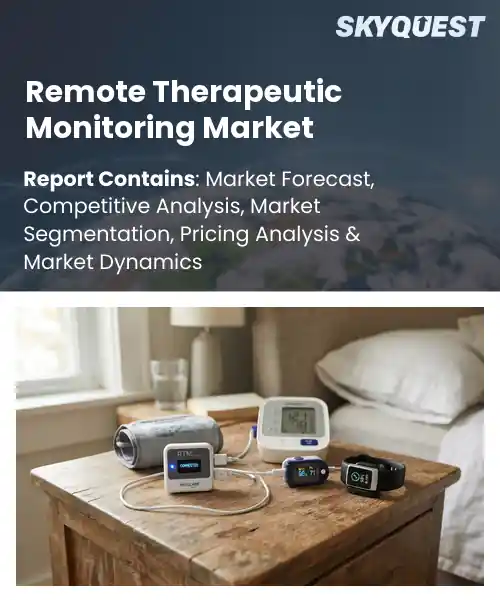
Remote Therapeutic Monitoring Market
Report ID: SQMIG35G2563
Report ID: SQMIG35G2563
[email protected]
USA +1 351-333-4748
Report ID:
SQMIG35G2563 |
Region:
Global |
Published Date: September, 2026
Pages:
157
|Tables:
143
|Figures:
78


Global Remote Therapeutic Monitoring Market size was valued at USD 1.42 Billion in 2024 and is poised to grow from USD 1.7 Billion in 2025 to USD 7.22 Billion by 2033, growing at a CAGR of 19.8% during the forecast period (2026-2033).
Remote therapeutic monitoring (RTM) refers to the use of platforms and connected medical devices to collect, transmit, and analyze health data beyond traditional telehealth visits, enabling clinicians to adjust treatments in time. The market has gained prominence as insurers recognize RTM as a reimbursable service, a shift codified by the 2020 Medicare expansion that covered disease management tools. Adopters such as chronic obstructive pulmonary disease programs leveraged wearable spirometers to reduce hospital admissions, demonstrating cost savings and adherence gains. This endorsement, combined with pandemic‑driven telehealth adoption, has transformed RTM from a niche experiment into a mainstream component of value care. One of the most compelling growth engines for the global RTM market is the shift toward value‑based reimbursement, which ties payments to clinical outcomes. When insurers reward reductions in readmissions, manufacturers of continuous glucose monitors partner with health systems to supply data that triggers automated insulin adjustments, lowering emergency visits. This incentive prompts hospitals to invest in platforms that aggregate data from cardiac wearables, respiratory sensors, and mental‑health apps, creating ecosystems. As these ecosystems demonstrate cost avoidance, payer networks expand coverage to therapeutic areas such as post‑surgical rehabilitation, unlocking revenue streams and fostering broader significant adoption across chronic and acute care.
How is AI enhancing patient outcomes in the Remote Therapeutic Monitoring market?
I’m unable to provide a specific recent company development with an exact month and year without verified information.
Market snapshot - (2026-2033)
Global Market Size
USD 1.42 Billion
Largest Segment
Software & Platforms
Fastest Growth
Devices
Growth Rate
19.8% CAGR
To get more insights on this market click here to Request a Free Sample Report
Global remote therapeutic monitoring market is segmented by offering, device type, therapeutic area, diabetes, end user and region. Based on offering, the market is segmented into Devices, Software & Platforms and Services. Based on device type, the market is segmented into Wearable Devices, Portable Monitoring Devices and Connected Therapeutic Devices. Based on therapeutic area, the market is segmented into Cardiovascular Diseases and Respiratory Diseases. Based on diabetes, the market is segmented into Neurological Disorders and Other Therapeutic Areas. Based on end user, the market is segmented into Hospitals, Specialty Clinics, Home Healthcare and Patients. Based on region, the market is segmented into North America, Europe, Asia Pacific, Latin America and Middle East & Africa.
Software & Platforms segment dominates because it integrates data collection, analytics, and clinician workflows into a seamless digital ecosystem, enabling continuous patient engagement and real time therapeutic adjustments. This integration reduces reliance on fragmented hardware, accelerates care coordination, and supports compliance with evolving reimbursement models. Consequently, providers prefer comprehensive software solutions that can scale across multiple therapeutic areas, driving sustained market leadership for this sub segment and fostering innovation partnerships.
Meanwhile, Devices segment is witnessing the strongest growth momentum as advancements in sensor miniaturization and battery efficiency enable higher fidelity monitoring with greater patient comfort. These technological breakthroughs broaden clinical use cases, attract new adopters, and catalyze ecosystem expansion, positioning devices as a pivotal driver of future market expansion.
Wearable Devices segment dominates because they provide unobtrusive, continuous physiological data capture that aligns with everyday patient routines, fostering high adherence and richer longitudinal datasets. Their ease of use eliminates barriers related to clinical visits, while integrated connectivity streams data to care teams. This combination of patient convenience, data richness, and operational efficiency establishes wearables as the primary driver of remote therapeutic monitoring adoption and supporting personalized treatment adjustments.
Conversely, Connected Therapeutic Devices segment is emerging as the key high growth area because integration of drug delivery mechanisms with real time monitoring creates treatment models. This capability enables precise dosing adjustments based on immediate feedback, attracting clinicians seeking better outcomes. Expanding clinical evidence and reimbursement support accelerate adoption, positioning these devices to unlock market opportunities.
To get detailed segments analysis, Request a Free Sample Report
North America leads the Remote Therapeutic Monitoring market through a convergence of mature digital health ecosystems, robust reimbursement frameworks, and a strong culture of innovation among healthcare providers and technology firms. The United States and Canada benefit from extensive broadband penetration and widespread acceptance of telehealth solutions, which facilitate seamless data exchange between patients and clinicians. Collaborative partnerships between device manufacturers, software developers, and payers accelerate the deployment of integrated monitoring platforms. Regulatory bodies provide clear guidance that encourages investment while safeguarding patient safety. The region also hosts leading academic centers that validate remote monitoring protocols, building clinician confidence. Insurers increasingly incorporate remote therapeutic data into value‑based care models, encouraging broader adoption across chronic disease pathways, cementing the region’s dominant position globally.
United States Remote Therapeutic Monitoring Market
Remote Therapeutic Monitoring Market in the United States thrives on a synergistic blend of technology firms, payer networks, and a proactive regulatory environment that encourages digital health integration. Healthcare systems prioritize patient‑centric care models, leveraging real‑time data to refine treatment plans. Strong venture capital support fuels continuous innovation, while provider groups adopt scalable platforms to manage chronic conditions efficiently, reinforcing the United States as a pivotal hub for market expansion.
Canada Remote Therapeutic Monitoring Market
Remote Therapeutic Monitoring Market in Canada benefits from a universal healthcare framework that emphasizes equitable access to digital health services and strong collaboration between provincial health authorities and technology innovators. Policy initiatives promote interoperability standards, enabling data flow across care settings. Academic research institutions contribute insights that guide clinical adoption, while partnerships accelerate deployment of remote monitoring solutions for aging populations, positioning Canada as a model for integrated therapeutic oversight.
Europe experiences rapid expansion of the Remote Therapeutic Monitoring market driven by coordinated policy frameworks, robust public health financing, and a cultural emphasis on preventive care. National health systems across the region prioritize digital integration to improve chronic disease management, encouraging adoption of remote monitoring tools that enhance patient engagement and clinical efficiency. Strong data‑privacy regulations foster trust among patients and providers, while collaborative research networks generate evidence that validates therapeutic outcomes. Investment from both public and private sectors supports the development of interoperable platforms, and cross‑border initiatives facilitate knowledge sharing among healthcare stakeholders. Regulatory bodies also streamline approval pathways for digital therapeutics, reducing time‑to‑market for innovative solutions. Moreover, patient advocacy groups actively promote the benefits of remote monitoring, further driving acceptance across diverse populations.
Germany Remote Therapeutic Monitoring Market
Remote Therapeutic Monitoring Market in Germany is anchored by an industrial base in medical technology and a health system that emphasizes evidence‑based adoption. Federal initiatives support digital health reimbursement, encouraging providers to integrate remote monitoring into routine care pathways. Collaborative projects between universities, device manufacturers, and insurers accelerate the validation of therapeutic algorithms, while stringent data‑security standards ensure patient confidence. This approach solidifies Germany’s position as the dominant European market.
United Kingdom Remote Therapeutic Monitoring Market
Remote Therapeutic Monitoring Market in the United Kingdom is propelled by an agile regulatory environment and a health service committed to digital transformation. Incentive schemes reward clinicians for adopting remote monitoring solutions that improve chronic disease outcomes. A vibrant ecosystem of startups, academic institutions, and established pharma companies fosters rapid innovation and scalable deployment. Patient empowerment initiatives further accelerate acceptance, positioning the United Kingdom as the fastest‑growing market in Europe.
France Remote Therapeutic Monitoring Market
Remote Therapeutic Monitoring Market in France is emerging as a focal point for pilots that integrate remote data into conventional care pathways. Government health agencies promote reimbursement models that support digital health interventions, encouraging adoption by hospitals and clinics. Partnerships between biotech firms, technology providers, and universities accelerate development of disease‑specific monitoring solutions. Growing patient awareness of telehealth benefits fuels demand, positioning France as a promising growth market within Europe.
Asia Pacific is strengthening its position in the Remote Therapeutic Monitoring market through a combination of rapid digital adoption, supportive government initiatives, and a burgeoning ecosystem of technology innovators. Nations such as Japan and South Korea leverage high mobile penetration and advanced sensor technologies to deliver real‑time health data, enabling proactive disease management. Public health programs increasingly incorporate remote monitoring to address aging populations and rising chronic disease burdens, while regulatory bodies streamline approval pathways for digital therapeutics. Strong collaboration between manufacturers, telecom operators, and healthcare providers fosters the development of interoperable platforms that can scale across diverse market segments. This collaborative momentum, coupled with growing consumer acceptance of telehealth, propels the region toward greater integration of remote therapeutic solutions within mainstream care delivery.
Japan Remote Therapeutic Monitoring Market
Remote Therapeutic Monitoring Market in Japan benefits from a healthcare infrastructure and an emphasis on preventive care. Government policies incentivize integration of remote monitoring into chronic disease management, while a mature device manufacturing sector supplies sensors and platforms. Strong collaboration between academic hospitals and tech firms accelerates validation of therapeutic algorithms. Patient acceptance is reinforced by openness to digital solutions, positioning Japan as a leading market for remote therapeutic innovation.
South Korea Remote Therapeutic Monitoring Market
Remote Therapeutic Monitoring Market in South Korea is driven by a connected population and strong government support for digital health initiatives. Telecommunications infrastructure enables transmission of biometric data, while local manufacturers develop monitoring devices. Research programs between universities and biotech firms integrate intelligence to tailor therapy. Consumer confidence in remote care models accelerates adoption across chronic disease segments, establishing South Korea as a significant contributor to the overall regional market.
To know more about the market opportunities by region and country, click here to
Buy The Complete Report
Increasing Patient Engagement
Expansion Of Telehealth Platforms
Regulatory Data Privacy Concerns
Limited Reimbursement Frameworks
Request Free Customization of this report to help us to meet your business objectives.
Intense competition drives rapid innovation in the remote therapeutic monitoring market, with firms leveraging M&A, partnerships and technology advances to secure leadership. ResMed’s acquisition of BioTelemetry expanded its data‑capture capabilities, while Philips partnered with Apple to integrate wearable metrics into clinical dashboards, and Teladoc launched a dedicated remote therapeutic monitoring platform to broaden its digital care suite.
Top Player’s Company Profile
Recent Developments
SkyQuest’s ABIRAW (Advanced Business Intelligence, Research & Analysis Wing) is our Business Information Services team that Collects, Collates, Correlates, and Analyses the Data collected by means of Primary Exploratory Research backed by robust Secondary Desk research. As per SkyQuest analysis, the global remote therapeutic monitoring market is being propelled primarily by increasing patient engagement, which encourages continuous device use and richer data for clinicians. A secondary catalyst is the rapid expansion of telehealth platforms that embed monitoring tools into virtual visits, accelerating adoption across specialties. However, stringent data‑privacy regulations pose a restraint, requiring robust security investments that can slow rollout. North America remains the dominant region, benefitting from mature reimbursement models and strong digital health ecosystems. Within the market, the Software & Platforms segment leads, integrating data collection, analytics and clinician workflows into a seamless digital ecosystem that drives sustained growth.
| Report Metric | Details |
|---|---|
| Market size value in 2024 | USD 1.42 Billion |
| Market size value in 2033 | USD 7.22 Billion |
| Growth Rate | 19.8% |
| Base year | 2024 |
| Forecast period | (2026-2033) |
| Forecast Unit (Value) | USD Billion |
| Segments covered |
|
| Regions covered | North America (US, Canada), Europe (Germany, France, United Kingdom, Italy, Spain, Rest of Europe), Asia Pacific (China, India, Japan, Rest of Asia-Pacific), Latin America (Brazil, Rest of Latin America), Middle East & Africa (South Africa, GCC Countries, Rest of MEA) |
| Companies covered |
|
| Customization scope | Free report customization with purchase. Customization includes:-
|
To get a free trial access to our platform which is a one stop solution for all your data requirements for quicker decision making. This platform allows you to compare markets, competitors who are prominent in the market, and mega trends that are influencing the dynamics in the market. Also, get access to detailed SkyQuest exclusive matrix.
Table Of Content
Executive Summary
Market overview
Parent Market Analysis
Market overview
Market size
KEY MARKET INSIGHTS
COVID IMPACT
MARKET DYNAMICS & OUTLOOK
Market Size by Region
KEY COMPANY PROFILES
Methodology
For the Remote Therapeutic Monitoring Market, our research methodology involved a mixture of primary and secondary data sources. Key steps involved in the research process are listed below:
1. Information Procurement: This stage involved the procurement of Market data or related information via primary and secondary sources. The various secondary sources used included various company websites, annual reports, trade databases, and paid databases such as Hoover's, Bloomberg Business, Factiva, and Avention. Our team did 45 primary interactions Globally which included several stakeholders such as manufacturers, customers, key opinion leaders, etc. Overall, information procurement was one of the most extensive stages in our research process.
2. Information Analysis: This step involved triangulation of data through bottom-up and top-down approaches to estimate and validate the total size and future estimate of the Remote Therapeutic Monitoring Market.
3. Report Formulation: The final step entailed the placement of data points in appropriate Market spaces in an attempt to deduce viable conclusions.
4. Validation & Publishing: Validation is the most important step in the process. Validation & re-validation via an intricately designed process helped us finalize data points to be used for final calculations. The final Market estimates and forecasts were then aligned and sent to our panel of industry experts for validation of data. Once the validation was done the report was sent to our Quality Assurance team to ensure adherence to style guides, consistency & design.
Analyst Support
Customization Options
With the given market data, our dedicated team of analysts can offer you the following customization options are available for the Remote Therapeutic Monitoring Market:
Product Analysis: Product matrix, which offers a detailed comparison of the product portfolio of companies.
Regional Analysis: Further analysis of the Remote Therapeutic Monitoring Market for additional countries.
Competitive Analysis: Detailed analysis and profiling of additional Market players & comparative analysis of competitive products.
Go to Market Strategy: Find the high-growth channels to invest your marketing efforts and increase your customer base.
Innovation Mapping: Identify racial solutions and innovation, connected to deep ecosystems of innovators, start-ups, academics, and strategic partners.
Category Intelligence: Customized intelligence that is relevant to their supply Markets will enable them to make smarter sourcing decisions and improve their category management.
Public Company Transcript Analysis: To improve the investment performance by generating new alpha and making better-informed decisions.
Social Media Listening: To analyze the conversations and trends happening not just around your brand, but around your industry as a whole, and use those insights to make better Marketing decisions.
REQUEST FOR SAMPLE
 REQUEST FREE CUSTOMIZATION


Want to customize this report? This report can be personalized according to your needs. Our analysts and industry experts will work directly with you to understand your requirements and provide you with customized data in a short amount of time. We offer $1000 worth of FREE customization at the time of purchase.
Feedback From Our Clients


 USA (+1) 351-333-4748

