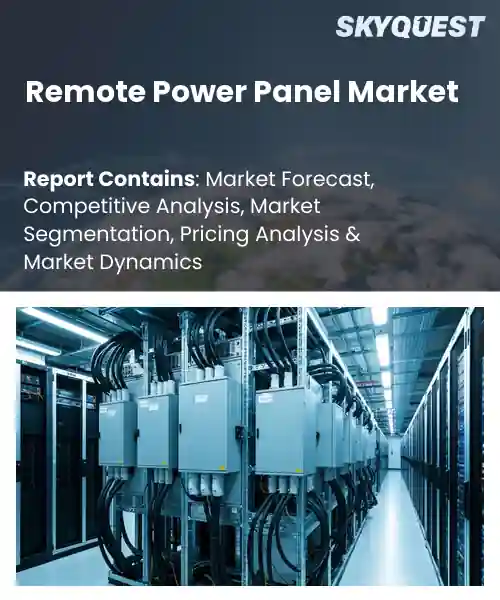
Remote Power Panel Market
Report ID: SQMIG20D2710
Report ID: SQMIG20D2710
[email protected]
USA +1 351-333-4748
Report ID:
SQMIG20D2710 |
Region:
Global |
Published Date: June, 2026
Pages:
157
|Tables:
142
|Figures:
78


Global Remote Power Panel Market size was valued at USD 1.82 Billion in 2024 and is poised to grow from USD 1.94 Billion in 2025 to USD 3.22 Billion by 2033, growing at a CAGR of 6.52% during the forecast period (2026-2033).
Remote power panels, also known as distributed electrical switchgear, provide centralized control of electrical distribution in facilities that are dispersed or located in environments such as offshore platforms, data centers, and renewable energy sites. The market emerged as utilities and industrial operators sought to minimize on‑site staffing while maintaining rapid fault isolation and load management. Over the past decade, advances in IoT connectivity, ruggedized enclosure design, and cloud‑based monitoring have transformed manual panels into nodes capable of remote diagnostics. This evolution matters because it reduces downtime, cuts operational expenses, and enhances safety, prompting widespread adoption across oil‑gas, telecom, and smart‑grid sectors.
The key trend driving the global remote power panel sector is the demand for renewable‑energy integration, which forces grid operators to manage distributed generation with precision and reliability. Remote power panels enable centralized monitoring of solar farms, wind turbines, and battery storage, allowing operators to react instantly to voltage fluctuations and to re‑route power without dispatching crews. As a result, utilities see lower maintenance costs and improved compliance with grid‑code standards, spurring further investment in smart‑panel deployments. Opportunities arise in data centers where load balancing is critical; Amazon Web Services has piloted remote panel solutions to mitigate overheating risks, illustrating the market’s expanding applicability beyond power‑heavy industries.
How is IoT Enhancing Efficiency in the Remote Power Panel Market?
IoT is transforming remote power panels by embedding sensors that continuously track voltage, temperature and load conditions. These data streams feed into cloud platforms where analytics identify inefficiencies and predict maintenance needs before failures occur. Operators can now adjust settings remotely, reducing the need for on‑site visits and minimizing downtime. Real‑time alerts enable quick response to abnormal patterns, while automated reporting streamlines compliance and performance reviews. The technology also supports integration with broader smart grid initiatives, allowing panels to respond dynamically to changing energy demands. As a result, utilities and industrial users experience smoother operations, lower operating costs and enhanced reliability across distributed power networks.
In June 2025, Schneider Electric launched EcoStruxure Pod Data Centre and advanced Rack Solutions designed for AI and high-performance computing workloads. The modular platform integrates AI-driven monitoring, intelligent power distribution, and high-density infrastructure, enabling faster deployment and improved efficiency while strengthening remote power panel applications in next-generation data centers.
Market snapshot - (2026-2033)
Global Market Size
USD 1.82 Billion
Largest Segment
Standard RPPs
Fastest Growth
Modular RPPs
Growth Rate
6.52% CAGR
To get more insights on this market click here to Request a Free Sample Report
Global remote power panel market is segmented by type, capacity, application, end-user, distribution and region. Based on type, the market is segmented into standard RPPs and modular RPPs. Based on capacity, the market is segmented into below 100A, 100-400A and above 400A. Based on application, the market is segmented into data centers, healthcare facilities and industrial. Based on end-user, the market is segmented into data center operators, hospitals and manufacturing plants. Based on distribution, the market is segmented into direct sales and electrical distributors. Based on region, the market is segmented into North America, Europe, Asia Pacific, Latin America and Middle East & Africa.
Based on the global remote power panel market growth, standard RPPs segment dominates because customers prioritize proven reliability and lower initial costs, making conventional designs the default choice for many projects. Engineers favor the familiar configuration, which simplifies installation and maintenance, thereby reducing downtime risk. This trust translates into recurring purchases across diverse facilities, reinforcing the market foothold of standard panels. The combination of cost effectiveness, ease of integration, and established supply chains fuels continued preference for this approach.
However, modular RPPs segment emerges as the most rapidly expanding area because its flexible architecture supports quick reconfiguration and future scalability, aligning with evolving power demands. The ability to add modules without extensive downtime attracts forward looking operators, creating fresh design opportunities and stimulating broader adoption across emerging projects.
Data centers segment dominates because the relentless need for high density power distribution drives reliance on remote power panels that guarantee uptime and precise load management. Operators seek solutions that integrate seamlessly with advanced monitoring systems, ensuring rapid fault detection and efficient thermal control. This critical dependence on robust power infrastructure cements data center preference for remote panels, reinforcing market leadership through continuous investment in resilient architectures and long term reliability.
Meanwhile, industrial segment emerges as the fastest growing area because expanding automation and smart factory initiatives demand adaptable power distribution for variable loads. Remote panels offering modular upgrades and rugged designs satisfy these requirements, prompting manufacturers to adopt them for production lines. This surge broadens market diversification and creates opportunities for innovative engineering solutions.
To get detailed segments analysis, Request a Free Sample Report
As per the global remote power panel market share, North America commands the leading position through a confluence of mature electrical infrastructure, high adoption of automation across manufacturing and data‑center environments, and a deep pool of engineering talent skilled in designing modular power solutions. Robust safety and reliability standards set by industry bodies encourage early integration of remote power panels. Leading original equipment manufacturers invest heavily in research and development, fostering continuous product innovation that meets demanding performance criteria. The region also benefits from strong procurement practices in critical sectors such as telecommunications, transportation, and industrial processing, where uninterrupted power is a strategic requirement. This combination of technical expertise, regulatory support, and market demand sustains the dominant status of North America in the global arena.
Remote power panel market in the United States thrives on a sophisticated industrial ecosystem that prioritizes reliability and rapid deployment. The presence of numerous specialized manufacturers accelerates product diversification, while extensive standards adoption ensures seamless integration across sectors ranging from aerospace to data centers. Customer focus on high safety performance and lifecycle cost efficiency further reinforces strong demand.
Remote power panel market in Canada is driven by a strategic emphasis on resilient infrastructure for remote and harsh environments. The country’s energy sector, coupled with growing investments in renewable integration, creates a steady need for compact, high‑efficiency power distribution solutions. Collaborative research initiatives between academia and industry promote innovative designs that meet stringent environmental and safety criteria, supporting a robust demand base across mining, oil‑gas, and municipal utilities.
Based on the global remote power panel regional forecast, Europe experiences rapid expansion as stringent safety directives and a continent‑wide push toward energy efficiency compel adoption of advanced power distribution technologies. The region’s deep engineering heritage combined with a collaborative standards framework enables seamless cross‑border product deployment. Growing investments in smart grid and renewable integration create a demand for modular panels that can be quickly installed and remotely monitored. Key verticals such as rail transportation, telecom networks, and industrial automation prioritize reliability and low environmental impact, driving manufacturers to innovate with lightweight materials and digital diagnostics. This regulatory and sustainability focus, together with strong demand from high‑tech sectors, fuels the accelerating growth of the European remote power panel market.
Remote power panel market in Germany benefits from a world‑renowned engineering culture that emphasizes precision and durability. The nation’s strong automotive and heavy‑industry base requires highly reliable power solutions, prompting manufacturers to adopt advanced modular designs. Integration with Industry 4.0 platforms facilitates real‑time monitoring, aligning with national initiatives for digital factories. This combination of technical rigor and demand for high‑performance equipment sustains Germany’s leadership in the European landscape.
Remote power panel market in the United Kingdom is characterized by swift adoption within telecommunications and smart‑city projects. Policy incentives encouraging infrastructure modernization have spurred investment in compact, remotely managed panels. The country’s emphasis on rapid deployment and ease of maintenance aligns with the needs of expanding data‑center footprints and next‑generation transport networks. Consequently, growth momentum outpaces many neighboring markets, establishing the United Kingdom as a fast‑moving hub for remote power solutions.
Remote power panel market in France is emerging as a focal point for renewable energy integration and grid modernization. Government programs supporting decarbonization promote the use of modular power distribution that can be quickly installed in both urban and rural settings. Collaboration between research institutes and equipment suppliers drives the development of panels with enhanced thermal management and digital diagnostics. These attributes position France as an emerging contributor to the broader European market trajectory.
As per global remote power panel regional outlook, Asia Pacific is strengthening its position by aligning rapid urban growth with intensive digital transformation initiatives that prioritize resilient power infrastructures. Governments across the region are championing policies that encourage the deployment of smart, modular power solutions to support burgeoning data‑center clusters, high‑speed rail networks, and advanced manufacturing hubs. The presence of world‑leading electronics and semiconductor manufacturers creates a demand for compact, highly reliable panels capable of seamless integration with IoT monitoring platforms. Collaborative innovation ecosystems, blending academic research with industry expertise, accelerate product development focused on energy efficiency and predictive maintenance. Together, these dynamics elevate the region’s role as a critical growth engine for remote power panel technologies.
Remote power panel market in Japan thrives on a culture of precision engineering and a high demand for continuous power in sectors such as robotics, automotive, and telecommunications. The country’s emphasis on reliability and compact design drives manufacturers to embed advanced diagnostics and connectivity features within panels. Integration with nationwide disaster‑resilience strategies further reinforces the need for robust, quickly deployable solutions. This focus on quality, safety, and digital readiness sustains Japan’s strong foothold in the regional market.
Remote power panel market in South Korea is propelled by its dominant semiconductor and display manufacturing industries, which require ultra‑reliable, low‑latency power distribution. National technology roadmaps promote the adoption of smart panels equipped with real‑time monitoring and automated fault detection. The country’s aggressive investment in 5G infrastructure and high‑speed rail also generates demand for modular solutions that can be installed with minimal disruption. This blend of high‑tech manufacturing needs and forward‑looking infrastructure projects consolidates South Korea’s momentum in the Asia Pacific arena.
To know more about the market opportunities by region and country, click here to
Buy The Complete Report
Growing Demand for Remote Power
Adoption of IoT Connectivity
Regulatory Compliance Challenges
High Initial Capital Expenditure
Request Free Customization of this report to help us to meet your business objectives.
Competition in the global remote power panel market outlook is intensifying as incumbents such as ABB, Schneider Electric and Toshiba expand modular product lines and pursue strategic partnerships to capture data‑center and edge‑site demand. Recent tech innovation includes ABB’s integration of digital monitoring into panels and Toshiba’s collaboration with Hanley Energy on advanced control systems, driving differentiation and accelerating market adoption.
Top Player’s Company Profile
Recent Developments
SkyQuest’s ABIRAW (Advanced Business Intelligence, Research & Analysis Wing) is our Business Information Services team that Collects, Collates, Correlates, and Analyses the Data collected by means of Primary Exploratory Research backed by robust Secondary Desk research.
As per SkyQuest analysis the global remote power panel industry is driven primarily by the growing demand for remote power solutions that enable rapid deployment and lower operating costs. A second major driver is the increasing adoption of IoT connectivity which adds real‑time monitoring and predictive maintenance capabilities. The market is dominated by North America where mature infrastructure and strong safety standards spur adoption, and the Standard RPP segment retains the largest share thanks to its proven reliability and lower upfront cost. However, regulatory compliance challenges act as a restraint, prolonging certification times and adding development expenses.
| Report Metric | Details |
|---|---|
| Market size value in 2024 | USD 1.82 Billion |
| Market size value in 2033 | USD 3.22 Billion |
| Growth Rate | 6.52% |
| Base year | 2024 |
| Forecast period | (2026-2033) |
| Forecast Unit (Value) | USD Billion |
| Segments covered |
|
| Regions covered | North America (US, Canada), Europe (Germany, France, United Kingdom, Italy, Spain, Rest of Europe), Asia Pacific (China, India, Japan, Rest of Asia-Pacific), Latin America (Brazil, Rest of Latin America), Middle East & Africa (South Africa, GCC Countries, Rest of MEA) |
| Companies covered |
|
| Customization scope | Free report customization with purchase. Customization includes:-
|
To get a free trial access to our platform which is a one stop solution for all your data requirements for quicker decision making. This platform allows you to compare markets, competitors who are prominent in the market, and mega trends that are influencing the dynamics in the market. Also, get access to detailed SkyQuest exclusive matrix.
Table Of Content
Executive Summary
Market overview
Parent Market Analysis
Market overview
Market size
KEY MARKET INSIGHTS
COVID IMPACT
MARKET DYNAMICS & OUTLOOK
Market Size by Region
KEY COMPANY PROFILES
Methodology
For the Remote Power Panel Market, our research methodology involved a mixture of primary and secondary data sources. Key steps involved in the research process are listed below:
1. Information Procurement: This stage involved the procurement of Market data or related information via primary and secondary sources. The various secondary sources used included various company websites, annual reports, trade databases, and paid databases such as Hoover's, Bloomberg Business, Factiva, and Avention. Our team did 45 primary interactions Globally which included several stakeholders such as manufacturers, customers, key opinion leaders, etc. Overall, information procurement was one of the most extensive stages in our research process.
2. Information Analysis: This step involved triangulation of data through bottom-up and top-down approaches to estimate and validate the total size and future estimate of the Remote Power Panel Market.
3. Report Formulation: The final step entailed the placement of data points in appropriate Market spaces in an attempt to deduce viable conclusions.
4. Validation & Publishing: Validation is the most important step in the process. Validation & re-validation via an intricately designed process helped us finalize data points to be used for final calculations. The final Market estimates and forecasts were then aligned and sent to our panel of industry experts for validation of data. Once the validation was done the report was sent to our Quality Assurance team to ensure adherence to style guides, consistency & design.
Analyst Support
Customization Options
With the given market data, our dedicated team of analysts can offer you the following customization options are available for the Remote Power Panel Market:
Product Analysis: Product matrix, which offers a detailed comparison of the product portfolio of companies.
Regional Analysis: Further analysis of the Remote Power Panel Market for additional countries.
Competitive Analysis: Detailed analysis and profiling of additional Market players & comparative analysis of competitive products.
Go to Market Strategy: Find the high-growth channels to invest your marketing efforts and increase your customer base.
Innovation Mapping: Identify racial solutions and innovation, connected to deep ecosystems of innovators, start-ups, academics, and strategic partners.
Category Intelligence: Customized intelligence that is relevant to their supply Markets will enable them to make smarter sourcing decisions and improve their category management.
Public Company Transcript Analysis: To improve the investment performance by generating new alpha and making better-informed decisions.
Social Media Listening: To analyze the conversations and trends happening not just around your brand, but around your industry as a whole, and use those insights to make better Marketing decisions.
REQUEST FOR SAMPLE
 REQUEST FREE CUSTOMIZATION
Global Remote Power Panel Market size was valued at USD 1.82 Billion in 2024 and is poised to grow from USD 1.94 Billion in 2025 to USD 3.22 Billion by 2033, growing at a CAGR of 6.52% during the forecast period (2026-2033).
Competition in the global remote power panel market is intensifying as incumbents such as ABB, Schneider Electric and Toshiba expand modular product lines and pursue strategic partnerships to capture data‑center and edge‑site demand. Recent tech innovation includes ABB’s integration of digital monitoring into panels and Toshiba’s collaboration with Hanley Energy on advanced control systems, driving differentiation and accelerating market adoption. 'Eaton Corporation', 'Schneider Electric', 'ABB Ltd.', 'Vertiv Holdings', 'Siemens AG', 'General Electric', 'Cyber Power Systems', 'Server Technology (Legrand)', 'Starline (Universal Electric)', 'Liebert (Vertiv)', 'Chatsworth Products', 'Anixter International', 'Panduit Corp.', 'Raritan (Legrand)', 'Hubbell Power Systems', 'Square D (Schneider)', 'ASCO Power Technologies (Schneider)', 'Russelectric (Siemens)', 'Powerware (Eaton)', 'Cummins Power Generation'
Growing demand for remote power solutions is driven by increased reliance on distributed energy resources and the need for rapid deployment in remote locations. This factor accelerates market expansion as operators seek flexible, scalable panels that can be installed without extensive infrastructure, reducing downtime and operational costs. The appeal of modular, plug‑and‑play designs further encourages adoption across various sectors, reinforcing the shift toward decentralized power management and fostering sustained growth. Integrating renewables enhances resilience and aligns with sustainability goals, increasing stakeholder appeal.
Ai-Driven Predictive Maintenance: Companies are increasingly embedding advanced analytics and machine learning into remote power panels to anticipate component wear, detect anomalies, and schedule service before failures occur. This proactive approach reduces unplanned downtime, extends equipment lifespan, and lowers maintenance costs, while providing operators with actionable insights through intuitive dashboards. As utilities and industrial users prioritize reliability, the shift toward AI-enabled panels is reshaping service contracts and creating new value propositions centered on continuous performance optimization and operational excellence today.
Why does North America Dominate the Global Remote Power Panel Market? |@12


Want to customize this report? This report can be personalized according to your needs. Our analysts and industry experts will work directly with you to understand your requirements and provide you with customized data in a short amount of time. We offer $1000 worth of FREE customization at the time of purchase.
Feedback From Our Clients


 USA (+1) 351-333-4748

