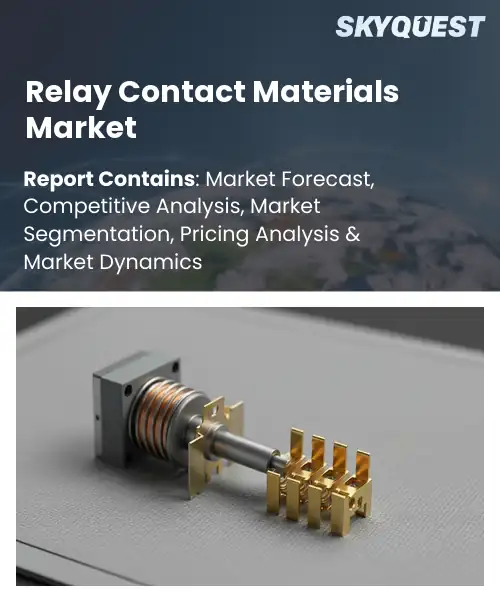
Relay Contact Materials Market
Report ID: SQMIG20D2783
Report ID: SQMIG20D2783
[email protected]
USA +1 351-333-4748
Report ID:
SQMIG20D2783 |
Region:
Global |
Published Date: July, 2026
Pages:
157
|Tables:
118
|Figures:
77


Global Relay Contact Materials Market size was valued at USD 642.8 Million in 2024 and is poised to grow from USD 683.94 Million in 2025 to USD 1123.44 Million by 2033, growing at a CAGR of 6.4% during the forecast period (2026-2033).
The relay contact materials market supplies insulating components that enable relays to open or close circuits in industrial, automotive and consumer equipment. Its significance stems from the need for reliable switching under high voltage, temperature and frequency stresses, where material choice directly influences lifespan and safety. Historically the market evolved from simple silver‑alloy contacts in mid‑20th century to composite and palladium‑based formulations that address arcing and wear. For example, automotive manufacturers adopted silver‑tin alloys in relays during the 1990s, cutting failure rates by 30 %. This evolution reflects growing demand for performance and stricter standards, positioning material innovation as a driver. Environmental regulations and the shift toward electric transportation constitute the leading growth factor for the relay contact materials market, because stricter emissions standards compel manufacturers to replace mechanical switches with alternatives that require newer contact alloys. In electric‑vehicle power‑train modules, for instance, palladium‑silver contacts provide lower resistance and longer life, enabling higher efficiency and reduced warranty claims. This demand spurs investment in cost‑effective silver‑tin‑copper blends, which opens opportunities for suppliers to capture market share in automotive voltage‑regulation systems. Consequently, regions with automotive clusters, notably Europe and China, experience accelerated adoption, while users benefit from greater overall system uptime and compliance.
How is AI reshaping the relay contact materials market?
AI is reshaping the relay contact materials market by turning material design into a data‑driven process. Machine‑learning models analyze vast datasets of alloy behavior, wear patterns and electrical performance, enabling engineers to predict the best compositions without lengthy trial‑and‑error cycles. This accelerates product development, reduces waste and improves reliability, especially for high‑frequency and high‑current applications. Vendors are integrating AI tools into their R&D workflows, allowing rapid customization for niche industries such as automotive, aerospace and renewable energy. The result is a more responsive supply chain that can meet evolving standards while keeping costs competitive.Siemens announced in June 2024, an AI‑enabled platform that forecasts optimal alloy mixes for relay contacts, shortening development time and enhancing material efficiency, thereby reinforcing market expansion.
Market snapshot - (2026-2033)
Global Market Size
USD 642.8 Million
Largest Segment
Copper-Based
Fastest Growth
Tungsten-Based
Growth Rate
6.4% CAGR
To get more insights on this market click here to Request a Free Sample Report
Global relay contact materials market is segmented by material type, contact type, relay type, end user and region. Based on material type, the market is segmented into Silver-Based, Gold-Based, Copper-Based and Tungsten-Based. Based on contact type, the market is segmented into Solid Contacts and Composite Contacts. Based on relay type, the market is segmented into Electromechanical Relays, Reed Relays and Power Relays. Based on end user, the market is segmented into Automotive, Industrial, Electronics and Power & Energy. Based on region, the market is segmented into North America, Europe, Asia Pacific, Latin America and Middle East & Africa.
Silver-Based segment leads because its superior electrical conductivity and low contact resistance make it the preferred choice for high frequency switching, while its excellent arc quenching characteristics enhance durability under repetitive operations. Designers favor it for automotive and industrial applications where reliability is paramount, and manufacturers benefit from processing techniques that reduce production complexity. These attributes collectively drive sustained preference and reinforce its leadership in the relay contact materials market.
Meanwhile, Gold-Based segment emerges as the most rapidly expanding area because its superior corrosion resistance and stable contact performance under harsh environmental conditions attract high reliability sectors such as aerospace and renewable energy. Material innovations and push for longer service life accelerate its adoption, creating growth avenues across market.
Power Relays segment dominates because they handle large current loads and high voltages, requiring contact materials that can withstand intense thermal and mechanical stress while maintaining conductivity. Their widespread use in industrial motor control, grid protection, and electric vehicle charging systems drives demand for wear resistant alloys. The need for reliable operation under demanding conditions shapes supplier focus and positions this segment at core of the relay contact materials market.
On the other hand, Reed Relays segment is witnessing the strongest growth momentum because its compact form factor and low power consumption meet rising demand in consumer electronics and IoT devices. Advances in glass encapsulation and innovative contact coatings enable switching speeds, propelling adoption and opening avenues for market expansion.
To get detailed segments analysis, Request a Free Sample Report
Asia Pacific’s leadership in the global Relay Contact Materials Market stems from a combination of deep engineering expertise, strong manufacturing ecosystems, and a sustained focus on high‑reliability electrical components. The region benefits from extensive research institutions that collaborate closely with original equipment manufacturers, fostering rapid innovation in contact alloy formulations and surface treatments. Robust supply chains ensure consistent availability of specialty copper, silver, and tungsten materials, while cost‑effective production capabilities keep component pricing competitive on a global scale. Additionally, growing adoption of advanced automation and smart grid technologies in industrial and infrastructure projects fuels demand for high‑performance relays, reinforcing the region’s dominance. The favorable regulatory environment encouraging energy efficiency and the presence of major multinational firms with regional R&D centers further amplify the competitive edge of Asia Pacific players.
Relay Contact Materials Market in Japan is characterized by a longstanding tradition of precision engineering and close collaboration between material suppliers and equipment manufacturers. Advanced research universities and corporate labs focus on developing wear‑resistant alloys and coating technologies that meet stringent reliability standards. Domestic automotive and rail sectors drive consistent demand, while a proactive approach to standards compliance ensures that Japanese relay components remain highly trusted in global supply chains.
Relay Contact Materials Market in South Korea benefits from a highly integrated electronics manufacturing base and aggressive investment in material science research. Close ties between semiconductor fabs, industrial automation firms, and specialty alloy producers enable rapid prototyping and scaling of high‑performance contact solutions. Government‑backed innovation programs emphasize energy‑efficient technologies, spurring adoption of advanced relays in smart factory and renewable energy applications, thereby reinforcing South Korea’s competitive position in the sector.
The rapid expansion of the Relay Contact Materials Market in North America is propelled by a confluence of advanced manufacturing capabilities, strong demand for high‑reliability power infrastructure, and a robust ecosystem of research institutions supporting material innovation. End‑use industries such as aerospace, data centers, and electric vehicle production require relays that can withstand intensive cycling and harsh environmental conditions, driving the adoption of premium contact alloys. A proactive regulatory climate promoting energy efficiency and grid modernization further encourages investment in next‑generation relay technologies. Collaboration between leading component makers and specialty material suppliers accelerates the introduction of novel coatings and additive manufacturing techniques, reinforcing North America’s position as a dynamic growth hub for relay contact solutions. The presence of major aerospace and defense contractors also creates a continuous demand for highly dependable relay assemblies across the continent.
Relay Contact Materials Market in United States is driven by industrial diversity and a leadership role in sectors that require precision relay components. Large‑scale power generation, aerospace, and military applications demand alloys with superior arc‑resistance and longevity, prompting refinement of copper‑based and silver‑tin formulations. Collaborative initiatives between universities and private firms accelerate development of nanostructured coatings, while stringent reliability standards ensure that American relay manufacturers remain at the forefront of global supply.
Relay Contact Materials Market in Canada benefits from emphasis on reliability engineering and proximity to manufacturing hubs. The country’s focus on renewable energy integration and smart grid projects creates demand for relays capable of handling frequent switching and harsh climatic conditions. Partnerships between research institutes and specialty metal producers foster innovation in corrosion‑resistant alloys, while compliance with rigorous safety standards ensures that Canadian relay components are trusted by both domestic and international system integrators.
Europe is strengthening its position in the Relay Contact Materials Market through a combination of stringent quality standards, deep engineering heritage, and coordinated efforts to advance sustainable manufacturing practices. Nations such as Germany, United Kingdom, and France host world‑renowned research laboratories that specialize in high‑temperature alloy development and precision coating processes, enabling the production of contacts with exceptional wear resistance. The region’s commitment to energy transition and smart infrastructure fuels demand for reliable relay solutions across automotive, railway, and renewable energy sectors. Collaborative frameworks between industry associations and academic institutions accelerate knowledge transfer, while compliance with rigorous environmental directives encourages adoption of recyclable and low‑impact material formulations, further solidifying Europe’s competitive edge. The proactive policy environment supporting high‑efficiency power equipment also creates favorable market conditions for manufacturers across the continent.
Relay Contact Materials Market in Germany is anchored by a strong tradition of precision engineering and a dense network of specialized suppliers. Automotive and industrial automation sectors drive demand for high‑performance contact alloys that can endure demanding thermal cycles. Collaborative projects between technical universities and leading manufacturers focus on developing advanced silicide‑based coatings, while adherence to rigorous German industrial standards ensures product reliability and long service life in both domestic and export markets.
Relay Contact Materials Market in United Kingdom benefits from a vibrant research ecosystem and a focus on high‑value niche applications such as aerospace and defense. The country’s emphasis on material survivability under extreme conditions encourages development of copper‑tungsten and silver‑palladium alloys with superior arc‑quenching capabilities. Strong collaborations between universities, government innovation agencies, and specialist manufacturers accelerate the rollout of environmentally compliant coating technologies, positioning the United Kingdom as a premier source of reliable relay components for critical infrastructure.
Relay Contact Materials Market in France is shaped by a strong emphasis on high‑tech manufacturing and a commitment to environmental sustainability. Aerospace, nuclear power, and high‑speed rail sectors demand relays with exceptional durability and low‑maintenance characteristics, prompting French firms to invest in silver‑nickel and gold‑plated contact solutions. Joint research initiatives with leading engineering schools drive innovation in low‑emission alloy production, while stringent French and EU regulations ensure that relay components meet the highest standards of safety and ecological responsibility.
To know more about the market opportunities by region and country, click here to
Buy The Complete Report
Increasing Demand for Faster Data Transfer
Adoption of IoT and Edge Devices
High Material Costs and Supply Constraints
Regulatory Scrutiny on Environmental Impact
Request Free Customization of this report to help us to meet your business objectives.
The competitive landscape is shaped by established material specialists such as Metalor, DODUCO GmbH, Umicore, Toshiba and Chugai, which are intensifying R&D on silver‑nickel and silver‑cadmium alloys while forming strategic partnerships with IoT‑focused relay manufacturers; new entrants are leveraging AI and connected‑device platforms to launch smart relay solutions that promise higher efficiency and lower failure rates.
Top Player’s Company Profile
Recent Developments
SkyQuest’s ABIRAW (Advanced Business Intelligence, Research & Analysis Wing) is our Business Information Services team that Collects, Collates, Correlates, and Analyses the Data collected by means of Primary Exploratory Research backed by robust Secondary Desk research. As per SkyQuest analysis the relay contact materials market is being propelled primarily by the surge in demand for faster data transfer which pushes manufacturers to develop low‑resistance alloys for high‑frequency switching. A second driver is the rapid adoption of AI‑enabled material design that shortens development cycles and tailors alloys for niche applications such as electric‑vehicle power modules. The silver‑based segment remains the dominant material choice because of its superior conductivity and arc‑quenching properties. Asia Pacific leads the market thanks to strong manufacturing ecosystems and extensive R&D investment. However, growth is tempered by high material costs and supply constraints that can delay projects and raise pricing pressure.
| Report Metric | Details |
|---|---|
| Market size value in 2024 | USD 642.8 Million |
| Market size value in 2033 | USD 1123.44 Million |
| Growth Rate | 6.4% |
| Base year | 2024 |
| Forecast period | (2026-2033) |
| Forecast Unit (Value) | USD Million |
| Segments covered |
|
| Regions covered | North America (US, Canada), Europe (Germany, France, United Kingdom, Italy, Spain, Rest of Europe), Asia Pacific (China, India, Japan, Rest of Asia-Pacific), Latin America (Brazil, Rest of Latin America), Middle East & Africa (South Africa, GCC Countries, Rest of MEA) |
| Companies covered |
|
| Customization scope | Free report customization with purchase. Customization includes:-
|
To get a free trial access to our platform which is a one stop solution for all your data requirements for quicker decision making. This platform allows you to compare markets, competitors who are prominent in the market, and mega trends that are influencing the dynamics in the market. Also, get access to detailed SkyQuest exclusive matrix.
Table Of Content
Executive Summary
Market overview
Parent Market Analysis
Market overview
Market size
KEY MARKET INSIGHTS
COVID IMPACT
MARKET DYNAMICS & OUTLOOK
Market Size by Region
KEY COMPANY PROFILES
Methodology
For the Relay Contact Materials Market, our research methodology involved a mixture of primary and secondary data sources. Key steps involved in the research process are listed below:
1. Information Procurement: This stage involved the procurement of Market data or related information via primary and secondary sources. The various secondary sources used included various company websites, annual reports, trade databases, and paid databases such as Hoover's, Bloomberg Business, Factiva, and Avention. Our team did 45 primary interactions Globally which included several stakeholders such as manufacturers, customers, key opinion leaders, etc. Overall, information procurement was one of the most extensive stages in our research process.
2. Information Analysis: This step involved triangulation of data through bottom-up and top-down approaches to estimate and validate the total size and future estimate of the Relay Contact Materials Market.
3. Report Formulation: The final step entailed the placement of data points in appropriate Market spaces in an attempt to deduce viable conclusions.
4. Validation & Publishing: Validation is the most important step in the process. Validation & re-validation via an intricately designed process helped us finalize data points to be used for final calculations. The final Market estimates and forecasts were then aligned and sent to our panel of industry experts for validation of data. Once the validation was done the report was sent to our Quality Assurance team to ensure adherence to style guides, consistency & design.
Analyst Support
Customization Options
With the given market data, our dedicated team of analysts can offer you the following customization options are available for the Relay Contact Materials Market:
Product Analysis: Product matrix, which offers a detailed comparison of the product portfolio of companies.
Regional Analysis: Further analysis of the Relay Contact Materials Market for additional countries.
Competitive Analysis: Detailed analysis and profiling of additional Market players & comparative analysis of competitive products.
Go to Market Strategy: Find the high-growth channels to invest your marketing efforts and increase your customer base.
Innovation Mapping: Identify racial solutions and innovation, connected to deep ecosystems of innovators, start-ups, academics, and strategic partners.
Category Intelligence: Customized intelligence that is relevant to their supply Markets will enable them to make smarter sourcing decisions and improve their category management.
Public Company Transcript Analysis: To improve the investment performance by generating new alpha and making better-informed decisions.
Social Media Listening: To analyze the conversations and trends happening not just around your brand, but around your industry as a whole, and use those insights to make better Marketing decisions.
REQUEST FOR SAMPLE
 REQUEST FREE CUSTOMIZATION


Want to customize this report? This report can be personalized according to your needs. Our analysts and industry experts will work directly with you to understand your requirements and provide you with customized data in a short amount of time. We offer $1000 worth of FREE customization at the time of purchase.
Feedback From Our Clients


 USA (+1) 351-333-4748

