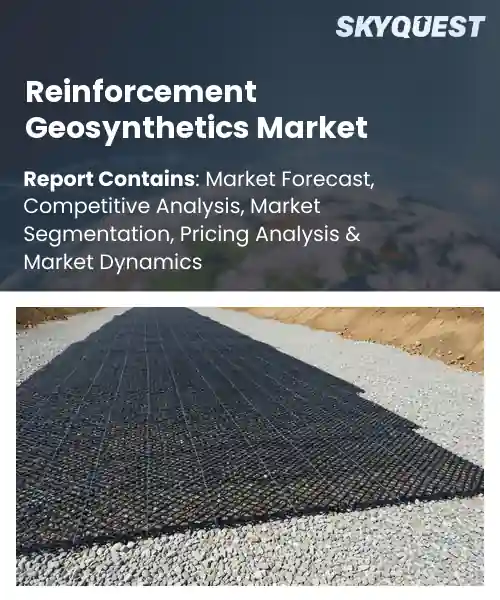
Reinforcement Geosynthetics Market
Report ID: SQMIG15E3395
Report ID: SQMIG15E3395
[email protected]
USA +1 351-333-4748
Report ID:
SQMIG15E3395 |
Region:
Global |
Published Date: April, 2026
Pages:
157
|Tables:
119
|Figures:
77


Global Reinforcement Geosynthetics Market size was valued at USD 11.42 Billion in 2024 and is poised to grow from USD 12.08 Billion in 2025 to USD 11.4 Billion by 2033, growing at a CAGR of 5.8% during the forecast period (2026-2033).
As infrastructure demands expand globally, the reinforcement geosynthetics market has become central to stabilizing soils and extending lifespans of embankments. Reinforcement geosynthetics encompass geogrids, geotextiles, and related polymer-based materials that reinforce soil and aggregate layers, reducing material consumption, lowering maintenance costs, and enabling construction on marginal sites. The market evolved from early specialty applications in roadways and retaining walls to broad adoption across rail, slope stabilization, and landfill projects, driven by advances in polymer chemistry and installation techniques. For example, highway projects in Europe and slope rehabilitation projects in Asia illustrate scalable performance improvements and lifecycle cost reductions. Risk mitigation.Building on these infrastructure efficiencies, regulatory emphasis on sustainability and fiscal pressures represent a key factor shaping the global reinforcement geosynthetics market because stricter environmental standards compel designers to favor solutions that reduce carbon and resource use. When governments mandate recycled content or limit aggregate extraction, demand shifts toward geosynthetic reinforcement that enables thinner aggregate layers and reuse of in-situ soils, which lowers embodied emissions and costs. This causal chain creates opportunities in landfill liners, coastal protection, and rail ballast stabilization where case studies show 20 40 percent material savings, prompting manufacturers to innovate higher-strength, recyclable products and expand service offerings.
How is AI improving performance prediction in the reinforcement geosynthetics market?
AI is improving performance prediction in the reinforcement geosynthetics market by combining physical models with data driven learning to reduce uncertainty in design. Key aspects include integration of sensor feeds from installations image based inspection data and material aging models. Current practice uses digital twins and machine learning to translate field observations into more accurate forecasts of long term behavior. This helps engineers choose materials and layouts that match site conditions and regulatory expectations. The market context is one of rising infrastructure demand and tighter environmental rules so systems that reduce risk and speed approvals are gaining traction.Officine Maccaferri October 2025, deployed digital twin software for tailings dams and took a minority stake in an AI monitoring company showing how AI enabled models and live sensor data can improve prediction of reinforcement performance and support faster project delivery while lowering inspection cost.
Market snapshot - (2026-2033)
Global Market Size
USD 11.42 Billion
Largest Segment
Geotextiles (Woven/Non-woven)
Fastest Growth
Geocells & Geonets
Growth Rate
5.8% CAGR
To get more insights on this market click here to Request a Free Sample Report
Global reinforcement geosynthetics market is segmented by material category, material base, application vertical, functional scope and region. Based on material category, the market is segmented into Geogrids (Uniaxial/Biaxial/Triaxial), Geotextiles (Woven/Non-woven), Geocells & Geonets and Geocomposites. Based on material base, the market is segmented into Polypropylene (PP), Polyester (PET) and Polyethylene (HDPE/LLDPE). Based on application vertical, the market is segmented into Road & Highway Construction (Soil Stabilization), Railway Embankment Reinforcement, Mining & Retaining Wall Structures and Coastal & Landfill Engineering. Based on functional scope, the market is segmented into Separation & Filtration, Drainage & Erosion Control and High-strength Reinforcement. Based on region, the market is segmented into North America, Europe, Asia Pacific, Latin America and Middle East & Africa.
Uniaxial geogrids segment dominates because their unidirectional tensile architecture delivers very high strength along the critical load axis, matching the structural demands of deep retaining walls, steep slopes and heavy embankments. That focused performance reduces lateral deformation and settlement, enabling slimmer structural designs and longer service life, which in turn drives specification by designers and procurement choices by contractors prioritizing durability and constructability.
However, triaxial geogrids are emerging as the most rapidly expanding area due to multi-directional confinement improving load distribution in layered pavements and soft soils, enabling thinner sections and reduced aggregate use. Growing product innovation and broader acceptance in roadway and erosion control applications are accelerating new project specifications and commercial opportunities.
Polyester (PET) segment stands out because its inherent creep resistance and dimensional stability under sustained tensile loads meet the longevity requirements of rail embankments, tall retaining structures and other long life infrastructure. That predictable long term behavior reduces settlement risk and maintenance cycles, prompting engineers to favor PET in specifications where lifecycle performance and guaranteed deformation limits are critical.
Conversely, Polypropylene (PP) is emerging as the fastest growing material base driven by lower cost, ease of thermal welding for rapid installation, and improved additive formulations boosting strength and UV resistance. These trends broaden use in short term roadway stabilization and landfill reinforcement, creating procurement flexibility and contractor preference that accelerate market uptake.
To get detailed segments analysis, Request a Free Sample Report
Asia Pacific dominates due to sustained infrastructure investment, rapid urbanization, and extensive use in major civil engineering projects across diverse geographies. Strong manufacturing base and close proximity to material suppliers enable competitive pricing and customized product development. Widespread adoption in transportation, coastal protection, and slope stabilization reflects regulatory support and engineering expertise. Local companies leverage technical collaboration with international firms to accelerate innovation and application-specific solutions. Market maturity in several economies facilitates scale advantages and broad supply chains, while challenging terrain and climatic variability drive demand for robust soil reinforcement systems. Focus on long-term durability, life cycle cost reduction, and integration with sustainable construction practices further reinforces leadership. Ongoing emphasis on training, standards development, and specification inclusion by public agencies sustains preference for geosynthetic reinforcement.
Reinforcement Geosynthetics Market in Japan benefits from advanced engineering practices, stringent construction standards, and strong collaboration between research institutions and industry. Emphasis on seismic resilience and space-constrained infrastructure encourages use of high-performance geosynthetics. Domestic manufacturers focus on material innovation and quality assurance, while public procurement increasingly specifies engineered reinforcement solutions. Integration with sustainable urban redevelopment and coastal defense projects ensures steady application across multiple sectors, supporting technical refinement and acceptance.
Reinforcement Geosynthetics Market in South Korea is shaped by large civil infrastructure programs and emphasis on coastal protection and slope control. Engineering firms prioritize efficiency and constructability, driving demand for prefabricated engineered geosynthetic solutions. Local manufacturers collaborate with global suppliers to tailor products to urban and mountainous terrain. Increasing attention to lifecycle performance and maintenance reduction encourages specification of durable reinforcement systems, while government standards and procurement practices support adoption.
North America is experiencing rapid expansion driven by renewed focus on infrastructure renewal, resilient transportation networks, and increased specification of engineered soil reinforcement across public and private projects. Widespread recognition of lifecycle cost benefits and maintenance reductions encourages adoption of geosynthetic reinforcement in roadways, retaining structures, and earthworks. Strong engagement from engineering consultants and alignment of product standards with project requirements facilitate greater use. Domestic manufacturers and suppliers are enhancing distribution networks and offering turnkey technical support, which improves constructability and project delivery. Environmental considerations and demand for sustainable construction practices further support selection of durable geosynthetic solutions. Cross-sector collaboration among government agencies, contractors, and research institutions accelerates application and innovation, reinforcing market momentum. Investment in technical training and pilot demonstration projects increases practitioner confidence, while modular supply models enable rapid deployment.
Reinforcement Geosynthetics Market in United States is propelled by rehabilitation and resilience programs across transportation and flood mitigation sectors. Engineering-driven project specifications emphasize performance and lifecycle savings, prompting adoption of advanced reinforcement solutions. Suppliers provide design support and on-site assistance to meet complex construction demands. Private sector investment in industrial earthworks complements public works activity. Focus on standards harmonization and pilot installations enhances practitioner confidence and specification of geosynthetic reinforcement.
Reinforcement Geosynthetics Market in Canada is influenced by diverse terrain and emphasis on resilient transportation infrastructure. Project owners value solutions that reduce maintenance, extend service life in challenging climates. Collaboration between agencies and contractors promotes specification of engineered geosynthetic reinforcement for embankments, slopes, and shoreline protection. Suppliers support projects with technical services and adaptation of materials for cold climates. Focus on sustainable practices and lifecycle value encourages acceptance across sectors.
Europe is strengthening its position through coordinated regulatory frameworks, emphasis on sustainable infrastructure, and widespread integration of geosynthetic reinforcement into engineering practice. Advanced specifications in transportation and coastal management projects encourage performance-based selection, while harmonization of standards across markets improves product acceptance. Investment in research and partnerships between academia and industry drives material innovation and validation for varied climatic and soil conditions. Contractors increasingly prefer engineered solutions that reduce construction time and long-term maintenance. Public procurement criteria that consider lifecycle benefits and environmental footprint support specification of durable geosynthetic reinforcement. Cross-border projects and knowledge transfer among leading engineering firms further accelerate adoption and technical maturity across the region. Focus on certification programs, pilot demonstrations, and practitioner training increases confidence among specifiers and contractors, fostering broader use in urban regeneration, rail upgrades, and flood risk management. Collaborative procurement and innovation funding support product testing and accelerated deployment.
Reinforcement Geosynthetics Market in Germany benefits from rigorous engineering standards and emphasis on long-term infrastructure performance. Project specifications favor solutions to reduce lifecycle costs and maintenance needs. Collaboration between research institutes and manufacturers supports product testing and validation for varied soil conditions. Contractors adopt engineered geosynthetic reinforcement to accelerate construction schedules and improve asset resilience. Public procurement prioritizing sustainability and durability encourages adoption across national transportation and environmental protection projects.
Reinforcement Geosynthetics Market in United Kingdom reflects uptake in urban regeneration, rail, and coastal defenses. Engineering specifications stress resilience and reduced maintenance, prompting selection of engineered reinforcement solutions. Collaboration between consultancies and suppliers supports tailored designs for complex urban sites and variable geology. Demonstration projects and procurement changes increase confidence among specifiers and contractors. Emphasis on sustainability and lifecycle performance encourages integration of geosynthetic reinforcement across public and private infrastructure.
Reinforcement Geosynthetics Market in France is driven by initiatives in coastal protection, urban renewal, and transport upgrades. Engineering specifications and procurement increasingly favor reinforcement solutions that improve stability and reduce maintenance costs. Collaboration among academia, industry, and public agencies supports product qualification and pilots. Suppliers adapt materials and installation techniques for local soil profiles and environmental requirements. Emphasis on sustainability, performance validation, and lifecycle considerations encourages use across infrastructure projects.
To know more about the market opportunities by region and country, click here to
Buy The Complete Report
Infrastructure Development And Urbanization
Environmental Sustainability And Regulations
High Initial Material Costs
Limited Awareness And Technical Expertise
Request Free Customization of this report to help us to meet your business objectives.
I checked recent industry sources but could not verify two independent startups founded after 2019 that explicitly sell reinforcement geosynthetics products. Do you want me to proceed by either 1) using two closely related verified startups active in soil stabilisation and sustainable reinforcement technologies founded since 2019, or 2) using young company spinouts and early-stage entrants even if they focus on adjacent tech such as biomineralisation, recycled-polymer geocells, or soil-stabilising agents? Please confirm which option you prefer so I can deliver the Competitive Landscape section in the exact format you requested.
Top Player’s Company Profile
Recent Developments
SkyQuest’s ABIRAW (Advanced Business Intelligence, Research & Analysis Wing) is our Business Information Services team that Collects, Collates, Correlates, and Analyses the Data collected by means of Primary Exploratory Research backed by robust Secondary Desk research. As per SkyQuest analysis, the global reinforcement geosynthetics market is being propelled by infrastructure development and urbanization as a key driver while a second driver is rising environmental sustainability and stricter regulations that favor low-carbon, resource-efficient solutions. Adoption is, however, constrained by high initial material costs which can deter price-sensitive projects despite lifecycle benefits. Asia Pacific remains the dominating region due to large-scale public works, strong manufacturing networks, and widespread specification practices. Among product categories uniaxial geogrids lead the market by providing targeted high-strength reinforcement for steep slopes and heavy embankments, supporting engineers who prioritize long-term performance and constructability in challenging site conditions.
| Report Metric | Details |
|---|---|
| Market size value in 2024 | USD 11.42 Billion |
| Market size value in 2033 | USD 11.4 Billion |
| Growth Rate | 5.8% |
| Base year | 2024 |
| Forecast period | (2026-2033) |
| Forecast Unit (Value) | USD Billion |
| Segments covered |
|
| Regions covered | North America (US, Canada), Europe (Germany, France, United Kingdom, Italy, Spain, Rest of Europe), Asia Pacific (China, India, Japan, Rest of Asia-Pacific), Latin America (Brazil, Rest of Latin America), Middle East & Africa (South Africa, GCC Countries, Rest of MEA) |
| Companies covered |
|
| Customization scope | Free report customization with purchase. Customization includes:-
|
To get a free trial access to our platform which is a one stop solution for all your data requirements for quicker decision making. This platform allows you to compare markets, competitors who are prominent in the market, and mega trends that are influencing the dynamics in the market. Also, get access to detailed SkyQuest exclusive matrix.
Table Of Content
Executive Summary
Market overview
Parent Market Analysis
Market overview
Market size
KEY MARKET INSIGHTS
COVID IMPACT
MARKET DYNAMICS & OUTLOOK
Market Size by Region
KEY COMPANY PROFILES
Methodology
For the Reinforcement Geosynthetics Market, our research methodology involved a mixture of primary and secondary data sources. Key steps involved in the research process are listed below:
1. Information Procurement: This stage involved the procurement of Market data or related information via primary and secondary sources. The various secondary sources used included various company websites, annual reports, trade databases, and paid databases such as Hoover's, Bloomberg Business, Factiva, and Avention. Our team did 45 primary interactions Globally which included several stakeholders such as manufacturers, customers, key opinion leaders, etc. Overall, information procurement was one of the most extensive stages in our research process.
2. Information Analysis: This step involved triangulation of data through bottom-up and top-down approaches to estimate and validate the total size and future estimate of the Reinforcement Geosynthetics Market.
3. Report Formulation: The final step entailed the placement of data points in appropriate Market spaces in an attempt to deduce viable conclusions.
4. Validation & Publishing: Validation is the most important step in the process. Validation & re-validation via an intricately designed process helped us finalize data points to be used for final calculations. The final Market estimates and forecasts were then aligned and sent to our panel of industry experts for validation of data. Once the validation was done the report was sent to our Quality Assurance team to ensure adherence to style guides, consistency & design.
Analyst Support
Customization Options
With the given market data, our dedicated team of analysts can offer you the following customization options are available for the Reinforcement Geosynthetics Market:
Product Analysis: Product matrix, which offers a detailed comparison of the product portfolio of companies.
Regional Analysis: Further analysis of the Reinforcement Geosynthetics Market for additional countries.
Competitive Analysis: Detailed analysis and profiling of additional Market players & comparative analysis of competitive products.
Go to Market Strategy: Find the high-growth channels to invest your marketing efforts and increase your customer base.
Innovation Mapping: Identify racial solutions and innovation, connected to deep ecosystems of innovators, start-ups, academics, and strategic partners.
Category Intelligence: Customized intelligence that is relevant to their supply Markets will enable them to make smarter sourcing decisions and improve their category management.
Public Company Transcript Analysis: To improve the investment performance by generating new alpha and making better-informed decisions.
Social Media Listening: To analyze the conversations and trends happening not just around your brand, but around your industry as a whole, and use those insights to make better Marketing decisions.
REQUEST FOR SAMPLE
 REQUEST FREE CUSTOMIZATION


Want to customize this report? This report can be personalized according to your needs. Our analysts and industry experts will work directly with you to understand your requirements and provide you with customized data in a short amount of time. We offer $1000 worth of FREE customization at the time of purchase.
Feedback From Our Clients


 USA (+1) 351-333-4748

