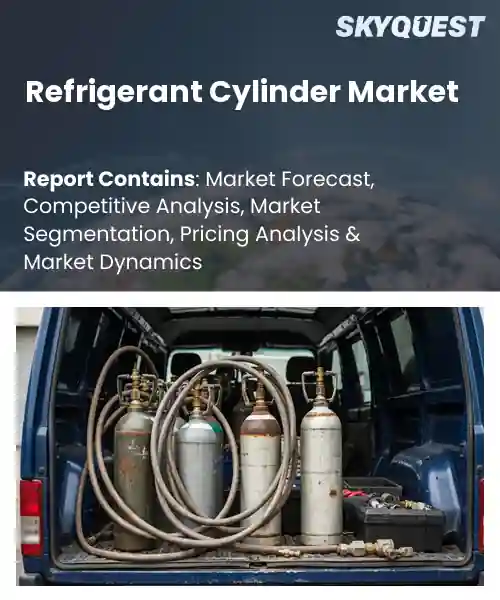
Refrigerant Cylinder Market
Report ID: SQMIG25I2052
Report ID: SQMIG25I2052
[email protected]
USA +1 351-333-4748
Report ID:
SQMIG25I2052 |
Region:
Global |
Published Date: February, 2026
Pages:
157
|Tables:
144
|Figures:
78


Global Refrigerant Cylinder Market size was valued at USD 1.8 Billion in 2024 and is poised to grow from USD 1.94 Billion in 2025 to USD 3.51 Billion by 2033, growing at a CAGR of 7.7% during the forecast period (2026-2033).
As global regulations accelerated the phase down of high GWP refrigerants, the primary driver for the refrigerant cylinder market became the need for storage and logistics. The market covers manufacture, certification, distribution and recycling of pressurized cylinders used to hold refrigerants for HVAC, automotive and cold chain, and it matters because cylinders form a critical link in safe, traceable chains. The sector shifted from generic gas cylinders to coded refrigerant packaging with safety valves, recovery fittings and testing protocols. For example, the Kigali Amendment and regional HFC controls caused a surge in certified recovery and refill cylinders in emerging markets.Building on regulatory shifts and rising cooling demand, the key factor driving the global refrigerant cylinder market is deployment of recovery and refill systems permitting safe handling of low GWP refrigerants. When manufacturers certify cylinders for alternative blends and service providers install recovery equipment, refurbishment costs decline and compliance becomes feasible, which expands uptake among HVAC contractors, automotive shops and cold storage operators. For instance supermarkets switching to CO2 cascade refrigeration need high pressure cylinders and trained recovery crews, generating orders for durable steel cylinders, portable refill stations and tracking, which creates openings for new rental schemes and reconditioning businesses.
How is IoT improving safety and tracking in the refrigerant cylinder market?
Internet of Things systems are improving safety and tracking in the refrigerant cylinder market by making cylinders connected assets that report pressure, temperature and location in real time. Fitted sensors and RFID or BLE tags enable early leak alerts and remote verification of custody which reduces accidental releases and strengthens compliance. With tighter regulations and increased emphasis on reclamation, traceability and accurate chain of custody are commercially important. Suppliers and service firms use telematics and cloud analytics to manage inventory schedule tests and prevent lost or mismatched cylinders, improving operational reliability and environmental stewardship.A-Gas January 2026, showcased a full lifecycle refrigerant management platform highlighting cylinder tracking and reclaim workflows using digital monitoring and analytics. By combining IoT enabled tracking with cloud reporting this development helps expand reuse streamline compliance and support market efficiency.
Market snapshot - (2026-2033)
Global Market Size
USD 1.8 Billion
Largest Segment
Fluorinated Gases
Fastest Growth
Natural Refrigerants
Growth Rate
7.7% CAGR
To get more insights on this market click here to Request a Free Sample Report
Global refrigerant cylinder market is segmented by type of refrigerant, cylinder material, cylinder size, end-use industry, distribution channel and region. Based on type of refrigerant, the market is segmented into Fluorinated Gases and Natural Refrigerants. Based on cylinder material, the market is segmented into Aluminum Cylinders, Carbon Steel, Alloy Steel and Others. Based on cylinder size, the market is segmented into Small Cylinders, Medium Cylinders and Large Cylinders. Based on end-use industry, the market is segmented into Automotive, Industrial Refrigeration and Others. Based on distribution channel, the market is segmented into Direct Sales, Distributors and Online Retail. Based on region, the market is segmented into North America, Europe, Asia Pacific, Latin America and Middle East & Africa.
Fluorinated Gases segment dominates because its long standing compatibility with existing refrigeration systems and established supply chains creates steady demand and manufacturing specialization. OEMs and service providers favor cylinders designed for these gases, which drives economies of scale in cylinder production and standardized safety and handling practices. Regulatory frameworks and industry familiarity reduce adoption barriers, encouraging sustained procurement and dense distribution networks that reinforce market leadership and enable faster turnaround in refilling and maintenance cycles.
However, Natural Refrigerants are emerging as the most rapidly expanding area, driven by regulatory momentum toward low global warming potential solutions and growing end user preference for sustainable options. Innovations in cylinder materials and safety features, along with expanding applications in commercial and low temperature refrigeration, are accelerating adoption and creating new supply chain and service opportunities.
Carbon Steel segment dominates because its mechanical strength and cost effectiveness match the demands of heavy duty refrigeration and industrial applications, prompting widespread adoption for bulk storage and transport. Manufacturers favor carbon steel for its durability under repeated filling cycles and compatibility with established valve and fitting standards, which reduces lifecycle costs and simplifies maintenance protocols, thereby sustaining preference among industrial buyers and major refrigeration service providers and supporting robust corrosion management practices.
Meanwhile, Aluminum Cylinders are witnessing the strongest growth momentum due to lightweight advantages that lower handling costs and enable safer transport for service technicians. Advances in alloy processing and protective coatings, combined with expanding use in automotive and portable refrigeration servicing, drive faster adoption and open new markets for cylinder manufacturers and refill networks.
To get detailed segments analysis, Request a Free Sample Report
Asia Pacific dominates the global refrigerant cylinder market due to a combination of robust manufacturing capacity, dense industrial and commercial cooling demand, and a well established supply chain that supports rapid distribution across adjacent markets. Strong presence of original equipment manufacturers and aftermarket service providers fosters widespread adoption of standardized cylinder formats and safe handling practices. Regulatory emphasis on refrigerant management and incentives for sustainable alternatives encourage investment in cylinder production, testing, and recovery infrastructure. Growth in end use sectors such as cold chain, data center cooling, and urban air conditioning fuels steady replacement and maintenance activity. Collaborative industry networks between suppliers, logistics firms, and certification bodies further reinforce regional leadership and allow efficient scaling of production and export capabilities.
Refrigerant Cylinder Market in Japan is shaped by advanced manufacturing quality standards, strong compliance culture, and a concentrated base of HVAC and automotive component producers. Demand emphasizes high safety and traceability, prompting manufacturers and service providers to prioritize rigorous testing, certification, and end of life recovery programs. Close collaboration between equipment makers and chemical suppliers supports specialized cylinder formats and tailored logistics solutions for domestic and export applications. enhancing resilience.
Refrigerant Cylinder Market in South Korea benefits from strong industrial cooling demand, a competitive manufacturing ecosystem, and focused investments in handling and safety technologies. Local suppliers work closely with appliance and refrigeration producers to develop cylinder variants suited to compact equipment and high efficiency systems. Emphasis on circular economy practices encourages recovery, refurbishment, and certified distribution channels. Strategic logistics hubs facilitate domestic reach and support exports to neighboring markets regionally.
Rapid expansion of the refrigerant cylinder market in North America is driven by a combination of regulatory emphasis on safe refrigerant handling, an active aftermarket for equipment servicing, and a broad commercial cooling base that demands reliable supply chains. Large service networks and specialized distributors enable timely cylinder provisioning and certified reclamation, supporting ongoing maintenance cycles. Transition toward alternative refrigerants and staged equipment upgrades has created demand for compatible cylinder formats and certified filling operations. Strengthened industry standards and training programs enhance safety and foster confidence among end users, while integrated logistics and recycling initiatives reduce operational barriers for suppliers and service providers seeking to scale across diverse regional markets. Collaborative programs between manufacturers, distributors, and training bodies are accelerating standardized practices and improving end user access to certified cylinder solutions.
Refrigerant Cylinder Market in United States reflects a mature service network, widespread regulatory oversight, and a high concentration of commercial refrigeration and HVAC maintenance activity. Suppliers emphasize certified reclamation services, diverse cylinder inventories, and comprehensive logistics to meet broad demand. Collaboration with training organizations and standards bodies supports safe handling practices. Demand for cylinders compatible with alternative refrigerant chemistries drives product diversification among manufacturers and distributors serving national maintenance programs.
Refrigerant Cylinder Market in Canada is shaped by distributed service centers, emphasis on environmental stewardship, and close coordination between suppliers and cold chain operators. Operators prioritize safe handling, certified reclamation, and resilient logistics to service remote and urban markets. Government guidance and industry training foster standardized practices, while manufacturers respond with cylinder options suited to varied settings. Cross border trade relationships supplement domestic supply and support filling and recovery services.
Europe is strengthening its position in the refrigerant cylinder market through a combination of harmonized regulatory frameworks, heightened focus on environmental stewardship, and coordinated industry initiatives that prioritize recovery and safe handling. National regulators and industry associations encourage standardized testing, certification, and end of life practices that facilitate cross border commerce and consistent quality. Investment in supply chain resilience, training programs, and innovative cylinder technologies enhances market reliability. Strong manufacturing bases in key countries support specialized cylinder variants and rigorous safety regimes. Close collaboration between equipment makers, distributors, and recycling providers reinforces a circular approach to refrigerant management, enabling the region to advance both operational standards and sustainable practices. Enhanced research and development efforts, coupled with cross country partnerships and customer education programs, support adoption of safer cylinder designs and efficient supply models.
Refrigerant Cylinder Market in Germany is characterized by precise manufacturing standards, strong engineering capabilities, and rigorous safety and testing regimes. Industrial and commercial cooling sectors demand high quality cylinders and certified reclamation processes. Suppliers emphasize traceability, documented handling procedures, and integration with equipment manufacturers for tailored cylinder solutions. Robust logistics networks support domestic and export requirements, while industry associations drive consistent compliance and training across the supply chain and innovation.
Refrigerant Cylinder Market in United Kingdom benefits from a mature regulatory landscape, active service networks, and a strong focus on safety and certification. Suppliers align with industry bodies to deliver standardized cylinder testing, reclamation services, and training programs that enhance handling practices. Demand is supported by commercial refrigeration, HVAC maintenance, and retrofit activity, prompting manufacturers to offer diversified cylinder options and comprehensive logistics solutions tailored to urban and regional requirements.
Refrigerant Cylinder Market in France is influenced by strong environmental policy emphasis, robust refrigeration and food processing sectors, and an emphasis on certified recovery services. Local manufacturers and service providers focus on safety compliant cylinder production, validated filling procedures, and end of life management. Partnerships between distributors and reclamation specialists improve traceability and chain of custody. Market participants prioritize training and standardized documentation to support reliable supply for domestic markets.
To know more about the market opportunities by region and country, click here to
Buy The Complete Report
Rising Demand From Cold Chains
Regulatory Shift Toward Low GWP
High Safety and Compliance Costs
Fluctuating Raw Material Prices
Request Free Customization of this report to help us to meet your business objectives.
Competitive dynamics in the global refrigerant cylinder market are driven by HFC phase down regulations that raise demand for reclaimed refrigerant and push suppliers toward circular models, provoking acquisitions, distribution alliances, and technology licensing. Market leaders pursue targeted M&A and tie ups to secure reclaim capacity and logistics, for example Hudson Technologies acquisitions and Daikin’s partnership with A Gas, while startups advance separation and digital tracking technologies.
Top Player’s Company Profile
Recent Developments
SkyQuest’s ABIRAW (Advanced Business Intelligence, Research & Analysis Wing) is our Business Information Services team that Collects, Collates, Correlates, and Analyses the Data collected by means of Primary Exploratory Research backed by robust Secondary Desk research. As per SkyQuest analysis, the refrigerant cylinder market is being propelled primarily by regulatory shifts toward low GWP refrigerants, which drive demand for compliant cylinders and recovery systems; however high safety and compliance costs restrain smaller producers and slow market entry. Asia Pacific remains the dominating region thanks to manufacturing capacity and cooling demand, while fluorinated gases continue as the dominating segment because of system compatibility and established supply chains. A second driver is expanding cold chain and industrial refrigeration needs that increase demand for certified cylinders and refill services, creating opportunities for reuse, tracking and circular business models and spur innovation in cylinder design and digital tracking.
| Report Metric | Details |
|---|---|
| Market size value in 2024 | USD 1.8 Billion |
| Market size value in 2033 | USD 3.51 Billion |
| Growth Rate | 7.7% |
| Base year | 2024 |
| Forecast period | (2026-2033) |
| Forecast Unit (Value) | USD Billion |
| Segments covered |
|
| Regions covered | North America (US, Canada), Europe (Germany, France, United Kingdom, Italy, Spain, Rest of Europe), Asia Pacific (China, India, Japan, Rest of Asia-Pacific), Latin America (Brazil, Rest of Latin America), Middle East & Africa (South Africa, GCC Countries, Rest of MEA) |
| Companies covered |
|
| Customization scope | Free report customization with purchase. Customization includes:-
|
To get a free trial access to our platform which is a one stop solution for all your data requirements for quicker decision making. This platform allows you to compare markets, competitors who are prominent in the market, and mega trends that are influencing the dynamics in the market. Also, get access to detailed SkyQuest exclusive matrix.
Table Of Content
Executive Summary
Market overview
Parent Market Analysis
Market overview
Market size
KEY MARKET INSIGHTS
COVID IMPACT
MARKET DYNAMICS & OUTLOOK
Market Size by Region
KEY COMPANY PROFILES
Methodology
For the Refrigerant Cylinder Market, our research methodology involved a mixture of primary and secondary data sources. Key steps involved in the research process are listed below:
1. Information Procurement: This stage involved the procurement of Market data or related information via primary and secondary sources. The various secondary sources used included various company websites, annual reports, trade databases, and paid databases such as Hoover's, Bloomberg Business, Factiva, and Avention. Our team did 45 primary interactions Globally which included several stakeholders such as manufacturers, customers, key opinion leaders, etc. Overall, information procurement was one of the most extensive stages in our research process.
2. Information Analysis: This step involved triangulation of data through bottom-up and top-down approaches to estimate and validate the total size and future estimate of the Refrigerant Cylinder Market.
3. Report Formulation: The final step entailed the placement of data points in appropriate Market spaces in an attempt to deduce viable conclusions.
4. Validation & Publishing: Validation is the most important step in the process. Validation & re-validation via an intricately designed process helped us finalize data points to be used for final calculations. The final Market estimates and forecasts were then aligned and sent to our panel of industry experts for validation of data. Once the validation was done the report was sent to our Quality Assurance team to ensure adherence to style guides, consistency & design.
Analyst Support
Customization Options
With the given market data, our dedicated team of analysts can offer you the following customization options are available for the Refrigerant Cylinder Market:
Product Analysis: Product matrix, which offers a detailed comparison of the product portfolio of companies.
Regional Analysis: Further analysis of the Refrigerant Cylinder Market for additional countries.
Competitive Analysis: Detailed analysis and profiling of additional Market players & comparative analysis of competitive products.
Go to Market Strategy: Find the high-growth channels to invest your marketing efforts and increase your customer base.
Innovation Mapping: Identify racial solutions and innovation, connected to deep ecosystems of innovators, start-ups, academics, and strategic partners.
Category Intelligence: Customized intelligence that is relevant to their supply Markets will enable them to make smarter sourcing decisions and improve their category management.
Public Company Transcript Analysis: To improve the investment performance by generating new alpha and making better-informed decisions.
Social Media Listening: To analyze the conversations and trends happening not just around your brand, but around your industry as a whole, and use those insights to make better Marketing decisions.
REQUEST FOR SAMPLE
 REQUEST FREE CUSTOMIZATION


Want to customize this report? This report can be personalized according to your needs. Our analysts and industry experts will work directly with you to understand your requirements and provide you with customized data in a short amount of time. We offer $1000 worth of FREE customization at the time of purchase.
Feedback From Our Clients


 USA (+1) 351-333-4748

