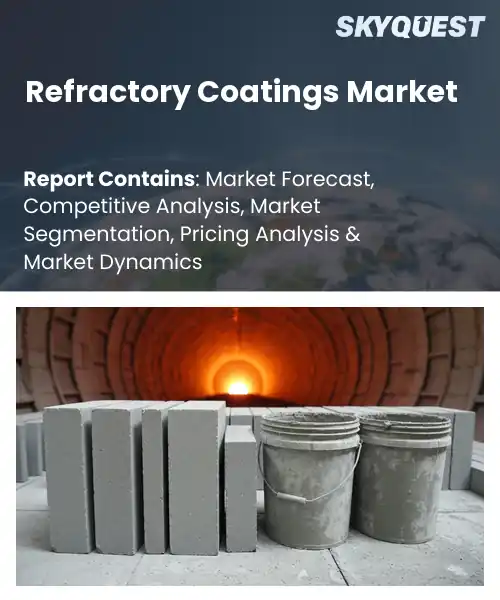
Refractory Coatings Market
Report ID: SQMIG15E3228
Report ID: SQMIG15E3228
[email protected]
USA +1 351-333-4748
Report ID:
SQMIG15E3228 |
Region:
Global |
Published Date: February, 2026
Pages:
157
|Tables:
143
|Figures:
78


Global Refractory Coatings Market size was valued at USD 374.6 Million in 2024 and is poised to grow from USD 392.21 Million in 2025 to USD 566.35 Million by 2033, growing at a CAGR of 4.7% during the forecast period (2026-2033).
The primary driver of the refractory coatings market is the accelerating demand for high-temperature protection across industries. Refractory coatings encompass specialized formulations that protect metal and ceramic surfaces from thermal shock, corrosion, abrasion and chemical attack, and they matter because equipment longevity affects cost and safety. Historically the market evolved from bulk refractory bricks and monolithic linings to thin film ceramic and nano-enabled coatings as process intensification and maintenance intervals increased. For example, steelmaking ladles shifted from brick relining toward sprayable coatings to reduce downtime, and glass furnaces adopted aluminous coatings to improve thermal efficiency, creating tailwinds for the sector.Building on demand for thermal protection, a key growth factor is regulatory pressure and operational economics that favor advanced longer-lasting coatings. Stricter emissions and energy-efficiency standards force plants to raise furnace temperatures and reduce heat loss, increasing substrate stress and demand for high-performance ceramic and corrosion-resistant chemistries. Cement preheater towers and petrochemical reformers now use alumina and zirconia coatings to prevent alkali attack, which cuts unscheduled shutdowns and maintenance costs. Innovations such as nanocomposites, robotic spray application and performance-based contracts lower lifecycle costs, attract CAPEX from steelmakers and renewable operators, and open commercially viable routes for market expansion at scale.
How is AI enhancing performance and lifecycle prediction in the refractory coatings market?
AI is enhancing performance and lifecycle prediction in the refractory coatings market by combining sensor driven condition monitoring, materials informatics and machine learning. Key aspects include continuous sensing of temperature and acoustic signals, digital twins that simulate thermal cycling and wear, and data driven formulation tuning that links microstructure to durability. The current state shows suppliers and plant operators using predictive models to prioritize maintenance and adjust coating recipes, which reduces unplanned outages and extends service life. In a market where longer lasting linings are increasingly important across steel, cement and energy sectors, these tools improve reliability and speed up product qualification, making coatings more consistent and easier to manage.Titomic September 2025, announced an exclusive supplier and developer partnership with Amaero that ties refractory powder qualification to coating production. The shared testing and process data from that collaboration feeds AI driven analytics and digital twins, improving wear forecasting, accelerating formulation optimization and supporting more efficient maintenance planning.
Market snapshot - (2026-2033)
Global Market Size
USD 374.6 Million
Largest Segment
Ceramic Coatings
Fastest Growth
Ceramic Coatings
Growth Rate
4.7% CAGR
To get more insights on this market click here to Request a Free Sample Report
Global refractory coatings market is segmented by product type, formulation type, application method, material type, end use industry and region. Based on product type, the market is segmented into Ceramic Coatings, Silicate Coatings and Metallic Coatings. Based on formulation type, the market is segmented into Water-Based and Solvent-Based. Based on application method, the market is segmented into Spray Coating and Brush Coating. Based on material type, the market is segmented into Oxide Materials and Non-Oxide Materials. Based on end use industry, the market is segmented into Steel Production, Non-Ferrous Metals, Container Glass, Float Glass and Others. Based on region, the market is segmented into North America, Europe, Asia Pacific, Latin America and Middle East & Africa.
Ceramic Coatings segment dominates because ceramic chemistries provide exceptional high temperature stability, chemical inertness and thermal shock resistance that extend service life in harsh refractory environments. Superior adhesion on oxide substrates and compatibility with advanced sintering and curing processes reduce downtime and maintenance. Industrial preference for durable, long lasting protection in steel and glass production drives procurement toward ceramic systems and sustained market leadership. Research and formulation innovation further reinforce their dominance.
However, Metallic Coatings are emerging as the most rapidly expanding area because alloyed surface layers improve thermal conductivity, impact resistance and metallurgical bonding to substrates. Growing demand in applications needing enhanced heat transfer and abrasion resistance, combined with advances in alloy formulations and application techniques, is creating new refractory coating opportunities.
Spray Coating segment dominates because automated spray techniques deliver consistent film thickness across complex geometries and large surfaces, enabling high throughput and reduced labor intensity in industrial refractory applications. Superior control over droplet size and deposition parameters improves microstructure and adhesion, leading to longer service life and lower maintenance cycles. Integration with robotics and in line curing systems further drives adoption by producers seeking scalable, repeatable coating performance.
On the other hand, Brush Coating is witnessing the strongest growth momentum as maintenance crews and small scale operators favor its low capital requirements and adaptability for site repairs. Innovations in brush compatible formulations with faster curing, improved adhesion and lower emissions expand its applicability for targeted patching and preventive maintenance, unlocking opportunities in service markets and niche production environments.
To get detailed segments analysis, Request a Free Sample Report
Asia Pacific dominance reflects a convergence of deep industrial demand, integrated supply chains, and concentrated technical capability. The region hosts large clusters of end users in steel, glass, cement, petrochemical, and power sectors that require frequent maintenance and advanced lining solutions, creating steady demand for refractory coatings. Cost efficiencies in production and logistics support competitive pricing while localized manufacturing enables fast service and customization. Stronger regional R&D networks and technology transfer, particularly between industrial leaders and specialty materials firms, accelerate adoption of high performance formulations. Market structure benefits from robust aftermarket services and dense distribution channels that improve accessibility across diverse industrial geographies, further reinforcing leadership in both volume and innovation.
Refractory Coatings Market in Japan reflects a high degree of technical sophistication and specialty applications. Domestic producers emphasize precision formulations and stringent quality control to meet demanding performance requirements in electronics related production, steel finishing, and niche ceramic processes. Collaboration between material scientists and industrial end users drives incremental innovation and tailored product offerings. The market values reliability, lifecycle performance, and compliance with strict environmental and safety norms, supporting premium positioning and export oriented technology diffusion.
Refractory Coatings Market in South Korea is shaped by heavy industrial demand and strong integration with large manufacturing groups. The presence of major steel, shipbuilding, and petrochemical sectors sustains need for durable high temperature and wear resistant coatings. Local suppliers work closely with original equipment manufacturers and maintenance contractors to deliver application expertise and rapid turnaround for plant refurbishments. Emphasis on process efficiency and cost effective maintenance solutions encourages adoption of advanced coating chemistries tailored to continuous operation environments.
Expansion across Europe is driven by a focus on modernization, regulatory pressure for cleaner and more efficient operations, and a shift toward lifecycle cost optimization among industrial operators. Many European firms are investing in retrofits and advanced maintenance strategies to extend furnace and kiln life while reducing energy consumption, which favors higher performance coatings. A dense network of specialist suppliers and engineering service providers supports rapid deployment of tailored solutions. Cross border collaboration among research institutions, standards bodies, and private industry accelerates innovation and qualification of new materials. Diverse end markets including metals, cement, glass, and energy infrastructure sustain demand and encourage specialization by national clusters with strong technical competencies.
Refractory Coatings Market in Germany benefits from a strong engineering tradition and concentrated heavy industry. Demand is supported by steelmaking, foundry, and high performance manufacturing that require durable, high reliability coatings. The supplier base emphasizes precision, testing capability, and integration with industrial maintenance programs. Standards and certification expectations drive quality oriented product development and close cooperation between materials suppliers and plant operators. This environment favours advanced formulations and end to end service models.
Refractory Coatings Market in United Kingdom is characterized by emerging opportunities tied to infrastructure renewal and energy sector activity. Suppliers focus on adaptable, service driven offerings that address offshore, petrochemical, and process plant needs. Niche expertise in specialty applications and a network of technical service providers enable tailored solutions for refurbishment and new build projects. Growth is supported by partnerships that combine materials know how with application engineering to meet evolving environmental and operational requirements.
Refractory Coatings Market in France is experiencing accelerated activity driven by investments in modernization and energy transition related projects. Industries such as glass, ceramics, and nuclear maintenance demand specialized, high performance coatings. Local innovation clusters and collaborative R&D initiatives promote development of formulations that meet strict safety and environmental standards. This fosters a dynamic market where suppliers work closely with end users to deliver application specific solutions and technical support.
North America is reinforcing its role through a combination of innovation, reshoring of critical manufacturing, and stronger aftersales service models. Emphasis on material science advances and performance validation supports broader adoption of specialty coatings that reduce downtime and extend asset life. Industry players are enhancing technical service footprints and investing in application training to improve field performance and client retention. Strategic partnerships between suppliers, testing laboratories, and industrial end users accelerate product qualification and customization. Focus on supply chain resilience and regional production capacity enables quicker response to maintenance cycles and supports longer term relationships with key industrial sectors.
Refractory Coatings Market in United States is driven by innovation and a large aftermarket services ecosystem. Suppliers emphasize tailored solutions, rigorous testing, and performance based service contracts to meet the needs of power generation, refining, and heavy manufacturing. Strong ties between materials developers and end users facilitate rapid iteration and scaling of new formulations. The market values technical support, coating application expertise, and comprehensive maintenance programs that minimize downtime and improve lifecycle economics.
Refractory Coatings Market in Canada is influenced by resource processing industries and a focus on environmental compliance. Demand stems from metallurgical operations, pulp and paper, and energy related facilities that require robust, cold climate tolerant coatings and maintenance solutions. Regional suppliers prioritize field service capability and collaboration with industrial operators to deliver customized formulations and application methods suited to large scale process environments. Emphasis on sustainable practices and long term asset preservation shapes procurement and supplier selection.
To know more about the market opportunities by region and country, click here to
Buy The Complete Report
Increasing Demand From Steel Industry
Technological Advancements In Coating Formulations
Volatile Raw Material Prices
Stringent Environmental Regulations Compliance
Request Free Customization of this report to help us to meet your business objectives.
The competitive landscape for global refractory coatings is consolidation driven and technology led, with major suppliers using targeted M&A, regional buyouts, recycling and application partnerships to lock in customers and shorten supply chains. RHI Magnesita and Vesuvius have pursued strategic acquisitions and local integrations, while players also invest in thermal spray and recycling collaborations to raise technical barriers and improve service response. Note on startups: focused, verifiable startups exclusively marketing refractory coatings founded since 2019 are scarce. Searches turned up adjacent deep tech coating initiatives and newer specialty coating ventures rather than independent refractory coatings startups meeting the exact criteria.
Top Player’s Company Profile
Recent Developments
SkyQuest’s ABIRAW (Advanced Business Intelligence, Research & Analysis Wing) is our Business Information Services team that Collects, Collates, Correlates, and Analyses the Data collected by means of Primary Exploratory Research backed by robust Secondary Desk research. As per SkyQuest analysis, the global refractory coatings market is being driven primarily by accelerating demand for high temperature protection across steel, glass and cement industries, while regulatory pressure and operational economics serve as a second key driver encouraging higher performance, longer lasting formulations. Growth is tempered by volatile raw material prices that squeeze margins and complicate supply chains. Asia Pacific emerges as the dominant region due to concentrated industrial demand and localized production, and ceramic coatings lead the product mix given their superior temperature stability and thermal shock resistance. Innovation in nanocomposites, robotic application and digital monitoring will further shape adoption and lifecycle economics.
| Report Metric | Details |
|---|---|
| Market size value in 2024 | USD 374.6 Million |
| Market size value in 2033 | USD 566.35 Million |
| Growth Rate | 4.7% |
| Base year | 2024 |
| Forecast period | (2026-2033) |
| Forecast Unit (Value) | USD Million |
| Segments covered |
|
| Regions covered | North America (US, Canada), Europe (Germany, France, United Kingdom, Italy, Spain, Rest of Europe), Asia Pacific (China, India, Japan, Rest of Asia-Pacific), Latin America (Brazil, Rest of Latin America), Middle East & Africa (South Africa, GCC Countries, Rest of MEA) |
| Companies covered |
|
| Customization scope | Free report customization with purchase. Customization includes:-
|
To get a free trial access to our platform which is a one stop solution for all your data requirements for quicker decision making. This platform allows you to compare markets, competitors who are prominent in the market, and mega trends that are influencing the dynamics in the market. Also, get access to detailed SkyQuest exclusive matrix.
Table Of Content
Executive Summary
Market overview
Parent Market Analysis
Market overview
Market size
KEY MARKET INSIGHTS
COVID IMPACT
MARKET DYNAMICS & OUTLOOK
Market Size by Region
KEY COMPANY PROFILES
Methodology
For the Refractory Coatings Market, our research methodology involved a mixture of primary and secondary data sources. Key steps involved in the research process are listed below:
1. Information Procurement: This stage involved the procurement of Market data or related information via primary and secondary sources. The various secondary sources used included various company websites, annual reports, trade databases, and paid databases such as Hoover's, Bloomberg Business, Factiva, and Avention. Our team did 45 primary interactions Globally which included several stakeholders such as manufacturers, customers, key opinion leaders, etc. Overall, information procurement was one of the most extensive stages in our research process.
2. Information Analysis: This step involved triangulation of data through bottom-up and top-down approaches to estimate and validate the total size and future estimate of the Refractory Coatings Market.
3. Report Formulation: The final step entailed the placement of data points in appropriate Market spaces in an attempt to deduce viable conclusions.
4. Validation & Publishing: Validation is the most important step in the process. Validation & re-validation via an intricately designed process helped us finalize data points to be used for final calculations. The final Market estimates and forecasts were then aligned and sent to our panel of industry experts for validation of data. Once the validation was done the report was sent to our Quality Assurance team to ensure adherence to style guides, consistency & design.
Analyst Support
Customization Options
With the given market data, our dedicated team of analysts can offer you the following customization options are available for the Refractory Coatings Market:
Product Analysis: Product matrix, which offers a detailed comparison of the product portfolio of companies.
Regional Analysis: Further analysis of the Refractory Coatings Market for additional countries.
Competitive Analysis: Detailed analysis and profiling of additional Market players & comparative analysis of competitive products.
Go to Market Strategy: Find the high-growth channels to invest your marketing efforts and increase your customer base.
Innovation Mapping: Identify racial solutions and innovation, connected to deep ecosystems of innovators, start-ups, academics, and strategic partners.
Category Intelligence: Customized intelligence that is relevant to their supply Markets will enable them to make smarter sourcing decisions and improve their category management.
Public Company Transcript Analysis: To improve the investment performance by generating new alpha and making better-informed decisions.
Social Media Listening: To analyze the conversations and trends happening not just around your brand, but around your industry as a whole, and use those insights to make better Marketing decisions.
REQUEST FOR SAMPLE
 REQUEST FREE CUSTOMIZATION


Want to customize this report? This report can be personalized according to your needs. Our analysts and industry experts will work directly with you to understand your requirements and provide you with customized data in a short amount of time. We offer $1000 worth of FREE customization at the time of purchase.
Feedback From Our Clients


 USA (+1) 351-333-4748

