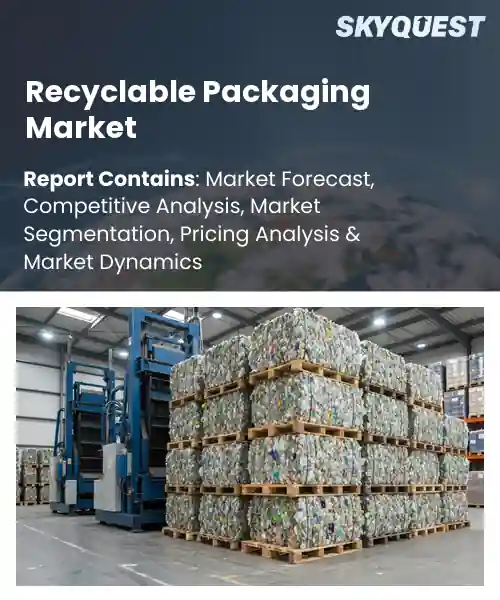
Recyclable Packaging Market
Report ID: SQMIG15F2342
Report ID: SQMIG15F2342
[email protected]
USA +1 351-333-4748
Report ID:
SQMIG15F2342 |
Region:
Global |
Published Date: June, 2026
Pages:
157
|Tables:
157
|Figures:
78


Global Recyclable Packaging Market size was valued at USD 29.8 Billion in 2024 and is poised to grow from USD 30.96 Billion in 2025 to USD 42.05 Billion by 2033, growing at a CAGR of 3.9% during the forecast period (2026-2033).
Recyclable packaging market centers on materials and systems designed to recover and reincorporate packaging waste into new products, and its primary driver is regulatory pressure coupled with shifting consumer values. This market matters because packaging accounts for a substantial share of solid waste and influences brand sustainability credentials, prompting manufacturers, retailers, and recyclers to invest in closed-loop systems. Historically, development moved from single-stream curbside recycling toward advanced material recovery and design-for-recycling practices as chemical recycling techniques and corporate commitments emerged, exemplified by beverage companies adopting PET bottle-to-bottle programs and retailers eliminating multi-material laminates to improve recyclability and material recovery rates.Building on regulatory and consumer pressure, technological innovation is the key factor accelerating global recyclable packaging growth because improved sorting, polymer chemistry and design raise yield and lower costs. When automated optical sorters and AI-guided recovery raise feedstock purity, manufacturers substitute virgin resin with recycled content without performance loss, which reduces production emissions and secures corporate sustainability commitments. Consequently, brands deploy recycled PET in beverages and recycled flexible films in consumer goods, creating commercial scale that cuts unit costs and attracts investment in regional recycling infrastructure, while extended producer responsibility schemes further incentivize circular procurement and broader sustained market expansion.
How is AI optimizing material selection in the recyclable packaging market?
AI optimizes material selection in the recyclable packaging market by combining data driven material screening with predictive modeling and supply chain intelligence. Key aspects include evaluating recyclability, barrier function, and end of life recovery for candidate materials. The current state sees brands and converters using machine learning to test many formulations virtually, running digital twins of production and sorting, and flagging trade offs for designers. This reduces trial and error and accelerates qualification of mono material and paper based solutions. Industry pilots and supplier tools are increasingly integrating AI to guide choices that balance performance with circularity and cost.Kenvue May 2026, deployed Greyparrot’s AI to track packaging through recycling systems and surface which formats and resins reach recovery most reliably, helping material teams choose substrates that are practically recyclable. That insight shortens development cycles and raises real world yield from recyclable inputs.
Market snapshot - (2026-2033)
Global Market Size
USD 29.8 Billion
Largest Segment
Paper & Paperboard
Fastest Growth
Biodegradable & Compostable Materials
Growth Rate
3.9% CAGR
To get more insights on this market click here to Request a Free Sample Report
Global recyclable packaging market is segmented by material type, packaging type, product type, end use industry, recycling process type and region. Based on material type, the market is segmented into Paper & Paperboard, Plastics (Recyclable Plastics), Glass, Metal, Biodegradable & Compostable Materials and Others. Based on packaging type, the market is segmented into Rigid Packaging, Flexible Packaging and Semi-Rigid Packaging. Based on product type, the market is segmented into Bottles & Jars, Cans, Boxes & Cartons, Bags & Pouches, Trays & Containers, Wrapping Films and Others. Based on end use industry, the market is segmented into Food & Beverage, Personal Care & Cosmetics, Healthcare & Pharmaceuticals, E-commerce & Retail, Industrial Goods, Household Products and Others. Based on recycling process type, the market is segmented into Mechanical Recycling, Chemical Recycling, Organic Recycling (Composting), Energy Recovery and Others. Based on region, the market is segmented into North America, Europe, Asia Pacific, Latin America and Middle East & Africa.
Recyclable plastics segment dominates because recyclable plastics offer versatility across packaging formats, enabling lightweight designs and high functional performance while aligning with recycling infrastructure. Their compatibility with existing collection systems and strong industry investment in recyclable resin development drive widespread adoption by brand owners focused on cost effective circularity. As a result, demand concentrates around plastic packaging innovations that preserve product integrity and streamline end of life recovery, reinforcing plastics' leadership.
However, paper and paperboard is the most rapidly expanding material due to rising consumer demand for sustainable options and advances in fiber based barrier coatings that extend shelf life yet remain recyclable. Investment in fiber recycling and lightweighting innovations is expanding applications across food and e commerce packaging, unlocking new market opportunities.
Mechanical recycling segment dominates because it provides a proven, cost efficient route to reclaim common packaging materials into feedstock that can be reintroduced into packaging production. Its compatibility with existing collection, sorting and extrusion infrastructure reduces technical barriers and enables manufacturers to meet corporate recycling targets with predictable material properties. Strong industry focus on scaling collection and standardizing polymers further cements mechanical recycling as the primary practical pathway for circular packaging systems.
However, chemical recycling is the most rapidly expanding process because advances in depolymerization and solvent based technologies enable recovery of contaminated and mixed plastics previously unsuitable for mechanical routes. Investment and regulatory encouragement for advanced recycling are accelerating commercialization, unlocking new feedstock options and stimulating innovations in recyclable packaging materials and circular supply chain models.
To get detailed segments analysis, Request a Free Sample Report
Asia Pacific commands a leading position driven by a combination of robust manufacturing ecosystems, advanced material innovation, and proactive regulatory and corporate sustainability commitments. Strong supplier networks and concentrated production capacity enable efficient scaling of recyclable substrates and design for reuse. Consumer preferences in key markets favor environmentally considerate packaging, prompting brand owners to prioritize recyclable solutions. Public policy frameworks and private sector investment foster circular value chains, while collaboration among industry, research institutions, and waste management entities accelerates commercialization of recyclable formats. Logistics and packaging innovation hubs in the region support rapid iteration and cost optimization, reinforcing competitive advantage and expanding adoption across food, personal care, and industrial applications. Investment in recycling infrastructure and efforts to standardize material streams improve recyclability outcomes and enable cross border sourcing. Technical expertise in polymer science and paper engineering further elevates product performance and cost competitiveness.
Recyclable Packaging Market in Japan benefits from advanced manufacturing capabilities, strong design culture, and tight alignment between brands and waste management systems. Manufacturers emphasize material purity and ease of sorting, while consumer acceptance of compact, efficient packaging supports adoption. Collaborative pilot programs between industry and research organizations refine recyclable formats for food and electronics applications. Regulatory encouragement and high environmental awareness sustain ongoing improvement in collection infrastructure and packaging circularity.
Recyclable Packaging Market in South Korea combines industrial agility, strong public private collaboration, and focus on material innovation for urban supply chains. Local firms prioritize lightweight, separable structures and improve recyclability through optimized labels and adhesives. Consumer preference for sustainable packaging and integrated collection systems supports closed loop initiatives. Collaboration between manufacturers, retailers, and waste handlers expedites scale up of recyclable formats across food service channels and urban retail networks.
Europe rapid expansion is propelled by stringent regulatory frameworks, ambitious corporate sustainability targets, and high consumer demand for circular packaging. Harmonized standards and extended producer responsibility models encourage product redesign toward recyclability and material reduction. Strong investment in sorting and recycling infrastructure, alongside innovation in mono material solutions and paper based formats, improves end of life outcomes. Collaboration across supply chains, including brands, converters, and waste managers, drives scalable solutions. Market dynamics are further shaped by an active advisory and standards community that promotes best practices and cross border cooperation, enabling faster adoption and continuous refinement of recyclable packaging across diverse product categories. Retailers and brand owners leverage reusable and recyclable design strategies, piloting closed loop systems that inform wider rollouts. Strong research centers and design studios collaborate to reconcile functional performance with recyclability, while financial mechanisms support infrastructure upgrades across the region.
Recyclable Packaging Market in Germany is anchored by advanced manufacturing, comprehensive collection and sorting systems, and strong policy alignment that incentivizes circular design. Industry leaders focus on durable mono material options and paper fiber innovations that ease recycling streams. Research institutions and converters collaborate with brand owners to validate performance while maintaining recyclability. High consumer environmental awareness and logistics reinforce pilot programs and implementation of recyclable packaging across retail channels.
Recyclable Packaging Market in United Kingdom is characterized by growing retailer commitments, design innovation, and policy signals that spur recyclable alternatives. Startups and converters experiment with mono materials and enhanced paper solutions tuned for recycling streams. Retail pilots and collaborative initiatives with waste managers refine collection and sorting practices. Consumer interest in sustainable packaging and brand transparency supports trials and scaled adoption, particularly across grocery and direct to consumer packaging.
Recyclable Packaging Market in France is marked by dynamic innovation, strong policy encouragement, and active collaboration among brands, converters, and waste operators. Emphasis on mono material and fiber based alternatives drives design shifts that simplify recycling streams. Emerging circular initiatives and pilot programs enhance collection and recycling integration. Consumer receptivity to sustainable packaging and ambitious corporate commitments accelerate market momentum, promoting wider adoption across food, cosmetics, and retail packaging categories.
North America is enhancing its market position through coordinated innovation among manufacturers, converters, and retail chains, combined with targeted investments in recycling infrastructure and material sorting capabilities. Market participants emphasize scalable mono material designs, improved label and adhesive technologies, and recyclable paper based solutions to meet diverse performance needs. Cross sector partnerships and corporate sustainability commitments catalyze pilot programs that inform wider rollouts. Policy developments and voluntary industry standards stimulate harmonization of material streams, while research institutions and technology providers advance materials science and processing techniques that reduce barriers to effective recycling and support more circular packaging systems. Retailers serve as testbeds for recyclable formats and influence supplier specifications. Consumer demand for clearer environmental credentials pressures brands to redesign packaging. Regional innovation clusters support pilot testing of alternative materials and logistics, while targeted financing facilitates expansion of sorting and processing capacity to strengthen circularity.
Recyclable Packaging Market in United States is driven by innovation among converters, retailer piloting, and corporate sustainability commitments that prioritize recyclable formats. Emphasis on mono material plastics and paper based alternatives simplifies recycling streams while preserving product protection. Collaboration among brands, waste managers, and technology providers advances sorting and processing capabilities. Retailer trials support commercialization across grocery, e commerce, and direct to consumer formats and logistics.
Recyclable Packaging Market in Canada reflects regional collaboration, growing investment, and alignment between brands and municipal collection systems to improve recyclability. Focus on mono materials, fiber innovations, and optimized closures enhances sorting outcomes. Pilot programs and partnerships among converters, retailers, and waste managers validate performance across climate and logistical contexts. Consumer interest in sustainable packaging and initiatives encourage broader adoption, particularly within retail, food service, and packaged goods channels nationwide.
To know more about the market opportunities by region and country, click here to
Buy The Complete Report
Consumer Demand For Sustainable Packaging
Policy Incentives And Corporate Targets
High Cost Of Recyclable Materials
Limited Recycling Infrastructure Availability
Request Free Customization of this report to help us to meet your business objectives.
Competitive dynamics in global recyclable packaging are driven by regulatory pressure such as extended producer responsibility, technology driven product differentiation and strategic consolidation. Mergers like Amcor’s acquisition of Bemis illustrate consolidation, while deep tech startups and pilot partnerships push new coating and collection capabilities exemplified by IonKraft’s plasma coating commercialization and Olyns’ retail reverse vending partnerships.
Top Player’s Company Profile
Recent Developments
SkyQuest’s ABIRAW (Advanced Business Intelligence, Research & Analysis Wing) is our Business Information Services team that Collects, Collates, Correlates, and Analyses the Data collected by means of Primary Exploratory Research backed by robust Secondary Desk research. As per SkyQuest analysis, the global recyclable packaging market is being driven primarily by regulatory pressure and shifting consumer preferences for sustainable packaging, while a second driver is rapid technological innovation in sorting, polymer chemistry and AI-enabled material selection that improves feedstock purity and recycled-content adoption. The recyclable plastics segment dominates the market thanks to versatility and investment in recyclable resins, and Asia Pacific is the leading region due to manufacturing scale, policy support and infrastructure expansion. A key restraint remains the premium cost and supply variability of recycled feedstocks which can hinder adoption for cost sensitive product lines and slow broader scale-up.
| Report Metric | Details |
|---|---|
| Market size value in 2024 | USD 29.8 Billion |
| Market size value in 2033 | USD 42.05 Billion |
| Growth Rate | 3.9% |
| Base year | 2024 |
| Forecast period | (2026-2033) |
| Forecast Unit (Value) | USD Billion |
| Segments covered |
|
| Regions covered | North America (US, Canada), Europe (Germany, France, United Kingdom, Italy, Spain, Rest of Europe), Asia Pacific (China, India, Japan, Rest of Asia-Pacific), Latin America (Brazil, Rest of Latin America), Middle East & Africa (South Africa, GCC Countries, Rest of MEA) |
| Companies covered |
|
| Customization scope | Free report customization with purchase. Customization includes:-
|
To get a free trial access to our platform which is a one stop solution for all your data requirements for quicker decision making. This platform allows you to compare markets, competitors who are prominent in the market, and mega trends that are influencing the dynamics in the market. Also, get access to detailed SkyQuest exclusive matrix.
Table Of Content
Executive Summary
Market overview
Parent Market Analysis
Market overview
Market size
KEY MARKET INSIGHTS
COVID IMPACT
MARKET DYNAMICS & OUTLOOK
Market Size by Region
KEY COMPANY PROFILES
Methodology
For the Recyclable Packaging Market, our research methodology involved a mixture of primary and secondary data sources. Key steps involved in the research process are listed below:
1. Information Procurement: This stage involved the procurement of Market data or related information via primary and secondary sources. The various secondary sources used included various company websites, annual reports, trade databases, and paid databases such as Hoover's, Bloomberg Business, Factiva, and Avention. Our team did 45 primary interactions Globally which included several stakeholders such as manufacturers, customers, key opinion leaders, etc. Overall, information procurement was one of the most extensive stages in our research process.
2. Information Analysis: This step involved triangulation of data through bottom-up and top-down approaches to estimate and validate the total size and future estimate of the Recyclable Packaging Market.
3. Report Formulation: The final step entailed the placement of data points in appropriate Market spaces in an attempt to deduce viable conclusions.
4. Validation & Publishing: Validation is the most important step in the process. Validation & re-validation via an intricately designed process helped us finalize data points to be used for final calculations. The final Market estimates and forecasts were then aligned and sent to our panel of industry experts for validation of data. Once the validation was done the report was sent to our Quality Assurance team to ensure adherence to style guides, consistency & design.
Analyst Support
Customization Options
With the given market data, our dedicated team of analysts can offer you the following customization options are available for the Recyclable Packaging Market:
Product Analysis: Product matrix, which offers a detailed comparison of the product portfolio of companies.
Regional Analysis: Further analysis of the Recyclable Packaging Market for additional countries.
Competitive Analysis: Detailed analysis and profiling of additional Market players & comparative analysis of competitive products.
Go to Market Strategy: Find the high-growth channels to invest your marketing efforts and increase your customer base.
Innovation Mapping: Identify racial solutions and innovation, connected to deep ecosystems of innovators, start-ups, academics, and strategic partners.
Category Intelligence: Customized intelligence that is relevant to their supply Markets will enable them to make smarter sourcing decisions and improve their category management.
Public Company Transcript Analysis: To improve the investment performance by generating new alpha and making better-informed decisions.
Social Media Listening: To analyze the conversations and trends happening not just around your brand, but around your industry as a whole, and use those insights to make better Marketing decisions.
REQUEST FOR SAMPLE
 REQUEST FREE CUSTOMIZATION


Want to customize this report? This report can be personalized according to your needs. Our analysts and industry experts will work directly with you to understand your requirements and provide you with customized data in a short amount of time. We offer $1000 worth of FREE customization at the time of purchase.
Feedback From Our Clients


 USA (+1) 351-333-4748

