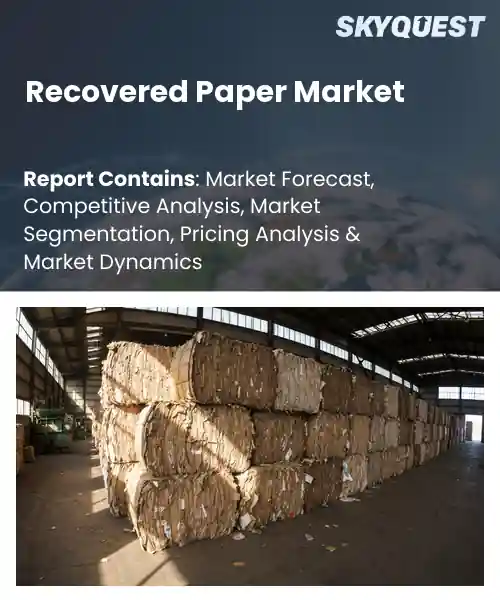
Recovered Paper Market
Report ID: SQMIG15Q2036
Report ID: SQMIG15Q2036
[email protected]
USA +1 351-333-4748
Report ID:
SQMIG15Q2036 |
Region:
Global |
Published Date: July, 2026
Pages:
157
|Tables:
183
|Figures:
79


Global Recovered Paper Market size was valued at USD 60.3 Billion in 2024 and is poised to grow from USD 61.81 Billion in 2025 to USD 75.31 Billion by 2033, growing at a CAGR of 2.5% during the forecast period (2026-2033).
High demand for sustainable packaging, increasing recycling initiatives, rising adoption of circular economy practices, stringent environmental regulations, and expanding use of recycled fiber in paper manufacturing are driving sales of recovered paper.
Increased emphasis on sustainable resource management and increasing demand for cost-effective recycled fiber, coupled with expanding packaging production, are expected to primarily drive recovered paper market growth. Advancement in recovered paper usage for manufacturing of consumer as well as industrial packaging products such as corrugated boxes, paper board, paper tissues, and other paper packaging products is boosting the market growth. Increasing investments in collection infrastructure, contamination elimination mechanism, new sorting chemicals and equipment new recycling plants are accelerating growth of recyclable paper. Decline of resources-to-recovered fiber conversion ratio, in-process newsprint recycling, process improvements and innovations and in-process and alternative end-use recycling programs are further improving the recycle paper business. Increasing demand for recycled paper packaging from retail industry, e-commerce and fast-moving consumer goods sectors will generate further opportunities for market growth.
On the contrary, fluctuations in recovered paper prices, contamination of recyclable materials, inconsistent collection infrastructure, and volatility in global trade policies are anticipated to slow down recovered paper market penetration across the study period and beyond.
How is Blockchain Improving Traceability In Recovered Paper Supply Chains?
Blockchain is enhancing the recovered paper market by providing greater transparency across the supply chain and more traceability of materials. Every batch of paper has a record stored on a secure digital ledger documenting the collection, sorting, processing, transportation and reprocessing or recycling, all of which are collaboratively stored and cannot be altered. Each batch can be assigned a unique digital identity code, making it easier to demonstrate the source, quality, and historical data of the paper being recycled. It reduces opportunities for fraud, reassures buyers, and helps recyclers to satisfy regulatory and sustainability targets. The recovered paper sector is gradually migrating to digitally more efficient tracking systems using blockchains.
Market snapshot - (2026-2033)
Global Market Size
USD 60.3 Billion
Largest Segment
Post-Consumer Recovered Paper
Fastest Growth
Post-Consumer Recovered Paper
Growth Rate
2.5% CAGR
To get more insights on this market click here to Request a Free Sample Report
Global recovered paper market is segmented by source, grade, paper type, application, end-use industry, distribution channel, and region. Based on source, the market is segmented into post-consumer recovered paper and pre-consumer (industrial) recovered paper. Based on grade, the market is segmented into old corrugated containers (OCC), old newspapers (ONP), mixed paper, high-grade paper (Office Paper, Deinking Grades), pulp substitutes, and others. Based on paper type, the market is segmented into containerboard, boxboard & carton board, newsprint, printing & writing paper, tissue paper, and others. Based on application, the market is segmented into packaging paper & board, printing & writing paper, tissue & hygiene products, specialty paper, and others. Based on end-use industry, the market is segmented into packaging, printing & publishing, consumer goods, food & beverage, industrial & manufacturing, and others. Based on distribution channel, the market is segmented into direct procurement, waste collection & recycling companies, paper traders & brokers, and others. Based on region, the market is segmented into North America, Europe, Asia Pacific, Latin America, and Middle East & Africa.
The old corrugated containers segment is anticipated to lead the global recovered paper market revenue generation across the study period. It provides the most easily recovered fiber stream available that matches containerboard mill needs, provides consistent feedstock, and is less expensive to process. Marketable commercial/retail waste, established collection infrastructure, and simple bale specifications make handling easier, while relentless corrugated demand ensures mills will treat OCC diligently. These structural benefits underpin recovered paper market flows and investments with economics of scale and supply security.
However, mixed paper is emerging as the fastest growing subsegment as per this recovered paper market forecast, as advancements in sorting technologies and enhanced sorting systems result in a more varied and extensive assortment of acceptable feedstock feed to mills. Diminishing soiling levels due to improved separation techniques and combination with a marked rise in commercial recovery and adaptable mill specifications will support increased processing options and investment, all the while will hasten market penetration and also provide avenues for enhancement of low grade recovered paper into higher value products.
The post-consumer recovered paper segment is slated to account for the highest global recovered paper market share in the future. It embodies the largest source of varied civic-driven material flows essential to circularity and upholding brand sustainability pledges thus defining its strategic significance. Widespread municipal collection systems, engagement in consumer recycling and traceability programs, along with government and brand recycling targets strengthen feedstock pool lock-in, legitimacy and to seamlessly integrate into the mainstream recovered paper supply chains.
Meanwhile, pre-consumer (industrial) recovered paper is accelerating fastest as manufacturers implement more robust internal takeback and waste minimization schemes, while meeting the need for reliable, relatively clean fiber streams in direct reuse applications. Increasing in-industry collaboration, process redesign to increase recovery of byproduct paper, and fortification of supplier contracts will less inherent variability and lower fixed costs, establishing plenty of near-term substitution possibilities for mill feedstock blends and judicious recycling paths.
To get detailed segments analysis, Request a Free Sample Report
Expansive collection networks, mature recycling infrastructure, and strong manufacturing demand centered on packaging and paperboard production are helping this region hold sway over others. Urbanization and modern waste management services provide a steady supply while investments in sorting and pulping technologies ensure material quality. Strong emphasis on circularity in the policies and support from both the industry and municipal administrations help to facilitate logistics and ensure reliable supply chains. The presence of efficiently working industrial clusters in certain countries provides opportunities for establishment of processing plants nearer to recycling markets, thus curtailing the costs related to transportation. Such combination of logistics, technologies, and policies makes the region a significant contributor of high-quality recovered paper and a center of innovative practices in recycling.
Recovered paper sales in Japan integrate efficient municipal collection networks with advanced sorting and pulping technology, supporting a steady supply of high-quality fiber for domestic converters. Intimate collaboration and co-development by industry research institutes and manufacturers enable process improvements and material specifications for paperboard and specialty grades. Optimized logistics and proximity to end use markets keep handling costs down, while industry and regulation initiatives reaffirm circularity and maximized use of recovered material.
Recovered paper demand in South Korea leverages concentrated industrial demand and efficient urban collection schemes to support a supply chain for recycled fiber. Material uniformity is improved through increased automation in collection and tight integration of mill operators and customers. Tight clustering of converters around collection centers without direct access to material reduces carriage and increases speed of processing, and source reduction policies coupled with other incentives foster continuous enhancement of recycling processing and product quality.
Stringent waste management policies, high recycling awareness among consumers, and a sophisticated industrial base that values recovered fiber are helping create new opportunities in the region. Investments in sophisticated sorting technology, a reliable municipal collection infrastructure and industry driven quality standards improve quality consistency and allow a broad range of end use grades. Closer co-operation of converters and mills with politicians maintains an efficient supply chain and close quality and specification compliance. Market trends echo a strong focus on circular economy themes and regional clustering adjusts processing technology for the demand of valuable commodity and niche recycled paper, underlining Europe's progressive position as market for recover fiber use innovation. Ties to supply chains for packaging and a focus on quality assurance further drive investment in pulp preparation and customized grade development region wide.
Recovered paper demand in Germany stands as the dominant force in European recovered fiber supply due to integrated collection systems, extensive processing capacity, and strong linkages to packaging and paper converting industries. Focus on maintaining quality standards and technology adoption in the sorting and pulping processes delivers identical quality output that flows to domestic conversion. Centralization in single hubs and supply chain collaboration between mills and brand owners minimize logistic inefficiencies and support specification harmonization and material availability.
Recovered paper market in the United Kingdom emerges as a node for recovered fiber driven by evolving collection practices, investments in material sorting, and participation from converters seeking recyclable feedstocks. Market actors emphasize traceability and grade specification to meet packaging and specialty paper producer requirements. Collaboration with municipal programs and private collectors further improves capture and streamlines supply. Flexibility in adapting processing lines and niche production capabilities supports recovered paper utilization growth.
Sales of recovered paper in France is among the fastest growing markets, driven by adoption of circular economy initiatives, expanding municipal collection innovation, and investment in sorting infrastructure. Industry participants develop the grades largely to satisfy the needs of packaging converters and specialty paper manufacturers. Collaboration of regional government bodies with private recyclers, guides pilot projects improving logistical aspects of the supply chain and fiber quality, contributing to varied channels for re-processed fiber use for local fiber milling units.
Modernization of collection infrastructure, expanded sorting capabilities, and closer coordination between mills, converters, and waste managers are supporting steady recovered paper demand in the region. Producers and receivers of recovered paper in the United States and Canada are realizing benefits from evolving procurement practices and private investments in material recovery facilities, leading to higher quality and better logistics of recovered fiber. Regional grade harmonization and end user commitment initiatives improve the flow and secure markets of recovered fiber. Geographic aggregation of demand centers and ongoing process improvements improve economies of scale while trade flow expansion and public/private integration of actions reinforce market functioning and adaptive capacity. State and provincial recovery infrastructure development programs and industry partnerships that optimize collection incentives with ongoing technology upgrades to deinking and fiber recovery keep improving the quality and range of grade options, positioning the United States and Canada for a greater integration of recovered paper into packaging and printing supply chains.
Recovered paper demand in the United States benefits from industrial demand centers, corporate engagement on recycled content, and upgrades to material recovery infrastructure. Emphasis on quality control, investment in automated sorting technology, and strong converter networks enable consistent supply of fiber grades. Public private partnerships and procurement commitments support route optimization and collection capture. These market dynamics encourage innovation in pulping processes and closer alignment between supply chain participants and end users.
Recovered paper market in Canada relies on coordinated municipal collection, regional processing, and ties with North American converters to strengthen recovered fiber flows. Investment in sorting and deinking technology enhances grade uniformity and broadens opportunities for domestic and cross border manufacturing. Industry working with government promotes planning and incentives that encourage feedstock collection. Geographic availability of processing capacity provides flexibility for seasonal fluctuations in supply and strengthens links with markets.
To know more about the market opportunities by region and country, click here to
Buy The Complete Report
Increasing Demand From Packaging Sector
Supportive Environmental Regulations and Policies
Variability In Feedstock Quality
High Collection Costs and Logistics
Request Free Customization of this report to help us to meet your business objectives.
The competitive landscape in the global recovered paper market is shaped by strategic consolidation, cross‑sector partnerships, and material innovation that alter demand for recovered fibres; large firms and specialised startups pursue acquisitions and licensing to secure feedstock and downstream conversion capacity, illustrated by recent industrial partnerships and equity investments aimed at scaling fibre‑based packaging technologies.
SkyQuest’s ABIRAW (Advanced Business Intelligence, Research & Analysis Wing) is our Business Information Services team that Collects, Collates, Correlates, and Analyses the Data collected by means of Primary Exploratory Research backed by robust Secondary Desk research.
As per SkyQuest analysis, launch of new recycling initiatives, rising adoption of circular economy practices, and stringent environmental regulations are anticipated to drive the demand for recovered paper going forward. However, fluctuations in recovered paper prices and contamination of recyclable materials are slated to slow down the adoption of recovered paper in the future. Asia Pacific is slated to spearhead the demand for recovered paper owing to well-established recycling infrastructure, strong demand for recycled packaging materials, supportive environmental regulations, and increasing investments in circular economy initiatives. Blockchain-enabled material traceability and development of digital recycling passports are anticipated to be key trends driving the recovered paper sector through 2033.
| Report Metric | Details |
|---|---|
| Market size value in 2024 | USD 60.3 Billion |
| Market size value in 2033 | USD 75.31 Billion |
| Growth Rate | 2.5% |
| Base year | 2024 |
| Forecast period | (2026-2033) |
| Forecast Unit (Value) | USD Billion |
| Segments covered |
|
| Regions covered | North America (US, Canada), Europe (Germany, France, United Kingdom, Italy, Spain, Rest of Europe), Asia Pacific (China, India, Japan, Rest of Asia-Pacific), Latin America (Brazil, Rest of Latin America), Middle East & Africa (South Africa, GCC Countries, Rest of MEA) |
| Companies covered |
|
| Customization scope | Free report customization with purchase. Customization includes:-
|
To get a free trial access to our platform which is a one stop solution for all your data requirements for quicker decision making. This platform allows you to compare markets, competitors who are prominent in the market, and mega trends that are influencing the dynamics in the market. Also, get access to detailed SkyQuest exclusive matrix.
Table Of Content
Executive Summary
Market overview
Parent Market Analysis
Market overview
Market size
KEY MARKET INSIGHTS
COVID IMPACT
MARKET DYNAMICS & OUTLOOK
Market Size by Region
KEY COMPANY PROFILES
Methodology
For the Recovered Paper Market, our research methodology involved a mixture of primary and secondary data sources. Key steps involved in the research process are listed below:
1. Information Procurement: This stage involved the procurement of Market data or related information via primary and secondary sources. The various secondary sources used included various company websites, annual reports, trade databases, and paid databases such as Hoover's, Bloomberg Business, Factiva, and Avention. Our team did 45 primary interactions Globally which included several stakeholders such as manufacturers, customers, key opinion leaders, etc. Overall, information procurement was one of the most extensive stages in our research process.
2. Information Analysis: This step involved triangulation of data through bottom-up and top-down approaches to estimate and validate the total size and future estimate of the Recovered Paper Market.
3. Report Formulation: The final step entailed the placement of data points in appropriate Market spaces in an attempt to deduce viable conclusions.
4. Validation & Publishing: Validation is the most important step in the process. Validation & re-validation via an intricately designed process helped us finalize data points to be used for final calculations. The final Market estimates and forecasts were then aligned and sent to our panel of industry experts for validation of data. Once the validation was done the report was sent to our Quality Assurance team to ensure adherence to style guides, consistency & design.
Analyst Support
Customization Options
With the given market data, our dedicated team of analysts can offer you the following customization options are available for the Recovered Paper Market:
Product Analysis: Product matrix, which offers a detailed comparison of the product portfolio of companies.
Regional Analysis: Further analysis of the Recovered Paper Market for additional countries.
Competitive Analysis: Detailed analysis and profiling of additional Market players & comparative analysis of competitive products.
Go to Market Strategy: Find the high-growth channels to invest your marketing efforts and increase your customer base.
Innovation Mapping: Identify racial solutions and innovation, connected to deep ecosystems of innovators, start-ups, academics, and strategic partners.
Category Intelligence: Customized intelligence that is relevant to their supply Markets will enable them to make smarter sourcing decisions and improve their category management.
Public Company Transcript Analysis: To improve the investment performance by generating new alpha and making better-informed decisions.
Social Media Listening: To analyze the conversations and trends happening not just around your brand, but around your industry as a whole, and use those insights to make better Marketing decisions.
REQUEST FOR SAMPLE
 REQUEST FREE CUSTOMIZATION
Global Recovered Paper Market size was valued at USD 60.3 Billion in 2024 and is poised to grow from USD 61.81 Billion in 2025 to USD 75.31 Billion by 2033, growing at a CAGR of 2.5% during the forecast period (2026-2033).
The competitive landscape in the global recovered paper market is shaped by strategic consolidation, cross‑sector partnerships, and material innovation that alter demand for recovered fibres; large firms and specialised startups pursue acquisitions and licensing to secure feedstock and downstream conversion capacity, illustrated by recent industrial partnerships and equity investments aimed at scaling fibre‑based packaging technologies. 'Nippon Paper Industries Co., Ltd.', 'DS Smith plc', 'Smurfit Westrock plc', 'International Paper Company', 'Pratt Industries, Inc.', 'Stora Enso Oyj', 'UPM-Kymmene Corporation', 'Mondi plc', 'Saica Group', 'Sappi Limited', 'Cascades Inc.', 'Packaging Corporation of America', 'Georgia-Pacific LLC', 'Oji Holdings Corporation', 'Nine Dragons Paper (Holdings) Limited', 'Lee & Man Paper Manufacturing Ltd.', 'Shandong Sun Paper Industry Joint Stock Co., Ltd.', 'Rengo Co., Ltd.', 'Hamburger Containerboard GmbH', 'Klabin S.A.'
The growth of consumer goods and e-commerce has increased demand for sustainable packaging, driving manufacturers to prefer products made from recovered paper, which supports reduced virgin fiber use and aligns with corporate sustainability goals. This preference encourages investment in recycled paper production capacity and innovation in product quality, enabling broader application across packaging formats. As manufacturers seek to meet environmental commitments and consumer expectations, recovered paper becomes an increasingly attractive raw material, thereby supporting steady expansion of the market through heightened procurement and long-term supply arrangements.
Brand Demand For Recycled Content: Leading consumer goods manufacturers and retailers are prioritizing recycled fiber in packaging and paper products as a core sustainability differentiator, driving stable procurement commitments and higher-quality specifications. This shift encourages partnerships across collection, processing and paper manufacturing, elevating demand for consistent feedstock and certified chain-of-custody practices. Brands leverage recycled content to strengthen circularity claims and consumer trust, prompting product redesign and investment in supply chain integration that supports premium pricing and long-term resource security for recovered paper value chains ecosystems.
Why does Asia Pacific Dominate the Global Recovered Paper Market? |@12


Want to customize this report? This report can be personalized according to your needs. Our analysts and industry experts will work directly with you to understand your requirements and provide you with customized data in a short amount of time. We offer $1000 worth of FREE customization at the time of purchase.
Feedback From Our Clients


 USA (+1) 351-333-4748

