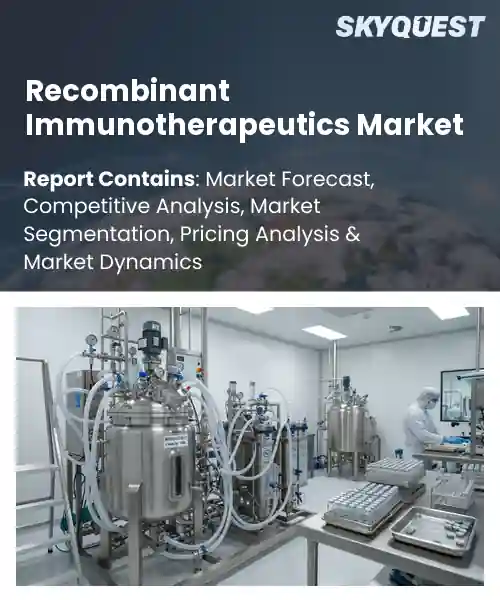
Recombinant Immunotherapeutics Market
Report ID: SQMIG35H2716
Report ID: SQMIG35H2716
[email protected]
USA +1 351-333-4748
Report ID:
SQMIG35H2716 |
Region:
Global |
Published Date: September, 2026
Pages:
157
|Tables:
94
|Figures:
76


Global Recombinant Immunotherapeutics Market size was valued at USD 1.62 Billion in 2024 and is poised to grow from USD 1.92 Billion in 2025 to USD 7.41 Billion by 2033, growing at a CAGR of 18.4% during the forecast period (2026-2033).
Recombinant immunotherapeutics represent engineered biologics that harness the immune system to target disease, and the market has become a cornerstone of modern oncology and rare‑disease treatment. Its primary driver is the proven clinical efficacy of checkpoint inhibitors such as pembrolizumab and CAR‑T cell products like tisagenlecleucel, which have transformed survival curves and generated multi‑billion‑dollar revenues. The sector originated in the late 1990s with recombinant monoclonal antibodies, progressed through the first approvals of rituximab and trastuzumab, and accelerated after genomic sequencing enabled precise antigen selection. Today the market exceeds $60 billion, reflecting both therapeutic success and strategic investment by pharma giants globally. The next pivotal factor shaping the global recombinant immunotherapeutics market is the convergence of advanced manufacturing platforms with personalized medicine, which reduces production costs and expands patient access. As cell‑free protein synthesis and modular bioreactors mature, developers can generate bespoke antibodies against emerging viral variants, exemplified by the creation of neutralizing antibodies for the COVID‑19 Omicron wave. This scalability lowers entry barriers, prompting partnerships between biotech startups and large pharmaceutical firms, thereby accelerating pipeline diversification into autoimmune and neurodegenerative indications. Consequently, capital inflows increase, regulatory pathways become more streamlined, and the market is poised to surpass $100 billion soon by 2032.
How is AI-driven automation influencing development timelines in the recombinant immunotherapeutics market?
AI driven automation is reshaping how recombinant immunotherapeutics move from concept to clinic. Machine learning models now predict protein folding while robotic labs execute high throughput screening without manual intervention. This integration reduces cycle time for candidate selection enabling researchers to iterate designs faster than traditional methods. The market sees a shift toward platforms that combine in silico design with automated cell line development shortening the gap between discovery and pre clinical testing. Companies report smoother handoffs between computational and wet lab teams fostering a more agile development environment. As a result timelines that once spanned years are now compressed accelerating entry of novel therapies.In March 2023, GSK partnered with Exscientia, leveraging AI driven automation to accelerate antibody design, shortening development timelines and supporting market growth. The collaboration blends Exscientia's generative AI platform with GSK's recombinant antibody pipeline, enabling rapid iteration of candidates and reducing time to preclinical evaluation, showing clear efficiency gains in the sector.
Market snapshot - (2026-2033)
Global Market Size
USD 1.62 Billion
Largest Segment
Monoclonal Antibodies
Fastest Growth
Recombinant Fusion Proteins
Growth Rate
18.4% CAGR
To get more insights on this market click here to Request a Free Sample Report
Global recombinant immunotherapeutics market is segmented by therapeutic class, expression platform, end user and region. Based on therapeutic class, the market is segmented into Monoclonal Antibodies, Cytokines and Growth Factors, Recombinant Fusion Proteins, Immune Checkpoint Inhibitors and Others. Based on expression platform, the market is segmented into Mammalian Expression Systems, Bacterial Cell Systems, Yeast and Fungal Systems and Others. Based on end user, the market is segmented into Pharmaceutical Biotech Companies, Contract Research Organizations, Clinical Diagnostic Laboratories and Academic Research Institutes. Based on region, the market is segmented into North America, Europe, Asia Pacific, Latin America and Middle East & Africa.
Immune checkpoint inhibitors segment dominates because they directly unleash T‑cell activity against cancer, addressing the core therapeutic objective of recombinant immunotherapeutics. Their ability to modulate pivotal pathways reduces resistance and broadens patient eligibility, attracting extensive R&D investment. The convergence of clinical success stories, robust patent portfolios, and strategic collaborations fuels continued prioritization by biotech firms, cementing their leadership in the market and drives sustained pipeline expansion across multiple oncology indications.
However, recombinant fusion proteins segment is witnessing the strongest growth momentum because they enable modular design of multispecific agents, simplifying manufacturing while expanding therapeutic reach. Emerging applications in cytokine delivery and antibody‑drug conjugates stimulate investor interest, and regulatory pathways are becoming more streamlined, accelerating market entry and future expansion opportunities.
Mammalian expression systems segment leads because they faithfully reproduce human protein folding, post‑translational modifications, and glycosylation patterns essential for immunotherapeutic activity. This biological fidelity ensures high affinity, reduced immunogenicity, and consistent efficacy across patient populations. Consequently, developers prioritize these platforms for complex antibodies and cytokines, allocating substantial R&D resources and forging partnerships that reinforce their central role in driving market confidence and product pipelines and across multiple therapeutic classes.
Meanwhile, yeast and fungal systems segment emerges as the fastest expanding area because they combine rapid growth rates with eukaryotic post‑translational capabilities, lowering production costs while maintaining functional integrity. Advances in strain engineering broaden their applicability to cytokines and fusion proteins, prompting heightened funding and accelerating pipeline diversification, which fuels market growth.
To get detailed segments analysis, Request a Free Sample Report
North America benefits from a uniquely convergent environment where cutting‑edge scientific research, substantial investment capital, and an advanced regulatory framework intersect to accelerate product development. Leading academic and research institutions cultivate a pipeline of innovative biologics, while a mature venture capital ecosystem funds early‑stage ventures and scales them rapidly. The region’s sophisticated clinical trial infrastructure and extensive networks of specialized healthcare providers ensure swift translation from laboratory to patient. Strong intellectual property protections and collaborative partnerships between industry and government further reinforce market leadership, creating a self‑reinforcing cycle of discovery, development, and commercial success that positions North America at the forefront of recombinant immunotherapeutics.
Recombinant Immunotherapeutics Market in the United States is propelled by a dense concentration of biotech hubs, world‑class research universities, and a highly experienced talent pool. The presence of major pharmaceutical corporations and a venture capital community eager to fund innovative therapies fuels continual pipeline expansion. Robust reimbursement mechanisms and a patient‑centric healthcare system encourage rapid adoption of emerging treatments, while regulatory agencies provide clear pathways that facilitate timely approvals. This ecosystem collectively sustains a dynamic market characterized by continual innovation and broad patient access.
Recombinant Immunotherapeutics Market in Canada is shaped by strong public research institutions and a collaborative approach between government agencies and private firms. Favorable policy incentives and a supportive funding environment nurture early‑stage development, while a well‑structured health system ensures equitable patient access. Strategic partnerships with international biotech leaders enhance technology transfer and accelerate commercialization. The emphasis on clinical excellence and a skilled scientific workforce underpins steady market growth and positions Canada as a noteworthy contributor within the broader North American landscape.
Europe’s rapid expansion is underpinned by a harmonized regulatory landscape that streamlines cross‑border clinical development and market entry. Deeply rooted public research infrastructures generate a prolific pipeline of novel candidates, while collaborative networks among universities, biotech clusters, and multinational firms foster shared expertise. Health systems across the region increasingly prioritize personalized medicine, creating strong demand for advanced biologics. Additionally, robust public funding mechanisms and strategic public‑private partnerships mitigate financial risk and accelerate innovation adoption. Together, these elements create a fertile environment where scientific breakthroughs quickly translate into patient‑focused solutions, cementing Europe’s role as a leading growth engine for recombinant immunotherapeutics.
Recombinant Immunotherapeutics Market in Germany benefits from a powerful combination of world‑renowned research institutes and a dense network of biotech startups. Strong industrial partnerships and a well‑established pharmaceutical manufacturing base enable efficient scale‑up of complex therapies. Comprehensive health insurance schemes support broad patient access, while regulatory authorities provide clear guidance that shortens development timelines. This integrated ecosystem sustains Germany’s dominant position and drives robust market activity across the therapeutic spectrum.
Recombinant Immunotherapeutics Market in the United Kingdom is distinguished by a vibrant life‑science sector anchored by leading universities and a thriving venture capital community. The country’s progressive regulatory framework encourages early clinical exploration, and a national health service committed to innovative treatments ensures rapid patient uptake. Strategic collaborations between academic centers and biotech firms amplify translational research, while a skilled workforce fuels continuous pipeline replenishment. These dynamics collectively accelerate market expansion and position the United Kingdom as a key growth driver in Europe.
Recombinant Immunotherapeutics Market in France is emerging through strong governmental support for biotech innovation and a collaborative culture linking research laboratories with industry partners. National health policies increasingly emphasize precision therapies, fostering demand for novel immunotherapeutics. Academic excellence and specialized research centers contribute a steady flow of innovative candidates, while public funding mechanisms reduce development barriers. This supportive environment is propelling France toward a more prominent role within the European market landscape.
Asia Pacific is strengthening its position by leveraging rapidly advancing scientific capabilities and increasing investment in biopharmaceutical infrastructure. Governments across the region are instituting favorable policy frameworks that encourage domestic R&D and attract foreign partnerships. A growing pool of skilled scientists and clinicians, combined with expanding clinical trial networks, accelerates the evaluation of novel therapies. Health systems are progressively adopting advanced treatment modalities, reflecting rising consumer expectations for cutting‑edge care. Moreover, concerted efforts to build manufacturing capacity and improve supply‑chain resilience enhance regional self‑sufficiency. These strategic initiatives collectively elevate the Asia Pacific footprint in the global recombinant immunotherapeutics arena.
Recombinant Immunotherapeutics Market in Japan is reinforced by a legacy of excellence in biomedical research and a sophisticated healthcare infrastructure. Strong collaboration between academic institutions and large pharmaceutical groups drives a steady flow of innovative candidates. Government initiatives that prioritize regenerative and immunologic therapies provide robust support for early‑stage development. The nation’s emphasis on high‑quality clinical practice ensures rapid integration of new treatments, while a commitment to stringent safety standards sustains patient confidence and market credibility.
Recombinant Immunotherapeutics Market in South Korea is propelled by aggressive investment in biotech ventures and a forward‑looking regulatory environment. A dynamic ecosystem of start‑ups, research hospitals, and multinational collaborations fuels pipeline diversification. Government incentives aimed at accelerating drug approval processes encourage swift market entry, while a technologically adept healthcare system facilitates adoption of cutting‑edge therapies. The combination of skilled scientific talent and supportive policy frameworks positions South Korea as an emerging hub within the Asia Pacific landscape.
To know more about the market opportunities by region and country, click here to
Buy The Complete Report
Expanding Indication Landscape
Advances in Gene Editing
High Manufacturing Complexity
Stringent Regulatory Requirements
Request Free Customization of this report to help us to meet your business objectives.
The competitive landscape is shaped by aggressive M&A, strategic alliances and rapid technology roll‑outs, with large biopharma firms acquiring niche developers to expand recombinant antibody pipelines while startups accelerate innovation through partnership models; recent examples include Pfizer’s acquisition of Seagen and Roche’s collaboration with Genentech to co‑develop next‑generation immune‑engaging proteins, driving intensified rivalry and accelerated market entry.
Top Player’s Company Profile
Recent Developments
SkyQuest’s ABIRAW (Advanced Business Intelligence, Research & Analysis Wing) is our Business Information Services team that Collects, Collates, Correlates, and Analyses the Data collected by means of Primary Exploratory Research backed by robust Secondary Desk research. As per SkyQuest analysis, the global recombinant immunotherapeutics market is propelled chiefly by an expanding indication landscape that widens clinical use of engineered biologics, while advances in gene‑editing technologies provide a second boost by allowing precise immune‑cell modifications and faster development cycles. Yet high manufacturing complexity remains a significantly challenging restraint, raising costs and limiting entry for smaller firms. North America continues to dominate the market thanks to its strong research ecosystem, ample capital and supportive regulatory framework, and within the therapeutic class, immune checkpoint inhibitors hold the largest share, driving sustained investment and pipeline growth across oncology and beyond.
| Report Metric | Details |
|---|---|
| Market size value in 2024 | USD 1.62 Billion |
| Market size value in 2033 | USD 7.41 Billion |
| Growth Rate | 18.4% |
| Base year | 2024 |
| Forecast period | (2026-2033) |
| Forecast Unit (Value) | USD Billion |
| Segments covered |
|
| Regions covered | North America (US, Canada), Europe (Germany, France, United Kingdom, Italy, Spain, Rest of Europe), Asia Pacific (China, India, Japan, Rest of Asia-Pacific), Latin America (Brazil, Rest of Latin America), Middle East & Africa (South Africa, GCC Countries, Rest of MEA) |
| Companies covered |
|
| Customization scope | Free report customization with purchase. Customization includes:-
|
To get a free trial access to our platform which is a one stop solution for all your data requirements for quicker decision making. This platform allows you to compare markets, competitors who are prominent in the market, and mega trends that are influencing the dynamics in the market. Also, get access to detailed SkyQuest exclusive matrix.
Table Of Content
Executive Summary
Market overview
Parent Market Analysis
Market overview
Market size
KEY MARKET INSIGHTS
COVID IMPACT
MARKET DYNAMICS & OUTLOOK
Market Size by Region
KEY COMPANY PROFILES
Methodology
For the Recombinant Immunotherapeutics Market, our research methodology involved a mixture of primary and secondary data sources. Key steps involved in the research process are listed below:
1. Information Procurement: This stage involved the procurement of Market data or related information via primary and secondary sources. The various secondary sources used included various company websites, annual reports, trade databases, and paid databases such as Hoover's, Bloomberg Business, Factiva, and Avention. Our team did 45 primary interactions Globally which included several stakeholders such as manufacturers, customers, key opinion leaders, etc. Overall, information procurement was one of the most extensive stages in our research process.
2. Information Analysis: This step involved triangulation of data through bottom-up and top-down approaches to estimate and validate the total size and future estimate of the Recombinant Immunotherapeutics Market.
3. Report Formulation: The final step entailed the placement of data points in appropriate Market spaces in an attempt to deduce viable conclusions.
4. Validation & Publishing: Validation is the most important step in the process. Validation & re-validation via an intricately designed process helped us finalize data points to be used for final calculations. The final Market estimates and forecasts were then aligned and sent to our panel of industry experts for validation of data. Once the validation was done the report was sent to our Quality Assurance team to ensure adherence to style guides, consistency & design.
Analyst Support
Customization Options
With the given market data, our dedicated team of analysts can offer you the following customization options are available for the Recombinant Immunotherapeutics Market:
Product Analysis: Product matrix, which offers a detailed comparison of the product portfolio of companies.
Regional Analysis: Further analysis of the Recombinant Immunotherapeutics Market for additional countries.
Competitive Analysis: Detailed analysis and profiling of additional Market players & comparative analysis of competitive products.
Go to Market Strategy: Find the high-growth channels to invest your marketing efforts and increase your customer base.
Innovation Mapping: Identify racial solutions and innovation, connected to deep ecosystems of innovators, start-ups, academics, and strategic partners.
Category Intelligence: Customized intelligence that is relevant to their supply Markets will enable them to make smarter sourcing decisions and improve their category management.
Public Company Transcript Analysis: To improve the investment performance by generating new alpha and making better-informed decisions.
Social Media Listening: To analyze the conversations and trends happening not just around your brand, but around your industry as a whole, and use those insights to make better Marketing decisions.
REQUEST FOR SAMPLE
 REQUEST FREE CUSTOMIZATION


Want to customize this report? This report can be personalized according to your needs. Our analysts and industry experts will work directly with you to understand your requirements and provide you with customized data in a short amount of time. We offer $1000 worth of FREE customization at the time of purchase.
Feedback From Our Clients


 USA (+1) 351-333-4748

