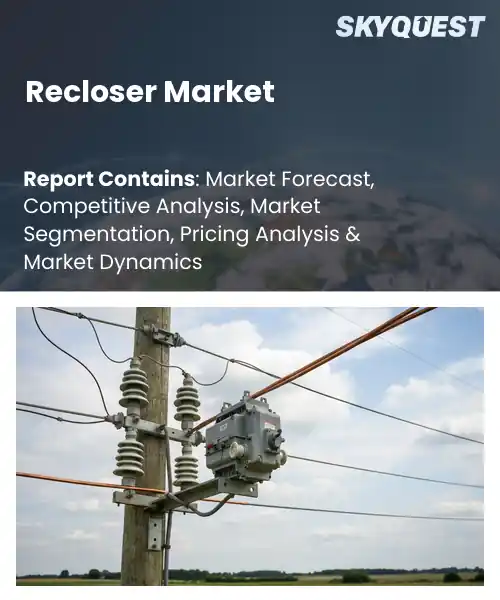
Recloser Market
Report ID: SQMIG55A2061
Report ID: SQMIG55A2061
[email protected]
USA +1 351-333-4748
Report ID:
SQMIG55A2061 |
Region:
Global |
Published Date: February, 2026
Pages:
184
|Tables:
90
|Figures:
71


Global Recloser Market size was valued at USD 1.5 Billion in 2024 and is poised to grow from USD 1.58 Billion in 2025 to USD 2.37 Billion by 2033, growing at a CAGR of 5.2% during the forecast period (2026-2033).
Rapid modernization of older electricity distribution infrastructure combined with increased network reliability has led to a pronounced increase in demand for reclosers globally. Many existing electric power grid systems were constructed decades ago using designs/technologies that simply cannot adequately support today’s increased demand for electricity from many sources (such as electric cars). When faced with today’s energy loading, adverse weather, etc., many systems will experience many more occurrences of faults, temporary outages and extended outages than they have in the past. Many electric utilities have recognized this fact and are under increasing pressure to implement automated protection devices.
A major factor accelerating recloser adoption is the rapid expansion of smart grid architectures and distributed energy resources such as rooftop solar, wind farms, battery storage, and microgrids. Energy generation sources that produce both reverse flow and fluctuating generation patterns add new challenges for traditional protection devices to effectively accommodate these business types. The result, as described, is that utilities have to rely on improved technology such as reclosers equipped with automatic controls and real-time communications/monitoring capabilities, and use of such technologies will help utilities maintain appropriate load-balance between generation and demand, as well as provide additional safety while connecting renewables to utility grids.
How do AI Algorithms Optimize Recloser Settings?
AI is increasingly transforming the global recloser market by enabling predictive maintenance and adaptive fault management (cause → effect). Traditional reclosers operate fixed thresholds, but AI-enhanced systems analyze real-time sensor data and historical trends to predict equipment degradation and fault likelihood. By reducing failures that are difficult to predict, and extending the lifespan of the asset, the implementation of intelligent reclosers became an opportunity for many utilities. Reclosers are controlled by AI algorithms and enable dynamic optimization of recloser settings to match changing load patterns, and as a result improve reliability, and decrease outages during the normal operating cycle. In conjunction with this trend, machine learning systems continue to be integrated with utility SCADA systems for automated decision making and quicker fault isolation, thus providing opportunities for utilities to improve their operational efficiency and to meet increasing market demand.
In March 2024, With the introduction of the next-generation XVL recloser, Eaton Corporation is providing utility companies in the U.S. Smart Grid Projects the ability to predict failures into the future and improve service reliability through predictive maintenance using machine learning-based analytics. This innovative product demonstrates how the integration of artificial intelligence (AI) is helping utilities to detect faults more quickly and experience fewer unplanned outages related to their distribution networks.
Market snapshot - 2026-2033
Global Market Size
USD 1.84 Billion
Largest Segment
Pole-Mounted
Fastest Growth
Underground
Growth Rate
4.5% CAGR
To get more insights on this market click here to Request a Free Sample Report
Global Recloser Market is segmented by Recloser Type, End User, Application, Installation Type, Control Mechanism and region. Based on Recloser Type, the market is segmented into Hydraulic Reclosers, Electric Reclosers and Smart Reclosers. Based on End User, the market is segmented into Utility Companies, Industrial Users and Commercial Enterprises. Based on Application, the market is segmented into Power Distribution and Renewable Energy. Based on Installation Type, the market is segmented into Overhead Installation and Underground Installation. Based on Control Mechanism, the market is segmented into Automatic Control and Manual Control. Based on region, the market is segmented into North America, Europe, Asia Pacific, Latin America and Middle East & Africa.
Pole-mounted reclosers are advancing through integration of digital relays, edge sensors, and remote connectivity, enabling automated fault isolation and condition monitoring across overhead feeders. The installations are favoured by utility companies because they don't need a lot of civil construction, can be deployed quickly, and require minimal effort to retrofit onto existing poles, reducing the capital and operational expenses associated with both. Additionally, the design allows crews to gain fast access to the installation site and the ability to quickly scale up the smart grid in the future, which helps to improve reliable service for both rural and urban areas worldwide today.
Underground installation is expected to be the fastest-growing segment in the global recloser market due to increasing urbanization and the shift toward resilient, weather-proof distribution networks. Storm hazards, enhanced public protection and aesthetic standards are prompting many cities to switch from overhead to underground wiring, thus making it necessary for utilities to invest in the development of special underground compatible reclosers capable of providing fast, reliable fault isolation and, consequently, increasing the likelihood of using them.
Hydraulic recloser technology remains widely used because its proven mechanical reliability and cost-effectiveness suit varied distribution environments. Innovations now integrate digital sensors and remote communication with traditional hydraulic mechanisms, enhancing fault detection and automated sectionalizing without sacrificing rugged performance. Because many utilities prioritize low lifecycle cost and dependable operation under load variability, hydraulic reclosers continue dominating, especially in regions where robustness and simple maintenance outweigh purely solid-state alternatives.
Electronic recloser technology is set to grow fastest because its advanced digital protection, real-time communication, and analytics meet smart grid demands. These reclosers optimize fault management, support remote control, and integrate with renewable-rich networks. Electronic systems provide increased flexibility and better performance of utility upgrades through automation and predictive insight. They will be widely adopted by the utility industry as such a system proves successful.
To get detailed segments analysis, Request a Free Sample Report
North America represents a mature yet high-growth region for the global recloser market as utilities prioritize grid hardening, wildfire prevention, and distribution automation programs. The widespread replacement of outdated feeders increased renewable interconnection, and the tendency to provide federal grant money for resilient infrastructures is causing rapid growth in the deployment of Intelligent Reclosers. The significant market presence of major manufacturers, and early adoption of Self-Healing Grid Technologies, only enhances regional interest.
The United States is the largest contributor to North America’s recloser market due to extensive grid modernization and resilience programs. Utilities are upgrading aging distribution equipment to mitigate wildfire hazard, storm outage and service interruption risks; therefore, there is a significant need for Federal Government Infrastructure Fund assistance and individual state utility reliability mandates to accelerate installation of automated/electronic Reclosers for both Rural Electric Cooperatives (REC) and Investor-Owned Utilities (IOU).
Canada supports the regional market through investments in resilient networks suited to harsh climate conditions and remote communities. Consequently, modern protective relaying and switchgear devices must be developed for the continued success of the integration of these resources onto the grid. Digital utility initiatives and Government-sponsored grid enhancement programs are also providing Canada with solid support for the increase in the use of reclosers.
Asia Pacific’s recloser market is expanding rapidly as utilities in China, India, Southeast Asia, and Australia invest in grid modernization and electrification. The increasing demand for dependable electricity, increasing use of renewable energy sources, and enhancements to rural networks supported by current implementations of advanced technology and automation have been primary motivators for the adoption of automated and remotely controlling reclosers throughout Asia Pacific. Additionally, the increase in overall investment by utilities and governments to develop more resilient distribution networks will only serve to enhance the growth of the automated and remotely controlled reclosers market in Asia Pacific, making it one of the fastest-growing regions globally.
Japan contributes strongly to the Asia Pacific recloser market through its focus on disaster-resilient and highly automated power networks. Utilities increasingly rely on dependable protective devices for rapid service restoration after a disturbance due to frequent typhoons or earthquakes. Domestic manufacturers and power quality standards have increased the requirement of electronic AREs in both urban and non-urban power distribution systems.
South Korea supports regional growth through rapid grid digitization and expansion of distributed energy projects. The electrically intensive nature of many industrial applications mandates the use of automated sectionalizing based upon outages/downtime, thereby minimizing such occurrences in these types of environments. With an abundance of local technology firms and the rapid development of SCADA-based automation solutions, the establishment of modern recloser technology is being accomplished quickly throughout the National Electric Distribution Infrastructure.
Europe’s recloser market is growing as utilities strengthen grid resilience and integrate high levels of renewables across national networks. There is great demand for advanced electronic and automated reclosers that meet rigorous reliability standards and are being installed because of Smart Grid initiatives across Europe. Western Europe has been the most advanced with the implantation of modernization projects; whereas Eastern Europe is focused on modernizing their outdated electrical systems. Additionally, the increased emphasis on decarbonization and digital protection has contributed to an increased need for technologies that provide real-time monitoring and adaptive fault management throughout Europe.
Germany plays a leading role in Europe’s recloser market through its aggressive energy transition and smart-grid agenda. Strong manufacturing capability and presence of major electrical Original Equipment Manufacturers (OEMs) in the region are enabling local innovation. To meet the increasing demands created by the digitization of electric utility grids and underground transmission lines, government funding is continuing to stimulate the development of advanced, data-enabled Recloser Solutions for use in advanced distribution grids.
France contributes significantly through nationwide grid reinforcement led by its centralized utility structure. To provide secure protection for long feeders as countries expand renewable energy generation capacity and improve rural electrification infrastructure, there has been a significant increase in the use of automated reclosers within the power industry. The emphasis of obtaining better power quality and reducing outage minutes will likely result in more legacy equipment being replaced by digital products and devices.
The UK market is shaped by strong regulatory pressure to enhance reliability and support net-zero targets. Due to the increasing number of photovoltaic systems, electric vehicle charging stations, and coastal wind turbine interconnections, distribution network operators are installing reclosers. The need for quick self-healing capabilities is primarily driven by the high risk of storms in the geographic areas served by these companies and their aging overhead infrastructure.
To know more about the market opportunities by region and country, click here to
Buy The Complete Report
Rising Need for Grid Reliability
Expansion of Renewable and Distributed Generation
Limited Awareness in Emerging Markets
Supply Chain and Component Constraints
Request Free Customization of this report to help us to meet your business objectives.
The global recloser market is moderately consolidated, led by international players such as ABB, Siemens, Schneider Electric, Eaton, S&C Electric, NOJA Power, Hubbell, and G&W Electric, competing on reliability, automation, and utility relationships. Innovation is centered on electronic controls, remote monitoring, and grid-edge analytics. Strategically, S&C focuses on resilience deployments with utility frameworks, Eaton expands intelligent control features, and NOJA Power scales production and automation offerings to serve renewable-heavy distribution networks.
The startup ecosystem in the global recloser market is expanding as utilities seek affordable automation for renewable-heavy and fault-prone feeders. Growing outage penalties and workforce shortages push smaller innovators to design digital, retrofit-ready reclosers with cloud connectivity and edge intelligence. Because these solutions reduce truck rolls and speed restoration, utilities increasingly test startup products alongside established brands, which stimulates competition, lowers costs, and accelerates modernization of distribution networks.
SkyQuest’s ABIRAW (Advanced Business Intelligence, Research & Analysis Wing) is our Business Information Services team that Collects, Collates, Correlates, and Analyses the Data collected by means of Primary Exploratory Research backed by robust Secondary Desk research.
As per SkyQuest analysis, the global recloser market is entering a decisive growth phase as utilities worldwide prioritize reliability, resilience, and digital transformation of distribution networks. Modernization of aging infrastructure, rising renewable penetration, and AI-enabled automation are reshaping protection strategies from reactive switching to predictive, self-healing operations. Regional investments across North America, Europe, and Asia Pacific demonstrate a shared focus on smart grids, undergrounding, and climate-resilient systems, while technology is shifting from hydraulic mechanisms toward electronic, communication-ready platforms.
Competitive activity from established OEMs and agile startups is accelerating innovation in cybersecurity, edge intelligence, and SF₆-free designs. Collectively, these forces are expanding adoption of advanced reclosers, positioning them as critical enablers of stable, sustainable, and future-ready electricity networks globally.
| Report Metric | Details |
|---|---|
| Market size value in 2024 | USD 1.5 Billion |
| Market size value in 2033 | USD 2.37 Billion |
| Growth Rate | 5.2% |
| Base year | 2024 |
| Forecast period | 2026-2033 |
| Forecast Unit (Value) | USD Billion |
| Segments covered |
|
| Regions covered | North America (US, Canada), Europe (Germany, France, United Kingdom, Italy, Spain, Rest of Europe), Asia Pacific (China, India, Japan, Rest of Asia-Pacific), Latin America (Brazil, Rest of Latin America), Middle East & Africa (South Africa, GCC Countries, Rest of MEA) |
| Companies covered |
|
| Customization scope | Free report customization with purchase. Customization includes:-
|
To get a free trial access to our platform which is a one stop solution for all your data requirements for quicker decision making. This platform allows you to compare markets, competitors who are prominent in the market, and mega trends that are influencing the dynamics in the market. Also, get access to detailed SkyQuest exclusive matrix.
Table Of Content
Executive Summary
Market overview
Parent Market Analysis
Market overview
Market size
KEY MARKET INSIGHTS
COVID IMPACT
MARKET DYNAMICS & OUTLOOK
Market Size by Region
KEY COMPANY PROFILES
Methodology
For the Recloser Market, our research methodology involved a mixture of primary and secondary data sources. Key steps involved in the research process are listed below:
1. Information Procurement: This stage involved the procurement of Market data or related information via primary and secondary sources. The various secondary sources used included various company websites, annual reports, trade databases, and paid databases such as Hoover's, Bloomberg Business, Factiva, and Avention. Our team did 45 primary interactions Globally which included several stakeholders such as manufacturers, customers, key opinion leaders, etc. Overall, information procurement was one of the most extensive stages in our research process.
2. Information Analysis: This step involved triangulation of data through bottom-up and top-down approaches to estimate and validate the total size and future estimate of the Recloser Market.
3. Report Formulation: The final step entailed the placement of data points in appropriate Market spaces in an attempt to deduce viable conclusions.
4. Validation & Publishing: Validation is the most important step in the process. Validation & re-validation via an intricately designed process helped us finalize data points to be used for final calculations. The final Market estimates and forecasts were then aligned and sent to our panel of industry experts for validation of data. Once the validation was done the report was sent to our Quality Assurance team to ensure adherence to style guides, consistency & design.
Analyst Support
Customization Options
With the given market data, our dedicated team of analysts can offer you the following customization options are available for the Recloser Market:
Product Analysis: Product matrix, which offers a detailed comparison of the product portfolio of companies.
Regional Analysis: Further analysis of the Recloser Market for additional countries.
Competitive Analysis: Detailed analysis and profiling of additional Market players & comparative analysis of competitive products.
Go to Market Strategy: Find the high-growth channels to invest your marketing efforts and increase your customer base.
Innovation Mapping: Identify racial solutions and innovation, connected to deep ecosystems of innovators, start-ups, academics, and strategic partners.
Category Intelligence: Customized intelligence that is relevant to their supply Markets will enable them to make smarter sourcing decisions and improve their category management.
Public Company Transcript Analysis: To improve the investment performance by generating new alpha and making better-informed decisions.
Social Media Listening: To analyze the conversations and trends happening not just around your brand, but around your industry as a whole, and use those insights to make better Marketing decisions.
REQUEST FOR SAMPLE
 REQUEST FREE CUSTOMIZATION
Global Recloser Market size was valued at USD 1.84 Billion in 2025 and is expected to grow from USD 1.92 Billion in 2026 to USD 2.53 Billion by 2033, growing at a CAGR of 4.5% in the forecast period (2026-2033).
The global recloser market is moderately consolidated, led by international players such as ABB, Siemens, Schneider Electric, Eaton, S&C Electric, NOJA Power, Hubbell, and G&W Electric, competing on reliability, automation, and utility relationships. Innovation is centered on electronic controls, remote monitoring, and grid-edge analytics. Strategically, S&C focuses on resilience deployments with utility frameworks, Eaton expands intelligent control features, and NOJA Power scales production and automation offerings to serve renewable-heavy distribution networks. 'ABB Ltd. (Switzerland)', 'Eaton Corporation (Ireland / USA)', 'Schneider Electric (France)', 'Siemens AG (Germany)', 'NOJA Power Switchgear Pty Ltd (Australia)', 'G&W Electric Company (USA)', 'S&C Electric Company (USA)', 'Hubbell Power Systems (USA)', 'GE (General Electric Company) (USA)', 'Tavrida Electric (Estonia)', 'Arteche Group (Spain)', 'ENTEC Electric & Electronic Co., Ltd. (South Korea)', 'BRUSH Group (United Kingdom)', 'Hughes Power System (Sweden)', 'Iljin Electric (South Korea)'
Growing dependence on uninterrupted electricity for digital economies is forcing utilities to reduce outage frequency and duration. This creates strong demand for automated reclosers that can instantly detect faults, isolate damaged sections, and restore supply without manual intervention. The result is improved service continuity, lower operational costs, and higher investment in modern protection equipment.
Cybersecurity and Data Privacy Concerns: As reclosers become connected to SCADA and cloud platforms, they expose utilities to cyber intrusion risks. Many operators hesitate to deploy fully digital devices without proven security frameworks and regulatory compliance. This concern increases testing time and approval cycles, which slows procurement of intelligent reclosers despite their operational advantages.
How do Self-Healing Grids Boost Recloser Use in North America?


Want to customize this report? This report can be personalized according to your needs. Our analysts and industry experts will work directly with you to understand your requirements and provide you with customized data in a short amount of time. We offer $1000 worth of FREE customization at the time of purchase.
Feedback From Our Clients


 USA (+1) 351-333-4748

