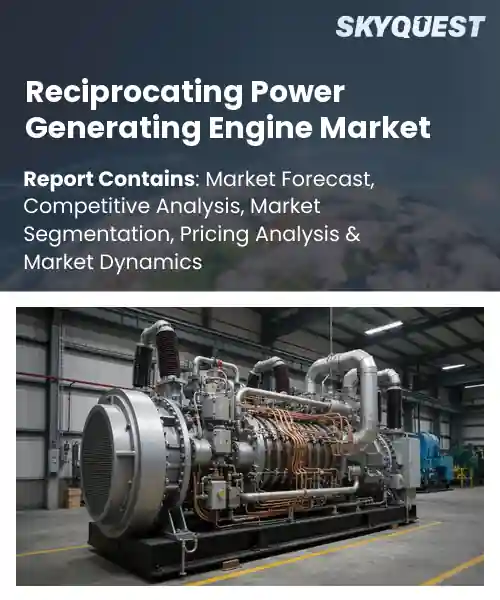
Reciprocating Power Generating Engine Market
Report ID: SQMIG20I3260
Report ID: SQMIG20I3260
[email protected]
USA +1 351-333-4748
Report ID:
SQMIG20I3260 |
Region:
Global |
Published Date: July, 2026
Pages:
157
|Tables:
133
|Figures:
77


Global Reciprocating Power Generating Engine Market size was valued at USD 45.0 Billion in 2024 and is poised to grow from USD 47.02 Billion in 2025 to USD 66.87 Billion by 2033, growing at a CAGR of 4.5% during the forecast period (2026-2033).
The reciprocating power‑generating engine market comprises internal combustion units that convert linear piston motion into electricity for industrial, commercial, and remote applications. Its significance stems from the ability of these engines to deliver power where grid access is limited or intermittent renewable sources cannot meet demand. Historically, the market expanded alongside industrialization, when diesel‑fueled reciprocating sets powered factories and marine vessels. In the 1990s, stricter emissions standards prompted manufacturers to adopt low‑sulfur fuels and turbocharging, while the 2010s saw a resurgence as data‑center backup systems required generators. This evolution illustrates how regulatory pressure and needs have consistently reshaped the sector.The dominant growth catalyst for the reciprocating power‑generating engine market is the rising need for resilient off‑grid energy in emerging economies and critical infrastructure. Urbanization stretches grid capacity, prompting operators to adopt modular engines that install quickly, run on multiple fuels, and lower downtime risk. Mining projects in Sub‑Saharan Africa now pair diesel‑rated units with bio‑fuel blends to meet cost and sustainability goals, while hospitals in hurricane‑prone regions depend on these engines for uninterrupted power during outages. This demand pushes manufacturers to refine emissions‑control systems and widen service networks, because guaranteed continuous operation significantly directly shapes capital‑allocation decisions of end‑users.
How is AI-driven predictive maintenance reshaping the reciprocating power generating engine market?
AI-driven predictive maintenance is transforming the reciprocating power‑generating engine market by turning reactive repairs into proactive strategies. Sensors embedded in engines continuously capture vibration, temperature and pressure data, which AI algorithms analyze to detect early signs of wear, mis‑alignment or fuel‑system issues. This real‑time insight enables operators to schedule interventions before failures occur, reducing unplanned downtime and extending component life. The technology also supports condition‑based monitoring across distributed sites, allowing centralized teams to prioritize resources efficiently. As utilities and industrial users seek higher reliability and lower operating costs, AI‑enabled maintenance is becoming a core differentiator for engine manufacturers and service providers, fostering tighter integration between hardware and digital services.In July 2023, Cummins announced the rollout of its AI‑powered predictive maintenance platform for its reciprocating engines, demonstrating how advanced analytics can boost uptime and operational efficiency.
Market snapshot - (2026-2033)
Global Market Size
USD 45.0 Billion
Largest Segment
Gas-fired
Fastest Growth
Renewable Fuels
Growth Rate
4.5% CAGR
To get more insights on this market click here to Request a Free Sample Report
Global reciprocating power generating engine market is segmented by fuel type, rated power, application, end user and region. Based on fuel type, the market is segmented into Gas-fired, Diesel-fired, Dual Fuel, Heavy Fuel Oil (HFO), Renewable Fuels and Others. Based on rated power, the market is segmented into Below 1 MW, 1 MW – 2 MW, Above 2 MW – 5 MW, Above 5 MW – 7.5 MW and Above 7.5 MW. Based on application, the market is segmented into Prime Power, Backup Power, Combined Heat & Power (CHP), Peak Shaving, Distributed Generation, Cogeneration and Base Load Power. Based on end user, the market is segmented into Utilities & Independent Power Producers, Industrial Manufacturing, Commercial Facilities, Oil & Gas, Mining, Marine & Shipping, Data Centers, Wastewater & Biogas Plants, Government & Defense and Others. Based on region, the market is segmented into North America, Europe, Asia Pacific, Latin America and Middle East & Africa.
Diesel‑fired segment dominates because its proven reliability, high energy density and performance under variable load conditions make it the preferred choice for power installations. Operators value its ability to start quickly and maintain stable output, especially in remote or harsh environments where fuel logistics are constrained. This confidence drives investment, reinforces supply chain stability, and encourages manufacturers to prioritize diesel engine innovations, reinforcing its leadership in the reciprocating power generating engine market.
However, renewable fuels segment is witnessing the strongest growth momentum because environmental regulations and corporate sustainability commitments are accelerating demand for low emission power solutions. Emerging bio based and hydrogen compatible engines enable cleaner operation while leveraging existing infrastructure, spurring OEM investment and creating new market opportunities that expand the overall addressable base for reciprocating engines.
Combined heat & power segment stands out because it delivers simultaneous electricity and usable thermal energy, markedly improving overall plant efficiency and reducing fuel consumption. This dual output aligns with industrial and commercial operators seeking cost savings and lower carbon footprints, making the technology attractive for facilities with continuous heat demand. Consequently, system integrators prioritize CHP solutions, driving product development and reinforcing its prominence within the reciprocating power generating engine market.
Meanwhile, peak shaving application is emerging as the key high growth area because utilities and large consumers are increasingly seeking flexible, on demand capacity to manage load spikes without expanding base generation. Advances in control systems and modular engine designs enable rapid deployment, enticing investors and accelerating market expansion as grid reliability concerns intensify.
To get detailed segments analysis, Request a Free Sample Report
North America maintains its lead through a combination of mature industrial ecosystems, deep engineering expertise and a supply chain that spans raw material sourcing to final assembly. The region hosts a concentration of original equipment manufacturers that continuously innovate to meet tightening emissions standards while delivering high reliability. Strong financial markets enable rapid investment in new facilities and advanced testing capabilities. A regulatory environment that balances safety with flexibility encourages adoption across power generation, oil and gas, and emerging renewable‑integrated applications. Extensive service networks and a skilled workforce further reinforce customer confidence, ensuring that operators prioritize North American solutions for critical infrastructure projects. Additionally, close collaboration between research institutions and industry accelerates the deployment of next‑generation engine designs that address both efficiency and environmental performance.
Reciprocating Power Generating Engine Market in United States benefits from a dense network of manufacturers and a tradition of high‑performance engineering. Demand is reinforced by widespread use in distributed generation, oil field operations and emerging hybrid power solutions. Investment in low‑emission technologies drives product refinement, while a robust aftermarket infrastructure ensures long‑term reliability for end‑users. Collaboration between academia and industry nurtures continuous improvement and rapid adoption of advanced control systems.
Reciprocating Power Generating Engine Market Canada leverages a strong emphasis on clean energy transition and a reputation for precision manufacturing. The sector supports remote mining operations, industrial processing and growing micro‑grid installations across vast territories. Focus on hybrid and low‑carbon engine configurations aligns with national climate objectives, while extensive service expertise sustains operational uptime in challenging environments. Partnerships with research centers foster innovation in fuel flexibility and emissions reduction strategies.
Europe’s rapid expansion stems from a convergence of stringent environmental mandates, strong engineering heritage and a market eager for resilient, low‑carbon power solutions. Policymakers incentivize adoption of efficient reciprocating engines to complement renewable generation and to ensure grid stability. The presence of world‑class OEMs combined with collaborative research ecosystems accelerates development of advanced combustion technologies and digital monitoring platforms. Industry clusters in key economies foster deep supplier networks, enabling swift customization for diverse applications ranging from industrial processes to remote power sites. This blend of regulatory support, technological excellence and agile supply chains positions Europe as a leader in the transition toward sustainable distributed generation. Continual investment in workforce development and cross‑border standardization further reinforces market confidence, encouraging both domestic adoption and export opportunities for European engine solutions.
Reciprocating Power Generating Engine Market Germany is anchored by a legacy of precision engineering and a dense network of component suppliers. The market serves extensive industrial zones, renewable integration sites and locomotive power needs. Emphasis on high efficiency and low emissions aligns with national climate targets, while strong collaboration between manufacturers and technical institutes drives continuous innovation. Robust after‑sales services ensure long‑term reliability across diverse operational environments through proactive maintenance.
Reciprocating Power Generating Engine Market United Kingdom experiences accelerated growth driven by demand for flexible backup power and offshore wind support. The sector benefits from a manufacturing base and emphasis on digital twin and predictive maintenance technologies. Alignment with decarbonisation pathways pushes manufacturers toward hybrid and low‑carbon engine designs. Close ties between academia, venture capital and OEMs foster prototyping, while a service infrastructure underpins confidence among utilities and industrial users.
Reciprocating Power Generating Engine Market France is emerging as a hub for low‑emission solutions driven by ambitious climate objectives. The market supports a mix of industrial facilities, agricultural processing and isolated community power projects. Collaboration between governmental research labs and manufacturers accelerates the development of engine platforms that integrate seamlessly with renewable sources. Expertise in after‑sales service and parts logistics enhances reliability, encouraging wider adoption across the national energy landscape.
Asia Pacific is strengthening its position through a blend of cost‑effective manufacturing, expanding demand for resilient power and strategic government support. Nations such as Japan and South Korea leverage highly automated production facilities to deliver competitive reciprocating engines that meet strict efficiency and emissions criteria. The region’s dense industrial clusters and growing renewable capacity create a need for reliable backup and hybrid solutions, prompting OEMs to integrate advanced digital controls. Collaborative R&D programs and export‑oriented strategies broaden market reach, while local incentives encourage adoption in remote islands, data centers and transportation sectors. This combination of manufacturing excellence, technological advancement and policy backing is elevating Asia Pacific as a pivotal supplier in the global landscape. Continued focus on workforce upskilling and green hydrogen integration further reinforces the region’s competitive edge.
Reciprocating Power Generating Engine Market Japan capitalizes on a tradition of precision engineering and a strong emphasis on reliability for disaster‑prone environments. Domestic OEMs supply engines for industrial complexes, maritime applications and island micro‑grids, integrating sophisticated monitoring systems. Government programmes promote low‑emission technologies and encourage retrofitting of existing fleets. Close collaboration with research institutes drives continuous enhancements in fuel flexibility, positioning Japan as a benchmark for high‑performance, resilient power solutions.
Reciprocating Power Generating Engine Market South Korea benefits from an automated supply chain and industrial policy that favors energy equipment. The market supplies engines for petrochemical complexes, smart factories and offshore platforms, emphasizing compact design and diagnostics. National initiatives encourage low‑carbon and hybrid engine architectures, while partnerships with universities accelerate adoption of intelligence for predictive maintenance. This approach strengthens South Korea’s role as an innovative supplier in the regional ecosystem.
To know more about the market opportunities by region and country, click here to
Buy The Complete Report
Increasing Renewable Integration
Integrating reciprocating power engines with renewable sources enables continuous energy supply when solar or wind outputs fluctuate, and this flexibility is valued by grid operators seeking reliability without extensive storage. The ability to operate on multiple fuels supports transition strategies, allowing utilities to balance intermittent generation while maintaining existing infrastructure. Stakeholders view this hybrid capability as a practical bridge toward decarbonization, thereby encouraging adoption of reciprocating engines in new projects and retrofits, which fuels market expansion through broader application contexts.
Advancements In Engine Efficiency
Recent engineering improvements have reduced internal friction, optimized combustion sequencing, and introduced advanced control algorithms, resulting in markedly higher thermal efficiency for reciprocating generators. These efficiency gains lower fuel consumption for equivalent power output, directly translating into reduced operating costs and extended maintenance intervals. Customers prioritize equipment that delivers more output per unit of fuel while minimizing downtime, and the perceived operational savings stimulate procurement decisions. Consequently, manufacturers experience heightened demand as efficiency becomes a primary selection criterion across industrial and utility sectors.
Stringent Emission Regulations
Regulatory bodies worldwide are tightening limits on nitrogen oxides, carbon monoxide, and particulate emissions from combustion engines, imposing more rigorous certification processes and compliance testing. Meeting these standards often requires additional after‑treatment systems or redesigns that increase complexity and cost, discouraging some developers from selecting reciprocating generators for new installations. The heightened compliance burden can delay project timelines and elevate capital requirements, leading certain investors to favor alternative technologies perceived as inherently cleaner, thereby restraining market growth.
High Capital Expenditure
The upfront investment needed for reciprocating power plants, including robust housing, auxiliary systems, and specialized control hardware, remains substantial compared to some competing power solutions. This high initial outlay can challenge budget-constrained projects, especially in emerging economies where financing options are limited. Decision‑makers may postpone or scale back deployments until sufficient capital is secured, and the perceived financial risk associated with large‑scale engine installations can shift preference toward lower‑cost, modular alternatives, thereby slowing market momentum.
Request Free Customization of this report to help us to meet your business objectives.
The competitive landscape of the global reciprocating power generating engine market is shaped by intense rivalry among established manufacturers and emerging players, driving strategic M&A activity, joint ventures, and accelerated technology innovation. Recent examples include major OEMs acquiring specialized component firms to broaden product portfolios and forming partnerships with digital solution providers to integrate advanced monitoring and predictive maintenance capabilities, thereby enhancing operational efficiency and market reach.
Top Player’s Company Profile
Recent Developments
SkyQuest’s ABIRAW (Advanced Business Intelligence, Research & Analysis Wing) is our Business Information Services team that Collects, Collates, Correlates, and Analyses the Data collected by means of Primary Exploratory Research backed by robust Secondary Desk research. As per SkyQuest analysis, the global reciprocating power generating engine market is propelled primarily by the rising need for resilient off‑grid energy in emerging economies, while advancements in engine efficiency serve as a second strong catalyst by lowering fuel consumption and operating costs. The diesel‑fired segment remains the dominant technology due to its proven reliability and quick start capability. North America continues to lead the market, supported by a mature supply chain and strong OEM presence. However, tightening emission regulations pose a significant restraint, increasing compliance costs and prompting some investors to consider alternative solutions. Overall, these dynamics shape a market expected to grow to $66.9 billion by 2033.
| Report Metric | Details |
|---|---|
| Market size value in 2024 | USD 45.0 Billion |
| Market size value in 2033 | USD 66.87 Billion |
| Growth Rate | 4.5% |
| Base year | 2024 |
| Forecast period | (2026-2033) |
| Forecast Unit (Value) | USD Billion |
| Segments covered |
|
| Regions covered | North America (US, Canada), Europe (Germany, France, United Kingdom, Italy, Spain, Rest of Europe), Asia Pacific (China, India, Japan, Rest of Asia-Pacific), Latin America (Brazil, Rest of Latin America), Middle East & Africa (South Africa, GCC Countries, Rest of MEA) |
| Companies covered |
|
| Customization scope | Free report customization with purchase. Customization includes:-
|
To get a free trial access to our platform which is a one stop solution for all your data requirements for quicker decision making. This platform allows you to compare markets, competitors who are prominent in the market, and mega trends that are influencing the dynamics in the market. Also, get access to detailed SkyQuest exclusive matrix.
Table Of Content
Executive Summary
Market overview
Parent Market Analysis
Market overview
Market size
KEY MARKET INSIGHTS
COVID IMPACT
MARKET DYNAMICS & OUTLOOK
Market Size by Region
KEY COMPANY PROFILES
Methodology
For the Reciprocating Power Generating Engine Market, our research methodology involved a mixture of primary and secondary data sources. Key steps involved in the research process are listed below:
1. Information Procurement: This stage involved the procurement of Market data or related information via primary and secondary sources. The various secondary sources used included various company websites, annual reports, trade databases, and paid databases such as Hoover's, Bloomberg Business, Factiva, and Avention. Our team did 45 primary interactions Globally which included several stakeholders such as manufacturers, customers, key opinion leaders, etc. Overall, information procurement was one of the most extensive stages in our research process.
2. Information Analysis: This step involved triangulation of data through bottom-up and top-down approaches to estimate and validate the total size and future estimate of the Reciprocating Power Generating Engine Market.
3. Report Formulation: The final step entailed the placement of data points in appropriate Market spaces in an attempt to deduce viable conclusions.
4. Validation & Publishing: Validation is the most important step in the process. Validation & re-validation via an intricately designed process helped us finalize data points to be used for final calculations. The final Market estimates and forecasts were then aligned and sent to our panel of industry experts for validation of data. Once the validation was done the report was sent to our Quality Assurance team to ensure adherence to style guides, consistency & design.
Analyst Support
Customization Options
With the given market data, our dedicated team of analysts can offer you the following customization options are available for the Reciprocating Power Generating Engine Market:
Product Analysis: Product matrix, which offers a detailed comparison of the product portfolio of companies.
Regional Analysis: Further analysis of the Reciprocating Power Generating Engine Market for additional countries.
Competitive Analysis: Detailed analysis and profiling of additional Market players & comparative analysis of competitive products.
Go to Market Strategy: Find the high-growth channels to invest your marketing efforts and increase your customer base.
Innovation Mapping: Identify racial solutions and innovation, connected to deep ecosystems of innovators, start-ups, academics, and strategic partners.
Category Intelligence: Customized intelligence that is relevant to their supply Markets will enable them to make smarter sourcing decisions and improve their category management.
Public Company Transcript Analysis: To improve the investment performance by generating new alpha and making better-informed decisions.
Social Media Listening: To analyze the conversations and trends happening not just around your brand, but around your industry as a whole, and use those insights to make better Marketing decisions.
REQUEST FOR SAMPLE
 REQUEST FREE CUSTOMIZATION


Want to customize this report? This report can be personalized according to your needs. Our analysts and industry experts will work directly with you to understand your requirements and provide you with customized data in a short amount of time. We offer $1000 worth of FREE customization at the time of purchase.
Feedback From Our Clients


 USA (+1) 351-333-4748

