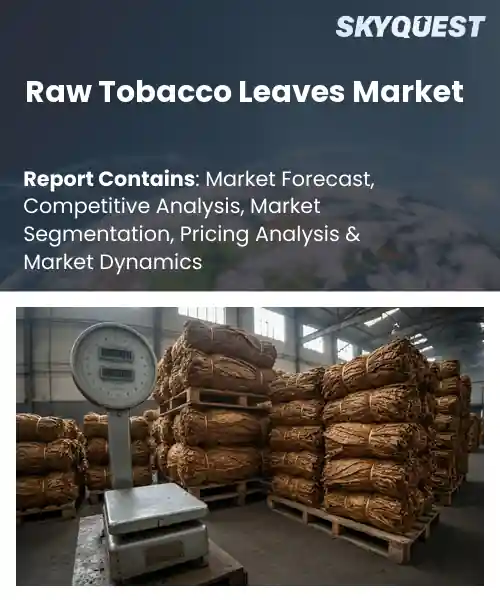
Raw Tobacco Leaves Market
Report ID: SQMIG30J2036
Report ID: SQMIG30J2036
[email protected]
USA +1 351-333-4748
Report ID:
SQMIG30J2036 |
Region:
Global |
Published Date: February, 2026
Pages:
157
|Tables:
147
|Figures:
78


Global Raw Tobacco Leaves Market size was valued at USD 20.30 Billion in 2024 and is poised to grow from USD 20.99 Billion in 2025 to USD 27.43 Billion by 2033, growing at a CAGR of 3.4% during the forecast period (2026-2033).
This market encompasses the production, trade and processing of unmanufactured leaf tobacco being used by manufacturers of cigarettes, cigars and smokeless forms of tobacco. The raw tobacco leaves market affects, ultimately, all global supply chains dependent on nicotine, as well as rural economies. Historically, the demand for raw tobacco leaves follows the consumption trend for cigarettes in developed markets, while supply has migrated to lower-cost producing areas, such as Brazil, Malawi, and Zimbabwe. In response to these dynamics, the raw tobacco export industry has experienced consolidation among many of the exporting countries, as well as significant investment in curing facilities in these regions.
While consumer consumption of tobacco and government regulation continue to be the driving forces behind this market, technological and agronomic advancement is also playing an increasingly important role. For example, cultivars and improved curing methods that reduce variations in nicotine levels and contaminants will enable tobacco processors to meet increasingly stringent regulatory and consumer requirements.
How can AI Optimize Quality Grading in the Raw Tobacco Leaves Market?
The combination of high-resolution imaging and spectral sensing with machine-learning tools is another way AI can improve the quality grading of raw tobacco leaves by generating reliable, consistent, and objective grade scores for raw tobacco leaves. Some of the other characteristics of such a system could include; automated defect identification and classification, maturity assessment (determining what foliage is ready for harvest), and traceable electronic records that can help alleviate the need for subjective human judgment when grading. Thousands of farms and warehouses still have experienced tobacco-grade employees who provide the grading service, which leads to variances and delays in the processing of that inventory.
For example, grading can now take place in real-time at the sorting line. This means that there is a data record of what occurred in the field and when the crop was harvested and dried, which contributes to the final quality of the leaf sold to buyers. Specific instances of this would be hyperspectral scanning to identify disease and/or moisture signals, and the use of convolutional neural networks to recognize fine-tuning differences in the curing process and coloration.
Market snapshot - 2026-2033
Global Market Size
USD 20.3 Billion
Largest Segment
Virginia (Flue-Cured) Tobacco
Fastest Growth
Other Specialty Types
Growth Rate
3.4% CAGR
To get more insights on this market click here to Request a Free Sample Report
The raw tobacco leaves market is segmented into leaf type, processing method, quality grade, distribution, end use and region. Based on leaf type, the market is segmented into Virginia (Flue-Cured) tobacco, burley tobacco, oriental (Turkish) tobacco, dark air-cured and other specialty types. Based on processing method, the market is segmented into natural and fermented. based on quality grade, the market is segmented into premium, standard and low grade.
Based on distribution, the market is segmented into direct and indirect. Based on end use, the market is segmented into cigarettes, cigars & cigarillos, chewing tobacco / smokeless tobacco, pipe tobacco, snuff & snus and others. Based on region, the market is segmented into North America, Europe, Asia Pacific, Latin America and Middle East & Africa.
As per raw tobacco leaves market outlook, virginia (flue-cured) tobacco segment dominates because its characteristic cured sugars and bright, mild aroma make it the foundational leaf for mainstream product formulations. Additionally, the continuation of supply chain commitments, and the ability of manufacturers to optimize cultivars for processing, have further cemented this market-leading role for virginia (flue-cured) tobacco as the principal source of raw materials used in the high-volume production of cigarettes with standardized flavour profiles.
As per raw tobacco leaves market forecast, burley tobacco has seen the greatest growth in recent years based on being a neutral base for formulation that has greater leaf strength and better processing characteristics. Thus, opening new avenues for innovating formulations of blends and for developing new product categories. Advances in breeding and processing techniques continue to improve the properties of Burley Tobacco regarding the ability to ferment or use it in smokeless products, which will open the door to new interest from manufacturers and create opportunities to diversification of product offerings and margin expansion.
As per raw tobacco leaves market analysis, the fermented segment of the industry has a strong presence because the controlled transformation of leaf chemistry through the fermentation process results in flavor characteristics that premium product manufacturers desire. The fermented process optimizes the chemistry of the leaf, removes the green harsh qualities from tobacco and creates a consistent sensory profile, which allows for the creation of higher value blended and artisanal products. The manufacturer’s desire for consistency in the aged character of a product and a long shelf life reinforces the dominance of fermented raw materials in the value-based product development strategies.
Natural is the fastest growing processing method due to the increasing demand for tobacco without any additives and the desire for a more streamlined supply chain that fits with the trend towards clean labels. The minimum processing used in natural processing preserves the integrity of the raw leaf in many product formats, thereby resulting in a cost-effective method. Manufacturers who want to develop an unaltered source of flavor, thus enabling manufacturers to adopt novel and traditional uses of natural processed raw materials rapidly.
To get detailed segments analysis, Request a Free Sample Report
As per raw tobacco leaves market regional forecast, Asia Pacific market is driven by a combination of favorable agricultural conditions, existing processing systems, and regional demand. The region has vertically integrated value chain that allows for greater consistency and reliability in both quality and supply. Proximity to large centers of consumption provides less complexity in managing logistics and allows for more effective distribution.
Japan Raw Tobacco Leaves Market
As per raw tobacco leaves market regional outlook, Japan market benefits from an existing infrastructure for processing, strong domestic demand from manufacturers, and a focus on premium grade and consistency. Quality control and traceability are key components of the agricultural process, and local companies are investing in the development of skilled long-term drying and blending professionals. Proximity to significant regional customers, combined with strong integration between growers and processors, results in an excellent infrastructure for reliable supply.
South Korea Raw Tobacco Leaves Market
The South Korean raw tobacco leaves market has developed sophisticated processing technologies, robust systems for ensuring quality, and concentrated demand from manufacturers. Controlled drying and blending technologies improve product uniformity, while strong relationships between growers and their commercial customers reduce the volatility of supply. The use of traceability and regulatory compliance is critical in supporting export procurement models. Domestic growers place a high priority on maintaining a resilient supply chain and developing to manage sourcing and consistency with long-term supplier relationships.
As per raw tobacco leaves industry analysis, technological developments, value-added processes, and strategic alignment between growers and processors are the key drivers for rapid growth in North America. As mechanization, digital traceability, and comprehensive quality assurance systems become more commonplace. There is a growing ability to provide products with the consistent quality and create new products by improving the way tobacco leaves are processed.
U.S. Raw Tobacco Leaves Market
The raw tobacco leaves market in the United States is comprised of several different growing areas and methods of mechanical processing, which are connected to the manufacturers by a strong system of contract farming and sourcing channels. Additionally, toll processing and blending provide added flexibility to how tobacco is sourced.
Canada Raw Tobacco Leaves Market
The raw tobacco leaves market in Canada consists of relatively small production areas, high levels of quality control, and significant collaboration between growers and processors. Cold chain and processing infrastructure allowed for the handling of delicate leaf types; the traceable systems allowed for regulatory oversight of the industry. Local suppliers communicate directly with manufacturers or toll processors through contracts to support their availability of a consistent grade of tobacco leaf.
The raw tobacco leaves market in Europe is growing as a result of strict regulations, allowing for product differentiation and cooperation on supply chain initiatives/exports. In addition to this, countries throughout Europe have also reinforced quality assurance and traceability frameworks that help to establish buyer confidence in terms of the origin of raw materials and the methods used to produce them, leading to more consistent purchasing practices. Investments made in processing technologies, analytical testing and sustainable farming have helped producers respond to the diehard demand for premium and specialty leaves.
Growers, cooperatives and processors throughout the region are using collaborative agreements for the purpose of sourcing contracted varieties of raw tobacco, thereby mitigating supply variability and enhancing the overall reliability of the product to meet customers’ needs. Regulatory policies governing the environmental implications of tobacco growing practices and use of responsible farming methods have helped strengthen Europe’s reputation as a supplier of premium, traceable raw tobacco for both domestic and international customers.
Germany Raw Tobacco Leaves Market
The raw tobacco leaves market in Germany is focused on developing a supply chain supported by strict regulations regarding quality, processing and traceability. This includes the use of blending and analytical testing to produce consistent leaf profiles for manufacturers who purchase them. Germany's regulatory policies as well as collaborative arrangements throughout the industry have helped create a solid foundation for contract farming and the development of new varieties of raw tobacco.
Furthermore, investment into drying and storage facilities has further contributed to the integrity of raw tobacco. Importantly, Germany’s emphasis on sustainability and regulatory compliance with environmental policies is also influencing the way that growers cultivate and procure crops, resulting in the establishment of Germany as a reliable supplier of premium raw tobacco for both domestic processing and export.
United Kingdom Raw Tobacco Leaves Market
The United Kingdom's raw tobacco leaves market prioritizes high-end quality, blending, and compliant products about laws. Processors and growers work cooperatively to create contracts for their varietals, choose the best possible leaves and cure them using precise curing methods. Brokers play an important role in cooperating with both parties to help fulfill their needs by sourcing and contracting and establishing a successful supply chain for varietals through broker-client cooperation. A commitment to sustainability-related procurement practices and supply chain transparency influences how manufacturers in the UK procure raw tobacco leaves from both domestic and international markets.
France Raw Tobacco Leaves Market
The French raw tobacco leaves market is the result of expertise in growing and processing raw tobacco in traditional and modern systems with a focus on the quality assurance of end products. Growers and processors work closely together to contractually source specific varieties of raw tobacco leaves for domestic use, while also producing premium varieties to export to other countries throughout the world. Regulatory compliance, sustainability, and traceability standards further enhance the overall quality profile and provide growers and processors with the tools needed to verify their buying decision about premium quality manufacturers in both the domestic market and the export market.
To know more about the market opportunities by region and country, click here to
Buy The Complete Report
Rising Demand from Manufacturers
Expansion of Processing Infrastructure
Stringent Health Regulations Worldwide
Supply Chain Disruptions and Risk
Request Free Customization of this report to help us to meet your business objectives.
The global raw tobacco leaves industry has become increasingly competitive as companies consolidate with each other; make strategic upstream investments and license new types of plants to ensure they can offer unique leaf varieties. Companies are using mergers and acquisitions (M&A), equity stakes in related agri-tech companies, direct supplier contracts and start-up and university licensed new crop technology to change how leaves are sourced.
Top Player’s Company Profile in the Raw Tobacco Leaves Market
Premiumization and Flavor Innovation
Sustainability Driven Agriculture
SkyQuest’s ABIRAW (Advanced Business Intelligence, Research & Analysis Wing) is our Business Information Services team that Collects, Collates, Correlates, and Analyses the Data collected by means of Primary Exploratory Research backed by robust Secondary Desk research.
As per SkyQuest analysis, the global raw tobacco leaves market is supported by a key driver of rising demand from manufacturers seeking consistent, high-quality leaf and a second driver of expanded processing and curing infrastructure that improves yields and traceability. A restraint is stringent health regulations and compliance burdens that suppress consumption and complicate sourcing. The dominating region is Asia Pacific, benefiting from favorable agronomy and integrated value chains, and the dominating segment is Virginia (flue-cured) tobacco given its blending consistency and mass market role. Market opportunities center on premiumization, sustainability programs and technology such as AI enabled grading to enhance quality and market access. The raw tobacco leaves market share is dominated by Virginia (flue-cured) tobacco by type, while cigarette manufacturing accounts for the largest application share.
| Report Metric | Details |
|---|---|
| Market size value in 2024 | USD 20.30 Billion |
| Market size value in 2033 | USD 27.43 Billion |
| Growth Rate | 3.4% |
| Base year | 2024 |
| Forecast period | 2026-2033 |
| Forecast Unit (Value) | USD Billion |
| Segments covered |
|
| Regions covered | North America (US, Canada), Europe (Germany, France, United Kingdom, Italy, Spain, Rest of Europe), Asia Pacific (China, India, Japan, Rest of Asia-Pacific), Latin America (Brazil, Rest of Latin America), Middle East & Africa (South Africa, GCC Countries, Rest of MEA) |
| Companies covered |
|
| Customization scope | Free report customization with purchase. Customization includes:-
|
To get a free trial access to our platform which is a one stop solution for all your data requirements for quicker decision making. This platform allows you to compare markets, competitors who are prominent in the market, and mega trends that are influencing the dynamics in the market. Also, get access to detailed SkyQuest exclusive matrix.
Table Of Content
Executive Summary
Market overview
Parent Market Analysis
Market overview
Market size
KEY MARKET INSIGHTS
COVID IMPACT
MARKET DYNAMICS & OUTLOOK
Market Size by Region
KEY COMPANY PROFILES
Methodology
For the Raw Tobacco Leaves Market, our research methodology involved a mixture of primary and secondary data sources. Key steps involved in the research process are listed below:
1. Information Procurement: This stage involved the procurement of Market data or related information via primary and secondary sources. The various secondary sources used included various company websites, annual reports, trade databases, and paid databases such as Hoover's, Bloomberg Business, Factiva, and Avention. Our team did 45 primary interactions Globally which included several stakeholders such as manufacturers, customers, key opinion leaders, etc. Overall, information procurement was one of the most extensive stages in our research process.
2. Information Analysis: This step involved triangulation of data through bottom-up and top-down approaches to estimate and validate the total size and future estimate of the Raw Tobacco Leaves Market.
3. Report Formulation: The final step entailed the placement of data points in appropriate Market spaces in an attempt to deduce viable conclusions.
4. Validation & Publishing: Validation is the most important step in the process. Validation & re-validation via an intricately designed process helped us finalize data points to be used for final calculations. The final Market estimates and forecasts were then aligned and sent to our panel of industry experts for validation of data. Once the validation was done the report was sent to our Quality Assurance team to ensure adherence to style guides, consistency & design.
Analyst Support
Customization Options
With the given market data, our dedicated team of analysts can offer you the following customization options are available for the Raw Tobacco Leaves Market:
Product Analysis: Product matrix, which offers a detailed comparison of the product portfolio of companies.
Regional Analysis: Further analysis of the Raw Tobacco Leaves Market for additional countries.
Competitive Analysis: Detailed analysis and profiling of additional Market players & comparative analysis of competitive products.
Go to Market Strategy: Find the high-growth channels to invest your marketing efforts and increase your customer base.
Innovation Mapping: Identify racial solutions and innovation, connected to deep ecosystems of innovators, start-ups, academics, and strategic partners.
Category Intelligence: Customized intelligence that is relevant to their supply Markets will enable them to make smarter sourcing decisions and improve their category management.
Public Company Transcript Analysis: To improve the investment performance by generating new alpha and making better-informed decisions.
Social Media Listening: To analyze the conversations and trends happening not just around your brand, but around your industry as a whole, and use those insights to make better Marketing decisions.
REQUEST FOR SAMPLE
 REQUEST FREE CUSTOMIZATION
Global Raw Tobacco Leaves Market size was valued at USD 20.3 Billion in 2024 and is poised to grow from USD 20.99 Billion in 2025 to USD 27.43 Billion by 2033, growing at a CAGR of 3.4% during the forecast period (2026-2033).
Alliance One International, Universal Corporation, Philip Morris International, Japan Tobacco Inc., ITC Limited, Orinoco Tobacco Company, A.U. Baksheesh Tobacco, Imperial Brands PLC, Scandinavian Tobacco Group, China National Tobacco Corporation, Altadis, Meridien Gifted Tobacco, Northern Lights Tobacco, NTC Holdings, Surya Agra, Givaudan Tobacco, Salim Group, Carreras Limited, Hanjin Tobacco, O. A. Mirza & Sons
The key driver of the Raw Tobacco Leaves Market is the consistent demand from the tobacco product manufacturing industry. Ongoing consumption of cigarettes and other tobacco products, particularly in emerging markets, continues to sustain demand for raw tobacco leaves.
A key market trend in the Raw Tobacco Leaves Market is the growing shift toward premium, organic, and sustainably sourced tobacco leaves. Manufacturers are increasingly focusing on high-quality leaf varieties, traceability, and advanced farming technologies such as precision agriculture to enhance yield, quality, and compliance with evolving regulations.
Asia-Pacific accounted for the largest share in the Raw Tobacco Leaves Market, driven by extensive tobacco cultivation, high consumption, and strong production bases in countries such as China and India.


Want to customize this report? This report can be personalized according to your needs. Our analysts and industry experts will work directly with you to understand your requirements and provide you with customized data in a short amount of time. We offer $1000 worth of FREE customization at the time of purchase.
Feedback From Our Clients


 USA (+1) 351-333-4748

