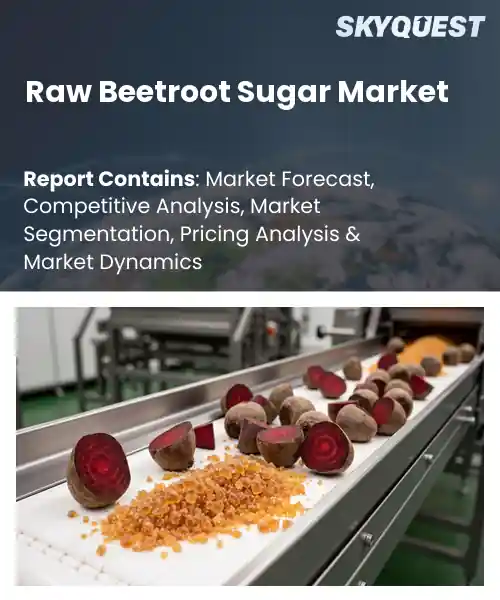
Raw Beetroot Sugar Market
Report ID: SQMIG30H2425
Report ID: SQMIG30H2425
[email protected]
USA +1 351-333-4748
Report ID:
SQMIG30H2425 |
Region:
Global |
Published Date: June, 2026
Pages:
157
|Tables:
201
|Figures:
80


Global Raw Beetroot Sugar Market size was valued at USD 9.5 Billion in 2024 and is poised to grow from USD 10.1 Billion in 2025 to USD 16.46 Billion by 2033, growing at a CAGR of 6.3% during the forecast period (2026-2033).
Primary driver of the raw beetroot sugar market is growing demand for sustainably sourced sweeteners that meet regulatory goals. The market comprises raw sucrose from sugar beet grown in temperate zones and processed by cooperatives and refiners, and it matters because it supplies food manufacturers, biofuel producers, and industrial users while shortening supply chains compared with cane sugar. Historically, production evolved from small local mills to larger operations as mechanization, breeding and processing technologies raised yields. Policy shifts such as the 2017 EU quota removal accelerated consolidation, and firms like Südzucker and American Crystal expanded capacity and byproduct refining strategically.Building on consolidation and byproduct strategies, the critical factor for global raw beetroot sugar growth is technological integration across cultivation, extraction and processing that lowers costs and enables product diversification. Better seed varieties and precision farming raise sugar per hectare, prompting processors to adopt higher-efficiency diffusion and enzyme-assisted extraction; consequently mills recover more sucrose from the same crop and produce molasses and pulp fit for bioethanol and animal feed. The effect is tangible: food companies gain secure sustainable inputs, fuel blenders source domestic ethanol, and producers develop biorefinery business lines that convert waste into bioplastics or prebiotic ingredients at scale.
How is AI improving demand forecasting in the raw beetroot sugar market?
AI improves demand forecasting in the raw beetroot sugar market by blending internal sales and mill processing data with external signals such as weather, crop condition, logistics and market prices. Machine learning models pick up seasonal rhythms and early disruption signs better than traditional statistical methods and generate practical scenarios for harvest timing, storage and sales. In a market that is highly seasonal and sensitive to supply swings, AI driven forecasts reduce stock imbalances, cut waste and help factories align processing campaigns with raw material availability. Real world instances include linking satellite imagery to mill planning and feeding retail demand signals into procurement to make planning more responsive.AGRANA November 2025, reported use of an AI.S² forecasting platform to deliver comprehensive demand predictions and reduce manual planning effort, showing how AI supports market efficiency by improving production alignment with demand and reducing operational strain across the beetroot sugar value chain.
Market snapshot - (2026-2033)
Global Market Size
USD 9.5 Billion
Largest Segment
White Beet Sugar
Fastest Growth
Liquid Beet Sugar
Growth Rate
6.3% CAGR
To get more insights on this market click here to Request a Free Sample Report
Global raw beetroot sugar market is segmented by product type, nature, form, application, end user, distribution channel, packaging and region. Based on product type, the market is segmented into White Beet Sugar, Brown Beet Sugar and Liquid Beet Sugar. Based on nature, the market is segmented into Conventional and Organic. Based on form, the market is segmented into Powder, Liquid and Syrup / Concentrate. Based on application, the market is segmented into Food & Beverage, Biofuel, Pharmaceutical, Animal Feed and Others. Based on end user, the market is segmented into Food Processors, Retail Consumers, Industrial Users, Livestock Industry and Others. Based on distribution channel, the market is segmented into Offline and Online. Based on packaging, the market is segmented into Bulk Bags, Sacks, Cartons and Drums. Based on region, the market is segmented into North America, Europe, Asia Pacific, Latin America and Middle East & Africa.
White Beet Sugar segment dominates because its crystalline, standardized properties match the operational needs of food processors and industrial users, enabling predictable sweetness, flow, and shelf stability. Established refining practices and cost efficient production drive wide adoption, while compatibility with common manufacturing equipment reduces conversion friction. Reliable sensory characteristics attract formulators seeking consistent taste, and mature logistics networks ensure supply continuity, reinforcing its central role across applications and regulatory familiarity.
However, Liquid Beet Sugar is witnessing the fastest growth due to formulation flexibility and dust free handling. Its liquid state enables precise blending in cold fill beverages and simplifies automation, supporting clean label trends. Growing adoption by manufacturers accelerates product innovation and opens new applications in ready to drink and specialty sweetener products, expanding market opportunity.
Offline segment stands out because long standing relationships with wholesalers, bulk distributors, and food processors anchor procurement routines that favor in person inspection and negotiated pricing. Established logistics networks and warehousing enable cost efficient large volume deliveries, while regulatory and quality assurance practices are embedded into offline channels, reducing operational risk. Procurement teams rely on direct supplier engagement to manage specifications and lead times, maintaining this channel as the primary access route for industrial buyers.
However, online distribution is the fastest growing channel as digital marketplaces and e procurement simplify ordering and enable smaller purchases. Enhanced traceability and targeted digital outreach attract artisanal producers and food startups. Faster onboarding and analytics driven inventory control improve demand visibility, unlocking new opportunities across retail and industrial customers.
To get detailed segments analysis, Request a Free Sample Report
Europe dominates the global raw beetroot sugar market due to an integrated value chain, established agricultural expertise, and proximity between production and processing hubs. Strong agronomic knowledge and supportive regulatory environments encourage consistent supply quality and innovation in processing methods. Well developed logistics and an extensive food and beverage manufacturing base create reliable demand for beetroot sugar in diverse applications. Regional collaboration among growers, processors, and research institutions fosters product standardization and incremental improvements. Premium positioning and emphasis on traceability and sustainability reinforce market preference among manufacturers prioritizing ingredient quality. These collective strengths sustain cost efficiencies and market resilience compared with other regions, maintaining the leading role of Europe in raw beetroot sugar sourcing and product development.
Raw Beetroot Sugar Market in Germany benefits from strong agricultural traditions, advanced processing capacity, and close links between growers and food manufacturers. A focus on quality control, varietal selection, and sustainable practices supports reliable raw material flows. Collaborative research initiatives and investment in processing technologies enhance product consistency and functional properties that appeal to premium manufacturers. Distribution networks bolster market reach while stringent regulatory and traceability expectations shape quality standards.
Raw Beetroot Sugar Market in United Kingdom is characterized by diversified demand from confectionery, bakery, and beverage sectors and emphasis on ingredient provenance. Strong retail innovation, private label development, and consumer interest in natural sweeteners drive adoption of beetroot derived sugar. Integration between processors and brand owners facilitates tailored formulations and clean label positioning. Policy emphasis on sustainability and effective cold chain infrastructure support consistent quality delivery to domestic manufacturers.
Raw Beetroot Sugar Market in France benefits from a strong tradition of ingredient sourcing, artisanal food production, culinary innovation, and emphasis on terroir. Emphasis on regional provenance and quality supports demand for refined beetroot sugar in specialty applications. Close coordination among cooperatives, processors, and brands fosters product differentiation and bespoke formulations. Robust domestic food manufacturing and a culture of traceability encourage suppliers to adopt sustainable cultivation and processing practices consistently.
Rapid expansion in North America is driven by evolving consumer preferences toward natural sweeteners, growing interest in clean label formulations, and dynamic product innovation across food and beverage segments. Strong private label activity and flexible manufacturing networks enable swift scale up of beetroot sugar incorporation into diverse recipes. Investment in processing capacity and partnerships with agricultural suppliers enhance supply chain responsiveness and product customization. Retailer focus on ingredient transparency, along with marketing that highlights natural origins, elevates acceptance among health conscious consumers. Cross border trade and logistical capabilities support broader distribution, while collaborative research and commercialization efforts among manufacturers and ingredient specialists accelerate adoption and refinement of functional attributes tailored to regional taste profiles. Regulatory alignment and sustainability commitments further incentivize industry scale up and sourcing.
Raw Beetroot Sugar Market in United States benefits from diverse demand across snack, bakery, and beverage manufacturers seeking natural sweetening options and clean label credentials. Investment in large scale processing and specialty ingredient formulation enables tailored functional profiles for brands. Sophisticated distribution networks and private label channels facilitate product trials and scaling. Collaborations between ingredient innovators and food producers accelerate recipe integration, while retailer emphasis on transparency supports premium positioning.
Raw Beetroot Sugar Market in Canada reflects strong manufacturer and consumer interest in natural, locally sourced ingredients and sustainable practices. Close integration with cross border supply chains and collaborative processing initiatives supports reliable availability and tailored formulations for specialty producers. Focus on traceability and quality enables suppliers to differentiate offerings. Partnerships between research organizations and industry accelerate refinement of functional and sensory properties to meet domestic and international market needs.
Asia Pacific is strengthening its position in the raw beetroot sugar market through targeted investments in processing technology, selective cultivation programs, and growing consumer interest in natural sweeteners. Enhanced agricultural practices and adaptation of suitable beet varieties support improving raw material quality, while modernization of processing facilities raises consistency and functionality for manufacturers. Rising culinary interest in natural ingredients and increasing product innovation among regional food companies create demand across multiple segments. Strategic partnerships with international ingredient suppliers and research collaborations facilitate knowledge transfer and product customization. Improving logistics and regional trade linkages further enable competitive sourcing and distribution, allowing Asia Pacific to move from a nascent participant toward a more influential role in global raw beetroot sugar supply chains.
Raw Beetroot Sugar Market in Japan reflects rigorous quality expectations, strong demand for natural and functional ingredients, and focus on traceability. Manufacturers require consistent functional performance and refined sensory profiles, prompting processors to optimize extraction and drying methods. Collaboration between research institutes and food companies supports product innovation for confectionery and beverage applications. Distribution channels and consumer preference for premium, clean label products support positioning and growth in beetroot sugar.
Raw Beetroot Sugar Market in South Korea reflects strong consumer interest in functional foods and premium natural ingredients, encouraging use in beverage and confectionery segments. Focus on product differentiation and sensory appeal leads processors to refine flavor balance and texture. Collaboration among ingredient suppliers, food manufacturers, and research centers speeds application development. Supply chain capabilities and innovative retailers support rapid market testing and further niche expansion of beetroot sugar formulations.
To know more about the market opportunities by region and country, click here to
Buy The Complete Report
Increasing Preference For Natural Sweeteners
Broadening Industrial Application Scope
Supply Variability Due To Climate
Complex Regulatory Labeling Requirements
Request Free Customization of this report to help us to meet your business objectives.
The competitive landscape for global raw beetroot sugar is concentrated among large integrated processors and regional cooperatives, with competition driven by securing beet supply, sustainability credentials, and specialty ingredient demand. Firms pursue M&A and strategic partnerships and invest in processing innovations and precision agriculture to differentiate. Examples include Südzucker’s factory upgrade program and industry moves to co locate biorefineries and precision farming partnerships.
Top Player’s Company Profile
Recent Developments
SkyQuest’s ABIRAW (Advanced Business Intelligence, Research & Analysis Wing) is our Business Information Services team that Collects, Collates, Correlates, and Analyses the Data collected by means of Primary Exploratory Research backed by robust Secondary Desk research. As per SkyQuest analysis, one key driver is rising demand for sustainably sourced sweeteners as manufacturers and consumers favor natural, traceable ingredients, while one restraint is supply variability driven by climate and seasonal yield fluctuations that complicate consistent procurement. Europe remains the dominating region thanks to an integrated value chain and strong processing capacity and White Beet Sugar is the dominating segment because its crystalline, standardized properties meet food processors' operational needs. A second driver is technological integration across cultivation and processing that increases sugar per hectare, improves extraction efficiency and enables product diversification, allowing producers to expand into biofuels and specialty ingredients while improving supply chain resilience.
| Report Metric | Details |
|---|---|
| Market size value in 2024 | USD 9.5 Billion |
| Market size value in 2033 | USD 16.46 Billion |
| Growth Rate | 6.3% |
| Base year | 2024 |
| Forecast period | (2026-2033) |
| Forecast Unit (Value) | USD Billion |
| Segments covered |
|
| Regions covered | North America (US, Canada), Europe (Germany, France, United Kingdom, Italy, Spain, Rest of Europe), Asia Pacific (China, India, Japan, Rest of Asia-Pacific), Latin America (Brazil, Rest of Latin America), Middle East & Africa (South Africa, GCC Countries, Rest of MEA) |
| Companies covered |
|
| Customization scope | Free report customization with purchase. Customization includes:-
|
To get a free trial access to our platform which is a one stop solution for all your data requirements for quicker decision making. This platform allows you to compare markets, competitors who are prominent in the market, and mega trends that are influencing the dynamics in the market. Also, get access to detailed SkyQuest exclusive matrix.
Table Of Content
Executive Summary
Market overview
Parent Market Analysis
Market overview
Market size
KEY MARKET INSIGHTS
COVID IMPACT
MARKET DYNAMICS & OUTLOOK
Market Size by Region
KEY COMPANY PROFILES
Methodology
For the Raw Beetroot Sugar Market, our research methodology involved a mixture of primary and secondary data sources. Key steps involved in the research process are listed below:
1. Information Procurement: This stage involved the procurement of Market data or related information via primary and secondary sources. The various secondary sources used included various company websites, annual reports, trade databases, and paid databases such as Hoover's, Bloomberg Business, Factiva, and Avention. Our team did 45 primary interactions Globally which included several stakeholders such as manufacturers, customers, key opinion leaders, etc. Overall, information procurement was one of the most extensive stages in our research process.
2. Information Analysis: This step involved triangulation of data through bottom-up and top-down approaches to estimate and validate the total size and future estimate of the Raw Beetroot Sugar Market.
3. Report Formulation: The final step entailed the placement of data points in appropriate Market spaces in an attempt to deduce viable conclusions.
4. Validation & Publishing: Validation is the most important step in the process. Validation & re-validation via an intricately designed process helped us finalize data points to be used for final calculations. The final Market estimates and forecasts were then aligned and sent to our panel of industry experts for validation of data. Once the validation was done the report was sent to our Quality Assurance team to ensure adherence to style guides, consistency & design.
Analyst Support
Customization Options
With the given market data, our dedicated team of analysts can offer you the following customization options are available for the Raw Beetroot Sugar Market:
Product Analysis: Product matrix, which offers a detailed comparison of the product portfolio of companies.
Regional Analysis: Further analysis of the Raw Beetroot Sugar Market for additional countries.
Competitive Analysis: Detailed analysis and profiling of additional Market players & comparative analysis of competitive products.
Go to Market Strategy: Find the high-growth channels to invest your marketing efforts and increase your customer base.
Innovation Mapping: Identify racial solutions and innovation, connected to deep ecosystems of innovators, start-ups, academics, and strategic partners.
Category Intelligence: Customized intelligence that is relevant to their supply Markets will enable them to make smarter sourcing decisions and improve their category management.
Public Company Transcript Analysis: To improve the investment performance by generating new alpha and making better-informed decisions.
Social Media Listening: To analyze the conversations and trends happening not just around your brand, but around your industry as a whole, and use those insights to make better Marketing decisions.
REQUEST FOR SAMPLE
 REQUEST FREE CUSTOMIZATION


Want to customize this report? This report can be personalized according to your needs. Our analysts and industry experts will work directly with you to understand your requirements and provide you with customized data in a short amount of time. We offer $1000 worth of FREE customization at the time of purchase.
Feedback From Our Clients


 USA (+1) 351-333-4748

