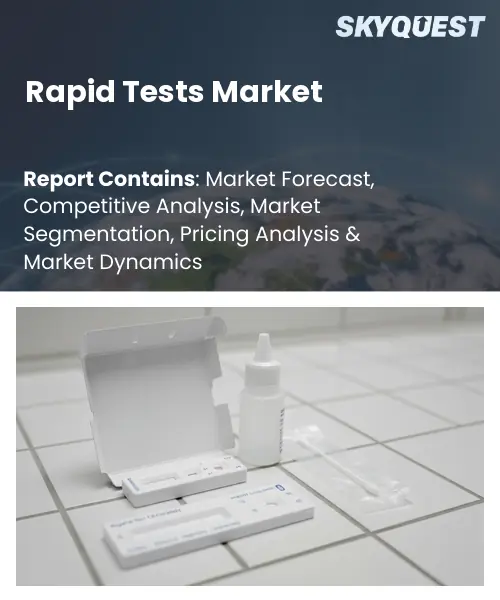
Rapid Tests Market
Report ID: SQMIG35A3708
Report ID: SQMIG35A3708
[email protected]
USA +1 351-333-4748
Report ID:
SQMIG35A3708 |
Region:
Global |
Published Date: May, 2026
Pages:
157
|Tables:
183
|Figures:
79


Global Rapid Tests Market size was valued at USD 38.2 Billion in 2024 and is poised to grow from USD 41.03 Billion in 2025 to USD 72.63 Billion by 2033, growing at a CAGR of 7.4% during the forecast period (2026-2033).
The rapid tests market encompasses point of care diagnostics that deliver quick, often qualitative results outside traditional laboratories, and it matters because timely detection supports clinical decisions and public health surveillance. Demand accelerated during the COVID 19 pandemic when antigen and antibody assays became essential for screening travelers, workplaces and schools, exposing weaknesses in laboratory capacity and driving innovations in lateral flow technology. Over time investment from manufacturers, regulatory adaptations and expanded reimbursement transformed a niche segment into a broad industry serving infectious disease, pregnancy, drug screening and chronic care monitoring with examples such as HIV tests and influenza kits.
A primary ongoing factor shaping the global rapid tests market is advances in assay sensitivity and decentralized testing infrastructure because improved accuracy reduces false results and builds clinician and consumer trust, which increases adoption across care settings. As sensitivity rose, public health programs expanded screening, leading employers to implement routine workplace testing and retail pharmacies to offer walk in services, creating new distribution channels for manufacturers. This shift enabled integration with telemedicine platforms that guide interpretation and confirmatory workflows, thereby creating revenue opportunities for software enabled diagnostics and partnerships with health systems seeking faster triage and resource allocation during outbreaks.
How is AI improving diagnostic accuracy in the rapid tests market?
AI is improving diagnostic accuracy in the rapid tests market by enhancing signal detection, image interpretation, assay design and quality assurance. Key aspects include smartphone image analysis that reduces user variability, cloud based models that flag unclear results and machine learning that refines test chemistry and cutoff selection.
The current state shows wider adoption of digital readers and AI models that convert qualitative lateral flow outputs into consistent clinically useful information. Market context favors decentralized testing and faster clinical decisions as manufacturers embed analytics into devices. Examples range from smartphone apps that read faint lines to integrated platforms that support multiplex testing and clinician workflows.ABCDx May 2026, announced completion of the Eurostars LVOCheck project pairing a triplex blood biomarker rapid test with a smartphone quantitative reader and AI supported decision algorithms. This innovation improves prehospital diagnostic accuracy and streamlines triage which supports faster treatment decisions and broader adoption of rapid diagnostic solutions.
Market snapshot - (2026-2033)
Global Market Size
USD 38.2 Billion
Largest Segment
Lateral Flow Assays
Fastest Growth
Molecular Rapid Tests
Growth Rate
7.4% CAGR
To get more insights on this market click here to Request a Free Sample Report
Global rapid tests market is segmented by product type, application, sample type, technology, end user, distribution channel and region. Based on product type, the market is segmented into Lateral Flow Assays, Rapid Antigen Tests, Rapid Antibody Tests, Molecular Rapid Tests, Dipstick Tests and Others. Based on application, the market is segmented into Infectious Disease Testing, Pregnancy & Fertility Testing, Cardiac Marker Testing, Glucose Monitoring, Drug Abuse Testing and Others. Based on sample type, the market is segmented into Blood, Urine, Saliva, Nasal & Throat Swabs and Others. Based on technology, the market is segmented into Immunochromatographic Assays, Molecular Diagnostics, Biosensor-Based Testing and Microfluidic Testing. Based on end user, the market is segmented into Hospitals & Clinics, Diagnostic Laboratories, Homecare Settings, Ambulatory Care Centers and Others. Based on distribution channel, the market is segmented into Hospital Pharmacies, Retail Pharmacies, Online Pharmacies and Direct Sales. Based on region, the market is segmented into North America, Europe, Asia Pacific, Latin America and Middle East & Africa.
How are lateral flow assays enhancing point of care diagnostics in the rapid tests market? |@12
Lateral Flow Assays segment dominates because their simple, cartridge-free format delivers rapid, easy-to-interpret results at the point of care, lowering training barriers and reducing diagnostic delays. Proven manufacturing scalability and broad assay compatibility encourage wide adoption across clinical, retail, and screening environments, while familiar regulatory pathways and low per-test cost promote routine use. These dynamics drive suppliers to prioritize lateral flow offerings and sustain broad market penetration.
However, Molecular Rapid Tests are the fastest growing product type driven by demand for higher sensitivity and specificity in decentralized testing. Advances in compact molecular platforms and simplified workflows enable confirmatory testing outside central labs, unlocking new clinical applications and higher-value diagnostic pathways. This innovation-led momentum is expanding use cases and creating opportunities for premium rapid diagnostics.
What role do homecare settings play in accelerating rapid tests market adoption? |@12
Hospitals & Clinics segment dominates because centralized care environments concentrate high diagnostic volumes and urgent clinical decision needs, prompting procurement of robust rapid tests that integrate with workflows. Clinical trust in validated assays and availability of trained personnel ensure frequent use for triage and inpatient care, steering manufacturers toward hospital-grade performance and regulatory compliance. Institutional purchasing and clinical reliance thus shape product priorities and steady demand for rapid tests.
However, Homecare Settings are the fastest growing end user driven by consumer demand for convenient self testing and telehealth integration. Broader regulatory approval for self administered rapid tests, combined with strong retail and online distribution, accelerates adoption. This shift expands the addressable market beyond institutions, spurring user-centric product design and recurring consumer-led revenue streams.
To get detailed segments analysis, Request a Free Sample Report
Why does North America Dominate the Global Rapid Tests Market? |@12
North America dominates the global rapid tests market because of a confluence of strong healthcare infrastructure, well developed regulatory and reimbursement frameworks, and substantial investment in research and development that together accelerate product commercialization and uptake. Established diagnostics firms and a dynamic startup landscape drive continuous innovation, while integrated laboratory networks and point of care channels enable broad distribution and clinical adoption. Public and private funding supports scalable manufacturing and supply chain resilience, and close collaboration among industry, academic centers, and healthcare providers expedites validation and real world implementation. Consumer familiarity with convenient testing formats and readiness to adopt at home and clinic based solutions further consolidate market leadership and sustained demand for rapid diagnostic technologies.
United States Rapid Tests Market |@12
Rapid Tests Market in United States is characterized by a mature diagnostic ecosystem, extensive clinical trial capacity, and direct pathways for commercialization, supported by large private investment and sophisticated distribution networks that reach hospitals, clinics, and retail channels. Strong laboratory infrastructure and active industry academic partnerships enable rapid validation and scaling, while consumer familiarity with at home testing and robust reimbursement practices sustain widespread adoption across clinical and nonclinical settings.
Canada Rapid Tests Market |@12
Rapid Tests Market in Canada benefits from a coordinated public health approach, strong provincial laboratory networks, and close collaboration between government agencies and domestic manufacturers to expand access to point of care diagnostics. Emphasis on equitable distribution, laboratory accreditation, and integration with primary care supports uptake across urban and regional settings. Partnerships with academic institutions and regulatory modernization foster localized innovation and reinforce supply chain stability for rapid diagnostic solutions.
What is Driving the Rapid Expansion of Rapid Tests Market in Europe? |@12
Europe is experiencing rapid expansion in the rapid tests market driven by centralized public health coordination, strong diagnostics manufacturing clusters, and evolving regulatory frameworks that facilitate innovation and market access. Adoption is supported by clinical laboratories, primary care networks, and retail distribution, complemented by strategic procurement and cross border collaboration among healthcare systems. Private laboratory chains and diagnostic firms are scaling point of care offerings, while digital health integration enhances reporting and surveillance. Consumer acceptance of decentralized testing, targeted investment in domestic production capacity, and partnerships with research centers help translate scientific capability into broader accessibility and practical deployment of rapid diagnostic solutions. Harmonized quality standards and evolving reimbursement pathways further reduce barriers to adoption and encourage commercialization across diverse national markets.
Germany Rapid Tests Market |@12
Rapid Tests Market in Germany combines a strong domestic manufacturing base with a mature diagnostics industry and active collaboration between clinical research centers and commercial developers to deliver validated point of care products. Robust hospital networks and specialized laboratory capacity support diagnostic integration, while export orientation sustains high manufacturing standards. Structured procurement mechanisms and professional training enable routine adoption of rapid tests across clinical workflows and broader national preparedness initiatives.
United Kingdom Rapid Tests Market |@12
Rapid Tests Market in United Kingdom reflects agile adoption of point of care diagnostics driven by strong clinical networks, proactive procurement, and collaboration among public health institutions and private innovators. The healthcare system emphasis on scalable deployment accelerates uptake across primary and community settings. Investment in digital reporting and home testing pathways enhances accessibility, while a dynamic startup scene and established laboratory partners promote continuous product refinement and market responsiveness.
France Rapid Tests Market |@12
Rapid Tests Market in France is emerging through strengthened domestic production, evolving regulatory approaches, and growing collaboration between public laboratories and private manufacturers to expand access to point of care solutions. Accredited laboratory networks and targeted procurement support deployment in hospitals and community clinics. Investment in clinical validation and partnerships with research institutions helps translate innovation into practical offerings, enhancing regional availability and patient access to rapid diagnostics available internationally.
How is Asia Pacific Strengthening its Position in Rapid Tests Market? |@12
Asia Pacific is strengthening its position in the rapid tests market by leveraging expanding local manufacturing capacity, a vibrant diagnostics startup community, and government initiatives that encourage domestic production and export orientation. Cost competitive production and scalable models attract partnerships with global firms, while regulatory pathways evolve to facilitate market entry for validated products. Expansion of decentralized healthcare delivery, increased investment in point of care technology, and integration with digital health platforms improve accessibility and reporting. Cross border collaborations, regional procurement mechanisms, and targeted capacity building in laboratory networks further enhance the region's ability to deliver affordable, high quality rapid diagnostic solutions to domestic and international markets. Skilled technical talent pools and expanding research and development hubs drive innovation in assay development and sample to answer platforms, while public private partnerships support localized validation.
Japan Rapid Tests Market |@12
Rapid Tests Market in Japan is characterized by high quality standards, rigorous regulatory oversight, and advanced technological integration that support sophisticated point of care diagnostics. Domestic manufacturers and research institutions collaborate to develop reliable assays and compact testing platforms for clinical use. Integration with hospital information systems and strict quality assurance encourages provider adoption, while precise manufacturing and resilient supply chains support selective export of premium diagnostic offerings available internationally.
South Korea Rapid Tests Market |@12
Rapid Tests Market in South Korea is driven by agile innovation, fast scaling of manufacturing, and close public private alignment that accelerates deployment of diagnostic technologies. A vibrant biotech startup ecosystem and experienced contract manufacturers support rapid iteration from prototype to production. Integration with digital health platforms and export strategies enhance market reach, while streamlined regulatory engagement and targeted support for clinical validation foster confidence among healthcare providers and partners.
To know more about the market opportunities by region and country, click here to
Buy The Complete Report
Drivers |@12
Rising Demand For Rapid Diagnostics
Technological Advances In Test Design
Restraints |@12
Regulatory Approval Complexity
Reimbursement And Payment Constraints
Request Free Customization of this report to help us to meet your business objectives.
The competitive landscape for global rapid tests is defined by consolidation and tech led differentiation as firms race to secure assay menus and point of care molecular capabilities. Competition is driven by the need to win institutional procurement and end to end workflows, prompting targeted acquisitions for distribution, commercial partnerships to accelerate market entry, and investments in microfluidics and digital readers as concrete differentiation examples.
Top Player’s Company Profile
Recent Developments
SkyQuest’s ABIRAW (Advanced Business Intelligence, Research & Analysis Wing) is our Business Information Services team that Collects, Collates, Correlates, and Analyses the Data collected by means of Primary Exploratory Research backed by robust Secondary Desk research. As per SkyQuest analysis, the global rapid tests market is being propelled primarily by rising demand for rapid diagnostics that enable faster clinical decisions and decentralized screening, while a key restraint is regulatory approval complexity that slows market entry and increases development costs. The dominating region is North America and the dominating segment is lateral flow assays, driven by low cost, ease of use and scalable manufacturing. A second driver is continuous technological advances in assay design and AI-enabled digital readers that improve sensitivity, reduce user variability and open new use cases across homecare and point of care settings, creating opportunities for integrated diagnostics and telehealth workflows.
| Report Metric | Details |
|---|---|
| Market size value in 2024 | USD 38.2 Billion |
| Market size value in 2033 | USD 72.63 Billion |
| Growth Rate | 7.4% |
| Base year | 2024 |
| Forecast period | (2026-2033) |
| Forecast Unit (Value) | USD Billion |
| Segments covered |
|
| Regions covered | North America (US, Canada), Europe (Germany, France, United Kingdom, Italy, Spain, Rest of Europe), Asia Pacific (China, India, Japan, Rest of Asia-Pacific), Latin America (Brazil, Rest of Latin America), Middle East & Africa (South Africa, GCC Countries, Rest of MEA) |
| Companies covered |
|
| Customization scope | Free report customization with purchase. Customization includes:-
|
To get a free trial access to our platform which is a one stop solution for all your data requirements for quicker decision making. This platform allows you to compare markets, competitors who are prominent in the market, and mega trends that are influencing the dynamics in the market. Also, get access to detailed SkyQuest exclusive matrix.
Table Of Content
Executive Summary
Market overview
Parent Market Analysis
Market overview
Market size
KEY MARKET INSIGHTS
COVID IMPACT
MARKET DYNAMICS & OUTLOOK
Market Size by Region
KEY COMPANY PROFILES
Methodology
For the Rapid Tests Market, our research methodology involved a mixture of primary and secondary data sources. Key steps involved in the research process are listed below:
1. Information Procurement: This stage involved the procurement of Market data or related information via primary and secondary sources. The various secondary sources used included various company websites, annual reports, trade databases, and paid databases such as Hoover's, Bloomberg Business, Factiva, and Avention. Our team did 45 primary interactions Globally which included several stakeholders such as manufacturers, customers, key opinion leaders, etc. Overall, information procurement was one of the most extensive stages in our research process.
2. Information Analysis: This step involved triangulation of data through bottom-up and top-down approaches to estimate and validate the total size and future estimate of the Rapid Tests Market.
3. Report Formulation: The final step entailed the placement of data points in appropriate Market spaces in an attempt to deduce viable conclusions.
4. Validation & Publishing: Validation is the most important step in the process. Validation & re-validation via an intricately designed process helped us finalize data points to be used for final calculations. The final Market estimates and forecasts were then aligned and sent to our panel of industry experts for validation of data. Once the validation was done the report was sent to our Quality Assurance team to ensure adherence to style guides, consistency & design.
Analyst Support
Customization Options
With the given market data, our dedicated team of analysts can offer you the following customization options are available for the Rapid Tests Market:
Product Analysis: Product matrix, which offers a detailed comparison of the product portfolio of companies.
Regional Analysis: Further analysis of the Rapid Tests Market for additional countries.
Competitive Analysis: Detailed analysis and profiling of additional Market players & comparative analysis of competitive products.
Go to Market Strategy: Find the high-growth channels to invest your marketing efforts and increase your customer base.
Innovation Mapping: Identify racial solutions and innovation, connected to deep ecosystems of innovators, start-ups, academics, and strategic partners.
Category Intelligence: Customized intelligence that is relevant to their supply Markets will enable them to make smarter sourcing decisions and improve their category management.
Public Company Transcript Analysis: To improve the investment performance by generating new alpha and making better-informed decisions.
Social Media Listening: To analyze the conversations and trends happening not just around your brand, but around your industry as a whole, and use those insights to make better Marketing decisions.
REQUEST FOR SAMPLE
 REQUEST FREE CUSTOMIZATION
Global Rapid Tests Market size was valued at USD 38.2 Billion in 2024 and is poised to grow from USD 41.03 Billion in 2025 to USD 72.63 Billion by 2033, growing at a CAGR of 7.4% during the forecast period (2026-2033).
The competitive landscape for global rapid tests is defined by consolidation and tech led differentiation as firms race to secure assay menus and point of care molecular capabilities. Competition is driven by the need to win institutional procurement and end to end workflows, prompting targeted acquisitions for distribution, commercial partnerships to accelerate market entry, and investments in microfluidics and digital readers as concrete differentiation examples. 'Abbott Laboratories', 'Roche', 'QuidelOrtho', 'BD', 'Siemens Healthineers', 'bioMérieux', 'Danaher Corporation', 'Thermo Fisher Scientific', 'OraSure Technologies', 'ACON Laboratories', 'SD Biosensor', 'Access Bio', 'Bionote', 'Sekisui Medical', 'Trinity Biotech', 'Nova Biomedical', 'Hangzhou AllTest Biotech', 'Wondfo Biotech', 'QIAGEN', 'Sysmex'
Rising demand for rapid diagnostics has expanded adoption across decentralized care settings, enabling quicker clinical decision making and shortening time to treatment initiation. This demand supports market growth by encouraging manufacturers to scale development of user-friendly tests that can be used outside laboratory environments. Greater patient preference for convenient testing, combined with healthcare providers’ need for timely results, has driven investment in diverse rapid test formats and distribution channels, fostering product innovation and broader market acceptance that sustains ongoing expansion.
Decentralized Testing Adoption: Shift toward decentralized testing is driving demand for rapid tests across nontraditional settings such as community clinics, pharmacies, workplaces and homes, enabling earlier detection and management of conditions. Manufacturers are adapting formats for ease of use, minimal training and safe disposal while service providers design new delivery models emphasizing accessibility, convenience and rapid clinical decision support. This trend encourages partnerships between test developers, point-of-care networks and retail health channels to broaden reach and effectively embed testing into routine care pathways.
Why does North America Dominate the Global Rapid Tests Market? |@12


Want to customize this report? This report can be personalized according to your needs. Our analysts and industry experts will work directly with you to understand your requirements and provide you with customized data in a short amount of time. We offer $1000 worth of FREE customization at the time of purchase.
Feedback From Our Clients


 USA (+1) 351-333-4748

