Ramucirumab Market
Report ID: SQMIG35I2596
Report ID: SQMIG35I2596
[email protected]
USA +1 351-333-4748
Report ID:
SQMIG35I2596 |
Region:
Global |
Published Date: March, 2026
Pages:
157
|Tables:
143
|Figures:
78


Global Ramucirumab Market size was valued at USD 2.40 Billion in 2024 and is poised to grow from USD 2.50 Billion in 2025 to USD 3.48 Billion by 2033, growing at a CAGR of 4.2% during the forecast period (2026-2033).
Key Takeaways: Market Trends & Insights
The global ramucirumab industry operates through commercial activities that involve developing and selling a monoclonal antibody treatment which works by blocking VEGFR-2 to prevent new blood vessel formation in patients with advanced gastric and colorectal and non-small cell lung cancers. Its significance exists because it provides a second-line treatment option which oncologists can use after traditional chemotherapy methods have proven ineffective, while enhancing their treatment results.
Moreover, the market witnessed regulatory approvals create uneven geographic adoption patterns which depend on reimbursement systems and testing outcomes and doctor implementation processes. European countries saw strong treatment adoption after gastric cancer trial results showed positive outcomes while emerging markets faced access difficulties caused by high costs and limited healthcare infrastructure. The ongoing clinical evidence base enables continuous expansion of treatment labels and treatment guidelines which allows positive results from phase III trials to increase doctor usage of ramucirumab for new treatments and payers to approve funding for wider patient access. The demonstration of immunotherapy synergy with other treatments has led doctors to implement combination treatment protocols which extend the average treatment duration while increasing the revenue from each patient. Patient assistance programs in emerging markets target specific patients to reduce their out-of-pocket expenses which enables treatment of access when pricing would have otherwise restricted demand. The combination of manufacturing scale-up and licensing agreements helps decrease operational expenses while opening pathways for wider access to reinforce market growth and sustainability.
How is AI Influencing Market Access and Pricing for Ramucirumab?
AI technology transforms the ramucirumab market outlook by enhancing evidence creation capabilities and boosting patient identification methods for access and pricing decisions. The system analyzes real-world data through automatic processes to show proof of its value in normal treatment situations, while predictive models identify patients who will respond best to the treatment, and AI-enabled trial designs cut development expenses and speed up the time needed to secure reimbursement. The current market Cyramza operates as an established oncology biologic which faces lifecycle challenges, so manufacturers and payers depend on AI-based real-world proof and pricing models to establish differentiated value which drives specific access programs and intelligent contracting strategies that connect clinical results to operational results.
The Cyramza product information for February 2026 from Eli Lilly includes AI-enabled tools which support payer discussions while AI-enabled evidence platforms facilitate faster pricing and access decisions for ramucirumab. The AI tools enable organizations to develop evidence faster while creating value-based contracts that improve both market uptake and operational productivity.
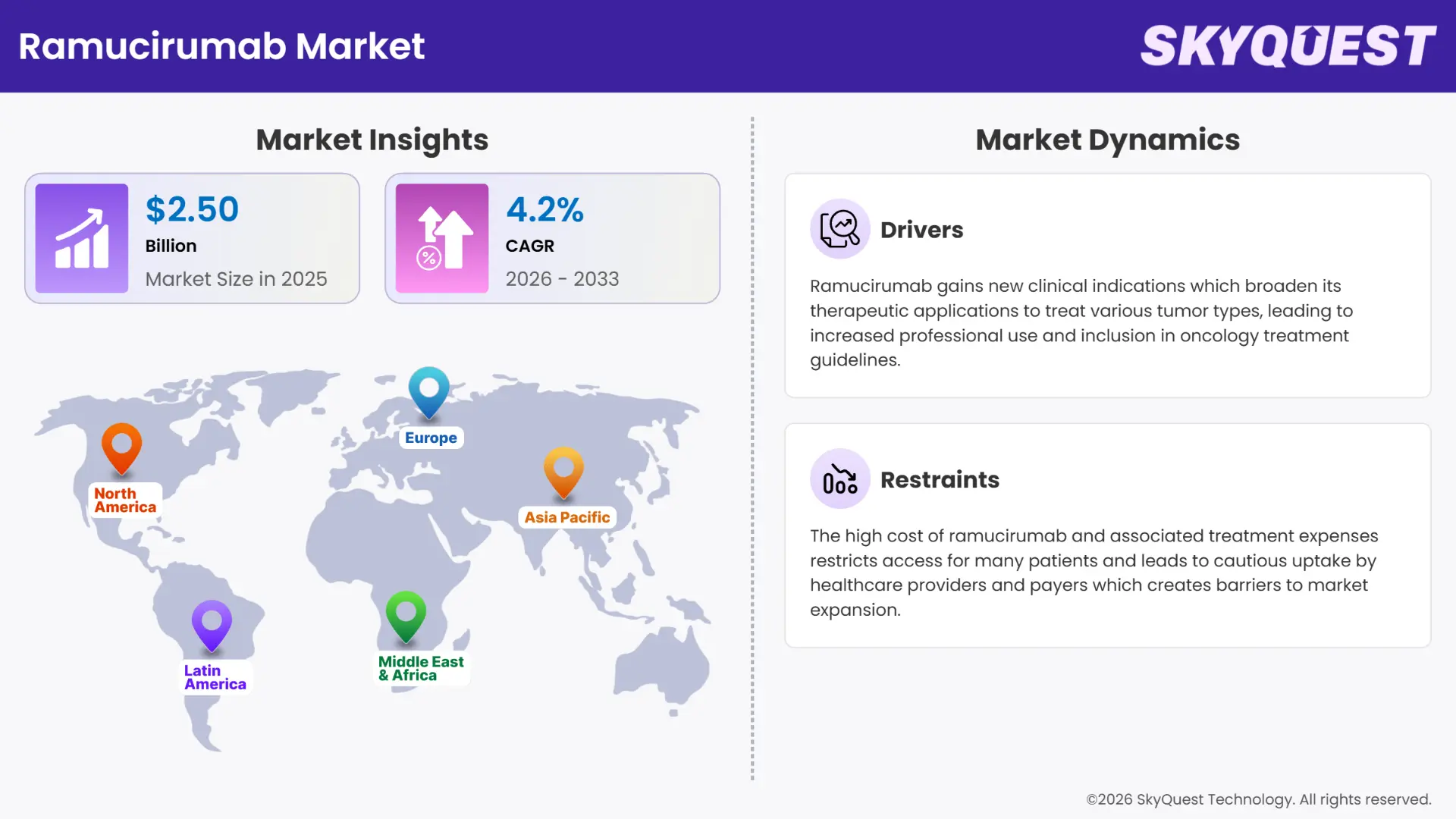
To get more insights on this market click here to Request a Free Sample Report
The global ramucirumab market share is segmented by administration route, indications, end user, formulation type, patient demographics, and region. In terms of administration route, the market is divided into intravenous and subcutaneous delivery. Based on indications, it is categorized into non-small cell lung cancer, gastric cancer, diabetic retinopathy, colorectal cancer, and other conditions. By end users, the market includes hospitals, clinics, and research institutions. In terms of formulation type, the segmentation comprises liquid formulations and lyophilized formulations. Based on patient demographics, the market is divided into adult and geriatric populations. Geographically, the market is segmented into North America, Europe, Asia Pacific, Latin America, and the Middle East & Africa.
As per the global ramucirumab market analysis, the intravenous segment leads the market because ramucirumab functions as a monoclonal antibody which fits with standard infusion medical procedures that allow medical staff to deliver exact doses through direct supervision while combining the treatment with cytotoxic chemotherapy in clinical applications. Oncologists choose to use intravenous treatment because they already know about this method and because hospitals have existing infrastructure which allows infusion procedures to proceed without interruptions after the FDA provides treatment permission.
However, the Subcutaneous delivery methods have emerged as the fastest growing segment because developers create easy to use products which doctors can use for treatment at home or in clinics, which also lowers the number of patients who need to visit infusion centers for treatment. The market for ramucirumab expands because delivery technology innovations and regulatory bodies show interest in making dosing pathways that require fewer resources more widely accessible.
According to the global ramucirumab market forecast, the gastric cancer specialist field leads the market because ramucirumab received full regulatory approval through pivotal trial evidence which established it as the standard rescue therapy for advanced gastric cancer patients. Clinical endorsement leads to drug formulary selection by payers which allows doctors to keep prescribing the drug while funding combination research and commercial resources to build the therapy's central role in the ramucirumab market and sustain ongoing product development.
Whereas the highest growth area for research now exists in non-small cell lung cancer because scientists' study how to use ramucirumab with immunotherapy and targeted agents to fill the existing treatment gaps. The clinical program expansion, the biomarker-driven approach which develops regulatory pathways, and the rising popularity of combination treatments create commercial pathways which lead to future market expansion.
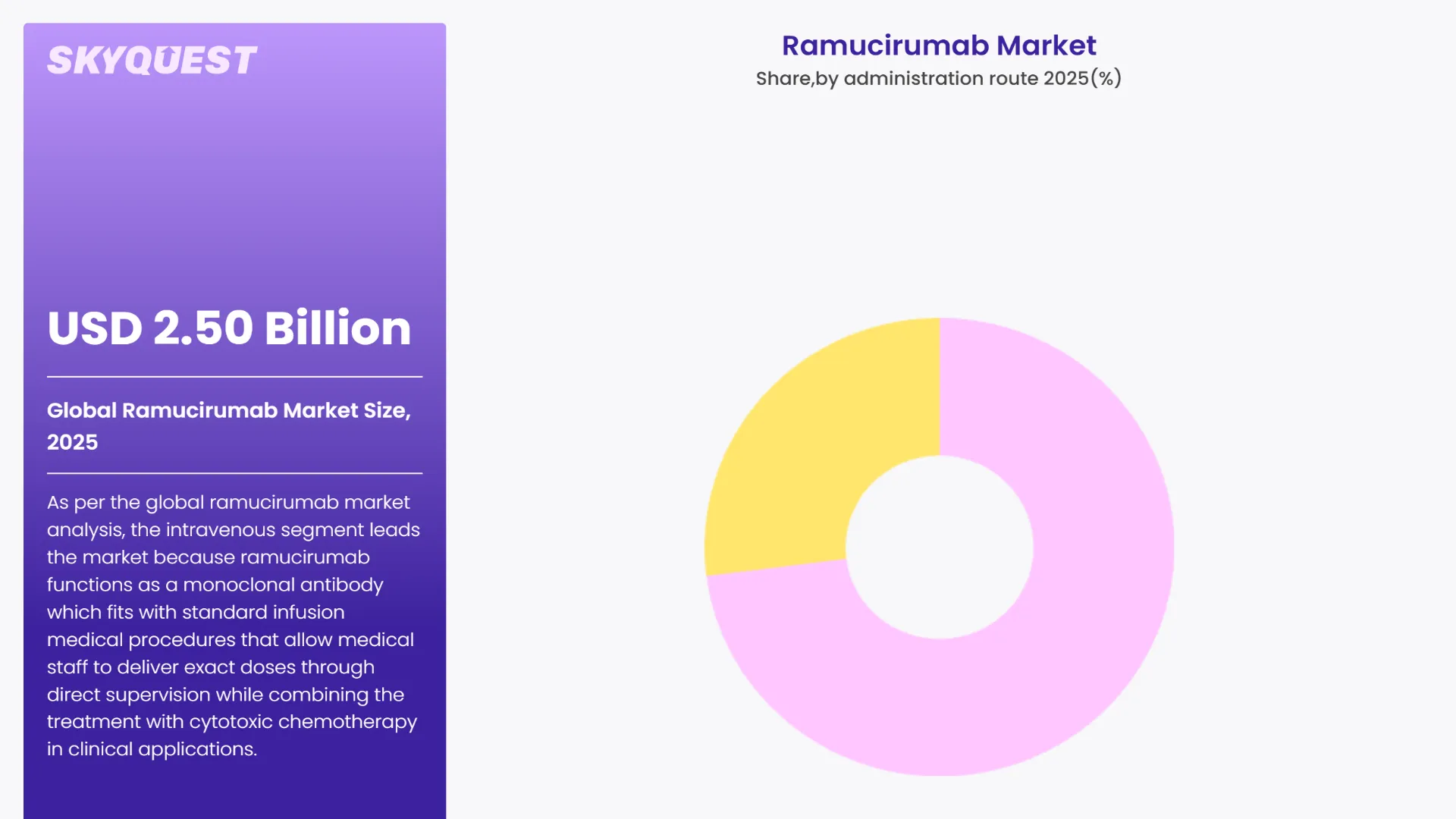
To get detailed segments analysis, Request a Free Sample Report
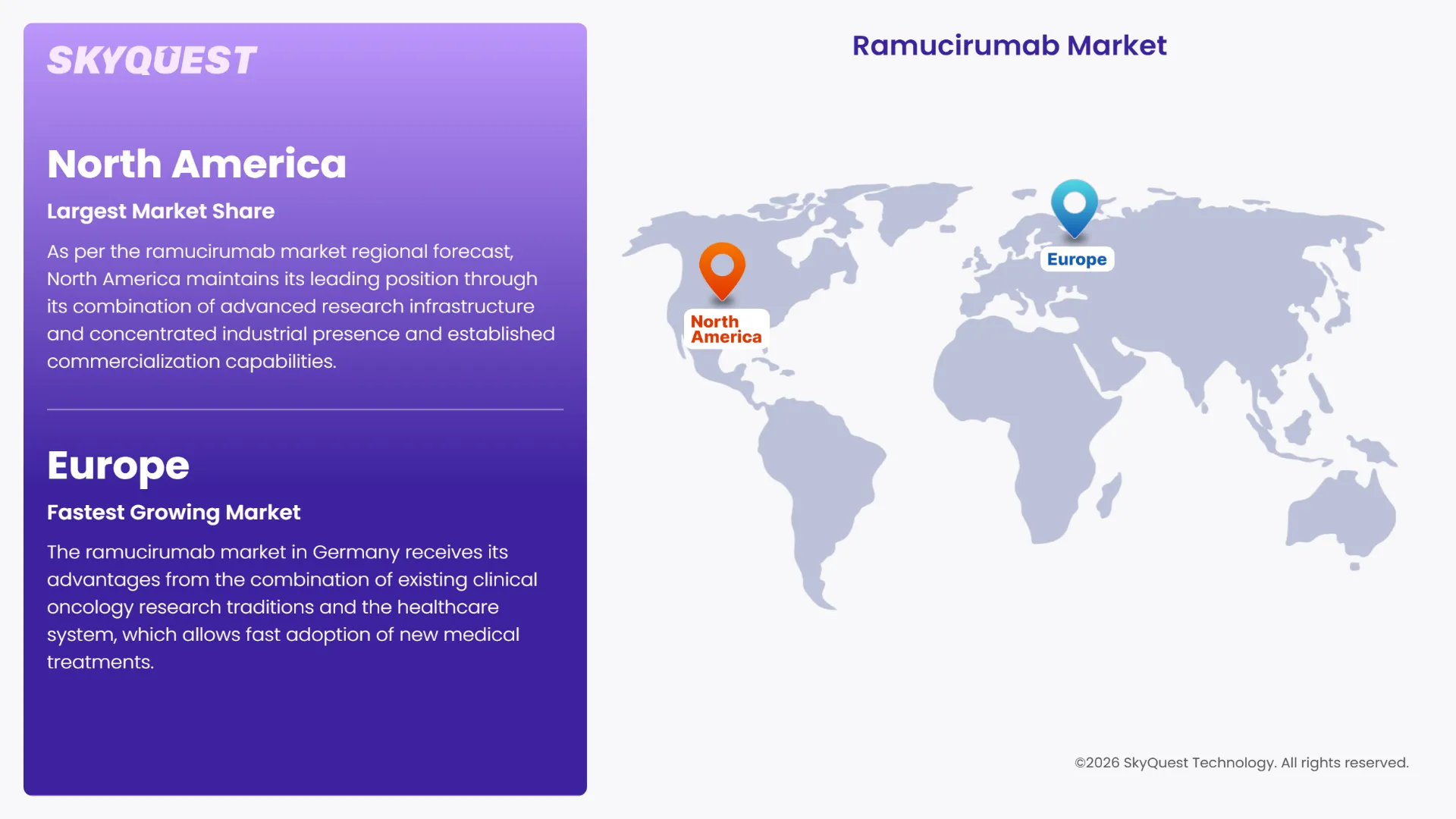
As per the ramucirumab market regional forecast, North America maintains its leading position through its combination of advanced research infrastructure and concentrated industrial presence and established commercialization capabilities. Established oncology centers together with extensive clinical trial networks create a system that builds medical evidence and introduces new therapies. The oncology drug development process benefits from a regulatory system that provides clear drug development routes which payers use to create their access and reimbursement plans. The strong academic partnership between universities and pharmaceutical companies and diagnostic companies creates faster development of personalized medicine. The distribution of medical products is secured by solid manufacturing and distribution systems which use educational programs to improve doctor knowledge and patient access. Market expansion through strategic partnerships and focused commercialization initiatives enables companies to reach all important healthcare delivery platforms.
The United States ramucirumab sector displays a dense network of oncology research institutions and major pharmaceutical company headquarters and specialized medical centers which help speed up clinical research. Clinicians who understand targeted therapies together with advanced diagnostics systems help identify suitable patients. Postmarketing evidence programs supply clinical data which payers use to create reimbursement paths between patients and clinics. The commercial infrastructure together with patient support programs allows products to reach various healthcare environments throughout the country.
The Canadian ramucirumab market functions within a system that uses governmental healthcare funding to control drug assessments and formulary decisions through centralized processes. The combination of provincial assessment systems and reimbursement models establishes guidelines for drug adoption, while joint research activities and specialized clinical centers create new medical evidence. Health technology assessment organizations must work with sponsors through their patient support programs and medical education initiatives to integrate ramucirumab into oncology treatment protocols within specialized healthcare facilities.
The European ramucirumab market growth is driven because three elements exist: strong clinical research centers and collaborative regulatory systems, which support personalized oncology treatment. The national health systems and regional payers are studying targeted therapies, which enables essential market access in these locations. Multinational academic research partnerships between universities and industry organizations create multicenter clinical trials and real-world evidence studies, which support both label changes and clinical guideline updates. The presence of established pharmaceutical companies combines growing biotech companies to expand market reach, which diagnostic networks can use to find the correct patients.
The ramucirumab market in Germany receives its advantages from the combination of existing clinical oncology research traditions and the healthcare system, which allows fast adoption of new medical treatments. The established specialty clinics together with diagnostic systems permit healthcare providers to identify patients precisely, while the reimbursement models and hospital funding systems determine the routes for medical treatment adoption. The collaboration between industry partners and academic institutions establishes partnerships which help create evidence-based guidelines and decide on medical guidelines. The combination of medical education and stakeholder participation creates an atmosphere where clinicians can gain confidence about using ramucirumab in their treatment procedures at specialized centers.
The ramucirumab market in the United Kingdom operates within a research environment which uses centralized health technology appraisal methods to determine access to medical treatments. The academic medical centers and specialized oncology hospitals participate in both clinical research and the collection of real-world data. The reimbursement strategies come from national appraisal body engagement together with payer agreement discussions, while patient advocacy groups and educational programs improve clinician understanding. The connection between sponsors and clinical networks provides a solution for access problems, while creating support systems that enhance standard care when necessary.
The ramucirumab market in France receives its support from a structured oncology care system, which uses evidence-based medicine to establish criteria for drug reimbursement assessments. The strong hospital networks together with research centers create a system which enables healthcare professionals to handle both clinical studies and post-authorization research. National health authorities and health technology assessment procedures determine the criteria which control access to medical treatments. The combined efforts of sponsors and medical societies and patient organizations create programs, which improve clinical knowledge and understanding of patient support systems, which then enhance the adoption of oncology practices.
Asia Pacific expands its presence through its new clinical research facilities and upgraded regulatory systems and its increased international partnership with pharmaceutical research sponsors. Investment in oncology infrastructure and diagnostic capabilities improves patient identification and treatment personalization. The region generates clinical evidence through its increased local trial activities and participation in multinational studies. The regulatory agencies across different markets develop new review processes to improve patient access to cutting-edge treatments, which supplement government and private initiatives that enhance reimbursement and patient support programs. The combination of strategic manufacturing and distribution partnerships together with specific medical education programs improves both supply chain security and doctors' knowledge of the products. The region now advances its former status as a market that follows trends to become a more active global participant in adopting ramucirumab.
The Japanese ramucirumab market derives its advantages from the country's advanced healthcare system and medical research facilities which uphold rigorous standards of cancer treatment. Advanced diagnostic platforms and experienced specialist physicians support precise patient selection and integration into treatment regimens. Local evidence of creation occurs because domestic institutions establish partnerships with international sponsors who conduct clinical trials. The reimbursement procedures together with payer engagement work as vital components in which medical education programs and patient support services increase core doctor access to cancer centers.
The South Korean ramucirumab market develops because the country experiences rapid growth of its oncology services and its hospitals maintain specialized doctor networks who actively participate in clinical research. The country establishes dedicated treatment facilities which improve diagnostic capacity and enable doctors to offer focused therapy while regulatory agencies and insurers build new pathways for emerging oncology treatments. Market introduction together with evidence of creation is enabled through collaborations between international sponsors and local healthcare organizations. The ongoing educational programs for doctors and the assistance services for patients help doctors to accept and implement national oncology standards.
To know more about the market opportunities by region and country, click here to
Buy The Complete Report
Expanding Clinical Indications
Growing Adoption in Emerging Regions
High Treatment Cost and Access
Complex Regulatory and Reimbursement Processes
Request Free Customization of this report to help us to meet your business objectives.
The global ramucirumab market competes through Lilly's product lifecycle management and emerging biosimilar competitors who benefit from regulatory changes and CDMO ties which speed up their introduction of follow-on products. Significant business methods surface through Henlius biosimilar development of HLX12 and Lilly's Loxo Oncology acquisition, which shows originators' broad M&A actions and companies' manufacturing ties that reduce their product development time.
SkyQuest’s ABIRAW (Advanced Business Intelligence, Research & Analysis Wing) is our Business Information Services team that Collects, Collates, Correlates, and Analyses the Data collected by means of Primary Exploratory Research backed by robust Secondary Desk research.
As per SkyQuest analysis, the global ramucirumab market trends will experience continuous growth because new clinical indications will create larger patient groups, and medical guidelines will start including the treatment. The main market driver comes from the increasing use of ramucirumab together with combination therapies and the introduction of new treatment indications for the drug. High treatment costs combined with complicated reimbursement procedures create barriers that prevent access to treatment in numerous markets. North America holds the leading market position because of its superior research capabilities and its ability to create reimbursement paths and its establishment of efficient commercial networks, which lead to Intravenous administration being the dominant segment because oncology centers already use established infusion methods. The second market driver comes from growing market presence in emerging regions, which organizations achieve through patient assistance programs and increased clinical trial activities that will enhance their market presence.
| Report Metric | Details |
|---|---|
| Market size value in 2024 | USD 2.40 Billion |
| Market size value in 2033 | USD 3.48 Billion |
| Growth Rate | 4.2% |
| Base year | 2024 |
| Forecast period | 2026-2033 |
| Forecast Unit (Value) | USD Billion |
| Segments covered |
|
| Regions covered | North America (US, Canada), Europe (Germany, France, United Kingdom, Italy, Spain, Rest of Europe), Asia Pacific (China, India, Japan, Rest of Asia-Pacific), Latin America (Brazil, Rest of Latin America), Middle East & Africa (South Africa, GCC Countries, Rest of MEA) |
| Companies covered |
|
| Customization scope | Free report customization with purchase. Customization includes:-
|
To get a free trial access to our platform which is a one stop solution for all your data requirements for quicker decision making. This platform allows you to compare markets, competitors who are prominent in the market, and mega trends that are influencing the dynamics in the market. Also, get access to detailed SkyQuest exclusive matrix.
Table Of Content
Executive Summary
Market overview
Parent Market Analysis
Market overview
Market size
KEY MARKET INSIGHTS
COVID IMPACT
MARKET DYNAMICS & OUTLOOK
Market Size by Region
KEY COMPANY PROFILES
Methodology
For the Ramucirumab Market, our research methodology involved a mixture of primary and secondary data sources. Key steps involved in the research process are listed below:
1. Information Procurement: This stage involved the procurement of Market data or related information via primary and secondary sources. The various secondary sources used included various company websites, annual reports, trade databases, and paid databases such as Hoover's, Bloomberg Business, Factiva, and Avention. Our team did 45 primary interactions Globally which included several stakeholders such as manufacturers, customers, key opinion leaders, etc. Overall, information procurement was one of the most extensive stages in our research process.
2. Information Analysis: This step involved triangulation of data through bottom-up and top-down approaches to estimate and validate the total size and future estimate of the Ramucirumab Market.
3. Report Formulation: The final step entailed the placement of data points in appropriate Market spaces in an attempt to deduce viable conclusions.
4. Validation & Publishing: Validation is the most important step in the process. Validation & re-validation via an intricately designed process helped us finalize data points to be used for final calculations. The final Market estimates and forecasts were then aligned and sent to our panel of industry experts for validation of data. Once the validation was done the report was sent to our Quality Assurance team to ensure adherence to style guides, consistency & design.
Analyst Support
Customization Options
With the given market data, our dedicated team of analysts can offer you the following customization options are available for the Ramucirumab Market:
Product Analysis: Product matrix, which offers a detailed comparison of the product portfolio of companies.
Regional Analysis: Further analysis of the Ramucirumab Market for additional countries.
Competitive Analysis: Detailed analysis and profiling of additional Market players & comparative analysis of competitive products.
Go to Market Strategy: Find the high-growth channels to invest your marketing efforts and increase your customer base.
Innovation Mapping: Identify racial solutions and innovation, connected to deep ecosystems of innovators, start-ups, academics, and strategic partners.
Category Intelligence: Customized intelligence that is relevant to their supply Markets will enable them to make smarter sourcing decisions and improve their category management.
Public Company Transcript Analysis: To improve the investment performance by generating new alpha and making better-informed decisions.
Social Media Listening: To analyze the conversations and trends happening not just around your brand, but around your industry as a whole, and use those insights to make better Marketing decisions.
REQUEST FOR SAMPLE
 REQUEST FREE CUSTOMIZATION
Global Ramucirumab Market size was valued at USD 2.4 Billion in 2024 and is poised to grow from USD 2.5 Billion in 2025 to USD 3.48 Billion by 2033, growing at a CAGR of 4.2% during the forecast period (2026-2033).
Competitive landscape for global ramucirumab is defined by originator Lilly’s lifecycle management and growing biosimilar challengers, with regulatory shifts and CDMO partnerships accelerating market entry for follow on products. Notable strategies include biosimilar development by companies such as Henlius with HLX12, large scale M&A by originators exemplified by Lilly’s acquisition of Loxo Oncology, and manufacturing partnerships to shorten time to market. 'Eli Lilly and Company', 'Amgen Inc.', 'Merck & Co., Inc.', 'AstraZeneca PLC', 'Bayer AG', 'Genentech, Inc.', 'Bristol-Myers Squibb Company', 'Pfizer Inc.', 'Roche Holding AG', 'Boehringer Ingelheim GmbH', 'Novartis AG', 'GSK (GlaxoSmithKline)', 'Sanofi S.A.', 'Abbot Laboratories', 'Celgene Corporation', 'Regeneron Pharmaceuticals, Inc.', 'Takeda Pharmaceutical Company Limited', 'Incyte Corporation', 'Spectrum Pharmaceuticals, Inc.', 'Immunomedics, Inc.'
Expansion of approved clinical indications for ramucirumab increases its therapeutic relevance across a broader range of tumor types, encouraging wider adoption by oncologists and incorporation into treatment protocols. As more cancer types and lines of therapy recognize efficacy, physician confidence and guideline inclusion grow, motivating healthcare institutions to stock and prescribe the drug. Broader clinical applicability fosters partnerships between manufacturers and clinical centers, stimulates investment in supply chains, and enhances perceived value among payers and patients, collectively supporting steady market growth.
Expansion Of Combination Therapies: Manufacturers and clinicians are increasingly exploring ramucirumab in combination with other systemic agents to enhance efficacy and broaden therapeutic indications. Collaborative research is driving regimen optimization and sequencing, fostering partnerships between companies and oncology centers. This trend supports differentiated positioning through combined protocols that may address resistance mechanisms and improve outcomes. Market adoption is influenced by safety management strategies and evolving practice patterns, with stakeholders prioritizing integrated treatment pathways and evidence generation to inform guideline inclusion and physician prescribing behavior.
North America Dominate the Global Ramucirumab Market.
The Gastric Cancer segment held the largest market share in 2025 due to the extensive use of Ramucirumab as a second-line treatment option for advanced gastric and gastroesophageal cancers.
The Intravenous (IV) segment currently dominates the market because Ramucirumab is primarily administered through infusion in hospitals and specialized oncology centers.
AI is helping improve patient identification, real-world evidence generation, pricing strategies, and reimbursement decisions. AI-enabled analytics are also supporting value-based contracting and market access initiatives.


Want to customize this report? This report can be personalized according to your needs. Our analysts and industry experts will work directly with you to understand your requirements and provide you with customized data in a short amount of time. We offer $1000 worth of FREE customization at the time of purchase.
Feedback From Our Clients


 USA (+1) 351-333-4748

