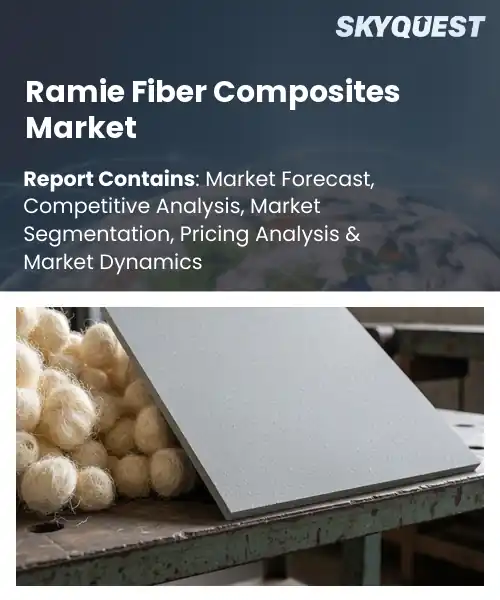
Ramie Fiber Composites Market
Report ID: SQMIG15F2298
Report ID: SQMIG15F2298
[email protected]
USA +1 351-333-4748
Report ID:
SQMIG15F2298 |
Region:
Global |
Published Date: February, 2026
Pages:
157
|Tables:
173
|Figures:
79


Global Ramie Fiber Composites Market size was valued at USD 18.45 Billion in 2024 and is poised to grow from USD 20.81 Billion in 2025 to USD 54.55 Billion by 2033, growing at a CAGR of 12.8% during the forecast period (2026-2033).
The primary driver of the ramie fiber composites market is the accelerating global demand for sustainable, high-performance bio-based materials that can replace glass fiber and petrochemical-derived polymers. Ramie, a bast fiber with high tensile strength and good thermal stability, transitioned from textile uses into reinforcement as manufacturers sought lower-carbon alternatives and lighter components. Over past decade pilot projects in automotive interior panels, lightweight construction panels, and consumer goods demonstrated viability, while regulatory pressure on emissions and circular-economy principles encouraged adoption. This market matters because it aligns environmental policy with functional performance, creating a pathway for composite supply chains to evolve.A central factor shaping the Global Ramie Fiber Composites Market is advances in fiber surface treatments and resin compatibility, since improved coupling leads to higher composite strength, durability and broader industrial adoption. When nanocoatings or chemical alkali treatments reduce fiber hydrophilicity, adhesion with thermoset and thermoplastic matrices improves, causing reduced moisture-related degradation and longer service life in automotive door panels and furniture components. As manufacturers observe predictable performance, procurement shifts toward ramie-based solutions, enabling scale economies that lower unit costs and attract investment in tooling for sports equipment and building facades, creating a reinforcing cycle of innovation and expansion globally.
How is AI improving production efficiency in the ramie fiber composites market?
AI is boosting production efficiency in the ramie fiber composites market by adding data driven control to material selection and manufacturing. Key aspects include automated quality inspection using image and sensor analytics and process models that predict how fiber treatments and curing affect final properties. The current state blends pilot scale adoption with academic progress and cautious industry uptake. In context the market is looking for reliable ways to convert ramie natural strength into consistent composite parts. Examples include smarter fiber grading, process monitoring and predictive maintenance which reduce rework and improve throughput while making ramie a more attractive sustainable reinforcement.Simplifyber April 2025, secured funding to scale a cellulose molding platform, showing how process innovation in natural fiber manufacturing can shorten production steps. This kind of digital and AI ready approach can be applied to ramie composites to streamline processing, raise consistency, and support broader market adoption.
Market snapshot - (2026-2033)
Global Market Size
USD 18.45 Billion
Largest Segment
Thermosets
Fastest Growth
Thermoplastics
Growth Rate
12.8% CAGR
To get more insights on this market click here to Request a Free Sample Report
Global ramie fiber composites market is segmented by product type, raw materials, product form, applications, end user industry, distribution channels and region. Based on product type, the market is segmented into Thermoplastics, Thermosets and Bio‑Composites. Based on raw materials, the market is segmented into Natural Fibers and Chemical Additives. Based on product form, the market is segmented into Sheets & Plates, Filaments & Yarns, Mats & Fabrics and Others. Based on applications, the market is segmented into Automotive Components, Construction & Building Materials, Electronics & Electricals, Consumer Goods and Others. Based on end user industry, the market is segmented into Fashion Industry, Automotive Industry, Construction Industry and Agriculture. Based on distribution channels, the market is segmented into Direct Sales and Indirect Sales. Based on region, the market is segmented into North America, Europe, Asia Pacific, Latin America and Middle East & Africa.
Thermoplastics segment dominates because their melt-processable matrices align with ramie fiber properties to enable efficient bonding and scalable production. Ease of thermoforming and compatibility with injection molding and extrusion reduce manufacturing complexity and support high-volume parts production. Recyclability and the ability to tune stiffness through polymer blends encourage design flexibility, driving integration of ramie-reinforced components into mainstream automotive, consumer, and industrial product lines.
However, thermosets are emerging as the fastest growing area due to crosslinked matrices offering thermal and chemical stability required for structural and electrical uses. Innovations in bio-based resins and faster cure systems improve adhesion with ramie fibers, unlocking higher-value applications in construction and electronics and prompting targeted investment in thermoset-ramie formulations.
Mats & Fabrics segment dominates because woven and nonwoven architectures provide balanced in-plane strength, surface finish, and formability that meet both aesthetic and functional requirements of ramie-reinforced parts. Fabric handling compatibility with resin infusion and compression molding reduces defects and enhances mechanical consistency, while visible natural fiber textures add design appeal that accelerates adoption in interiors, consumer products, and sustainable building components.
However, filaments & yarns are witnessing the strongest growth as spinning and surface treatments boost tensile performance and enable tighter textile integration. Their role in braided and woven reinforcements opens lightweight structural applications for mobility and sporting goods, while demand for premium sustainable textiles accelerates innovation and commercial uptake of yarn-based ramie composites.
To get detailed segments analysis, Request a Free Sample Report
Asia Pacific dominance is rooted in a convergence of manufacturing scale, established natural fiber cultivation, and integrated value chains that support composite production. Regional strengths include dense supplier networks that link raw ramie supply with textile processors and composite fabricators, enabling efficient material flows and rapid commercialization of innovations. A balance of cost advantages and focused research collaborations between industry and academic institutions accelerates adoption of ramie in automotive, construction, and consumer applications. Policy frameworks that encourage sustainable materials and circular economy practices, together with active private investment in pilot production and process optimization, reinforce competitiveness. Proximity to large end use markets within the region reduces logistical friction, while export oriented strategies and partnerships with global OEMs extend influence beyond regional borders.
Ramie Fiber Composites Market Japan benefits from advanced material science expertise and precision manufacturing that support high quality composite components. Research institutes and specialist manufacturers collaborate to refine processes and enhance performance for demanding applications. Culture of rigorous standards and close links to automotive and electronics supply chains encourages early adoption. Emphasis on value products and niche engineering applications positions Japan as a technology leader in the ramie composite ecosystem.
Ramie Fiber Composites Market South Korea leverages advanced manufacturing agility and strong industrial design capabilities to integrate ramie into high performance applications. Industry led innovation hubs foster production and scale up of bio based composites, while close cooperation with OEMs accelerates validation. Emphasis on lightweighting, aesthetic finishes and hybrid material systems supports growth in automotive and consumer sectors. Strategic investment and focused technical expertise raise competitiveness within regional supply chains.
Europe expansion is propelled by a strategic intersection of policy emphasis on sustainability, strong industrial ecosystems, and active research networks that translate natural fiber potential into commercial composite solutions. Market appetite for low environmental impact materials across transportation, building, and consumer goods stimulates demand for ramie based systems. Established manufacturing clusters provide skilled processing capabilities and pilot scale infrastructure, while collaborative projects among universities, research centers and industry accelerate material qualification and supply chain integration. Procurement preferences that favor lifecycle performance and circularity foster uptake, and cross border partnerships enable knowledge transfer and market access. Germany leads in scale and technical application, the United Kingdom is developing niche expertise and testbed opportunities, and France is advancing rapidly through textile heritage and focused innovation.
Ramie Fiber Composites Market Germany draws on a deep industrial base and engineering tradition that enable integration of ramie into technical components. Collaboration among manufacturers, research institutes and suppliers advances material qualification and application development for automotive and construction use. Established testing infrastructure and supplier networks shorten commercialization timelines, and emphasis on lifecycle performance and industrial standards secures Germany position as the dominant hub within the European ramie composite landscape.
Ramie Fiber Composites Market United Kingdom shows emerging strength driven by lightweight design innovation and materials testing. Collaborations between universities and niche manufacturers produce demonstrators that highlight ramie suitability for specialty transport and consumer uses. Agile supply chains enable rapid prototyping and bespoke component development. Growing interest from engineering consultancies and design firms, supported by pilot scale activity, positions the United Kingdom as a developing market for ramie composite applications.
Ramie Fiber Composites Market France advances with a textile heritage and innovation ecosystem that turns fiber expertise into composite solutions. Design focused manufacturers and specialist producers work with research centers to improve processing and finishing for consumer and mobility applications. Regional clusters support pilot manufacturing and value chain integration, while sustainability oriented procurement and brand demand drive trials. These trends position France as a growing hub for ramie composite offerings.
North America is advancing its role through targeted investments in research, pilot manufacturing, and collaborative networks that bridge academia, startups and established manufacturers. Emphasis on lightweighting, lifecycle performance and sustainable sourcing aligns ramie composites with automotive, aerospace and durable goods innovation agendas. Regional initiatives to qualify natural fiber materials, develop processing technologies and validate performance in demanding environments reduce adoption barriers. Venture and industrial funding supports scale up of novel processing methods, while demonstration projects with OEMs provide practical pathways to commercialization. Cross border scientific exchange and growing supplier ecosystems enhance material availability and technical know how, and public and private partnerships advancing standards development and certification work help integrate ramie composites into regulated supply chains and promote circular economy practices.
Ramie Fiber Composites Market United States leverages strong research and startup ecosystems to advance material development. Partnerships between universities, testing laboratories and OEMs accelerate qualification for transport and durable goods. Pilot manufacturing facilities and demonstration programs reduce scale up risk, while venture funding supports commercialization. Emphasis on lifecycle assessment, material sourcing transparency and supply chain resilience actively positions United States to adopt ramie composites for performance and sustainability target markets.
Ramie Fiber Composites Market Canada builds on a manufacturing culture and applied research network to advance natural fiber composites for niche industrial uses. Provincial innovation programs and pilot facilities support processing trials and lifecycle evaluation. Close links between material scientists and small manufacturers enable tailored component development, while focus on sustainable sourcing, circular practices and brand differentiation positions Canada to supply ramie composite solutions to domestic and environmentally conscious markets.
To know more about the market opportunities by region and country, click here to
Buy The Complete Report
Increasing Demand From Automotive
Sustainable Material Preference Among Builders
Limited Fiber Supply and Quality
High Processing and Manufacturing Costs
Request Free Customization of this report to help us to meet your business objectives.
Competitive dynamics in the global ramie fiber composites market center on OEM sourcing and specialist material suppliers competing to offer scalable certified natural fiber solutions for automotive interiors. Firms pursue partnerships and co development, for example Bcomp and Porsche on natural fiber body and interior parts, and strategic financing and acquisitions such as Ahlstrom Capital's investment in Bast Fibre. New prepreg technologies like INCA's target OEM adoption.
Top Player’s Company Profile
Recent Developments
SkyQuest’s ABIRAW (Advanced Business Intelligence, Research & Analysis Wing) is our Business Information Services team that Collects, Collates, Correlates, and Analyses the Data collected by means of Primary Exploratory Research backed by robust Secondary Desk research. As per SkyQuest analysis, the global ramie fiber composites market is driven primarily by rising demand for sustainable, high-performance bio-based materials that replace traditional reinforcements, and further supported by advances in fiber surface treatments and improved resin compatibility that unlock broader industrial use. Growth is concentrated in Asia Pacific where integrated supply chains and manufacturing scale dominate, with thermoplastics leading product type adoption due to melt processability and recyclability. A key restraint remains inconsistent raw ramie supply and quality, which increases processing needs and hinders large-scale procurement. Continued technology-driven material qualification and pilot production will be pivotal to convert promise into mainstream commercial volumes.
| Report Metric | Details |
|---|---|
| Market size value in 2024 | USD 18.45 Billion |
| Market size value in 2033 | USD 54.55 Billion |
| Growth Rate | 12.8% |
| Base year | 2024 |
| Forecast period | (2026-2033) |
| Forecast Unit (Value) | USD Billion |
| Segments covered |
|
| Regions covered | North America (US, Canada), Europe (Germany, France, United Kingdom, Italy, Spain, Rest of Europe), Asia Pacific (China, India, Japan, Rest of Asia-Pacific), Latin America (Brazil, Rest of Latin America), Middle East & Africa (South Africa, GCC Countries, Rest of MEA) |
| Companies covered |
|
| Customization scope | Free report customization with purchase. Customization includes:-
|
To get a free trial access to our platform which is a one stop solution for all your data requirements for quicker decision making. This platform allows you to compare markets, competitors who are prominent in the market, and mega trends that are influencing the dynamics in the market. Also, get access to detailed SkyQuest exclusive matrix.
Table Of Content
Executive Summary
Market overview
Parent Market Analysis
Market overview
Market size
KEY MARKET INSIGHTS
COVID IMPACT
MARKET DYNAMICS & OUTLOOK
Market Size by Region
KEY COMPANY PROFILES
Methodology
For the Ramie Fiber Composites Market, our research methodology involved a mixture of primary and secondary data sources. Key steps involved in the research process are listed below:
1. Information Procurement: This stage involved the procurement of Market data or related information via primary and secondary sources. The various secondary sources used included various company websites, annual reports, trade databases, and paid databases such as Hoover's, Bloomberg Business, Factiva, and Avention. Our team did 45 primary interactions Globally which included several stakeholders such as manufacturers, customers, key opinion leaders, etc. Overall, information procurement was one of the most extensive stages in our research process.
2. Information Analysis: This step involved triangulation of data through bottom-up and top-down approaches to estimate and validate the total size and future estimate of the Ramie Fiber Composites Market.
3. Report Formulation: The final step entailed the placement of data points in appropriate Market spaces in an attempt to deduce viable conclusions.
4. Validation & Publishing: Validation is the most important step in the process. Validation & re-validation via an intricately designed process helped us finalize data points to be used for final calculations. The final Market estimates and forecasts were then aligned and sent to our panel of industry experts for validation of data. Once the validation was done the report was sent to our Quality Assurance team to ensure adherence to style guides, consistency & design.
Analyst Support
Customization Options
With the given market data, our dedicated team of analysts can offer you the following customization options are available for the Ramie Fiber Composites Market:
Product Analysis: Product matrix, which offers a detailed comparison of the product portfolio of companies.
Regional Analysis: Further analysis of the Ramie Fiber Composites Market for additional countries.
Competitive Analysis: Detailed analysis and profiling of additional Market players & comparative analysis of competitive products.
Go to Market Strategy: Find the high-growth channels to invest your marketing efforts and increase your customer base.
Innovation Mapping: Identify racial solutions and innovation, connected to deep ecosystems of innovators, start-ups, academics, and strategic partners.
Category Intelligence: Customized intelligence that is relevant to their supply Markets will enable them to make smarter sourcing decisions and improve their category management.
Public Company Transcript Analysis: To improve the investment performance by generating new alpha and making better-informed decisions.
Social Media Listening: To analyze the conversations and trends happening not just around your brand, but around your industry as a whole, and use those insights to make better Marketing decisions.
REQUEST FOR SAMPLE
 REQUEST FREE CUSTOMIZATION


Want to customize this report? This report can be personalized according to your needs. Our analysts and industry experts will work directly with you to understand your requirements and provide you with customized data in a short amount of time. We offer $1000 worth of FREE customization at the time of purchase.
Feedback From Our Clients


 USA (+1) 351-333-4748

