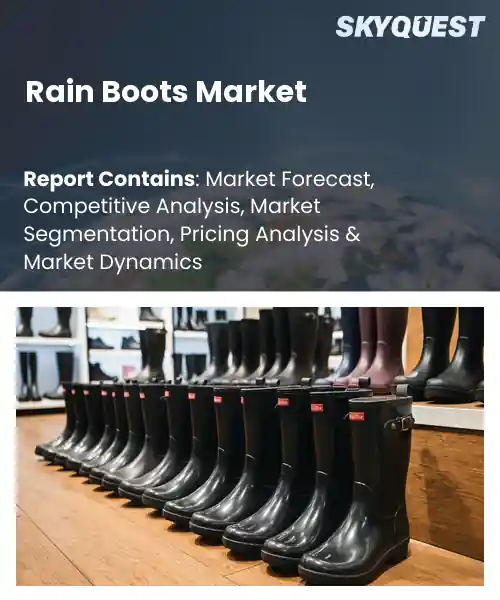
Rain Boots Market
Report ID: SQMIG25K2214
Report ID: SQMIG25K2214
[email protected]
USA +1 351-333-4748
Report ID:
SQMIG25K2214 |
Region:
Global |
Published Date: July, 2026
Pages:
157
|Tables:
143
|Figures:
78


Global Rain Boots Market size was valued at USD 1.52 Billion in 2024 and is poised to grow from USD 1.61 Billion in 2025 to USD 2.52 Billion by 2033, growing at a CAGR of 5.81% during the forecast period (2026-2033).
High demand for waterproof footwear, increasing frequency of extreme weather events, rising consumer interest in outdoor activities, innovations in sustainable footwear materials, and expanding fashion trends are driving sales of rain boots.
Growing popularity of rain boots among city commuters, farm laborers, nature lovers and factory workers is driving market growth. Growing investments in eco-friendly footwear production, using recycled rubber as raw material, bio-based polymers and direct-to-consumer marketing channels are also fueling market expansion. Ongoing innovations in lightweight sole design, improved padding, better grip technology and water-resistant materials are expected to further enhance the usability of the product. Also, growing online channels, exclusive collaborations, and rising preference for sustainable footwear are anticipated to open up new avenues for the market globally. Increasing demand for durable and comfortable all-weather footwear, coupled with increasing consumer preference for stylish and functional rain boots, is expected to primarily drive rain boots market growth.
However, seasonal demand fluctuations, volatility in raw material prices, intense competition from alternative waterproof footwear, and high manufacturing costs for premium sustainable products are forecasted to impede rain boots market penetration through 2033.
How is AI Improving Personalization Among Rain Boot Manufacturers?
Innovation in rain boots by using artificial intelligence (AI) is improving customer experience and selection process. AI enables more tailored shopping by providing accurate product recommendations through the use of machine learning. Machine learning utilizes customer’s details, preference and behavior to eliminate the wrong choices of Rain Boots and provide the best match according to style, shape and usability, hence making the shopping experience more savvy. AI applications also include 3D footwear scanning and virtual try on for rain boots providing designed preferences which helps selecting the size, shade and cloth more assured.
Market snapshot - (2026-2033)
Global Market Size
USD 1.52 Billion
Largest Segment
PVC
Fastest Growth
Neoprene
Growth Rate
5.81% CAGR
To get more insights on this market click here to Request a Free Sample Report
Global rain boots market is segmented by material, end-user, application, distribution channel, price, and region. Based on material, the market is segmented into rubber, PVC, and neoprene. Based on end-user, the market is segmented into adults and children. Based on application, the market is segmented into fashion/lifestyle, agricultural/work, and outdoor & hiking. Based on distribution channel, the market is segmented into online retail, department stores, and specialty outdoor stores. Based on price, the market is segmented into budget, mid-range, and premium. Based on region, the market is segmented into North America, Europe, Asia Pacific, Latin America, and Middle East & Africa.
The rubber segment is predicted to lead the global rain boots market revenue generation across the study period. Its inherent characteristics provide consistent waterproofing, elasticity and abrasion prevention for common and industrial applications. These qualities help minimize product defect rates and refunds, deepening retailer & customer trust. Industry-standard manufacturing methods & sourcing networks help minimize supply& manufacturing-time, maintaining leading market supply & shelf presence.
However, PVC is emerging as the most rapidly expanding material segment because of lower costs of production, the attractiveness of adds to the range of multiple apparel and accessories the facility for weekly style changes increases the number of SKUs and signifies a shift in the way textiles are used by providing an opportunity for new brands.
The online retail segment is forecasted to account for the highest global rain boots market share going forward. Digital channels offer unparalleled assortments, discoverability, and fulfillment efficiencies that appeal to today's buying patterns. Many brands and retailers are recognizing that direct-to-consumer, data-first marketing and sales can boost product visibility and facilitate niche or seasonal products away from shelves, coupled with a seamless returns process and scalable online content. Retailers and brands are optimizing digital strategies to expand their footprint.
However, department stores are becoming the most rapidly expanding distribution channel as per this rain boots industry analysis, by utilizing curated selections, sale promotions and constant traffic to expose rain boots to the mass market. In-store better presenting and seasonal branding can facilitate mass-market premium, allowing brand to scale visibility and justify higher price ranges while gaining additional volume and cross-category crossings in the store.
To get detailed segments analysis, Request a Free Sample Report
Persistent consumer demand, robust manufacturing ecosystems, and a culture that blends practical needs with fashion sensibilities are expected to help this region maintain its dominance. Moreover, various climatic conditions of the region make it possible to use rain boots all the time while the high density of urban population keeps retail business thriving throughout the year. The development of reliable footwear supply chains along with the proximity to raw materials ensures an efficient production process, which enables companies to act quickly in the manufacturing process. Active technical research and collaboration with manufacturers enable firms to manufacture high-quality footwear, which distinguishes itself through superior performance. Expansion of omnichannel channels facilitates development of new fashion trends, while ongoing cross-border trade and recognition of companies' brands further help reach new markets.
Rain boots market in Japan benefits from a sophisticated consumer base that values functional innovation and design. For urban commuters and outdoor recreational uses, demand for hard-to-abrasion weather resistant shoes matches current fashion trends. Local producers building a brand emphasize smart material expertise, local precision manufacturing and designer collaborations to produce value differentiated lines. Distribution is strong on specialty stores and the internet, which help niche brands inch into mid-size city boutiques.
Demand for rain boots in South Korea is driven by a dynamic fashion culture and a manufacturing base focused on performance and contemporary styling. Urban lifestyle demand and active outdoor culture foster innovative and adaptable concepts, combining utility with aesthetic value. Regional design trends are promoted through collaborations with material and fabric manufacturers and online garment sellers, while tailored retail displays and social-media marketing enhance exposure in regional markets, facilitating selective distribution of unique design-centric items.
Shifting consumer preferences, diverse climate patterns, and a sophisticated retail environment that embraces both functional footwear and fashion led interpretation are helping shape sales of rain boots in Europe. Consumers are looking for high-quality product alternatives and environmentally friendly products, and so companies are using sustainable materials and taking eco-friendly practices to design footwear. Effective selling systems, strong retail chains, and online shopping possibilities help brands to distribute their trendy brands quickly. The cooperation of designers and producers of performance materials makes their products different, whereas the strong presence of brands in markets increases customer loyalty. The shift of focus on tracking the materials in production and the establishment of sustainability strategies help build relationships with buyers. The efficient possibilities of launching marketing campaigns based on regional preferences.
Demand for rain boots in Germany reflects strong demand for durable, performance-oriented footwear supported by extensive retail networks and a pragmatic consumer approach. Manufacturers focus on engineering quality, durable materials, and functional fit to all consumer groups that they want to address. Specialty outdoor retailers and industrial safety channels collect orders that allow cross segment distribution against mainstream fashion outlets. Material innovators and established brands ensure that product performance is maintained, and their regional presence continued.
Rain boots market in United Kingdom is characterized by agile trend adoption and strong digital engagement that accelerate product diffusion. Consumers want style focused, multi-functional footwear that works well in all kinds of city situations. Direct to consumer models, groundbreaking collaborations, influencer driven campaigns all raise profiles for new brands as well as familiar names. Pop ups, experiential retail and other retail formats work alongside online channels to help new brands enter the Market and gain traction across the city.
Adoption of rain boots in France is emerging with a clear emphasis on design and craftsmanship positioning. Fashion led consumers and boutique retailers favor distinctive silhouettes, artisanal touches and premium material choices that align with style sensitive demand. Designers partnering with niche or specialist manufacturers can produce emotionally resonant collections. A selective distribution through concept stores and curated online spaces, complemented by sustainability stores and stories of old-school craftsmanship, can attract the right feel for the right buyers.
Product innovation, channel diversification and lifestyle alignment that expands rain boots appeal beyond traditional use are expected to help boost sales of rain boots across the region. brands are focusing on innovation as far as technical aspects are concerned, comfort and the incorporation of sustainable materials so that they can attract a wide array of consumers who are becoming more price conscious and more concerned about protecting the environment. Owing to establishment of wide distribution channels and growth of online shopping, both the existing players and new entrants into the market have a good platform for distribution. Happenings in outdoor activities among consumers are making this region to experience positive demand factors and the collaboration between manufacturers of high-technology materials and stakeholders in the channels for safety products will open a way for rain boots in areas of occupational safety. Collaboration among designers, wholesalers and material scientists is enabling the makers of rain boots in the Americas to create innovative products easily and quickly. The marketing campaigns being employed by such companies in the Americas today are meant to enhance their position in this market and also engage consumers while they are in the search of rain boots.
Rain boots market in United States is driven by diverse demand from outdoor recreation, urban commuting and occupational safety segments. Brands balance technical performance with lifestyle appeal, leveraging collaborations with outdoor labels and fashion partners to reach multiple consumer groups. Extensive wholesale channels, national retailers and direct to consumer platforms enable broad distribution, while emphasis on sustainable materials and comfort technologies supports product differentiation and consumer relevance across regional markets.
Rain boot demand in Canada centers on durability, weather resilience and multifunctional design suited to varied outdoor conditions. Insulation, traction and dependable performance continue to be a priority among consumers and outdoors consumers and brands continue to focus on embedding natural and robust materials within innovative construction. Local producers and niche distribution focus on quality fabrics and sustainable sourcing, while cross border commercial partnerships and internet based platforms facilitate access to markets for local brands. The seasonal outdoor activity continues to shape product development and positioning.
To know more about the market opportunities by region and country, click here to
Buy The Complete Report
Growing Outdoor Leisure Activities
Advancements In Material Technology
Raw Material Price Volatility
Environmental Regulatory Constraints
Request Free Customization of this report to help us to meet your business objectives.
Competition in the global rain boots market centers on premium heritage labels, designer collaborations, and consolidation among technical producers. Sustainability driven material innovation and product extensions are major competitive drivers. Examples include Hunter’s collaboration with Stella McCartney in 2019 and Rocky Brands’ acquisition of specialist labels such as Muck Boot and XTRATUF to deepen technical and lifestyle portfolios.
SkyQuest’s ABIRAW (Advanced Business Intelligence, Research & Analysis Wing) is our Business Information Services team that Collects, Collates, Correlates, and Analyses the Data collected by means of Primary Exploratory Research backed by robust Secondary Desk research.
As per SkyQuest analysis, increasing frequency of extreme weather events, rising consumer interest in outdoor activities, and expanding fashion trends are anticipated to drive the demand for rain boots going forward. However, seasonal demand fluctuations and volatility in raw material prices are slated to slow down the adoption of rain boots in the future. North America is slated to spearhead the demand for rain boots owing to high consumer spending on outdoor apparel, increasing demand for premium and sustainable footwear, strong retail and e-commerce networks, and frequent seasonal rainfall across several regions. AI-powered personalization and adoption of virtual try-on technologies are anticipated to be key trends driving the rain boots market through 2033.
| Report Metric | Details |
|---|---|
| Market size value in 2024 | USD 1.52 Billion |
| Market size value in 2033 | USD 2.52 Billion |
| Growth Rate | 5.81% |
| Base year | 2024 |
| Forecast period | (2026-2033) |
| Forecast Unit (Value) | USD Billion |
| Segments covered |
|
| Regions covered | North America (US, Canada), Europe (Germany, France, United Kingdom, Italy, Spain, Rest of Europe), Asia Pacific (China, India, Japan, Rest of Asia-Pacific), Latin America (Brazil, Rest of Latin America), Middle East & Africa (South Africa, GCC Countries, Rest of MEA) |
| Companies covered |
|
| Customization scope | Free report customization with purchase. Customization includes:-
|
To get a free trial access to our platform which is a one stop solution for all your data requirements for quicker decision making. This platform allows you to compare markets, competitors who are prominent in the market, and mega trends that are influencing the dynamics in the market. Also, get access to detailed SkyQuest exclusive matrix.
Table Of Content
Executive Summary
Market overview
Parent Market Analysis
Market overview
Market size
KEY MARKET INSIGHTS
COVID IMPACT
MARKET DYNAMICS & OUTLOOK
Market Size by Region
KEY COMPANY PROFILES
Methodology
For the Rain Boots Market, our research methodology involved a mixture of primary and secondary data sources. Key steps involved in the research process are listed below:
1. Information Procurement: This stage involved the procurement of Market data or related information via primary and secondary sources. The various secondary sources used included various company websites, annual reports, trade databases, and paid databases such as Hoover's, Bloomberg Business, Factiva, and Avention. Our team did 45 primary interactions Globally which included several stakeholders such as manufacturers, customers, key opinion leaders, etc. Overall, information procurement was one of the most extensive stages in our research process.
2. Information Analysis: This step involved triangulation of data through bottom-up and top-down approaches to estimate and validate the total size and future estimate of the Rain Boots Market.
3. Report Formulation: The final step entailed the placement of data points in appropriate Market spaces in an attempt to deduce viable conclusions.
4. Validation & Publishing: Validation is the most important step in the process. Validation & re-validation via an intricately designed process helped us finalize data points to be used for final calculations. The final Market estimates and forecasts were then aligned and sent to our panel of industry experts for validation of data. Once the validation was done the report was sent to our Quality Assurance team to ensure adherence to style guides, consistency & design.
Analyst Support
Customization Options
With the given market data, our dedicated team of analysts can offer you the following customization options are available for the Rain Boots Market:
Product Analysis: Product matrix, which offers a detailed comparison of the product portfolio of companies.
Regional Analysis: Further analysis of the Rain Boots Market for additional countries.
Competitive Analysis: Detailed analysis and profiling of additional Market players & comparative analysis of competitive products.
Go to Market Strategy: Find the high-growth channels to invest your marketing efforts and increase your customer base.
Innovation Mapping: Identify racial solutions and innovation, connected to deep ecosystems of innovators, start-ups, academics, and strategic partners.
Category Intelligence: Customized intelligence that is relevant to their supply Markets will enable them to make smarter sourcing decisions and improve their category management.
Public Company Transcript Analysis: To improve the investment performance by generating new alpha and making better-informed decisions.
Social Media Listening: To analyze the conversations and trends happening not just around your brand, but around your industry as a whole, and use those insights to make better Marketing decisions.
REQUEST FOR SAMPLE
 REQUEST FREE CUSTOMIZATION
Global Rain Boots Market size was valued at USD 1.52 Billion in 2024 and is poised to grow from USD 1.61 Billion in 2025 to USD 2.52 Billion by 2033, growing at a CAGR of 5.81% during the forecast period (2026-2033).
Competition in the global rain boots market centers on premium heritage labels, designer collaborations, and consolidation among technical producers. Sustainability driven material innovation and product extensions are major competitive drivers. Examples include Hunter’s collaboration with Stella McCartney in 2019 and Rocky Brands’ acquisition of specialist labels such as Muck Boot and XTRATUF to deepen technical and lifestyle portfolios. 'Hunter Boot Ltd.', 'Le Chameau', 'Aigle SAS', 'Bogs Footwear (Weyco Group)', 'Tretorn (Haglöfs/Fenix Outdoor)', 'Muck Boot (Honeywell)', 'Joules (UK brand)', 'Tommy Hilfiger (PVH)', 'Kamik (Genfoot Inc.)', 'Staheekum', 'UGG (Deckers Outdoor)', 'Western Chief (IPATH)', 'Sperry (Wolverine World Wide)', 'Sloggers LLC', 'Servus Boots (Honeywell)', 'ACE Boots', 'Dunlop Boots (Protective Industrial Products)', 'Tingley Rubber', 'LaCrosse Footwear (ABC-MartGroup)', 'MiddletonBoot'
The increasing popularity of outdoor leisure activities encourages consumer demand for durable, weather-appropriate footwear, prompting manufacturers to expand rain boot offerings and distribution channels. As more people seek functional and fashionable protection during recreational pursuits, retailers and brands invest in diverse styles and materials to meet evolving preferences. This alignment between lifestyle behavior and product development strengthens market visibility and drives innovation in design and comfort, fostering broader acceptance and purchase frequency among varied customer segments who prioritize utility and aesthetic appeal.
Sustainable Material Innovation: Suppliers and brands are prioritizing plant-based, recycled and biodegradable polymers to meet rising consumer demand for lower-impact footwear. Designers integrate circularity through modular construction and take back programs, enabling repairability and material recovery. This focus reshapes sourcing strategies, elevates transparency across supply chains and fosters collaborative partnerships with material scientists and recyclers. Emphasis on tactile performance and aesthetic appeal ensures sustainable options do not compromise functionality, accelerating mainstream acceptance among eco-conscious buyers and influencing retail assortments and broader brand narratives.
Why does Asia Pacific Dominate the Global Rain Boots Market? |@12


Want to customize this report? This report can be personalized according to your needs. Our analysts and industry experts will work directly with you to understand your requirements and provide you with customized data in a short amount of time. We offer $1000 worth of FREE customization at the time of purchase.
Feedback From Our Clients


 USA (+1) 351-333-4748

