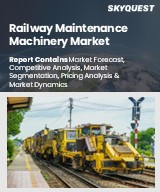
Railway Maintenance Machinery Market
Report ID: SQMIG20C2118
Report ID: SQMIG20C2118
[email protected]
USA +1 351-333-4748
Report ID:
SQMIG20C2118 |
Region:
Global |
Published Date: May, 2025
Pages:
196
|Tables:
88
|Figures:
71


Global Railway Maintenance Machinery Market size was valued at USD 4.45 Billion in 2024 and is poised to grow from USD 4.71 Billion in 2025 to USD 7.45 Billion by 2033, growing at a CAGR of 5.9% during the forecast period (2026–2033).
Governments and private industry across the globe are significantly investing in railway infrastructure to allow for greater connectivity, reduce congestion, and create sustainable transport. Such a spike in investment needs efficient maintenance works to ensure durability and safety of the infrastructure. Mega projects like China's Belt and Road Initiative and India's railway modernization are driving the need for high-end maintenance equipment.
Moreover, the CEF, the transport infrastructure investment strategic tool of the EU, will invest over 80% of such funding on efficiency-improving, sustainability, and network intelligence-enhancing measures. So large an investment indicates increased need for more high-end maintenance machinery to ensure improved and new infrastructures of the railways with best performance standards. Emphasis on sustainability and smart systems means increased reliance on emerging technologies.
In addition, for the railway maintenance machinery market growth, a lot of initial investment in R&D, production is needed, and procurement of cutting-edge technology for the equipment to be designed, purchased, and installed. All these cost money, including production, which may be heavy for small or local companies because it is an expenditure on which they cannot place a cap without compromising profitability, hence, competitive advantage.
Market snapshot - 2026-2033
Global Market Size
USD 4.2 billion
Largest Segment
Ballast Track
Fastest Growth
Non-Ballast Track
Growth Rate
5.9% CAGR
To get more insights on this market click here to Request a Free Sample Report
Global Railway Maintenance Machinery Market is segmented by Product, Sales Channel, Application, Operational Mode, End User and region. Based on Product, the market is segmented into Tamping machine, Stabilizing machinery, Ballast cleaning machinery, Rail handling machinery, Surfacing machinery and Others. Based on Sales Channel, the market is segmented into OEM and Aftermarket. Based on Application, the market is segmented into Ballast track and Non-ballast tracks. Based on Operational Mode, the market is segmented into Manual, Semi-automatic and Fully-automatic. Based on End User, the market is segmented into Railway infrastructure companies, Contractors, Railway operators and Others. Based on region, the market is segmented into North America, Europe, Asia Pacific, Latin America and Middle East & Africa.
As per the 2024 global railway maintenance machinery industry analysis, the tamping machine segment dominated the market and grow with the highest CAGR during the forecast period as it is crucial in enhancing safety and ride quality. Worn-out railway tracks often lead to derailment, and hence tamping is a very important safety function. Tamping improves the smoothness of train travel through the reduction of wear and vibrations on the track. This, in turn, enhances passenger comfort and reduces maintenance costs for rail operators.
The ballast cleaners category is projected to maintain the second largest market share during the forecast period. Most of the ballast maintenance equipment utilized are ballast regulators and ballast cleaners. Ballast cleaners are highly essential in railway operations by recycling and cleaning ballast by removing debris and dirt accumulated over time.
Based on the 2024 global railway maintenance machinery market forecast, the ballast track segment is expected to account for over USD 6.9 billion by 2032. The developing economies are investing heavily in rail infrastructure, and high-speed rail networks are expanding at a rapid rate. This surge in investments is driving a higher demand for advanced machinery used for ballast renewal, cleaning, and stabilization. With stakeholders setting their sights on extending the lifespan of rail infrastructure and enhancing network performance, a discernible trend is towards innovative ballast maintenance solutions. With the emphasis placed on extending the life of tracks and ensuring smooth running, market growth for the ballast track segment is being propelled. Innovation in ballast management equipment is also further boosting market growth. The growing emphasis on efficient and sustainable rail operations underscores the relevance of these innovations.
The non-ballast track category is anticipated to dominate the global railway maintenance machinery industry due to the enhanced use of this kind of track for urban transport and high-speed rail systems. Since these kinds of tracks have enhanced stability, diminished maintenance requirements, and longer durations, they are a prudent choice for the design of long-term infrastructures. With ongoing urban development through the regeneration of rail networks, there is greater demand for specialist technology capable of servicing track without ballast.
To get detailed segments analysis, Request a Free Sample Report
India and China are largely investing in railways, which offers a robust growth opportunity in the Asia-Pacific railway maintenance machinery market. The investment will upgrade and extend rail infrastructure, crucial in raising connectivity levels and fostering economic development. Urbanization is accelerating with expanding cities and rising populations, increasing the demand for efficient transport systems.
The China railway maintenance machinery market had the greatest market share since government-backed mega-infrastructure schemes not only enhance the quality of rail services but also satisfy the needs of upcoming urban centers, promote regional cohesion, and advance economic growth. China's Belt and Road policy, aimed at upgrading transport relationships with Southeast Asia, is creating a growing demand for track-laying machines. This boom is a manifestation of China's commitment to regional connectivity, promoting infrastructure growth and lengthening railway lines.
Japan's recent infrastructure boom is creating lucrative opportunities in various areas of the market. As the government spearheads efforts to advance transport, urban amenities, and green infrastructure, sectors like construction, engineering, and technology are set to experience substantial growth. This revival not only stimulates economic growth but also enhances the lives of the people, providing a rare window of opportunity for entrepreneurs and investors.
As a result of continued expenditures on high-speed rail and cross-border integration, Europe continues to be an important railway maintenance machinery market. With a view to automation and sustainability, the region is aiming to make rail operations more eco-friendly. Western and Central Europe, especially, are experiencing strong demand for leading-edge maintenance technology like tamping, ballast cleaning, and non-ballast track systems. This is driven by the European Union (EU) supported infrastructure developments and by older track networks.
The rail network of the United Kingdom is experiencing an ongoing modernization process, and initiatives like High Speed 2 (HS2) are generating demand for cutting-edge maintenance technology. Automation, predictive maintenance, and eco-friendly technology are being placed top of the agenda in terms of minimizing costs through life and optimizing the level of satisfaction to which passengers can be expected to become accustomed. Firms like Network Rail are more frequently using intelligent tamping and ballast cleaning machines, backed by long-term railway infrastructure resilience investment from both government and the private sector.
The government of France remains too heavily invest in its rail network at home and abroad to guarantee significant expenditure on high-speed TGV railways. In cutting down delays and maximizing safety, the SNCF is placing paramount importance on automation and digitalization of maintenance. The high driving force for the sustainability of French public transport is also fueling the need for hybrid and electric maintenance vehicles, which is supportive of a more eco-friendly and efficient railway maintenance environment.
Usage of artificial intelligence, internet of things, and robots in monitoring tracks real-time and their maintenance has topped Germany as smart rail maintenance tech in Europe. In its "Strong Rail" effort, Deutsche Bahn is increasing the services of passengers as well as freight it is offering, simultaneously elevating the need for constant and automated upkeep. In addition, the nation is a center for large equipment manufacturers, making it at the forefront of innovation in the European market for manufacturing railway maintenance machinery.
The massive freight rail system in North America, particularly in the United States and Canada, is the major driver of the railway maintenance machinery market in the region. There is an increasing focus on predictive analysis and sensor-equipped maintenance systems, which is spurring investment in track renewal and modernization projects, respectively. Moreover, the region is adopting fuel-efficient and autonomous equipment to enhance safety, minimize downtime, and enable long-term viability of its train network.
As the United States has the world's largest freight rail network, that network requires a lot of maintenance in a bid to prevent disruptions. To become more operationally efficient, major rail operators like Union Pacific and BNSF are using tamping and grinding machines for rail powered by artificial intelligence. Further, the passenger and freight rails are being upgraded as a result of investment in infrastructure by the federal government, which will give rise to an intense demand for advanced rail maintenance equipment in the future.
The Canadian railway maintenance machinery market is growing on account of infrastructure development geared towards boosting intercity and freight transportation capacity. There is significant demand being generated for ballast and track renewal equipment as a result of efforts such as the refurbishment of corridors by VIA Rail and the investment in long-haul freight handled by CN. To encourage the use of long-lasting, high-precision maintenance equipment that is adapted to the Canadian environment and landscape, cold weather capability, lifecycle efficiency, and automation are emphasized.
To know more about the market opportunities by region and country, click here to
Buy The Complete Report
More Investment in the Railway Operations Infrastructure
Need for Installing Maintenance and Automation Systems
High Costs of Both Capital and Operations
Barriers to Compliance with Regulatory and Safety Standards
Request Free Customization of this report to help us to meet your business objectives.
There is much rivalry in the global railway maintenance machinery market, where international and local businesses compete with each other on the basis of automation, product innovation, and strategic alliances. Many players are investing in R&D to develop diagnostic equipment that is AI-based and intelligent tamping. Several significant strategies involve the licensing of technology, acquisition of niche manufacturers, and geographic expansion of operations in Asia and Latin America. Plasser & Theurer, among others, is leveraging its technological dominance to offer environmentally friendly and highly effective maintenance options.
SkyQuest’s ABIRAW (Advanced Business Intelligence, Research & Analysis Wing) is our Business Information Services team that Collects, Collates, Correlates, and Analyses the Data collected by means of Primary Exploratory Research backed by robust Secondary Desk research.
As per SkyQuest analysis, it is expected that the global railway maintenance machinery market will register strong growth, and this is being propelled by the upgrading of infrastructure, expanding urban transport, and the incentive to automate. Market pressures are being revised through technological gains in artificial intelligence, internet of things, and green gear even as capital expenditure and regulatory hurdles pose challenges. While the North American and European sectors are pioneers in innovation and automation, Asia-Pacific remains the most dynamic region of greatest development. The reason is the growth and development of the rail sector. To address the increasing demand for rail systems which are not only effective but also safe and reliable, railroad manufacturers and operators are coming together to create solutions for the next generation. To ascertain the future of railway maintenance operations globally, there will be a need to maintain a constant focus on predictive maintenance, digital integration, and other green technology.
| Report Metric | Details |
|---|---|
| Market size value in 2024 | USD 4.45 Billion |
| Market size value in 2033 | USD 7.45 Billion |
| Growth Rate | 5.9% |
| Base year | 2024 |
| Forecast period | 2026-2033 |
| Forecast Unit (Value) | USD Billion |
| Segments covered |
|
| Regions covered | North America (US, Canada), Europe (Germany, France, United Kingdom, Italy, Spain, Rest of Europe), Asia Pacific (China, India, Japan, Rest of Asia-Pacific), Latin America (Brazil, Rest of Latin America), Middle East & Africa (South Africa, GCC Countries, Rest of MEA) |
| Companies covered |
|
| Customization scope | Free report customization with purchase. Customization includes:-
|
To get a free trial access to our platform which is a one stop solution for all your data requirements for quicker decision making. This platform allows you to compare markets, competitors who are prominent in the market, and mega trends that are influencing the dynamics in the market. Also, get access to detailed SkyQuest exclusive matrix.
Table Of Content
Executive Summary
Market overview
Parent Market Analysis
Market overview
Market size
KEY MARKET INSIGHTS
COVID IMPACT
MARKET DYNAMICS & OUTLOOK
Market Size by Region
KEY COMPANY PROFILES
Methodology
For the Railway Maintenance Machinery Market, our research methodology involved a mixture of primary and secondary data sources. Key steps involved in the research process are listed below:
1. Information Procurement: This stage involved the procurement of Market data or related information via primary and secondary sources. The various secondary sources used included various company websites, annual reports, trade databases, and paid databases such as Hoover's, Bloomberg Business, Factiva, and Avention. Our team did 45 primary interactions Globally which included several stakeholders such as manufacturers, customers, key opinion leaders, etc. Overall, information procurement was one of the most extensive stages in our research process.
2. Information Analysis: This step involved triangulation of data through bottom-up and top-down approaches to estimate and validate the total size and future estimate of the Railway Maintenance Machinery Market.
3. Report Formulation: The final step entailed the placement of data points in appropriate Market spaces in an attempt to deduce viable conclusions.
4. Validation & Publishing: Validation is the most important step in the process. Validation & re-validation via an intricately designed process helped us finalize data points to be used for final calculations. The final Market estimates and forecasts were then aligned and sent to our panel of industry experts for validation of data. Once the validation was done the report was sent to our Quality Assurance team to ensure adherence to style guides, consistency & design.
Analyst Support
Customization Options
With the given market data, our dedicated team of analysts can offer you the following customization options are available for the Railway Maintenance Machinery Market:
Product Analysis: Product matrix, which offers a detailed comparison of the product portfolio of companies.
Regional Analysis: Further analysis of the Railway Maintenance Machinery Market for additional countries.
Competitive Analysis: Detailed analysis and profiling of additional Market players & comparative analysis of competitive products.
Go to Market Strategy: Find the high-growth channels to invest your marketing efforts and increase your customer base.
Innovation Mapping: Identify racial solutions and innovation, connected to deep ecosystems of innovators, start-ups, academics, and strategic partners.
Category Intelligence: Customized intelligence that is relevant to their supply Markets will enable them to make smarter sourcing decisions and improve their category management.
Public Company Transcript Analysis: To improve the investment performance by generating new alpha and making better-informed decisions.
Social Media Listening: To analyze the conversations and trends happening not just around your brand, but around your industry as a whole, and use those insights to make better Marketing decisions.
REQUEST FOR SAMPLE
 REQUEST FREE CUSTOMIZATION


Want to customize this report? This report can be personalized according to your needs. Our analysts and industry experts will work directly with you to understand your requirements and provide you with customized data in a short amount of time. We offer $1000 worth of FREE customization at the time of purchase.
Feedback From Our Clients


 USA (+1) 351-333-4748

