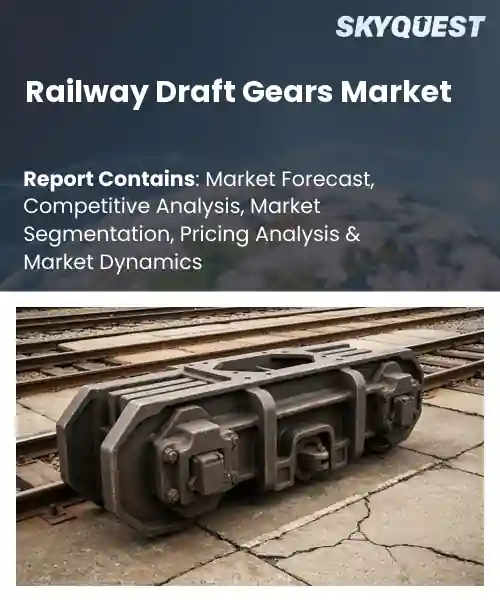
Railway Draft Gears Market
Report ID: SQMIG20U2038
Report ID: SQMIG20U2038
[email protected]
USA +1 351-333-4748
Report ID:
SQMIG20U2038 |
Region:
Global |
Published Date: August, 2026
Pages:
157
|Tables:
143
|Figures:
78


Global Railway Draft Gears Market size was valued at USD 724.8 Million in 2024 and is poised to grow from USD 766.11 Million in 2025 to USD 1193.7 Million by 2033, growing at a CAGR of 5.7% during the forecast period (2026-2033).
The railway draft gears market growth is driven by expanding railway networks, more freight movement, and a lot of investments in rail infrastructure modernization around the globe. As freight keeps growing, the demand for quick, dependable freight wagons rises, so there’s more need for advanced draft gear systems to soak up shocks and cut down longitudinal forces between rail vehicles. Government push to build high-speed, urban, and heavy haul rail lines is also helping market growth along, even when budgets are tight. Then there’s the older fleet situation, aging railway wagons need replacement or upgraded draft gears, but with better durability, and more load handling capabilities. More attention on railway safety and operational efficiency, plus lower maintenance spend, is pushing operators toward more technologically advanced systems.
On top of that, cross-border freight corridors are expanding, and urbanization keeps moving forward so rail transportation demand gets stronger. Manufacturers are leaning into lightweight materials and focusing on better energy absorption, longer service life, and steadier performance when conditions are rough and the tracks aren’t exactly forgiving.
AI and IoT are reshaping the railway draft gears market outlook by putting sensors on them that keep collecting data like vibration, temperature, and load, all the time. Those data streams then get fed into machine learning models that can catch wear trends early, instead of waiting for failures, and instead of sticking only to scheduled overhauls. Operators get real time dashboards too, so they can see gear health across whole fleets, which reduces the “surprise” breakdowns, and also helps the gears last longer. When the gear systems connect with IoT platforms, it also becomes possible to do remote firmware updates, and adaptive control modes. That means performance can adjust to different train speeds and cargo weights, instead of staying fixed. Together, this combined intelligence raises safety levels, cuts downtime, and supports tighter timetables, making draft gear systems more responsive to day to day operating demands.
Market snapshot - (2026-2033)
Global Market Size
USD 724.8 Million
Largest Segment
Friction Draft Gears
Fastest Growth
Elastomeric Draft Gears
Growth Rate
5.7% CAGR
To get more insights on this market click here to Request a Free Sample Report
The global railway draft gears market is segmented by draft gear type, railcar type, application, end user, sales channel and region. Based on draft gear type, the market is segmented into Friction Draft Gears, Hydraulic Draft Gears and Elastomeric Draft Gears. Based on railcar type, the market is segmented into Freight Wagons, Passenger Coaches and Locomotives. Based on application, the market is segmented into New Rolling Stock, Retrofit and Maintenance & Replacement. Based on end user, the market is segmented into Railway Operators, Rolling Stock OEMs and MRO Providers. Based on sales channel, the market is segmented into OEM and Aftermarket. Based on region, the market is segmented into North America, Europe, Asia Pacific, Latin America and Middle East & Africa.
As per the railway draft gears market analysis, the friction draft gears segment dominates since rail operators bank on its tested mechanical dependability to soak up longitudinal forces when braking is happening, not just in theory but in real life. Because its construction is straight forward, the upkeep load stays low , which matches the cost conscious side of both freight and passenger services. Also, the entrenched supplier network plus years of in field know how builds trust, so it keeps being picked for new rolling stock, and even for retrofits. On top of that, it can handle shock loads without needing complicated fluid setups , so it fits rough operating conditions better than some alternatives.
However, the hydraulic draft gears segment is showing the strongest growth pace, since rail networks want gentler force transfer and less wear on the equipment. Modern fluid technologies allow more exact damping control , which sounds appealing to operators updating locomotives for higher speeds. That improvement nudges demand upward for fresh installations, opening market space and basically pushing more engineering work forward.
According to the railway draft gears market forecast, the New Rolling Stock segment dominates as manufacturers tend to keep things simple by embedding draft gear solutions directly into the build specs, so the integration with structural components is clean, right from the start. This early move avoids annoying compatibility troubles later, and it lines up with the sector push toward better performance and safety expectations. If everything is incorporated smoothly, certification can be faster too , which helps new fleets enter service quicker while still satisfying regulatory requirements. Plus, when energy efficient propulsion systems get prioritized, the draft gears must manage higher torque yet keep noise low, so the role stays central in today train designs.
Meanwhile, the Retrofit segment is turning into a fast growing pocket because older fleets need updated draft gear tech to meet current safety thresholds. Operators roll out replacement programs with better materials and coatings, which helps extend service life and cuts downtime. That renewal habit increases demand for flexible gear solutions and gives suppliers a more steady stream of new contracts, even when overall fleet growth isn’t dramatic.
To get detailed segments analysis, Request a Free Sample Report
As per the railway draft gears market regional forecast, Asia Pacific dominance comes from a mix of advanced manufacturing know-how, long span rail network development, and an engineering focus that feels very exact, almost obsessive. In the region there’s a thick supplier web where high‑quality machining meets inventive material science, so companies can roll out draft gears that still satisfy tough safety expectations. Also, original equipment manufacturers and component suppliers stay in close contact , so product changes happen faster and offerings fit modern rolling stock needs. On top of that supportive policy setups plus strategic public private programs keep pushing continual improvements for high speed and commuter rail systems, which basically keeps demand steady for dependable gear solutions. This all together, the technical skill, the tough supply chains, and those proactive market signals, puts Asia Pacific as the main hub for railway draft gears globally.
Japan Railway Draft Gears Market
The Railway Draft Gears sector in Japan is tied to a long history of precision engineering, and a very connected supply chain where component makers link directly with major train manufacturers. Local demand is boosted by ongoing modernization for high speed and urban rail services, while export efforts ride on Japan’s brand for quality and steadiness. Joint research efforts also help material performance and gear efficiency, plus they support the design of next generation propulsion systems.
South Korea Railway Draft Gears Market
The Railway Draft Gears industry in South Korea leans hard into technological breakthroughs and a manufacturing base that is quick to adjust to worldwide norms. The country’s wide high speed rail map creates steady needs for durable gear solutions, and export work is helped by competitive pricing and smart coating techniques. Universities and industry teams keep working together so lightweight high strength material choices get adopted sooner for new projects.
The European railway draft gears sector is moving ahead because of a blend of strict safety rules, a mature rail system, and a clear sustainability angle. Manufacturers do well with strong engineering know-how and a joint ecosystem, including major OEMs, research groups, and standards bodies. Money going into high speed corridors and upgrades for older lines means more demand for gear sets that stay durable while lowering noise and vibration. Europe’s green mobility agenda also pushes lightweight, high efficiency components, and strong intellectual property systems make it easier to keep innovating. Put simply, these elements keep Europe’s rapid expansion going in the railway draft gears market.
Germany Railway Draft Gears Market
The Railway Draft Gears Market in Germany is shaped by an engineering tradition plus a dense network of specialized suppliers that serve both local needs and international train manufacturers. Germany’s high speed and regional rail services generate consistent demand for precisely crafted gears, while quality assurance remains a priority so products match rigorous European requirements. Industry and universities collaborate on material science and gear design improvements, which keeps Germany viewed as a leader in this space.
United Kingdom Railway Draft Gears Market
The Railway Draft Gears Market share in the United Kingdom is growing as rail electrification and capacity upgrades expand along key corridors. The market benefits from a cooperative setup where component makers align with train operators who want better reliability and reduced maintenance expenses. Modular design and digital monitoring are getting more attention, which matches the country’s push toward smarter rail infrastructure. Research partnerships with engineering institutes also back development of next-generation gear materials and manufacturing methods.
France Railway Draft Gears Market
The Railway Draft Gears Market in France is the fastest growing slice, largely because of bold high speed rail expansion plans and a national sustainability drive. Gear manufacturers working alongside leading train builders help bring in lightweight , quieter components faster. Government support for modernizing regional lines increases demand for reliable gear solutions that still satisfy strict environmental requirements. Academic research hubs contribute newer material concepts , which keeps France’s market momentum rising quickly.
North America is strengthening its railway draft gears position, using a mix of infrastructure revitalization, smarter manufacturing methods and also a clear push on safety, reliability. The region has huge freight and passenger rail lines, so gear solutions have to handle heavy loads plus varying operating situations. New investment into high‑capacity rail corridors, plus digital asset management tools, makes it easier to move toward gears with higher durability and predictive maintenance functions. At the same time, component suppliers and major locomotive builders keep collaborating, so material engineering and precision machining keep getting better. Altogether these forces raise North America’s standing as an important market for high‑performance railway draft gears, even when demand shifts.
United States Railway Draft Gears Market
In the United States, the railway draft gears market benefits from a big freight rail network and ongoing modernization of passenger routes. There’s strong emphasis on high reliability and meeting strict safety requirements, so the need stays for sturdy gear designs. When manufacturing technologies, like additive processes and more thorough inspection, get integrated the component quality tends to rise and the time to deliver can drop a little. Partnerships with research institutions also help speed up progress on alloys and coating solutions, that reinforces the competitive advantage the United States already has.
Canada Railway Draft Gears Market
In Canada, the railway draft gears market is mainly shaped by resilient freight corridors and the growth of commuter rail projects in busy urban areas. The market uses a deep pool of engineering talent and keeps close ties with locomotive manufacturers, to deliver gear solutions that focus on durability and easier upkeep. Predictive analytics and condition‑based monitoring are being adopted, which supports asset reliability day after day. Meanwhile, joint research efforts look into high‑strength, lighter material choices, designed for the country’s changing climate conditions, and that helps maintain consistent performance.
To know more about the market opportunities by region and country, click here to
Buy The Complete Report
Rising Demand For Rail Freight
Advancements In Gear Material Technology
High Capital Investment Requirements
Stringent Safety And Certification Standards
Request Free Customization of this report to help us to meet your business objectives.
The competitive scene in the global railway draft gears market is shaped by hard rivalry between well established makers and newer innovators, and this keeps pushing everyone toward constant product upgrades plus more cost efficiency tweaks. Lately, there’s been M&A stuff too. For example Wabtec’s acquisition of Faiveley Transport pooled together know how in high performance gearing. Also, strategic partnerships matter, like when Siemens Mobility and Alstom collaborate to co-develop next generation lightweight draft gear assemblies, which speeds up the transfer of know how and engineering practices. At the same time, a lot of firms are putting real money into additive manufacturing, and newer materials, mainly to satisfy stricter safety expectations and also lower the lifecycle spending.
Top Player’s Company Profile
Recent Developments in the Railway Draft Gears Market
SkyQuest’s ABIRAW (Advanced Business Intelligence, Research & Analysis Wing) is our Business Information Services team that Collects, Collates, Correlates, and Analyses the Data collected by means of Primary Exploratory Research backed by robust Secondary Desk research.
As per SkyQuest analysis, the global railway draft gears market is expected to grow. This growth is mainly pulled by freight demand, so operators feel pressure to use more efficient gear systems. Also, gear material innovations give options that are lighter and last longer, which pushes adoption even further. The friction draft gear segment is still the leading pick, mostly due to its long proven reliability and low upkeep. Asia Pacific remains in front, since rail expansion is broad there, and the manufacturing base is strong as well. That said, there are restraints: high capital investment needs can slow adoption for smaller operators and for several emerging markets, across the period up to 2025 and continuing beyond.
| Report Metric | Details |
|---|---|
| Market size value in 2024 | USD 724.8 Million |
| Market size value in 2033 | USD 1193.7 Million |
| Growth Rate | 5.7% |
| Base year | 2024 |
| Forecast period | (2026-2033) |
| Forecast Unit (Value) | USD Million |
| Segments covered |
|
| Regions covered | North America (US, Canada), Europe (Germany, France, United Kingdom, Italy, Spain, Rest of Europe), Asia Pacific (China, India, Japan, Rest of Asia-Pacific), Latin America (Brazil, Rest of Latin America), Middle East & Africa (South Africa, GCC Countries, Rest of MEA) |
| Companies covered |
|
| Customization scope | Free report customization with purchase. Customization includes:-
|
To get a free trial access to our platform which is a one stop solution for all your data requirements for quicker decision making. This platform allows you to compare markets, competitors who are prominent in the market, and mega trends that are influencing the dynamics in the market. Also, get access to detailed SkyQuest exclusive matrix.
Table Of Content
Executive Summary
Market overview
Parent Market Analysis
Market overview
Market size
KEY MARKET INSIGHTS
COVID IMPACT
MARKET DYNAMICS & OUTLOOK
Market Size by Region
KEY COMPANY PROFILES
Methodology
For the Railway Draft Gears Market, our research methodology involved a mixture of primary and secondary data sources. Key steps involved in the research process are listed below:
1. Information Procurement: This stage involved the procurement of Market data or related information via primary and secondary sources. The various secondary sources used included various company websites, annual reports, trade databases, and paid databases such as Hoover's, Bloomberg Business, Factiva, and Avention. Our team did 45 primary interactions Globally which included several stakeholders such as manufacturers, customers, key opinion leaders, etc. Overall, information procurement was one of the most extensive stages in our research process.
2. Information Analysis: This step involved triangulation of data through bottom-up and top-down approaches to estimate and validate the total size and future estimate of the Railway Draft Gears Market.
3. Report Formulation: The final step entailed the placement of data points in appropriate Market spaces in an attempt to deduce viable conclusions.
4. Validation & Publishing: Validation is the most important step in the process. Validation & re-validation via an intricately designed process helped us finalize data points to be used for final calculations. The final Market estimates and forecasts were then aligned and sent to our panel of industry experts for validation of data. Once the validation was done the report was sent to our Quality Assurance team to ensure adherence to style guides, consistency & design.
Analyst Support
Customization Options
With the given market data, our dedicated team of analysts can offer you the following customization options are available for the Railway Draft Gears Market:
Product Analysis: Product matrix, which offers a detailed comparison of the product portfolio of companies.
Regional Analysis: Further analysis of the Railway Draft Gears Market for additional countries.
Competitive Analysis: Detailed analysis and profiling of additional Market players & comparative analysis of competitive products.
Go to Market Strategy: Find the high-growth channels to invest your marketing efforts and increase your customer base.
Innovation Mapping: Identify racial solutions and innovation, connected to deep ecosystems of innovators, start-ups, academics, and strategic partners.
Category Intelligence: Customized intelligence that is relevant to their supply Markets will enable them to make smarter sourcing decisions and improve their category management.
Public Company Transcript Analysis: To improve the investment performance by generating new alpha and making better-informed decisions.
Social Media Listening: To analyze the conversations and trends happening not just around your brand, but around your industry as a whole, and use those insights to make better Marketing decisions.
REQUEST FOR SAMPLE
 REQUEST FREE CUSTOMIZATION
Global Railway Draft Gears Market size was valued at USD 724.8 Million in 2024 and is poised to grow from USD 766.11 Million in 2025 to USD 1193.7 Million by 2033, growing at a CAGR of 5.7% during the forecast period (2026-2033).
The competitive landscape of the global railway draft gears market is shaped by intense rivalry among established manufacturers and emerging innovators, driving continuous product enhancement and cost‑efficiency improvements. Recent M&A activity such as Wabtec’s acquisition of Faiveley Transport has consolidated expertise in high‑performance gearing, while strategic partnerships like Siemens Mobility collaborating with Alstom to co‑develop next‑generation lightweight draft gear assemblies accelerate technology transfer. Companies are also investing heavily in additive manufacturing and advanced materials to meet stricter safety standards and reduce lifecycle costs. 'Wabtec Corporation', 'Amsted Rail Company, Inc.', 'Escorts Kubota Limited', 'Nippon Steel Corporation', 'Voith GmbH & Co. KGaA', 'Dellner Couplers AB', 'CAF MiiRA', 'Titagarh Rail Systems Limited', 'CRRC Corporation Limited', 'SAB WABCO', 'Schaefer Technologies', 'SOMA GmbH', 'Downer Rail', 'NARSTCO', 'Greenbrier Companies, Inc.', 'FreightCar America, Inc.', 'Indian Railways Wheel Factory', 'Mitsubishi Steel Mfg. Co., Ltd.', 'NIPPON COUPLER Co., Ltd.', 'L.B. Foster Company'
The growth of intercity logistics and the shift toward more sustainable cargo handling are prompting railway operators to adopt higher‑efficiency gear systems, which enable smoother power transmission and reduced maintenance intervals. This operational advantage aligns with network expansion plans and supports longer train configurations, thereby creating a compelling business case for investing in advanced draft gears across emerging and mature markets alike. The anticipated reliability improvements also foster confidence among freight customers, encouraging broader adoption of rail solutions over road transport alternatives.
Digital Twin Integration: Rail operators are increasingly adopting digital twin technology to create virtual replicas of gear assemblies, enabling real‑time monitoring of wear patterns, predictive maintenance scheduling, and rapid design iteration. This virtual environment reduces downtime, extends component lifespan, and supports continuous improvement across the supply chain. As manufacturers embed sensor data and analytics, decision‑making becomes more data‑driven, fostering collaborations with software firms and accelerating the shift toward condition‑based asset management in rail networks for future‑proofed operations worldwide and sustainable growth objectives.
Why does Asia Pacific Dominate the Global Railway Draft Gears Market? |@12


Want to customize this report? This report can be personalized according to your needs. Our analysts and industry experts will work directly with you to understand your requirements and provide you with customized data in a short amount of time. We offer $1000 worth of FREE customization at the time of purchase.
Feedback From Our Clients


 USA (+1) 351-333-4748

