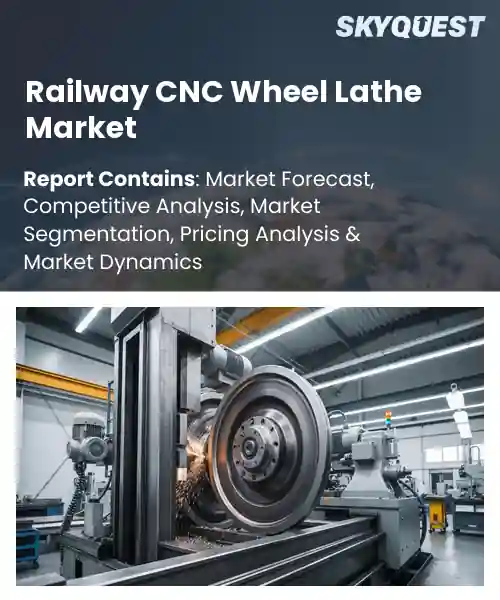
Railway CNC Wheel Lathe Market
Report ID: SQMIG20I3573
Report ID: SQMIG20I3573
[email protected]
USA +1 351-333-4748
Report ID:
SQMIG20I3573 |
Region:
Global |
Published Date: August, 2026
Pages:
157
|Tables:
117
|Figures:
77


Global Railway CNC Wheel Lathe Market size was valued at USD 486.3 Million in 2024 and is poised to grow from USD 518.4 Million in 2025 to USD 864.41 Million by 2033, growing at a CAGR of 6.6% during the forecast period (2026-2033).
The railway CNC wheel lathe market comprises manufacturers and service providers that refurbish train wheels using computer‑numerical‑controlled turning machines. Its importance stems from the safety‑critical nature of wheel geometry, where deviations can cause derailments or accelerated wear. Historically, the sector relied on manual lathes, but the shift to CNC technology accelerated after the 1990s when European high‑speed networks demanded tighter tolerances and faster turnaround. For example, Deutsche Bahn adopted CNC wheels in 2002, cutting re‑machining time by 30 percent. This evolution reflects broader automation trends and illustrates how regulatory pressure and the need for operational efficiency drive market expansion globally.
Rising freight volumes and the push for higher axle loads constitute the primary catalyst propelling the global railway CNC wheel lathe market forward. As cargo demand intensifies, wheels endure greater stress, prompting more frequent re‑profiling; CNC lathes respond by delivering sub‑micron precision that extends service life and reduces downtime. Consequently, operators such as China Railway Corporation have invested in multi‑axis CNC stations, observing a 20% drop in wheel‑related failures. This efficiency gain unlocks opportunities for aftermarket service contracts and for manufacturers to offer predictive‑maintenance software integrated with lathe data, further spurring market growth through collaborative industry standards worldwide in.
How is AI-driven Automation Improving Efficiency In The Railway CNC Wheel Lathe Market?
AI‑driven automation is reshaping the railway CNC wheel lathe market by integrating real‑time data analytics, predictive maintenance and adaptive control systems. Modern lathes now monitor vibration, temperature and tool wear, allowing operators to adjust cutting parameters on the fly and avoid unexpected downtime. This shift reduces manual intervention, shortens setup cycles and improves the consistency of wheel profiles, which is critical for safety and ride quality. As rail networks expand and demand higher throughput, manufacturers are adopting these intelligent solutions to stay competitive and meet tighter delivery schedules while maintaining high precision standards.
Market snapshot - (2026-2033)
Global Market Size
USD 486.3 Million
Largest Segment
Underfloor Wheel Lathe
Fastest Growth
Above-Floor Wheel Lathe
Growth Rate
6.6% CAGR
To get more insights on this market click here to Request a Free Sample Report
Global railway cnc wheel lathe market is segmented by product type, operation mode, application, end user and region. Based on product type, the market is segmented into Underfloor Wheel Lathe and Above-Floor Wheel Lathe. Based on operation mode, the market is segmented into Automatic and Semi-Automatic. Based on application, the market is segmented into Passenger Rail, Freight Rail, Metro & Light Rail and High-Speed Rail. Based on end user, the market is segmented into Railway Operators, Rolling Stock Manufacturers and Maintenance, Repair & Overhaul (MRO) Facilities. Based on region, the market is segmented into North America, Europe, Asia Pacific, Latin America and Middle East & Africa.
Underfloor Wheel Lathe segment dominates because its integration directly into the track structure eliminates the need for track removal, streamlining turnaround time and minimizing service disruption. This inherent efficiency aligns with operators’ emphasis on uptime, making it the preferred choice for routine wheel reprofiling. The design’s compact footprint also fits constrained depot spaces, further reinforcing its appeal across diverse railway networks and supports seamless integration with automated inspection systems.
However, Above Floor Wheel Lathe segment is witnessing the strongest growth momentum because its elevated configuration accommodates larger wheelsets and facilitates easier access for high capacity freight and high speed rail applications. Innovations in modular tooling and remote operation are expanding its adoption, unlocking new opportunities for advanced wheel refurbishment across expanding rail fleets.
Automatic segment leads because it delivers uninterrupted machining cycles, reducing human error and accelerating throughput. Real time sensor feedback enables precise material removal, aligning with strict safety standards and allowing operators to meet dense scheduling demands. The ability to integrate with enterprise maintenance management systems further enhances predictive planning, making fully automated lathe solutions the cornerstone of modern rail asset strategies and delivering measurable cost efficiencies across the lifecycle while supporting sustainability objectives.
Meanwhile, Semi Automatic segment emerges as the key high growth area because it offers a balanced blend of operator control and technological assistance, appealing to facilities transitioning from manual to fully automated systems. Its flexibility accommodates diverse wheel profiles and allows incremental investment, driving broader adoption among mid size maintenance shops and fostering ecosystem expansion for hybrid workflow solutions.
To get detailed segments analysis, Request a Free Sample Report
Asia Pacific dominates the global Railway CNC Wheel Lathe market because the region combines a mature railway infrastructure with a deep engineering tradition that fuels continuous innovation in precision machining. Leading manufacturers have integrated sophisticated computer‑numerical‑control technologies with lean production philosophies, delivering highly reliable lathe solutions tailored to heavy‑duty rolling stock requirements. Close collaboration between original equipment makers, component suppliers, and research institutes accelerates product development cycles and ensures rapid adoption of advanced materials and monitoring systems. Strong governmental emphasis on rail network expansion and modernization creates a steady pipeline of investment, while export‑focused strategies leverage the region’s cost‑effective yet high‑quality production capabilities to serve markets worldwide. These synergistic factors cement Asia Pacific’s position as the benchmark for technological leadership and supply reliability in the sector.
Railway CNC Wheel Lathe Market in Japan benefits from a legacy of precision engineering and a dense high‑speed rail network that demands exacting wheel maintenance standards. Domestic manufacturers collaborate closely with leading rail operators to develop lathe configurations optimized for Japanese loading gauges and climate conditions. Ongoing investment in smart factory initiatives enhances automation and data analytics, while a strong export tradition positions Japanese lathe technology as a preferred choice for international rail fleets.
Railway CNC Wheel Lathe Market in South Korea is propelled by a robust manufacturing base that emphasizes high‑tech automation and rapid prototyping. Industry leaders work in concert with rail authorities to tailor lathe systems that address the specific wear patterns of Korean rolling stock. Strategic government programs support research into advanced cutting tools and digital twin applications, fostering a culture of continuous improvement. The synergy between local expertise and global outreach enables South Korean suppliers to deliver competitively priced, high‑quality solutions across diverse market segments.
Europe experiences rapid expansion of the Railway CNC Wheel Lathe market due to a convergence of stringent safety regulations, aggressive sustainability agendas, and substantial investment in high‑speed passenger corridors. The region’s emphasis on interoperable standards encourages manufacturers to develop versatile lathe platforms adaptable to varied gauge requirements. Digital transformation initiatives, such as predictive maintenance and IoT connectivity, enhance operational efficiency and reduce downtime for rail operators. Collaborative research networks across the continent accelerate adoption of cutting‑edge materials and energy‑efficient processes. Together, these dynamics reinforce Europe’s reputation as a hub for advanced rail technology and drive continuous demand for sophisticated wheel‑lathing solutions.
Railway CNC Wheel Lathe Market in Germany benefits from a strong engineering heritage and a well‑established network of heavy‑industry suppliers. German manufacturers focus on precision design, integrating robust automation and advanced diagnostic features that meet the exacting standards of domestic and European rail operators. Close ties with research institutions foster ongoing development of high‑performance tooling and sustainable machining practices, reinforcing Germany’s dominant position in the European landscape.
Railway CNC Wheel Lathe Market in the United Kingdom is energized by ambitious modernization programs and a renewed focus on high‑speed rail corridors. Suppliers are aligning product portfolios with the UK’s drive for increased network capacity and reduced carbon footprints, emphasizing modular designs and remote monitoring capabilities. Partnerships between rail infrastructure agencies and technology firms accelerate the rollout of intelligent lathe solutions that enhance turnaround times and support the nation’s strategic mobility objectives.
Railway CNC Wheel Lathe Market in France is emerging as a growing niche driven by expanding freight corridors and a national commitment to greener transport modes. French manufacturers are adopting flexible lathe architectures that accommodate diverse rolling stock profiles while integrating energy‑saving features. Collaborative initiatives with European research bodies are fostering innovation in composite wheel materials and adaptive control systems, positioning France as an emerging contributor to the continent’s rail maintenance ecosystem.
North America strengthens its position in the Railway CNC Wheel Lathe market through a focus on reliability, large‑scale freight operations, and the integration of advanced digital technologies. Rail operators prioritize equipment that can endure high mileage and harsh operating environments, prompting manufacturers to enhance durability and precision in lathe design. Government incentives for infrastructure renewal and private sector investment in next‑generation rail assets drive demand for sophisticated wheel‑lathing solutions. The adoption of data‑driven maintenance strategies, including real‑time condition monitoring and AI‑enabled forecasting, improves asset longevity and operational efficiency, cementing North America’s role as a key player in the global market.
Railway CNC Wheel Lathe Market in the United States is shaped by an extensive freight rail network that requires high‑throughput, rugged lathe systems capable of handling diverse wheel wear scenarios. Domestic manufacturers emphasize scalability and integration with cloud‑based maintenance platforms, enabling operators to optimize service schedules and reduce downtime. Collaborative efforts with railcar builders and technology providers accelerate the introduction of smart lathe solutions that align with the industry’s emphasis on cost efficiency and asset performance.
Railway CNC Wheel Lathe Market in Canada reflects the nation’s commitment to maintaining robust rail links across challenging geographies and climatic conditions. Suppliers focus on producing lathe equipment that delivers reliable performance in cold environments while supporting the growing adoption of predictive maintenance frameworks. Partnerships with regional rail authorities encourage the development of customized solutions that address the unique demands of Canada’s mixed passenger and freight services.
To know more about the market opportunities by region and country, click here to
Buy The Complete Report
Adoption Of Automation is Growing
Rise In High Speed Rail Projects
High Capital Investment is Required
Stringent Safety Regulations are Challenging
Request Free Customization of this report to help us to meet your business objectives.
The competitive landscape is shaped by intense rivalry among established manufacturers such as Linde‑Hilfl, SLM Group and CRRC, each leveraging strategic M&A, joint ventures and advanced digital technologies to capture market share; recent drivers include the push for higher precision and reduced downtime, prompting firms to integrate AI‑based monitoring, acquire specialized CNC software providers and form partnerships with automation leaders to accelerate product innovation.
SkyQuest’s ABIRAW (Advanced Business Intelligence, Research & Analysis Wing) is our Business Information Services team that Collects, Collates, Correlates, and Analyses the Data collected by means of Primary Exploratory Research backed by robust Secondary Desk research.
As per SkyQuest analysis, the global railway CNC wheel lathe market is being propelled primarily by the growing adoption of automation, which delivers tighter tolerances and faster turnaround for wheel refurbishment. A second important driver is the surge in high‑speed rail projects that demand ultra‑precise wheel geometry, further fueling demand for advanced CNC lathes. The market’s strongest restraint is the high capital outlay required to acquire and integrate these sophisticated machines, which can discourage smaller operators. Asia Pacific dominates the landscape due to its mature rail networks, strong engineering base and aggressive infrastructure investment, while the underfloor wheel lathe segment leads in volume because its integration into the track reduces downtime and service disruption.
| Report Metric | Details |
|---|---|
| Market size value in 2024 | USD 486.3 Million |
| Market size value in 2033 | USD 864.41 Million |
| Growth Rate | 6.6% |
| Base year | 2024 |
| Forecast period | (2026-2033) |
| Forecast Unit (Value) | USD Million |
| Segments covered |
|
| Regions covered | North America (US, Canada), Europe (Germany, France, United Kingdom, Italy, Spain, Rest of Europe), Asia Pacific (China, India, Japan, Rest of Asia-Pacific), Latin America (Brazil, Rest of Latin America), Middle East & Africa (South Africa, GCC Countries, Rest of MEA) |
| Companies covered |
|
| Customization scope | Free report customization with purchase. Customization includes:-
|
To get a free trial access to our platform which is a one stop solution for all your data requirements for quicker decision making. This platform allows you to compare markets, competitors who are prominent in the market, and mega trends that are influencing the dynamics in the market. Also, get access to detailed SkyQuest exclusive matrix.
Table Of Content
Executive Summary
Market overview
Parent Market Analysis
Market overview
Market size
KEY MARKET INSIGHTS
COVID IMPACT
MARKET DYNAMICS & OUTLOOK
Market Size by Region
KEY COMPANY PROFILES
Methodology
For the Railway CNC Wheel Lathe Market, our research methodology involved a mixture of primary and secondary data sources. Key steps involved in the research process are listed below:
1. Information Procurement: This stage involved the procurement of Market data or related information via primary and secondary sources. The various secondary sources used included various company websites, annual reports, trade databases, and paid databases such as Hoover's, Bloomberg Business, Factiva, and Avention. Our team did 45 primary interactions Globally which included several stakeholders such as manufacturers, customers, key opinion leaders, etc. Overall, information procurement was one of the most extensive stages in our research process.
2. Information Analysis: This step involved triangulation of data through bottom-up and top-down approaches to estimate and validate the total size and future estimate of the Railway CNC Wheel Lathe Market.
3. Report Formulation: The final step entailed the placement of data points in appropriate Market spaces in an attempt to deduce viable conclusions.
4. Validation & Publishing: Validation is the most important step in the process. Validation & re-validation via an intricately designed process helped us finalize data points to be used for final calculations. The final Market estimates and forecasts were then aligned and sent to our panel of industry experts for validation of data. Once the validation was done the report was sent to our Quality Assurance team to ensure adherence to style guides, consistency & design.
Analyst Support
Customization Options
With the given market data, our dedicated team of analysts can offer you the following customization options are available for the Railway CNC Wheel Lathe Market:
Product Analysis: Product matrix, which offers a detailed comparison of the product portfolio of companies.
Regional Analysis: Further analysis of the Railway CNC Wheel Lathe Market for additional countries.
Competitive Analysis: Detailed analysis and profiling of additional Market players & comparative analysis of competitive products.
Go to Market Strategy: Find the high-growth channels to invest your marketing efforts and increase your customer base.
Innovation Mapping: Identify racial solutions and innovation, connected to deep ecosystems of innovators, start-ups, academics, and strategic partners.
Category Intelligence: Customized intelligence that is relevant to their supply Markets will enable them to make smarter sourcing decisions and improve their category management.
Public Company Transcript Analysis: To improve the investment performance by generating new alpha and making better-informed decisions.
Social Media Listening: To analyze the conversations and trends happening not just around your brand, but around your industry as a whole, and use those insights to make better Marketing decisions.
REQUEST FOR SAMPLE
 REQUEST FREE CUSTOMIZATION
Global Railway Cnc Wheel Lathe Market size was valued at USD 486.3 Million in 2024 and is poised to grow from USD 518.4 Million in 2025 to USD 864.41 Million by 2033, growing at a CAGR of 6.6% during the forecast period (2026-2033).
The competitive landscape is shaped by intense rivalry among established manufacturers such as Linde‑Hilfl, SLM Group and CRRC, each leveraging strategic M&A, joint ventures and advanced digital technologies to capture market share; recent drivers include the push for higher precision and reduced downtime, prompting firms to integrate AI‑based monitoring, acquire specialized CNC software providers and form partnerships with automation leaders to accelerate product innovation. 'Hegenscheidt-MFD GmbH', 'Danobatgroup', 'Niles-Simmons-Hegenscheidt GmbH', 'RAFAMET S.A.', 'NSH USA Corporation', 'MECNO SERVICE S.r.l.', 'Geminis Lathes S.A.', 'PITTLER T&S GmbH', 'Hankook Machine Tools Co., Ltd.', 'Qiqihar No.2 Machine Tool (Group) Co., Ltd.', 'Dalian Machine Tool Group Co., Ltd.', 'Shenyang Machine Tool Co., Ltd.', 'JSC Stan-Samara', 'Baoji Machine Tool Group Co., Ltd.', 'Doosan Machine Tools Co., Ltd.', 'HACO Group', 'Nanjing No.2 Machine Tool Works Co., Ltd.', 'FFG Europe & Americas', 'Toshiba Machine Co., Ltd.', 'Yamazaki Mazak Corporation'
The shift toward automated CNC wheel lathes enables manufacturers to achieve consistent dimensional accuracy while minimizing manual intervention, thereby reducing cycle times and enhancing overall equipment effectiveness. This technological momentum fosters confidence among railway operators seeking reliable maintenance solutions, and it stimulates supplier investment in advanced control systems. Consequently, the market experiences accelerated acceptance as operators recognize the tangible benefits of reduced labor dependence and improved product quality, reinforcing growth trajectories across both established and emerging railway networks globally today rapidly.
Smart Automation Integration: Railway operators are increasingly adopting CNC wheel lathes equipped with AI-driven monitoring and predictive maintenance capabilities. This shift enables real‑time condition assessment, reduces unscheduled downtime, and extends tool life. By integrating sensor data with cloud analytics, manufacturers can offer tailored service contracts and remote diagnostics, fostering tighter OEM‑operator collaboration. The resulting efficiency gains encourage fleet upgrades, positioning smart automation as a cornerstone of modern rail infrastructure and driving demand for next‑generation lathe solutions worldwide through digital platforms globally and partnerships.
Why does Asia Pacific Dominate the Global Railway CNC Wheel Lathe Market? |@12


Want to customize this report? This report can be personalized according to your needs. Our analysts and industry experts will work directly with you to understand your requirements and provide you with customized data in a short amount of time. We offer $1000 worth of FREE customization at the time of purchase.
Feedback From Our Clients


 USA (+1) 351-333-4748

