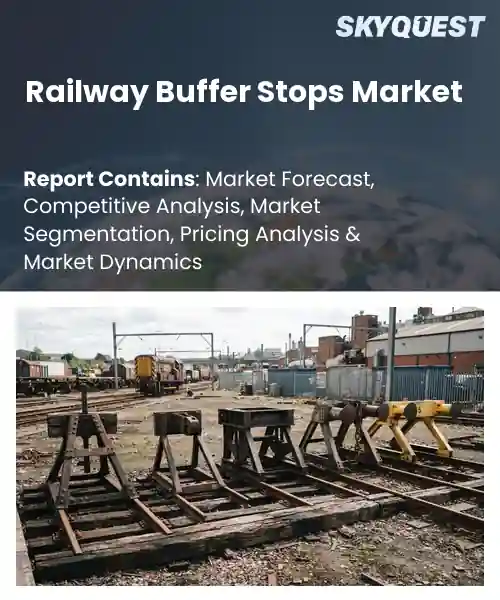
Railway Buffer Stops Market
Report ID: SQMIG20U2043
Report ID: SQMIG20U2043
[email protected]
USA +1 351-333-4748
Report ID:
SQMIG20U2043 |
Region:
Global |
Published Date: August, 2026
Pages:
157
|Tables:
145
|Figures:
78


Global Railway Buffer Stops Market size was valued at USD 582.3 Million in 2024 and is poised to grow from USD 615.49 Million in 2025 to USD 959.01 Million by 2033, growing at a CAGR of 5.7% during the forecast period (2026-2033).
Urban railway buffer stops market supplies devices at track termini that arrest rolling stock and protect infrastructure, a role that has grown as networks expand and train speeds increase. Primary demand originates from tightening safety regulations worldwide, prompting operators to replace antiquated mechanical stops with hydraulic or friction systems. Historically, simple wooden blocks served lines, but high‑speed services in Europe and Asia forced a shift toward designs equipped with sensors and monitoring. For example, Network Rail installed hydraulic stops on commuter lines in 2015, and Japan’s Shinkansen adopted friction stops for velocities above 300 km/h. This evolution has broadened the market. Urbanization drives a surge in commuter rail projects, which in turn raises safety requirements at terminal stations and fuels demand for modern buffer stops. As cities expand electrified metros and light‑rail lines, the risk of overruns grows, prompting procurement of energy‑dissipating stops that integrate with signaling and diagnostics. Delhi Metro’s Phase III upgrade installed smart buffer stops with real‑time monitoring, cutting incident response time by 30 percent. Manufacturers respond by offering modular, retrofittable designs, creating revenue opportunities in emerging markets undergoing network upgrades. Consequently, policy‑backed infrastructure spending combined with advanced product offerings expands market size significantly and accelerates global worldwide adoption rapidly.
How is IoT-driven automation influencing safety standards in the railway buffer stops market?
IoT driven automation is reshaping safety standards for railway buffer stops by embedding sensors that continuously monitor impact forces, wear levels and alignment in real time. Data streams feed predictive algorithms that alert maintenance crews before a stop reaches a critical condition, reducing the risk of failure during emergencies. Remote diagnostics enable operators to verify the health of each device without manual inspection, speeding response times and lowering human error. The technology also supports integration with signaling systems, allowing trains to receive instant feedback on buffer stop status and adjust braking strategies accordingly. As rail networks expand and traffic density rises, these smart solutions become essential for maintaining high safety margins while optimizing operational efficiency.In January 2026, Northern Powerhouse Rail announced the deployment of IoT enabled buffer stop monitoring, demonstrating how connected devices improve safety and drive market growth.
Market snapshot - (2026-2033)
Global Market Size
USD 582.3 Million
Largest Segment
Fixed Buffer Stops
Fastest Growth
Hydraulic Buffer Stops
Growth Rate
5.7% CAGR
To get more insights on this market click here to Request a Free Sample Report
Global railway buffer stops market is segmented by buffer stop type, rail type, installation, end user, material and region. Based on buffer stop type, the market is segmented into Friction Buffer Stops, Hydraulic Buffer Stops, Fixed Buffer Stops and Spring Buffer Stops. Based on rail type, the market is segmented into Passenger Railways, Freight Railways, Metro & Light Rail and Industrial Railways. Based on installation, the market is segmented into Permanent and Temporary. Based on end user, the market is segmented into Railway Operators, Infrastructure Contractors and Industrial Facilities. Based on material, the market is segmented into Steel, Composite and Reinforced Concrete. Based on region, the market is segmented into North America, Europe, Asia Pacific, Latin America and Middle East & Africa.
Hydraulic buffer stops segment dominates because they absorb kinetic energy through fluid damping, providing superior impact mitigation for high speed operations. Their ability to adjust resistance characteristics aligns with diverse train profiles, reducing wear on rolling stock and track infrastructure. Operators favor them for reliability, low maintenance, and compliance with stringent safety standards, driving widespread adoption across the market. Their modular design also facilitates retrofitting on existing lines, further expanding appeal among infrastructure managers seeking cost effective upgrades.
However, friction buffer stops segment is witnessing the strongest growth momentum as rail operators prioritize low cost, simple maintenance solutions for secondary lines and urban networks. Their passive energy dissipation mechanism requires minimal auxiliary systems, making them attractive for expanding metro and light rail projects, thereby fueling market expansion.
Composite segment dominates because its lightweight yet high strength characteristics enable designers to achieve superior energy absorption without imposing excessive loads on track structures. The material’s resistance to corrosion and fatigue extends service life, reducing lifecycle costs for operators. Additionally, the ability to mold complex geometries supports integration of safety features, making composites the preferred choice for new installations where performance and sustainability are paramount.
On the other hand, steel segment is emerging as the key high growth area as cost pressures drive operators toward proven, readily available solutions for large scale retrofits. Advances in high strength alloy formulations improve impact performance while maintaining affordability, encouraging adoption across freight and industrial railways. This momentum expands market opportunities and reinforces steel’s role in future buffer stop deployments.
To get detailed segments analysis, Request a Free Sample Report
Asia Pacific leads the global railway buffer stops market due to a combination of advanced rail infrastructure, strong safety regulations, and a culture of continuous innovation. The region benefits from high traffic density on both high‑speed and commuter lines, prompting operators to prioritize reliable end‑of‑track protection. Local manufacturers leverage sophisticated engineering capabilities and close collaboration with rail operators to deliver customized solutions that meet stringent performance criteria. Government initiatives that emphasize rail network expansion and modernization further stimulate demand for modern buffer stop designs. The integration of digital monitoring systems also enhances predictive maintenance, ensuring that buffer stops remain effective throughout their service life. (subheading)
Railway Buffer Stops Market in Japan is shaped by a long‑standing commitment to safety and precision engineering. Domestic manufacturers collaborate closely with the national rail operator to develop buffer stops that integrate seamlessly with high‑speed lines and densely packed urban networks. Emphasis on low‑maintenance designs and advanced energy‑absorption materials reflects the country’s focus on reliability. Investment in research drives improvements that keep Japan at the forefront of rail end‑of‑track protection.
Railway Buffer Stops Market in South Korea benefits from a regulatory environment and a strong domestic manufacturing base. Collaboration between rail operators and engineering firms yields buffer stop solutions that address the demands of both high‑speed corridors and densely populated commuter lines. Focus on modular designs and installation supports network expansion. Research into composite materials enhances energy absorption while reducing maintenance intervals, reinforcing South Korea’s reputation for rail safety infrastructure.
The European railway buffer stops market is experiencing rapid expansion driven by stringent safety standards, extensive network modernization, and a strong emphasis on sustainability. Countries across the region are upgrading legacy lines and investing in high‑speed corridors, which creates demand for advanced end‑of‑track protection that can absorb higher kinetic energies. Collaborative research programs among manufacturers, rail operators, and academic institutions foster innovation in energy‑absorbing materials and smart monitoring solutions. Regulatory frameworks encourage the adoption of buffer stops that meet rigorous performance criteria, while environmental policies promote designs that minimize waste and facilitate recycling. Together, these factors position Europe as a dynamic hub where safety, technology, and environmental responsibility converge to accelerate market growth. (subheading)
Railway Buffer Stops Market in Germany is anchored by an engineering tradition and a safety regulatory regime. Leading manufacturers collaborate closely with national rail agencies to develop buffer stops that meet performance standards for both high‑speed and freight corridors. Emphasis on modular construction and recyclable components aligns with the country’s sustainability goals. Investment in testing facilities ensures that German buffer stop solutions remain at the forefront of reliability and advancement.
Railway Buffer Stops Market in United Kingdom is experiencing growth as network upgrades and high‑speed projects drive demand for advanced safety solutions. Domestic manufacturers leverage innovative energy‑absorption technologies to meet the stringent performance criteria set by rail authorities. Collaboration with operators facilitates deployment of modular buffer stop systems that minimize installation disruption. Emphasis on sustainability encourages the use of recyclable materials, reinforcing United Kingdom’s leadership in modern rail safety infrastructure.
Railway Buffer Stops Market in France is emerging as the country modernizes its rail network and expands services. French manufacturers focus on developing buffer stops that combine design with energy‑absorption capacity for station environments. Partnerships with national rail agencies promote adoption of standardized safety components, facilitating integration across diverse line types. Emphasis on economy drives the use of recyclable materials, positioning France as an innovative player in buffer stop landscape.
North America is strengthening its position in the railway buffer stops market through a combination of infrastructure renewal, technological adoption, and a focus on safety excellence. Both the United States and Canada are investing in the modernization of freight corridors and passenger lines, which creates a need for buffer stops capable of handling higher speeds and heavier loads. Industry players are integrating smart sensors and real‑time monitoring to improve predictive maintenance and reduce downtime. Collaborative initiatives between manufacturers and rail operators promote the development of modular, easily installable solutions that minimize service disruptions. Environmental considerations are also driving the adoption of recyclable materials and designs that support circular economy principles, further enhancing the region’s commitment to sustainable rail safety. These efforts collectively raise the overall resilience of rail operations. (subheading)
Railway Buffer Stops Market in United States is driven by freight network upgrades and the expansion of passenger corridors. Domestic manufacturers focus on delivering buffer stops with energy‑absorption capabilities to meet performance standards of both freight and passenger services. Partnerships with rail operators enable rapid deployment of modular systems that reduce installation time. Sustainability initiatives encourage the use of recyclable components, aligning the United States market with overall environmental goals.
Railway Buffer Stops Market in Canada benefits from an emphasis on safety standards and a focus on passenger rail revitalization. Canadian manufacturers are developing buffer stops that incorporate modular designs and energy‑dissipating materials to suit diverse climatic conditions. Collaboration with national rail agencies ensures compliance with rigorous performance criteria and facilitates integration across mixed‑traffic lines. Environmental stewardship drives the adoption of recyclable components, reinforcing Canada’s commitment to sustainable rail infrastructure.
To know more about the market opportunities by region and country, click here to
Buy The Complete Report
Growing Infrastructure Investment
Adoption Of Advanced Materials
High Installation Cost
Stringent Regulatory Certification
Request Free Customization of this report to help us to meet your business objectives.
The competitive landscape of the global railway buffer stops market is shaped by aggressive funding rounds, strategic partnerships, and rapid technology integration, driving firms to out‑innovate rivals in safety and performance. Recent examples include RailVision’s $4 million seed investment to expand its sensor‑based monitoring platform and RAILWAY’s $100 million Series A round aimed at scaling modular buffer‑stop production for high‑speed networks. These moves underscore a race to capture market share through advanced engineering and expanded service ecosystems.
Top Player’s Company Profile
Recent Developments
SkyQuest’s ABIRAW (Advanced Business Intelligence, Research & Analysis Wing) is our Business Information Services team that Collects, Collates, Correlates, and Analyses the Data collected by means of Primary Exploratory Research backed by robust Secondary Desk research. As per SkyQuest analysis the global railway buffer stops market is projected to grow at a 5.7 % CAGR, spurred chiefly by rising infrastructure investment and further boosted by the adoption of advanced lightweight materials, while high installation costs pose a notable restraint. Asia‑Pacific dominates the market by virtue of dense high‑speed and commuter networks and stringent safety standards, and hydraulic buffer stops emerge as the leading segment, with friction stops gaining strong momentum in urban projects. Operators also benefit from modular designs that lower lifecycle costs and enable quicker retrofits, encouraging adoption across emerging economies. This blend of strong capital spending, material innovation and regional demand underpins the market’s positive outlook.
| Report Metric | Details |
|---|---|
| Market size value in 2024 | USD 582.3 Million |
| Market size value in 2033 | USD 959.01 Million |
| Growth Rate | 5.7% |
| Base year | 2024 |
| Forecast period | (2026-2033) |
| Forecast Unit (Value) | USD Million |
| Segments covered |
|
| Regions covered | North America (US, Canada), Europe (Germany, France, United Kingdom, Italy, Spain, Rest of Europe), Asia Pacific (China, India, Japan, Rest of Asia-Pacific), Latin America (Brazil, Rest of Latin America), Middle East & Africa (South Africa, GCC Countries, Rest of MEA) |
| Companies covered |
|
| Customization scope | Free report customization with purchase. Customization includes:-
|
To get a free trial access to our platform which is a one stop solution for all your data requirements for quicker decision making. This platform allows you to compare markets, competitors who are prominent in the market, and mega trends that are influencing the dynamics in the market. Also, get access to detailed SkyQuest exclusive matrix.
Table Of Content
Executive Summary
Market overview
Parent Market Analysis
Market overview
Market size
KEY MARKET INSIGHTS
COVID IMPACT
MARKET DYNAMICS & OUTLOOK
Market Size by Region
KEY COMPANY PROFILES
Methodology
For the Railway Buffer Stops Market, our research methodology involved a mixture of primary and secondary data sources. Key steps involved in the research process are listed below:
1. Information Procurement: This stage involved the procurement of Market data or related information via primary and secondary sources. The various secondary sources used included various company websites, annual reports, trade databases, and paid databases such as Hoover's, Bloomberg Business, Factiva, and Avention. Our team did 45 primary interactions Globally which included several stakeholders such as manufacturers, customers, key opinion leaders, etc. Overall, information procurement was one of the most extensive stages in our research process.
2. Information Analysis: This step involved triangulation of data through bottom-up and top-down approaches to estimate and validate the total size and future estimate of the Railway Buffer Stops Market.
3. Report Formulation: The final step entailed the placement of data points in appropriate Market spaces in an attempt to deduce viable conclusions.
4. Validation & Publishing: Validation is the most important step in the process. Validation & re-validation via an intricately designed process helped us finalize data points to be used for final calculations. The final Market estimates and forecasts were then aligned and sent to our panel of industry experts for validation of data. Once the validation was done the report was sent to our Quality Assurance team to ensure adherence to style guides, consistency & design.
Analyst Support
Customization Options
With the given market data, our dedicated team of analysts can offer you the following customization options are available for the Railway Buffer Stops Market:
Product Analysis: Product matrix, which offers a detailed comparison of the product portfolio of companies.
Regional Analysis: Further analysis of the Railway Buffer Stops Market for additional countries.
Competitive Analysis: Detailed analysis and profiling of additional Market players & comparative analysis of competitive products.
Go to Market Strategy: Find the high-growth channels to invest your marketing efforts and increase your customer base.
Innovation Mapping: Identify racial solutions and innovation, connected to deep ecosystems of innovators, start-ups, academics, and strategic partners.
Category Intelligence: Customized intelligence that is relevant to their supply Markets will enable them to make smarter sourcing decisions and improve their category management.
Public Company Transcript Analysis: To improve the investment performance by generating new alpha and making better-informed decisions.
Social Media Listening: To analyze the conversations and trends happening not just around your brand, but around your industry as a whole, and use those insights to make better Marketing decisions.
REQUEST FOR SAMPLE
 REQUEST FREE CUSTOMIZATION


Want to customize this report? This report can be personalized according to your needs. Our analysts and industry experts will work directly with you to understand your requirements and provide you with customized data in a short amount of time. We offer $1000 worth of FREE customization at the time of purchase.
Feedback From Our Clients


 USA (+1) 351-333-4748

